
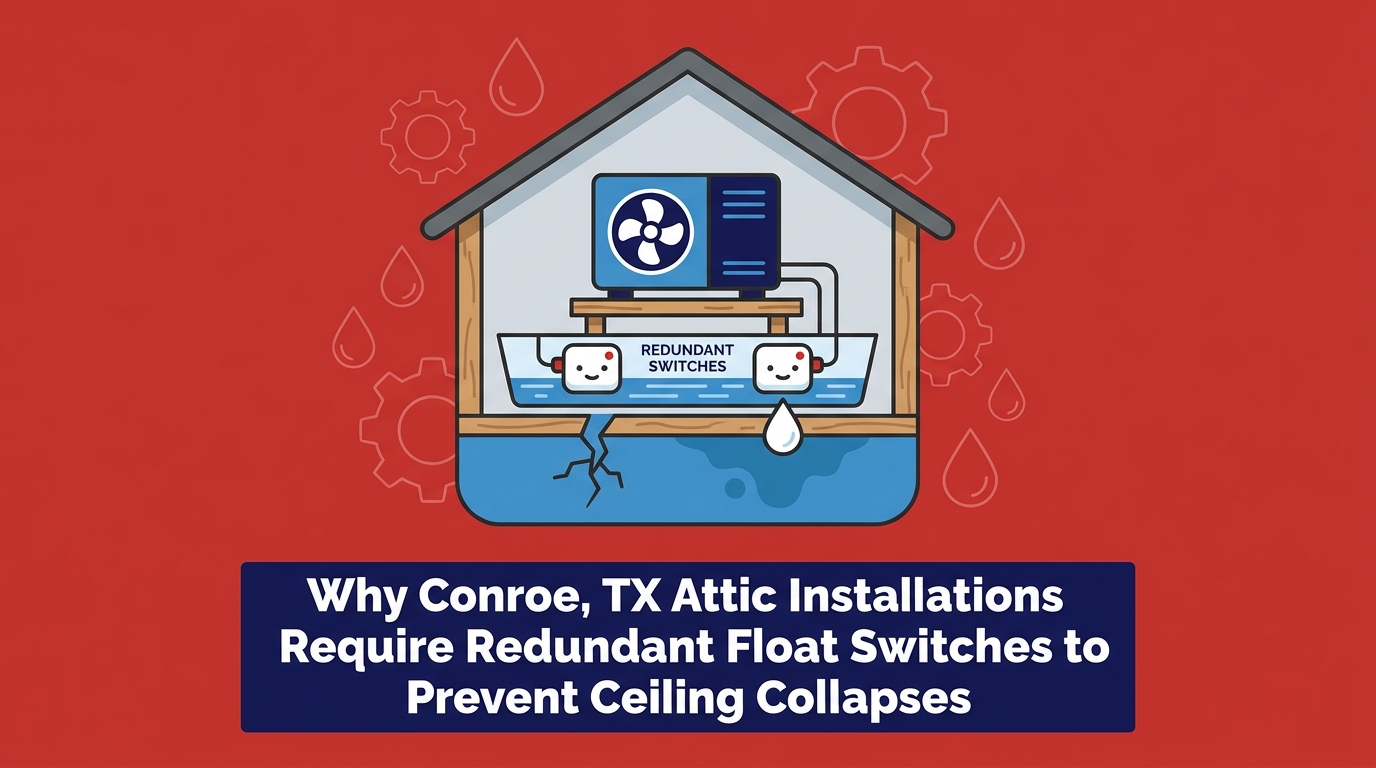

The Hidden Threat Above: How 20 Gallons of Daily Condensation Endangers Your Home
At Carl's Quality Cooling and Heating LLC, our team frequently reminds homeowners that an average residential air conditioning system can produce 5 to 20 gallons of condensation per day in high-humidity climates. Understanding why Conroe attic installations require redundant float switches is the first step in protecting your property from the devastating consequences of unchecked water overflow. When your air conditioner runs continuously during the hottest months of the year, it extracts massive amounts of moisture from your indoor air. All of that water collects in a drain pan located directly above your living space.
If the primary drainage system fails and the unit lacks proper backup protections, those 20 gallons of water have nowhere to go but down. Standard single-switch setups are highly vulnerable to clogging and mechanical failure. A pattern we see often in Conroe area homes with attic-mounted air handlers is that when that single point of failure gives out, the accumulated water quickly overflows the pan, soaking into the insulation and drywall below. This hidden threat operates silently until a massive wet spot appears on the ceiling—or worse, the ceiling entirely gives way.
To put the structural risk into perspective, consider the sheer weight of the water your system generates when running at full capacity:
• 1 Day — Estimated Condensation Volume: 20 Gallons — Approximate Water Weight: 166 Pounds
• 3 Days (Weekend) — Estimated Condensation Volume: 60 Gallons — Approximate Water Weight: 500 Pounds
• 1 Week (Undetected) — Estimated Condensation Volume: 140 Gallons — Approximate Water Weight: 1,166 Pounds
As the table illustrates, a failed drain line can place over a thousand pounds of water weight on standard half-inch ceiling drywall in just a single week. This is exactly why our experts emphasize relying on professional air conditioning services to install and verify redundant safety mechanisms. It is a structural necessity, not merely an optional upgrade. The cost and disruption of repairing a collapsed ceiling far outweigh the proactive installation of a secondary float switch.
Why Gulf Coast Humidity Pushes Attic AC Units to the Limit
The humid subtropical climate of the Gulf Coast fundamentally changes how an air conditioning system operates. In drier regions, an air conditioner primarily focuses on lowering the sensible heat—the temperature you read on a thermometer. However, in our region, our technicians see firsthand how the system must work aggressively to remove latent heat, which is the heavy moisture suspended in the air. This extraction process forces the evaporator coil to shed an incredible volume of water.
When you combine Conroe's extreme late-summer Gulf Coast humidity with continuous system operation, it maximizes the volume of water the evaporator coil must shed daily. The system is essentially wringing out the air like a wet sponge hour after hour. Furthermore, attic temperatures drastically increase the workload. An attic in the afternoon can easily reach 130 to 140 degrees Fahrenheit. The air handler located in this hostile environment is surrounded by extreme heat while trying to manage freezing cold refrigerant and massive amounts of condensation.
The Physics of Latent Heat Removal
As warm, moist return air blows over the icy evaporator coil, the moisture instantly condenses into liquid water. Because the air in our region is so saturated, the flow of water off the coil is practically a steady stream rather than an occasional drip. Standard single-switch setups, which might perform adequately in arid climates like Arizona or Nevada, are fundamentally inadequate for this region's moisture load.
During the August late-summer peak condensation period, the primary drain line is operating at maximum capacity. The constant presence of water creates an environment where any slight restriction in the pipe can cause an immediate backup. Without a redundant float switch to instantly cut power to the system when the water level rises, the unit will blindly continue extracting moisture, overflowing the primary pan in a matter of hours.
Understanding Primary vs. Secondary Float Switches
An HVAC float switch is a specialized water-level detection device designed to shut off the air conditioning unit if water backs up in the drainage system. By cutting the low-voltage control circuit to the thermostat, the switch stops the outdoor compressor from running, halting the condensation process before water can spill over the edges of the pan. In our experience working with Conroe area homes with attic-mounted air handlers, understanding the distinction between primary and secondary protections is vital.
The primary drain pan sits directly beneath the evaporator coil inside the air handler cabinet. It catches the water as it drips off the coil and funnels it into the primary PVC drain line, which carries the water safely outside your home. The primary float switch is typically installed directly into the primary drain line or screwed into a dedicated port on the primary pan. If the main pipe clogs, water backs up into the switch, lifting a small internal float that breaks the electrical circuit.
However, primary switches can fail. They can become coated in grime, stuck in the "down" position, or bypassed by a cracked primary pan. This is where the secondary (auxiliary) drain pan and secondary float switch become critical. The secondary pan is a larger, separate metal or plastic tray installed underneath the entire air handler unit. It acts as the ultimate fallback mechanism.
The Mechanics of Condensate Overflow
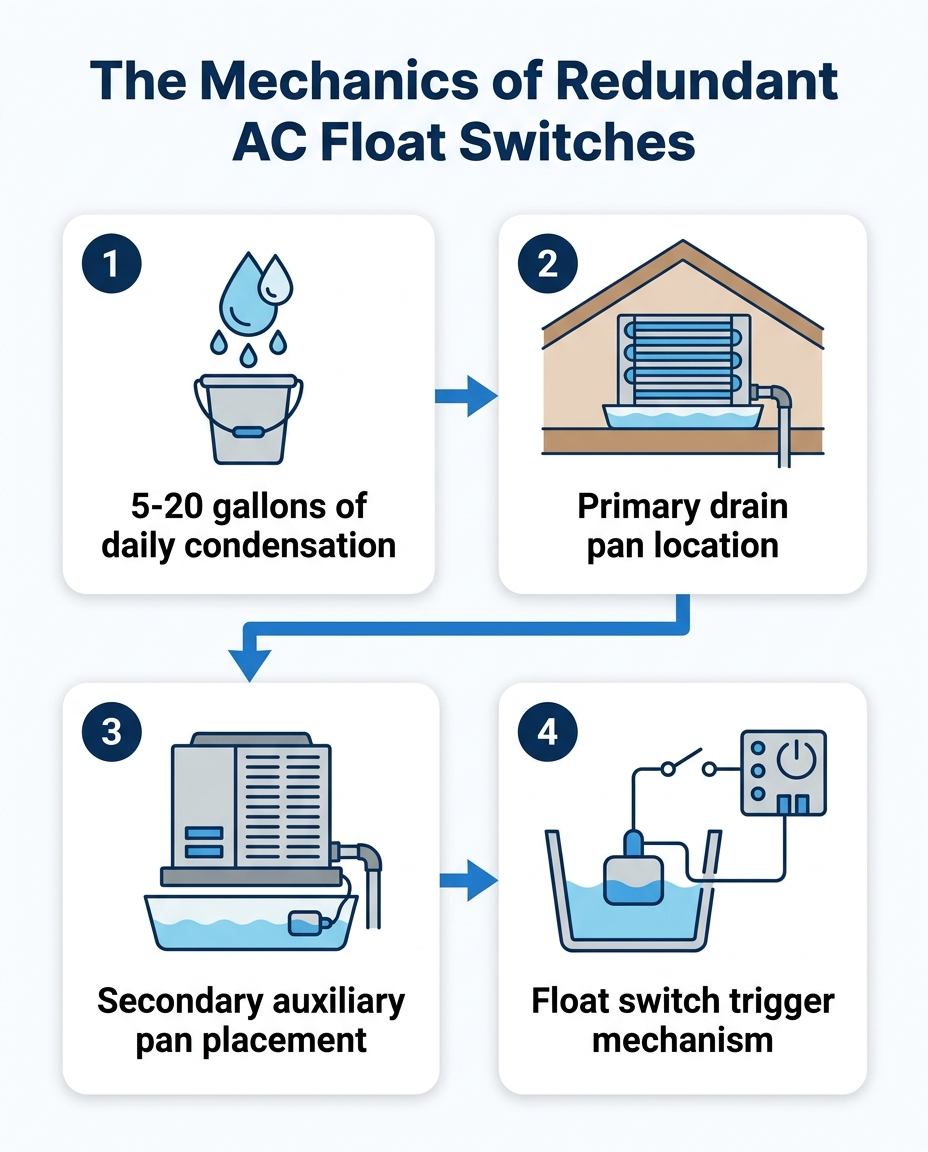
When our team installs a fully redundant system, the overflow sequence follows a specific, safe path:
1. Normal Operation: Water travels from the evaporator coil into the primary pan and out the main drain line.
2. Primary Blockage: The main line clogs. Water backs up and triggers the primary float switch, shutting off the system.
3. Primary Failure: If the primary switch is stuck or the primary pan cracks, water overflows into the large secondary auxiliary pan beneath the unit.
4. Secondary Activation: As water pools in the auxiliary pan, the secondary float switch triggers, acting as a fail-safe redundancy to shut the system down before the secondary pan overflows onto the ceiling.
Because these switches sit in hostile attic environments, integrating their inspection into a routine AC maintenance plan ensures both the primary and secondary mechanisms remain free-moving and electrically sound.

The Link Between Late-Summer Heat, Algae, and Drain Line Clogs
To understand why redundant float switches are necessary, you have to look at what actually causes the primary drain line to fail in the first place. A warm, dark attic combined with standing water creates the perfect breeding ground for biological growth. Dust and airborne particulates bypass the air filter, stick to the wet evaporator coil, and wash down into the drain pan, providing a constant food source for bacteria, algae, and mold.
Continuous system operation accelerates this biological growth dramatically. As the algae feeds and multiplies, it forms a thick, gelatinous sludge—often referred to as "zooglea" in the HVAC industry. This white or translucent slime coats the inside of the primary PVC drain pipe. Over weeks of heavy usage, the sludge thickens until it completely bridges the diameter of the pipe, forming a watertight seal that stops drainage in its tracks.
During the August late-summer peak condensation season, our technicians find that these clogs are not a matter of "if" but "when." As families prepare for the back-to-school transition and cooling units work overtime to beat the end-of-season heat, the system is simply moving too much water through an environment that heavily favors biological fouling. When the primary line chokes on this algae buildup, the water has to go somewhere.
Common signs we tell our customers to watch for that indicate a primary line is developing a severe clog include:
• Gurgling noises: Sounds of trapped air bubbling up near the indoor air handler.
• Musty odors: A distinct damp or mildew smell coming from your supply vents when the AC turns on.
• Slow drainage: Water visibly pooling in the primary pan rather than flowing swiftly out the pipe.
• Intermittent shut-offs: The system turning off unexpectedly, which often means the primary float switch is tripping and resetting as water slowly seeps past a partial clog.
Because the biological load is so high in our climate, relying on a single line of defense is incredibly risky. Even if you are diligent about clearing AC condensate drain line clogs periodically, a heavy algae bloom can block a pipe in a matter of days, making the secondary float switch an essential, non-negotiable safeguard.
IMC Section 307.2.3: Why Redundancy is a Code Requirement
The requirement for redundant overflow protection is not just a best practice recommended by cautious technicians; it is a strict legal requirement embedded in modern building standards. The International Mechanical Code (IMC) Section 307.2.3 specifically dictates the rules for condensate disposal, explicitly requiring an auxiliary drain pan with a water-level detection device for any cooling coil located where structural damage can occur.
Because an attic sits directly above the living space, it falls squarely under this classification. The code exists specifically to prevent the catastrophic property damage that results from unchecked water overflow. These regulations mandate that if the primary drainage system fails, a secondary system must be in place to safely manage the water or shut the equipment down completely. These are not optional plumbing upgrades; they are mandatory safeguards designed to protect the structural integrity of the home.
At Carl's Quality Cooling and Heating LLC, our team applies military-level precision and strict adherence to Conroe building codes to ensure these mandatory safety systems are installed flawlessly. A compliant installation requires careful leveling of the auxiliary pan, proper wiring of the secondary float switch in series with the primary switch, and secure routing of any secondary drain lines.
Unfortunately, unpermitted or non-compliant installations sometimes ignore these safety standards to cut costs. A contractor might install an air handler in an attic with only a primary switch, leaving the homeowner completely exposed to a single point of failure. For Conroe area homes with attic-mounted air handlers, verifying that your system meets IMC Section 307.2.3 requirements is one of the most important steps you can take to secure your property against water damage.
Preventing Catastrophic Ceiling Collapses and Water Damage
The real-world consequences of inadequate overflow protection are severe. When a primary drain fails and no secondary switch is present to halt the system, the resulting overflow does not just cause a minor leak. The immense weight of 20 gallons of water soaking into ceiling drywall and fiberglass insulation quickly compromises the structural integrity of the materials.
Drywall is highly porous. As it absorbs the condensation, it swells, loses its rigid strength, and becomes incredibly heavy. Eventually, the fasteners holding the drywall to the ceiling joists tear through the softened gypsum, resulting in a sudden, catastrophic ceiling collapse. When a ceiling falls, it brings down a deluge of dirty water, heavy wet insulation, and jagged drywall chunks. This causes extensive structural damage, ruins expensive flooring, and destroys personal property in the rooms below.
Even if the ceiling does not collapse entirely, the secondary risk of rampant mold growth is severe. Moisture that goes undetected in the attic can saturate structural beams and insulation, creating a massive remediation project that requires specialized indoor air quality solutions to resolve the resulting airborne mold spores.
When homeowners face an AC installation decision, the conversation should cover more than just SEER ratings and cooling capacity. For example, during a recent consultation, our team worked with a local homeowner who needed to choose and install a new AC unit. By patiently discussing multiple brands, configurations, and options—including the critical pros and cons of these exact structural safeguards alongside a new Daikin variable speed unit—we ensured the homeowner secured a system that protects their property completely, keeping them a customer for life. We strongly advise that a redundant float switch is the only reliable barrier against this type of disaster for Conroe area homes with attic-mounted air handlers.
Proactive Measures: Keeping Your Overflow Protections Reliable
Having redundant float switches installed is the critical first step, but ensuring they actually function when an emergency strikes requires proactive attention. These safety devices sit in extreme attic conditions year-round, subjected to intense heat, humidity, and dust. Over time, the mechanical floats can seize up from mineral deposits, or the low-voltage wiring can corrode, rendering the fail-safe useless.
Even redundant systems require professional verification to ensure the switches haven't seized or disconnected. Clearing primary lines before the peak season hits is the best way to prevent the primary switch from ever needing to activate. Routine professional check-ups catch minor drainage issues, such as a sagging PVC pipe or a slow-draining P-trap, before they trigger emergency shut-offs.
During a professional overflow protection check, our technicians will typically:
• Test the primary switch: Manually lift the float to verify it instantly breaks the low-voltage circuit and shuts down the compressor.
• Inspect the auxiliary pan: Ensure the secondary pan is free of rust, debris, and cracks that could allow water to bypass the secondary switch.
• Verify the wiring: Confirm that both primary and secondary switches are wired correctly in series to the air handler's control board.
• Flush the condensate line: Remove existing algae sludge to restore full flow capacity before the August late-summer peak condensation period begins.
Timely response is critical when drainage issues surface. In one instance, our team diagnosed and fixed a severe AC drainage issue just before a late-summer thunderstorm rolled in. Our technician arrived as soon as it was safe, quickly identified the failing drain components, and successfully repaired the AC within an hour of arrival, ensuring the overflow protections were fully active before the heavy weather hit. By relying on experts who serve the Montgomery County service areas, you ensure your home's structural safeguards are always ready to perform.
Frequently Asked Questions
Does code require an AC float switch in Texas?
Yes, the International Mechanical Code (IMC) requires water-level detection devices for cooling coils located where structural damage can occur. In Texas, because many air handlers are installed in attics directly above living spaces, these float switches are mandatory. They ensure the system shuts down before overflowing water can destroy the ceiling drywall.
What is a secondary float switch on an AC?
A secondary float switch is a backup safety device mounted on the auxiliary drain pan beneath the air handler. If the primary drain line clogs and the primary switch fails to shut off the system, water spills into the secondary pan. The secondary switch detects this overflow and acts as a final fail-safe to cut power to the unit.
Why is my AC leaking through the ceiling?
An AC leaks through the ceiling when the condensate drain line clogs and the system lacks functional float switches to shut it down. As the unit continues to run, it produces gallons of water that overflow the drain pan, soak through the attic insulation, and saturate the drywall. This is a severe structural risk that requires immediate professional repair.
Where should the HVAC float switch be located?
The primary float switch should be located on the primary drain pan or spliced directly into the primary PVC condensate drain line near the air handler. The secondary float switch must be clipped or screwed onto the edge of the secondary auxiliary drain pan that sits underneath the entire HVAC unit.
How much water does an AC produce in high humidity?
In high-humidity climates, an average residential AC system can produce between 5 and 20 gallons of condensation per day. The exact amount depends on the system's cooling capacity, the indoor humidity levels, and how continuously the system runs. During peak summer heat, this massive volume of water makes reliable drainage absolutely critical.
What happens if an AC float switch fails entirely?
If an AC float switch fails entirely and the drain line is clogged, the air conditioner will continue running and producing condensation blindly. The water will quickly overflow the drain pan, flood the attic floor, and soak into the ceiling below. This often leads to catastrophic ceiling collapses, ruined flooring, and extensive mold growth.
Protect Your Home from Hidden Attic Threats
At Carl's Quality Cooling and Heating LLC, we know that understanding why Conroe attic installations require redundant float switches is the best defense against devastating ceiling collapses and extensive water damage. Don't wait for a clogged drain line to test your system's limits during peak humidity. Secure your home's structural integrity by scheduling a routine AC maintenance plan today to ensure your primary and secondary overflow protections are wired correctly and ready to perform.