
Is Your Heat Pump Not Cooling During the Fall Switchover?
Are you turning on your thermostat for an October mid-fall heating startup, only to find the system blowing warm air when you want cool, or emitting a startling burning odor? Navigating the unpredictable shift between seasons requires a reliable set of home maintenance tips and troubleshooting strategies to keep your system running safely. At Carl's Quality Cooling and Heating LLC, our team frequently sees homeowners caught off guard when a heat pump behaves erratically during the seasonal switchover, wondering if a strange smell or a sudden lack of cooling is a normal operational hiccup or a serious safety hazard.
During the autumn months, your heat pump is asked to perform a complex balancing act, sometimes switching between cooling during a warm afternoon and heating during a chilly night. This rapid shifting exposes underlying mechanical stress that accumulated over the summer. Acknowledging the specific frustration of unexpected burning smells, short-cycling, or airflow issues is the first step in diagnosing the problem. The core decision point you face is determining whether a startup odor or performance lag is merely harmless seasonal dust burning off, or a potential electrical hazard requiring immediate attention.
While some basic checks can be performed safely at home, complex mechanical failures inside the system demand professional HVAC services. We always advise our customers to prioritize safety over do-it-yourself repairs, ensuring that high-voltage components and pressurized refrigerants are handled correctly, protecting both your property and your family as the weather begins to cool.
The Reversing Valve: Why Your System Might Be Stuck in Heat Mode
One of the most common reasons a heat pump runs continuously but fails to cool your home is a malfunction within the reversing valve. Unlike a traditional air conditioner, a heat pump is designed to move heat in two directions: pulling heat out of your home during the summer and drawing heat indoors during the winter. The component responsible for this dual functionality is the reversing valve, a critical mechanical part that physically changes the direction of the refrigerant flow.
For many Conroe TX area homes, the heat pump operates almost continuously for months on end. In our experience servicing local properties, this heavy, sustained usage can cause the reversing valve to become physically jammed or electrically stuck. When this happens, the system may run non-stop, but it will blow the opposite temperature air of what your thermostat is requesting. If your thermostat is set to cool but the registers are blasting warm air, a stuck reversing valve is often the primary suspect.
How the Reversing Valve Operates
To understand why the valve fails, it helps to know how it operates. The reversing valve contains a sliding internal mechanism that directs high-pressure refrigerant gas from the compressor to either the indoor or outdoor coil. This slide is controlled by a smaller component called a solenoid, which is an electromagnetic coil. When your thermostat signals a mode change, it sends an electrical voltage to the solenoid. The solenoid then shifts the pressure inside the valve, forcing the internal slide to move and reverse the refrigerant flow.
If the solenoid burns out due to electrical fatigue, or if the internal slide becomes coated in debris or degraded oil, the valve cannot shift. The system remains locked in its previous mode, completely ignoring your thermostat's commands to switch from heating back to cooling.
Symptoms of Valve Failure
Identifying a failing reversing valve involves paying close attention to your system's output. The most obvious symptom is wildly inconsistent air temperatures or a system that is stubbornly stuck in a single mode despite repeated thermostat adjustments. You might also hear a strange hissing sound coming from the outdoor unit as the internal slide struggles to seat properly, allowing high-pressure and low-pressure refrigerant to mix.
The professional boundary: It is critical to understand that reversing valve replacement is strictly a professional job. Accessing, testing, and replacing this component requires recovering the existing refrigerant, unbrazing the old valve with a torch, brazing in a new valve under a nitrogen sweep to prevent oxidation, and recharging the system. These procedures require specialized licensing and handling certifications.
Safe Troubleshooting: 4 Things to Check Before Calling a Pro
Before you assume your heat pump has suffered a catastrophic failure during an October mid-fall heating startup, there are several safe, homeowner-friendly checks you can perform. Our technicians often find that what appears to be a major mechanical breakdown is actually a simple airflow restriction or a power interruption. By systematically ruling out these basic issues, you can save time and ensure your system is ready for professional diagnostics if needed.
1. Verify your thermostat settings and power: It sounds overly simple, but a surprising number of service calls are resolved at the thermostat. Ensure the system is explicitly set to the desired mode (either "Heat" or "Cool") rather than just "Auto." If your thermostat is battery-operated, replace the batteries with fresh ones. A weak battery can cause the thermostat to lose communication with the main control board, resulting in short-cycling or a failure to switch modes.
2. Inspect and replace dirty air filters: Airflow is the lifeblood of your heat pump. A clogged, dirty air filter severely restricts the volume of air moving over the indoor coil. In cooling mode, this lack of airflow can cause the indoor coil to freeze solid into a block of ice. In heating mode, it can cause the system to overheat and shut down prematurely on a safety limit switch. Check your filter and replace it if you cannot clearly see light shining through the media.
3. Check the electrical panel for tripped breakers: Your heat pump system relies on two separate electrical circuits—one for the indoor air handler and one for the outdoor compressor. Check your home's main electrical panel for any tripped breakers dedicated to the HVAC system. If a breaker is tripped, you may reset it exactly once. If it trips again immediately, leave it off; this indicates a serious electrical short that requires a professional.
4. Ensure the outdoor compressor is free of obstructions: The outdoor unit needs adequate breathing room to release or absorb heat. Over the summer and early fall, leaves, tall grass, and storm debris can easily block the delicate aluminum fins on the outdoor coil. Carefully clear away any vegetation or debris within a two-foot radius of the unit to ensure proper heat transfer.
To catch these basic issues early and keep your system running efficiently year-round, we highly recommend establishing a routine HVAC maintenance plan. Regular professional tune-ups ensure that filters, electrical connections, and outdoor coils are perfectly optimized before the extreme weather arrives.
Burning Smells During Startup: Harmless Dust or Electrical Hazard?
One of the most alarming experiences for homeowners in Conroe TX area homes is turning on the heat for the first time in autumn and being greeted by a strong, pervasive burning smell. Every October, our dispatchers field calls from worried customers trying to distinguish between normal seasonal dust burn-off and a dangerous electrical issue—a critical safety skill for any homeowner.
Heat pumps often utilize auxiliary electric heat strips to supplement the system when outdoor temperatures drop sharply. During the long summer months, these heat strips sit completely unused, collecting a fine layer of household dust, pet dander, and airborne particles. When you initiate the first heating cycle of the season, these high-voltage strips glow red-hot, instantly incinerating the accumulated dust. This process creates a distinct odor that permeates the house.
However, not all burning smells are harmless. If a wire is melting, a capacitor is failing, or a blower motor is overheating, the resulting odor will be sharply different from burning dust. Knowing the difference allows you to react appropriately and keep your home safe.
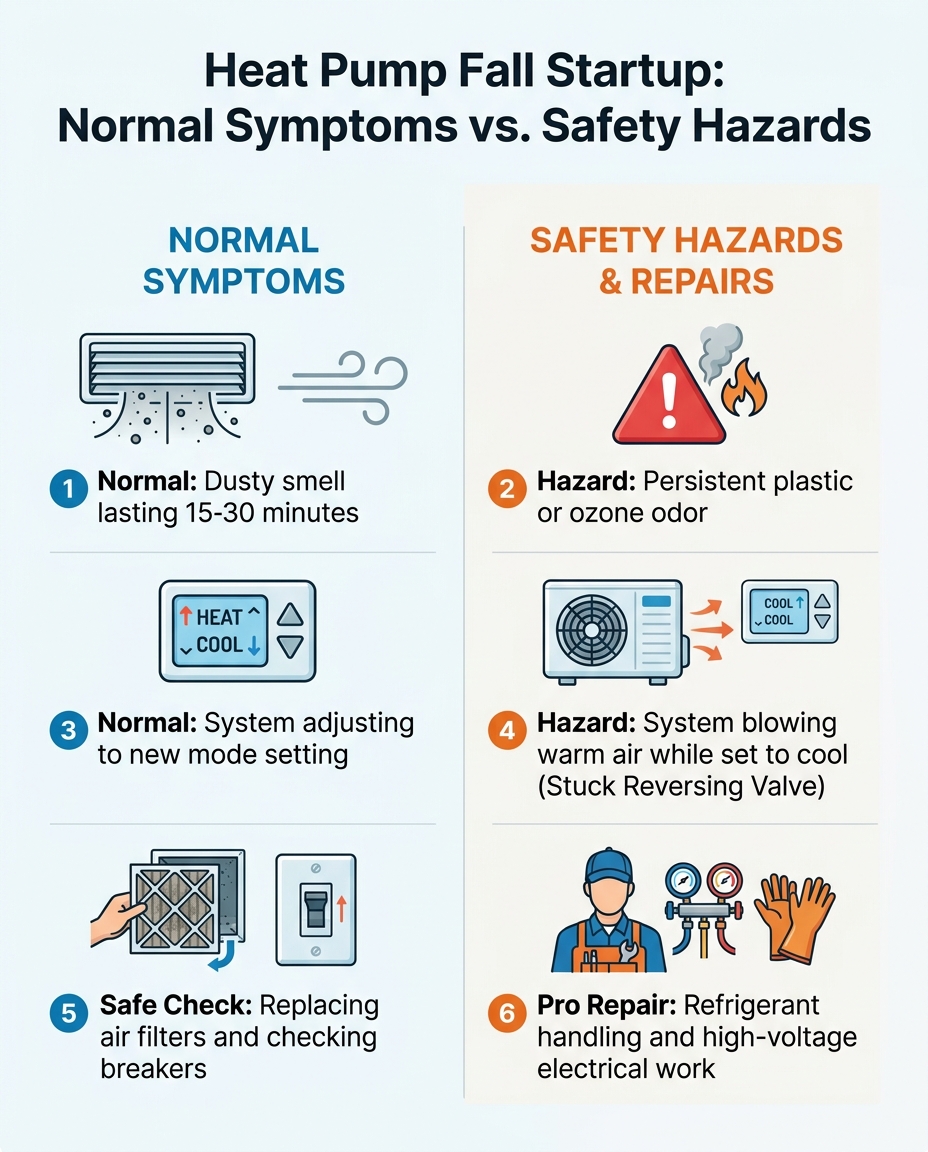
• Odor Characteristics — Normal Dust Burn-Off: Smells like dusty toast or a warm, slightly musty burning scent. — Potential Electrical Hazard: Acrid, sharp plastic smell, melting rubber, or a distinct ozone odor.
• Duration of Smell — Normal Dust Burn-Off: Fades entirely within 15 to 30 minutes of the first cycle. — Potential Electrical Hazard: Persists for hours, grows stronger, or returns every single cycle.
• Visual Signs — Normal Dust Burn-Off: No visible smoke; normal airflow from all vents. — Potential Electrical Hazard: Visible smoke from vents or the indoor unit; system shutting down unexpectedly.
• Required Action — Normal Dust Burn-Off: Open a window and allow the system to run through its first cycle. — Potential Electrical Hazard: Shut off the system at the breaker immediately and call a professional.
If you ever detect an acrid plastic smell or an ozone odor, do not wait to see if it dissipates. Instruct all family members to avoid the utility closet, shut off the system at the main electrical panel immediately, and contact a licensed technician to inspect the wiring and internal components.

How Extreme Summer Heat Causes Fall Component Fatigue
To understand why your heat pump might suddenly fail during an October mid-fall heating startup, you have to look at what the system endured over the previous six months. Our team sees the reality of Conroe's high humidity and intense summer heat loads firsthand, which forces systems to run non-stop for half the year. This relentless operation creates severe component fatigue that often remains completely hidden until the system is forced to switch modes or handle fluctuating day and night temperatures in the autumn.
Two of the most vulnerable components are capacitors and contactors. A capacitor acts like a heavy-duty battery, storing energy to give the compressor and fan motors the massive jolt of electricity they need to start spinning. Over a long summer, a capacitor might cycle on and off tens of thousands of times in extreme heat. This degrades the internal chemicals, causing the capacitor to lose its ability to hold a charge. The contactor, which is a mechanical relay that snaps shut to allow high voltage to reach the compressor, also suffers. Every time it closes, a tiny electrical arc occurs. Over a brutal summer, this arcing creates pitting and carbon buildup on the metal contacts.
This fatigue often goes unnoticed while the system is happily chugging along in a single mode. However, when the fall transition arrives and the system is asked to switch functions, these weakened components finally give out. If you want to understand more about the sheer stress these systems endure, reading about why your heat pump struggles on 100-degree days provides deeper context on summer wear and tear.
Because this hidden degradation is so common, transitional inspections are paramount. A technician can measure the microfarad output of your capacitors and inspect the contactors for pitting before the winter cold sets in, replacing weakened parts before they cause a sudden, catastrophic breakdown.
When to Stop Troubleshooting and Call for Professional Repairs
While checking filters and resetting a tripped breaker are perfectly safe for homeowners, there is a hard line where DIY troubleshooting must stop. Any work involving pressurized refrigerants, high-voltage electricity, or internal mechanical components requires a licensed technician. We regularly remind our customers that modern heat pumps operate at voltages high enough to cause severe injury, and handling refrigerant without proper EPA certification is both illegal and dangerous.
Ignoring persistent issues or attempting to bypass safety switches can lead to complete compressor failure. The compressor is the heart of your heat pump, and replacing it is one of the most extensive repairs an HVAC system can undergo. If your system is short-cycling, producing persistent burning smells, or failing to cool after you have completed the basic homeowner checks, it is time to call for backup.
We pride ourselves on serving the Conroe and Montgomery County service areas with a disciplined, step-by-step diagnostic approach. Operating with military precision and reliability, our technicians systematically rule out hazards safely. When a professional from our team arrives at your home, you can expect a thorough evaluation. They will test electrical components under a load, verify the exact refrigerant charge using digital gauges, inspect the reversing valve solenoid for proper voltage, and measure the amperage draw of your motors.
This level of rigorous testing ensures that for Conroe TX area homes, the root cause of the failure is identified and resolved correctly the first time, rather than just applying a temporary bandage to a deeper mechanical issue.
Frequently Asked Questions About Heat Pump Performance
When dealing with an unexpected breakdown during an October mid-fall heating startup, homeowners often have the same pressing questions. Here are clear, direct answers to help you understand what your system is experiencing.
Why is my heat pump running but not cooling?
If your heat pump is running but not cooling, it often points to a stuck reversing valve, profoundly dirty indoor coils, or a slow refrigerant leak. The system is moving air, but the mechanical process required to extract heat from that air is failing, requiring a professional diagnostic test to pinpoint the exact internal failure.
Why is my heat pump not blowing cold air?
A heat pump not blowing cold air could simply be a severely clogged air filter restricting airflow, or a tripped breaker on the outdoor unit causing only the indoor fan to run. If the outdoor compressor has lost power while the indoor blower continues to operate, the air coming from your vents will remain at room temperature.
What does a burning smell from a heat pump mean?
A burning smell from a heat pump usually indicates seasonal dust burning off the auxiliary heat strips during the first few heating cycles of the year. However, if the smell is acrid, smells like melting plastic, or persists beyond the first thirty minutes, it indicates a dangerous electrical hazard that requires immediate shutdown.
Is it normal for a heat pump to smell like burning in the fall?
Yes, it is entirely normal for a heat pump to smell like burning dust for the first 15 to 30 minutes of the initial heating cycle in the fall. Once the accumulated summer dust is incinerated off the heating elements, the smell should dissipate completely and not return during subsequent cycles.
How do you fix a heat pump that is not cooling?
To fix a heat pump that is not cooling, first check the thermostat settings, replace dirty air filters, and reset any tripped breakers. If those basic homeowner checks do not restore cooling, a licensed professional must be called to diagnose complex issues like a failing reversing valve, a bad capacitor, or incorrect refrigerant levels, which is a pattern we see often during fall maintenance visits.
Can extreme summer weather cause my heat pump to fail in October?
Yes, prolonged high-load operation during extreme summer weather degrades electrical components like capacitors and contactors. This hidden fatigue often manifests in October when the system is suddenly forced to switch modes or handle rapidly fluctuating day and night temperatures, causing weakened parts to finally fail.
Ensure Safe and Reliable Comfort This Season
Transitioning your home comfort system from summer cooling to autumn heating shouldn't be a source of stress. By following these clear, safety-focused guidelines, you can confidently distinguish between harmless seasonal startup symptoms and actual mechanical or electrical hazards. Don't let the fatigue from a brutal summer turn into a sudden breakdown when you need your system the most. Reassure yourself that a prompt, professional inspection can catch weakened components early, preventing minor wear and tear from escalating into a major winter failure. If you are experiencing issues with your system in Conroe TX area homes, let our dedicated team help. Schedule a comprehensive evaluation of your heat pump and heating services with Carl's Quality Cooling and Heating LLC today to guarantee reliable, safe performance all season long.