
The Fall Heating Startup Dilemma: Facing a System Replacement
Before the first true chill settles over the region, navigating options comparisons for homeowners becomes a sudden priority. At Carl's Quality Cooling and Heating LLC, our team frequently sees families caught off guard when an older heating unit fails its routine October pre-winter heating startup inspection. You are abruptly faced with a significant choice: do you transition to an energy-efficient air-source heat pump, or do you stick with a traditional gas furnace? This decision point often turns a standard maintenance visit into a race against the upcoming cold weather. Understanding the operational differences, efficiency ratings, and long-term comfort implications of both systems is the best way to move forward confidently. When evaluating your next steps, understanding how these replacement options integrate with your existing air conditioning services is a vital part of the process.
Understanding Air-Source Heat Pumps in Variable Climates
In our daily work throughout Conroe, the conversation around modern home comfort frequently centers on the debate between air-source heat pumps vs. traditional gas furnaces. To make an informed choice, it helps to understand exactly how an air-source heat pump operates. Unlike traditional systems that consume fuel to create heat, a heat pump utilizes electricity to transfer heat from one place to another. During the winter, it extracts ambient thermal energy from the outdoor air—even when it feels cold outside—and pumps that warmth into your living space.
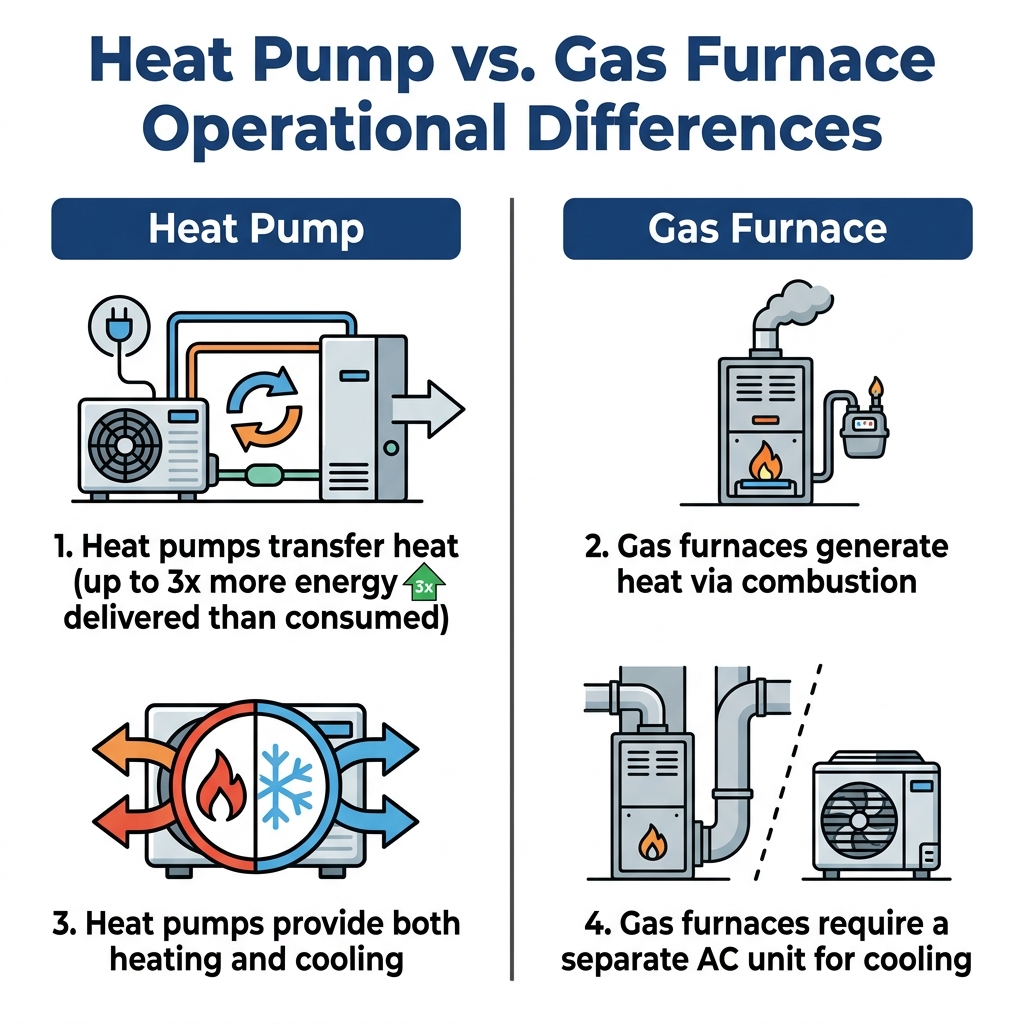
This method of heat transfer is remarkably efficient. Modern, high-efficiency heat pump units can deliver up to three times more heat energy to a home than the electrical energy they consume to perform the work. Furthermore, heat pumps offer a dual benefit: they are not just heating systems. When the weather warms up, the system reverses its operation, pulling heat and humidity out of your indoor air and expelling it outside, functioning exactly like a standard air conditioner. If you ever experience a situation where the system struggles during the summer, researching the common causes for a heat pump not cooling usually reveals that the fundamental refrigeration cycle is the same as any dedicated AC unit.
The Heat Transfer Process Explained
The mechanics behind this dual-purpose capability rely on a sophisticated refrigeration cycle. Here is a look at how the system captures and moves thermal energy:
1. Absorption: Liquid refrigerant inside the outdoor coil evaporates into a gas as it absorbs ambient heat from the outside air.
2. Compression: The system's compressor pressurizes this warm gas, significantly raising its temperature.
3. Distribution: The hot, pressurized gas travels to the indoor coil, where the air handler's blower fan pushes air across it, distributing warmth throughout the home's ductwork.
4. Reversal: A specialized component called a reversing valve allows the flow of refrigerant to change direction, switching the system from heating mode to cooling mode seamlessly.
A common misconception we hear from homeowners is that heat pumps cannot function in moderate winter environments. In reality, modern variable-speed compressors allow these systems to extract sufficient heat even when temperatures drop near freezing, making them a highly versatile solution for year-round climate control.
The Role of Traditional Gas Furnaces in Modern Homes
While heat pumps represent the cutting edge of energy-efficient heat transfer, our technicians still maintain and install traditional gas furnaces, which remain a staple in many homes for very specific operational reasons. When comparing air-source heat pumps vs. traditional gas furnaces, the most fundamental difference lies in how warmth is generated. A gas furnace relies on a combustion process, burning natural gas or liquid propane to create heat directly.
This direct combustion allows furnaces to produce air that feels exceptionally hot coming out of the vents. During sudden, extreme cold snaps, a gas furnace can raise the indoor temperature rapidly. However, this rapid heating capability requires specific, dedicated infrastructure. A home must have access to a municipal gas line or a liquid propane tank, along with properly installed ventilation flues to safely exhaust combustion byproducts like carbon monoxide outside the home.
The Anatomy of Gas Combustion
To understand the reliability of a furnace, it is helpful to look at its core components and sequence of operations:
• The Burners: When the thermostat calls for heat, gas flows into the burners and is ignited, creating a controlled flame.
• The Heat Exchanger: The flames heat up a specialized metal chamber called the heat exchanger. The combustion gases remain safely contained inside this chamber.
• The Blower Motor: The system's fan pulls indoor air across the outside of the hot heat exchanger, warming the air before pushing it through the ductwork.
• The Flue System: Once the heat is extracted, the toxic combustion gases are safely vented out of the house through the roof or a side wall.
It is important to remember that a gas furnace is strictly a heating appliance. To achieve year-round comfort, a furnace must be paired with a completely separate central air conditioning unit. This means maintaining two distinct mechanical systems with different lifespans and operational requirements.
Side-by-Side Efficiency and Performance Profiles
When we sit down with homeowners to directly compare the efficiency profiles of these two systems, we always emphasize their long-term operational differences. Because air-source heat pumps vs. traditional gas furnaces use entirely different methods to warm a home, they are measured by different efficiency metrics. The U.S. Department of Energy and ENERGY STAR provide rigorous testing standards to help consumers make objective comparisons.
Heat pumps are evaluated using the Heating Seasonal Performance Factor (HSPF or HSPF2) for winter efficiency, and the Seasonal Energy Efficiency Ratio (SEER or SEER2) for summer cooling. Gas furnaces, on the other hand, are measured by Annual Fuel Utilization Efficiency (AFUE), which calculates the percentage of fuel successfully converted into usable heat rather than lost as exhaust. A high-efficiency furnace might boast an AFUE of 95%, meaning 95% of the fuel becomes heat. However, because a heat pump moves heat rather than creating it, its efficiency often exceeds 100% when compared to direct electrical resistance heating.
Understanding the Operational Differences
• Primary Function — Air-Source Heat Pump: Transfers ambient heat — Traditional Gas Furnace: Generates heat via combustion
• Efficiency Metric — Air-Source Heat Pump: HSPF2 (Heating) / SEER2 (Cooling) — Traditional Gas Furnace: AFUE (Heating only)
• Energy Source — Air-Source Heat Pump: Electricity — Traditional Gas Furnace: Natural Gas or Propane
• Cold Weather Performance — Air-Source Heat Pump: Highly efficient in mild/moderate cold; runs longer cycles — Traditional Gas Furnace: Produces rapid, intense heat; ideal for deep freezes
• Environmental Impact — Air-Source Heat Pump: No on-site emissions or combustion byproducts — Traditional Gas Furnace: Produces exhaust gases that must be vented outdoors
From an environmental standpoint, heat pumps offer a distinct advantage by eliminating on-site fossil fuel combustion. As the electrical grid increasingly shifts toward renewable energy sources, the carbon footprint of operating a heat pump continues to shrink. Conversely, a gas furnace will always rely on fossil fuels, making its environmental impact relatively fixed over its lifespan.

Maintenance Demands and System Lifespans
The long-term ownership experience is heavily influenced by how much upkeep a system requires and how long it is expected to last. Because a heat pump manages both heating and cooling, it operates year-round. This continuous 12-month workload means that regular upkeep is absolutely essential to prevent premature wear and tear. Scheduling routine HVAC maintenance twice a year—once in the spring for cooling and once during the October pre-winter heating startup—is the standard recommendation we give to our heat pump customers.
Gas furnaces, by contrast, are seasonal appliances. They sit dormant throughout the long summer months and only activate when the temperature drops. This seasonal usage pattern often allows a well-maintained gas furnace to last slightly longer than a heat pump, provided the heat exchanger and burners are kept clean and free of rust. However, this longevity assumes the homeowner is also maintaining their separate central AC unit, which handles the summer workload.
Common Wear-and-Tear Components
During a professional pre-winter inspection, our technicians look for different signs of wear depending on the system type:
• Heat Pump Inspections: We verify reversing valve operation, check refrigerant charge levels, clean the outdoor condenser coils, and ensure the defrost control board is functioning properly to prevent winter ice buildup.
• Gas Furnace Inspections: We analyze the heat exchanger for dangerous micro-cracks, clean the flame sensor, inspect the gas valve and ignition system, and verify that the flue pipe is drafting carbon monoxide safely out of the home.
• Shared Components: Both systems share an indoor air handler, blower motor, and filtration system, meaning regular filter changes remain the most critical homeowner responsibility regardless of the technology chosen.
Climate Suitability for Southeast Texas Winters
Generic national advice often fails to account for regional weather patterns, making climate suitability one of the most critical factors in this decision. Having served this region for years, we know firsthand that Conroe's variable, mostly mild winters make air-source heat pumps uniquely advantageous compared to the harsh, sub-zero climates of the northern United States. In regions where winter temperatures routinely plunge below zero for weeks at a time, a gas furnace is often necessary to combat extreme heat loss. In Southeast Texas, those conditions are rare.
The local climate is characterized by mild to moderate winter temperature fluctuations. An air-source heat pump operates at peak efficiency in these exact conditions, extracting plenty of ambient heat from 40-degree or 50-degree air without ever needing to activate its auxiliary electric heat strips. By the time the weather transitions to a brief freeze, a modern heat pump is still more than capable of keeping a well-insulated home comfortable.
Why Regional Weather Patterns Dictate HVAC Choices
Beyond winter performance, the reality of living in the Montgomery County service areas is that summer cooling is just as critical—if not more so—than winter heating. The region experiences intense summer heat coupled with high humidity. A high-efficiency heat pump excels at dehumidification during the cooling season, running longer, slower cycles that pull moisture out of the indoor air more effectively than older, single-stage air conditioners. Because you are investing in a system that will spend the majority of its life cooling your home, upgrading to a premium heat pump often provides a better return on investment in a southern climate than splitting your budget between a high-end furnace and a standard air conditioner.
Navigating Energy Incentives and Utility Rebates
Upgrading a home's mechanical systems represents a significant investment, but various financial incentives can help offset the initial installation costs. Federal, state, and local entities frequently encourage homeowners to transition toward higher-efficiency, electrified heating solutions to reduce strain on the power grid and lower overall emissions.
We always remind our customers that federal tax credits may apply to qualifying high-efficiency heat pump installations, allowing homeowners to claim a portion of the project cost on their annual tax returns. Additionally, many local utility providers offer their own incentive programs and rebates designed to encourage energy-efficient upgrades. Because these programs are constantly evolving and have strict efficiency requirements, it is highly recommended to consult with a tax professional or check directly with your local utility provider for the most current program details before making a final purchase decision. Evaluating these incentives objectively is a key factor in determining the long-term value and payback period of a system replacement.
Frequently Asked Questions About Heating Replacements
Should I replace my gas furnace with a heat pump in Texas?
Replacing a gas furnace with a heat pump is often highly recommended in Texas due to the region's mild winters. A heat pump operates at peak efficiency in moderate climates, easily extracting enough ambient heat to keep your home warm without the need for combustible fuels. Additionally, because a heat pump also acts as a high-efficiency air conditioner during the long, hot Texas summers, it provides excellent year-round value and dehumidification.
What is the lifespan of a heat pump vs a gas furnace?
A gas furnace typically lasts slightly longer than a heat pump, often reaching 15 to 20 years with proper maintenance. This is primarily because a furnace only operates during the winter months, giving it a long resting period during the summer. A heat pump, however, works year-round to provide both heating and cooling, which generally puts its expected lifespan closer to 12 to 15 years, depending heavily on the consistency of seasonal maintenance.
Is it better to have a heat pump or a gas furnace?
The better option depends entirely on your local climate, existing home infrastructure, and efficiency goals. A heat pump is generally better for moderate climates, energy efficiency, and reducing fossil fuel usage, as it handles both heating and cooling in one unit. A gas furnace is often better for homes in extreme northern climates that experience prolonged freezing temperatures, or for homes that already have robust gas line infrastructure in place.
Can you replace a gas furnace with a heat pump?
Yes, you can replace a gas furnace with a heat pump, and many homeowners choose to do so to improve energy efficiency. The transition requires capping off the existing gas line safely and ensuring your home's electrical panel has the capacity to support the new heat pump system. A professional HVAC assessment is necessary to determine if your current ductwork and electrical infrastructure are ready for the conversion.
At what temperature does a heat pump become inefficient?
Older heat pumps typically began losing efficiency when outdoor temperatures dropped below 35 or 40 degrees Fahrenheit. However, modern cold-climate heat pumps equipped with variable-speed compressors can maintain high efficiency even when temperatures drop into the teens or single digits. In a mild climate, a modern heat pump will rarely, if ever, reach a temperature where it becomes inefficient enough to require secondary auxiliary heating.
Making the Right Choice for Your Home's Comfort
Ultimately, the choice between an air-source heat pump and a traditional gas furnace comes down to evaluating your local climate, existing home infrastructure, and long-term energy efficiency goals. Making this decision during the October pre-winter heating startup ensures that your home is fully prepared before severe weather arrives. At Carl's Quality Cooling and Heating LLC, we believe navigating these options shouldn't be done through guesswork. As a veteran-owned HVAC company, we ensure you receive honest, objective guidance rooted in integrity and reliability, rather than aggressive sales tactics. By securing a professional assessment of your home's specific layout and thermal needs, you can confidently schedule professional heat pump repair or replacement services that will keep your family comfortable for years to come.