
Facing a Late-Summer AC Breakdown: The Refrigerant Dilemma
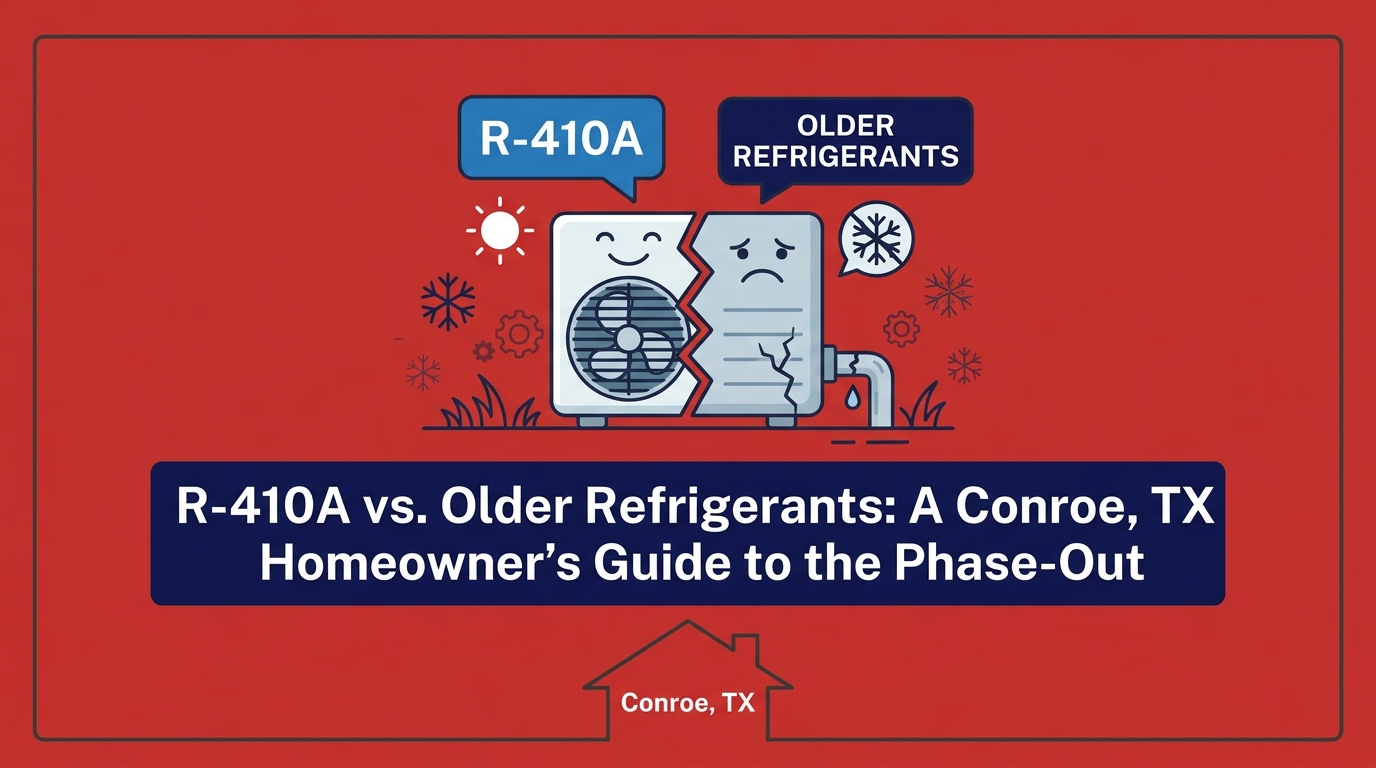
Are you currently staring down a malfunctioning AC unit during the intense heat of late August, wondering about R-410A vs. Older Refrigerants: What Conroe Homeowners Need to Know About the Phase-Out? You are certainly not alone. At Carl's Quality Cooling and Heating LLC, our team sees this exact scenario constantly as families prep for the back-to-school transition. The late August end-of-season cooling demand puts an incredible amount of stress on residential cooling equipment. After running tirelessly since May, systems often reach their breaking point just as the temperatures peak. When your vents start blowing warm air or the system shuts down completely, you are immediately forced to make a difficult choice between a quick fix to restore cooling or investing in a brand-new system.
This decision is no longer just about the cost of replacement parts or the labor required to install them. Today, the choice is heavily influenced by the specific type of refrigerant your current system uses. The HVAC industry is undergoing a massive shift, and the rules regarding what can be repaired and what must be replaced are changing rapidly. For your immediate comfort and safety, our technicians provide comprehensive Air Conditioning Services to help you navigate these urgent breakdowns.
Our goal is to set the stage for an objective, pressure-free comparison. In our years of servicing Conroe neighborhoods, we've found that giving homeowners clear facts is the best way to help them evaluate their options effectively. Whether you are dealing with a minor electrical failure or a major sealed-system leak, understanding the regulatory landscape and how it impacts your home's cooling infrastructure is the first step toward a lasting solution.
Understanding the EPA Timelines: R-22, R-410A, and the 2025 Shift
To make an informed decision about your HVAC equipment, you first need to understand the regulatory changes driving the phase-out of older refrigerants. The Environmental Protection Agency (EPA) has established strict guidelines designed to reduce the environmental impact of residential and commercial cooling systems. These regulations directly affect the availability and practicality of repairing legacy R-22 and aging R-410A HVAC units.
Here is a clear breakdown of the timeline and what it means for your home, based on what we are currently seeing in the field:
• The R-22 total ban (2020): Once the standard for decades, R-22 (commonly known as Freon) was identified as an ozone-depleting substance. The EPA mandated a gradual phase-out that culminated in a complete ban on the production and import of R-22 in 2020. If you have a system built before 2010, it likely uses R-22, meaning any new supply must come from reclaimed or recycled stock, making it incredibly scarce.
• The EPA AIM Act: The American Innovation and Manufacturing (AIM) Act was enacted to address hydrofluorocarbons (HFCs), which have a high Global Warming Potential (GWP). This legislation mandates a phased 85 percent reduction in HFC production and consumption by the year 2036.
• The R-410A phase-down: Because R-410A is an HFC, it falls directly under the AIM Act. While R-410A is not banned, it is currently in a strict phase-down period. This means the total amount of R-410A that can be produced or imported shrinks every year, which will gradually tighten supplies and impact future availability.
• The 2025 low-GWP transition: Starting in 2025, newly manufactured residential air conditioning and heat pump systems will be required to use next-generation, low-GWP refrigerants (such as R-454B or R-32). These new refrigerants are designed to be far more environmentally friendly while offering excellent energy efficiency.
Understanding this timeline clarifies why simply recharging an older unit is no longer a straightforward process. The industry is moving forward, and legacy systems are being left behind.
How Refrigerant Leaks Impact Comfort in Texas Humidity
Air conditioners do not actually "create" cold air; they remove heat and moisture from the air already inside your house. They do this using a closed, sealed loop of refrigerant. Under normal operating conditions, a system should never run out of refrigerant. If your system is low, it means there is a physical leak somewhere in the coils or the line set that must be professionally located and repaired.
An undercharged system loses its ability to effectively absorb heat. Just as importantly, it loses its ability to pull humidity out of the indoor air. In our region, effective dehumidification is just as critical as temperature control. An undercharged legacy system will fail at both, leaving your home feeling clammy, sticky, and deeply uncomfortable.
We strongly warn against the "band-aid" approach of simply topping off a leaking system without fixing the root cause. Adding refrigerant to a leaking unit is a temporary measure that guarantees you will face the exact same problem again shortly. Furthermore, running an undercharged system forces the compressor to overwork constantly. The compressor relies on the returning refrigerant to keep it cool; without enough of it, the compressor will overheat and eventually suffer a catastrophic failure.
Our team recently helped a Conroe family who realized this during a sweltering late-August week when their system started struggling. A previous technician from another company had missed a slow leak in the Freon line, leaving the home clammy and uncomfortable. Once our crew thoroughly investigated, located, and properly repaired the leak, the system finally regained its ability to cool and dehumidify effectively. If you suspect a leak is compromising your comfort, professional AC repair in Conroe is necessary to protect the equipment from permanent damage.
Comparing Your Options: Legacy R-22 vs. Aging R-410A Systems
When our technicians arrive at a breakdown, the type of refrigerant your system relies on plays a massive role in determining your next steps. Deep diving into the specific pros, cons, and realities of keeping legacy R-22 and aging R-410A HVAC units running reveals stark differences in long-term viability.
For R-22 systems, the reality we see in the field is harsh. Because of the extreme scarcity of R-22 following the 2020 ban, any major repair or recharge is highly impractical. The older the unit, the less sense it makes to invest heavily in outdated, obsolete technology.
For R-410A systems, the situation is more nuanced. R-410A is still available, and minor repairs can easily be justified. However, the ongoing phase-down means future availability will decrease. If an R-410A system suffers a major failure—like a ruptured evaporator coil or a dead compressor—the long-term repair viability is questionable.
Looking ahead to the new 2025 standard systems, the benefits of jumping to low-GWP refrigerants become clear. Upgrading future-proofs your home against ongoing phase-downs and provides access to vastly improved energy efficiency.
• Legacy R-22 — Current Availability: Extremely scarce (reclaimed only) — Repair Viability: Highly impractical for major leaks — Long-Term Outlook: Obsolete; replacement heavily advised
• Aging R-410A — Current Availability: Available, but phasing down — Repair Viability: Viable for minor fixes; risky for major component failures — Long-Term Outlook: Phasing out; supplies will tighten over the next decade
• 2025 Low-GWP Standards — Current Availability: Becoming the new industry standard — Repair Viability: Fully supported with modern parts and warranties — Long-Term Outlook: Future-proofed; highly efficient and environmentally compliant
The Hidden Risks of Holding On Too Long
Delaying an inevitable replacement often introduces hidden risks that go beyond the initial repair bill. Systems that are limping along typically suffer frequent breakdowns during peak usage times, leaving you stranded exactly when you need cooling the most. Additionally, decreased efficiency leads to significantly higher utility bills month after month. Finally, there is the intense stress of waiting for hard-to-source parts for older models, which can leave your home without air conditioning for days or even weeks. Regular check-ups through an HVAC maintenance plan can help identify these risks early, but as we tell our customers every day, eventually, every system reaches the end of its useful life.
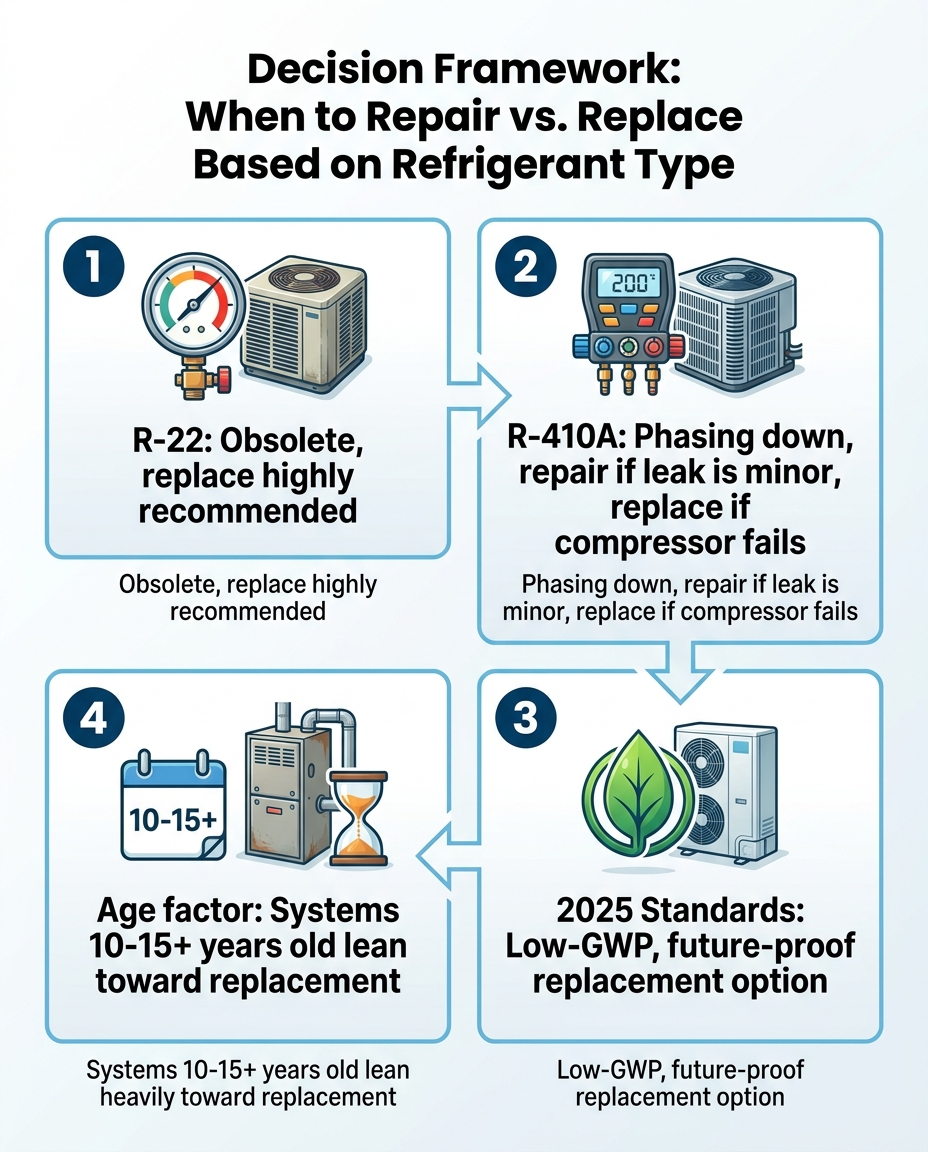
Decision Framework: When to Repair vs. Replace Based on Refrigerant Type
Making the choice between repairing and replacing does not have to be a guessing game. By looking at a few objective factors, you can determine the most logical path forward for your home. We use this structured checklist to evaluate systems in Conroe:
• Age of the Unit: The lifespan of a typical air conditioner in Texas is roughly 10 to 15 years. Systems over this age threshold are prime candidates for replacement rather than major repair, as multiple components are likely nearing the end of their functional life.
• Type of Refrigerant: If your system uses R-22, a major breakdown means almost certain replacement. If it uses R-410A, you must carefully weigh the severity of the leak against the system's overall health and the reality of the ongoing phase-down.
• Severity of the Breakdown: A simple electrical fix, like a blown capacitor or a failing contactor, is almost always worth repairing, regardless of the refrigerant type. However, a major compressor failure or a deeply inaccessible coil leak often justifies a full replacement.
• Future Plans: Consider how long you plan to stay in the house. If you are moving in a year, a repair might make sense. If this is your forever home, investing in a new, future-proof system offers better long-term value.
Our crew at Carl's Quality Cooling and Heating LLC recently guided a Conroe resident through this exact decision when their air conditioner stopped working during an extreme late-summer heatwave right before the back-to-school rush. Because of the legacy equipment's age and the severity of the failure, our quick assessment confirmed that a new unit was the most reliable path forward. The new system was installed the very next morning, providing immediate relief from the extreme heat and putting an end to constant repair worries.

Navigating the Costs: Flexible Options for Upgrading
As a family-run business, we acknowledge that replacing an HVAC system is a significant investment, especially when the breakdown is entirely unexpected. The late August end-of-season cooling demand rarely gives homeowners time to prepare. However, upgrading to modern equipment does not have to drain your savings, and there are multiple avenues to make the transition manageable.
Modern, high-efficiency systems often qualify for general energy rebates and federal tax credits designed to encourage the adoption of environmentally friendly technology. We always advise readers to consult a tax professional or local utility provider to verify current programs and eligibility requirements. These incentives can help offset the initial investment of a new installation.
Beyond incentives, it is crucial to discuss how long-term utility savings factor into the equation. A new, highly efficient system uses significantly less electricity to cool your home than a struggling, undercharged older unit. Over the lifespan of the new equipment, these monthly utility savings can substantially offset the initial investment compared to constantly repairing and running an old, inefficient unit.
Furthermore, you do not have to tackle the entire investment upfront. We offer flexible financing options to make the transition to new refrigerant standards manageable. Financing allows you to restore your home's comfort immediately while spreading the investment out over a timeline that works for your household budget.
Common Questions About the Refrigerant Phase-Out in Texas
Understanding the shift in cooling technology can be overwhelming. To help clarify the process, our experts have compiled answers to the most frequent questions we receive from Conroe homeowners. If you are exploring upgrades, you might also want to review our guide on Texas energy rebates for HVAC upgrades before making your final decision.
How long will R-410A be available?
R-410A will remain available for the foreseeable future, but its supply is actively decreasing. The EPA AIM Act mandates a gradual phase-down of production and importation that continues through 2036. As the supply tightens over the next decade, obtaining R-410A for major repairs will become progressively more difficult.
What is the new AC refrigerant for 2025?
Starting in 2025, new residential systems will transition to low-GWP (Global Warming Potential) refrigerants, primarily R-454B and R-32. These newer refrigerants are designed to drastically reduce environmental impact while providing excellent thermodynamic properties for efficient home cooling.
Is it worth fixing an R-22 AC unit?
In almost all cases we see, it is not worth fixing a major issue on an R-22 unit. Because the production and import of R-22 were completely banned in 2020, the refrigerant is extremely scarce. Investing heavily in an obsolete system is a poor long-term strategy compared to upgrading to modern equipment.
Can I still get R-410A for my AC?
Yes, you can still get R-410A for your existing air conditioner today. Our licensed HVAC professionals have access to current supplies to perform routine maintenance and necessary repairs. However, you should be aware that the ongoing phase-down will steadily impact long-term availability.
Will a new refrigerant system cool my home better during a Texas summer?
Absolutely. New systems utilizing modern refrigerants are paired with advanced compressor technology, such as variable-speed motors, which provide superior temperature control and enhanced dehumidification. This means a new system will not only cool your home more effectively during a harsh Texas summer, but it will also maintain a much more consistent, comfortable indoor environment.
Making an Informed, Pressure-Free HVAC Decision
Ultimately, the right choice depends heavily on your system's age, the specific refrigerant it currently uses, and the exact nature of the breakdown. Navigating the phase-out of legacy refrigerants shouldn't be stressful or rushed, even when dealing with a sudden failure in late summer. You deserve clear facts and a logical path forward.
Working with our veteran-owned and family-run team at Carl's Quality Cooling and Heating LLC means you receive guidance rooted in discipline, integrity, and accountability. We are committed to providing trustworthy, no-pressure evaluations so you can weigh your options carefully. We believe in empowering homeowners with objective information, prioritizing your long-term comfort and safety over a quick sale. If your system is struggling, we encourage you to seek a professional assessment to ensure your home remains a cool, comfortable refuge for years to come.