



Texas Energy Rebates for HVAC Upgrades: What's Available Right Now
Texas energy rebates for HVAC upgrades can put real money back in your pocket when you replace or upgrade your home's cooling and heating system. Between federal tax credits, upcoming state rebate programs, and utility incentives from providers across the state, Texas homeowners have more ways to offset the cost of a new high-efficiency system than ever before.
Here's a quick look at what's available:
| Program | Who It's For | Max Benefit |
|---|---|---|
| Federal 25C Tax Credit (Heat Pump) | All eligible homeowners | 30% of cost, up to $2,000/year |
| Federal 25C Tax Credit (Central AC) | All eligible homeowners | 30% of cost, up to $600/year |
| HOMES Rebate (IRA-funded, pending TX launch) | All income levels | Up to $8,000 (doubled for LMI households) |
| HEAR Rebate (IRA-funded, pending TX launch) | Low-to-moderate income only | Up to $14,000 per home |
| Oncor Utility Rebate | Oncor service area customers | Up to $600 for qualifying heat pumps |
| Austin Energy Rebate | Austin Energy customers | Averaging $800 per installation |
| CPS Energy Rebate | San Antonio area customers | $90–$310 per ton of capacity |
Texas summers are relentless, and replacing an aging, inefficient HVAC system is one of the smartest moves a homeowner can make — both for comfort and for long-term energy savings. The good news is that a layered system of incentives is available right now or coming soon, and understanding how each one works can help you make the most of your upgrade.
The federal tax credits are available today and run through 2032. Texas-administered state rebate programs — funded by the $690 million allocated to Texas under the Inflation Reduction Act — are currently in the planning phase through SECO (the State Energy Conservation Office) and are expected to launch in late 2026. In the meantime, utility-specific programs from providers like Oncor, CPS Energy, and Austin Energy are active and accepting applications.
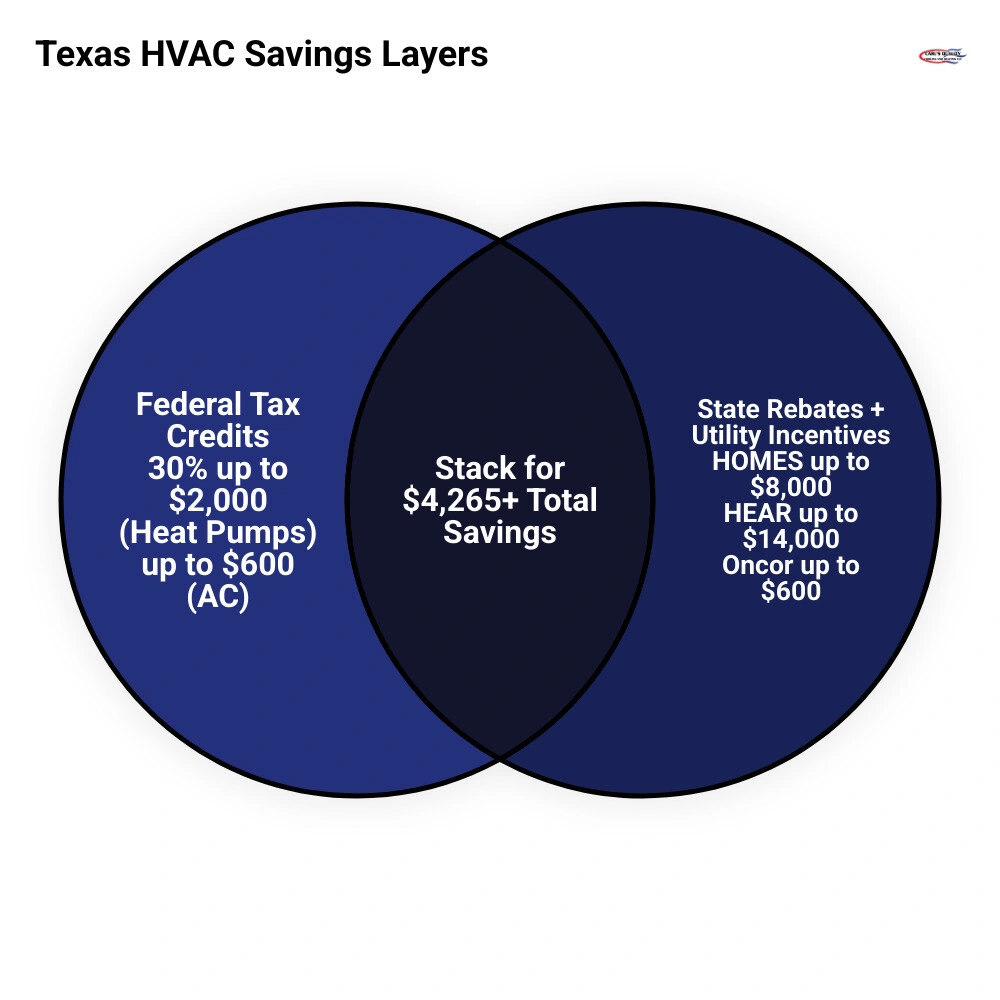
Stacking these programs together — federal credits, state rebates, utility incentives, and manufacturer promotions — can add up to $4,265 or more in total savings on a qualifying high-efficiency heat pump installation.
Federal Tax Credits for Energy-Efficient HVAC Upgrades

When we talk about immediate savings, the first place we look is the federal government. Under the Inflation Reduction Act (IRA), the Section 25C tax credit—formally known as the Energy-Efficient Home Improvement Credit—has been significantly expanded. This isn't just a deduction that lowers your taxable income; it is a dollar-for-dollar credit against the taxes you owe.
For those of us living in areas like Conroe, The Woodlands, or Houston, the 25C credit offers a substantial 30% credit on the total cost of installation. However, there are different annual caps depending on what you install:
- Heat Pumps: You can claim up to $2,000 per year for an Energy Efficient Heat Pump. This is often the best financial move for Texas homeowners because heat pumps provide both cooling for our humid summers and efficient heating for those occasional winter cold snaps.
- Central Air Conditioners: High-efficiency central AC units qualify for a credit of up to $600.
- Annual Aggregate Limit: There is a general $1,200 annual limit for most energy improvements (like windows, doors, and furnaces), but heat pumps and heat pump water heaters have a separate $2,000 limit. This means you could potentially claim up to $3,200 in a single year if you time your upgrades correctly!
To claim these credits, you must be upgrading your primary residence; rental properties and new construction typically do not qualify for the 25C credit. When tax season rolls around, you’ll need to file IRS Form 5695. Because these credits are scheduled to remain in place until 2032, you have time to plan your upgrades, but given the rising energy costs in Texas, sooner is usually better. If you aren't sure if your current unit is ready to go, it might be time to check for Signs You Need AC Replacement.
Understanding the HOMES and HEAR Texas Energy Rebates for HVAC Upgrades
The biggest news in texas energy rebates for hvac upgrades is the $690 million allocated to the Lone Star State for two specific programs: HOMES and HEAR. These are state-administered programs, meaning the Texas State Energy Conservation Office (SECO) is responsible for the rollout.
As of May 2026, we are in the final stages of the planning phase, with a full program launch expected by late 2026. Here is how these two heavy-hitters break down:
| Feature | HOMES Program | HEAR Program |
|---|---|---|
| Full Name | Home Owner Managing Energy Savings | Home Electrification and Appliance Rebates |
| Primary Focus | Whole-home energy performance | Electrification (switching to electric) |
| Eligibility | All income levels | Low-to-Moderate Income (LMI) |
| Max Rebate | Up to $8,000 (standard income) | Up to $14,000 per household |
| Pathway | Modeled or Measured savings | Point-of-sale discounts |
The HOMES program is performance-based. It rewards you based on how much energy you actually save. There are two ways to prove this: "modeled savings" (an estimate based on professional software before installation) or "measured savings" (actual utility bill data after the upgrade). For standard-income households, the rebate can reach $8,000, but for those meeting low-to-moderate income requirements, these amounts can be doubled.
The HEAR program is specifically designed for electrification. If you are switching from a gas furnace to a high-efficiency heat pump, this is your primary target. This program is strictly for households earning less than 150% of the Area Median Income (AMI). For those who qualify, it can cover up to 100% of the cost of a new heat pump, up to a $8,000 limit for the unit itself, plus additional funds for electrical panel upgrades and duct sealing.
Maximizing Texas Energy Rebates for HVAC Upgrades with Heat Pumps
In the eyes of rebate programs, not all HVAC systems are created equal. Heat pumps are the clear winners. Because they move heat rather than generating it, they are incredibly efficient. To qualify for the top-tier texas energy rebates for hvac upgrades, your system generally needs to meet the newer SEER2 (Seasonal Energy Efficiency Ratio 2) and HSPF2 (Heating Seasonal Performance Factor 2) standards.
For federal tax credits, a split-system heat pump usually needs a SEER2 rating of 16 or higher. In our Texas climate, we often recommend even higher ratings to handle the extreme heat. We often discuss Why Choose Daikin for Your HVAC Needs because their inverter technology excels at maintaining comfort while meeting the strict Energy Star "Most Efficient" criteria required for maximum rebates.
Whether you are in Spring, Tomball, or Willis, a heat pump can offer year-round comfort. If you are currently dealing with an old gas unit, it’s worth considering whether to Repair or Replace Your Furnace with a modern heat pump system to capture these incentives.
Stacking Manufacturer Incentives with Texas Energy Rebates for HVAC Upgrades
One of the best "insider secrets" we can share is the power of stacking. You aren't limited to just one rebate. You can combine a federal tax credit with a state rebate, a utility incentive, and a manufacturer promotion.
Major brands like Carrier, Trane, and Lennox frequently offer seasonal promotions:
- Carrier Cool Cash: Often provides instant rebates during spring and fall.
- Trane Promotions: Can include significant trade-in allowances or special Financing terms.
- Lennox Ultimate Comfort: Offers rebates that can reach into the thousands for full system replacements.
The best time to buy is typically during the "shoulder seasons"—March through May or September through November. Manufacturers are eager to move inventory, and contractors like us have more flexibility in our schedules. Combining these Promotions with government incentives is how some of our customers achieve total savings exceeding $4,000.
Local Utility Incentives and Efficiency Requirements
While we wait for the full state rollout of the IRA rebates, local utility companies are already offering excellent incentives. Your eligibility usually depends on who sends you your electric bill.
- Oncor: If you are in the Oncor service area (which covers parts of our northern service zones), you can find rebates around $600 for Heat Pumps with a SEER2 of 17+ and $550 for Central AC units at the same efficiency level.
- Austin Energy: For those in the Austin area, rebates average $800, but can go higher for Tier 3 systems. They also offer a "Home Energy Savings" bonus—an extra $200 if you complete multiple efficiency upgrades.
- CPS Energy: Serving the San Antonio region, they offer between $90 and $310 per ton. A 3-ton unit could net you nearly $1,000 in rebates alone.
- CoServ: This electric co-op also provides various rebates for high-efficiency heat pumps and smart thermostats.
Most of these programs require a post-installation inspection to verify that the equipment was installed correctly and meets the efficiency claims. To keep your system running at peak efficiency and ensure you stay eligible for future incentives, we highly recommend a Maintenance Plan. Regular HVAC Maintenance Tips for Homeowners can also help you avoid the stress of a mid-summer breakdown.
How to Qualify and Apply for Your Incentives
The application process for texas energy rebates for hvac upgrades can be a bit of a paperwork marathon, but we are here to help you navigate it. To ensure your claim isn't rejected, follow these steps:
- Hire a Licensed Contractor: All federal and utility programs require installation by a TDLR-licensed HVAC professional. As a Veteran Owned HVAC Company, we take pride in meeting and exceeding these standards.
- Manual J Load Calculation: Your system must be sized correctly for your home. An oversized unit will short-cycle and fail to dehumidify, while an undersized unit won't keep you cool. Most rebate programs require proof of a Manual J calculation.
- The AHRI Certificate: This is the most important document. It proves that the outdoor condenser and the indoor coil are a "matched set" that actually achieves the SEER2 rating promised. Without this, your rebate application is a non-starter.
- Itemized Invoices: Your receipt must clearly show the model numbers, serial numbers, and the date of installation.
- Submit Quickly: Many utility rebates, like Oncor and Austin Energy, have a 90-day deadline from the date of installation. If you miss the window, the money stays with the utility.
Frequently Asked Questions about Texas HVAC Rebates
Can I combine federal tax credits with local utility rebates?
Yes! In fact, we encourage it. Federal tax credits are handled through your tax return, while utility rebates are usually paid out via check or bill credit. They are completely separate programs and "stackable."
Do rental properties qualify for the HOMES and HEAR programs?
Yes, the HOMES and HEAR programs include provisions for multi-family dwellings and rental properties, though the rebate amounts and application processes may differ from owner-occupied single-family homes. However, the federal 25C tax credit is generally reserved for primary residences only.
What is an AHRI certificate and why is it required for my claim?
The Air-Conditioning, Heating, and Refrigeration Institute (AHRI) provides a certificate that verifies the efficiency ratings of a specific combination of HVAC components. Since a system's efficiency depends on both the indoor and outdoor units working together, this certificate is the only "official" proof that your system meets the SEER2 requirements for a rebate.
Conclusion
Navigating texas energy rebates for hvac upgrades might seem overwhelming, but the potential savings make it well worth the effort. Whether you are in Conroe, Montgomery, or The Woodlands, the combination of federal tax credits and local incentives can transform a high-efficiency upgrade from a "maybe someday" project into an affordable reality today.
At Carl's Cooling LLC, we specialize in helping our neighbors throughout Montgomery County and the surrounding areas find the perfect balance of comfort and value. From professional installation to helping you gather the documentation for your AHRI certificate, we are with you every step of the way. Don't wait until your old unit gives out in the middle of July. Whether you need to know When to Replace Your Heater or you're ready for a full Heat Pump Installation Tomball TX, our team is ready to help.
Give us a call today to schedule a consultation and let's start saving you money on your energy bills!


