
What Happens to Your Home When a Storm Cuts the Power
How power outages from storms affect your system is something every homeowner in Montgomery County should understand before the next severe weather event arrives — not after.
Here is a quick summary of the main ways a storm outage can impact your home systems:
- HVAC system – Shuts down mid-cycle, risking compressor strain, control board damage from voltage spikes, and failed restarts
- Refrigerator and freezer – Safe for only 4 hours (refrigerator) or up to 48 hours (full freezer) without power
- Sump pumps and well pumps – Stop working immediately, risking flooding or loss of water pressure
- Medical devices – CPAP machines, oxygen concentrators, and dialysis equipment lose power without a backup source
- Security systems and garage doors – May lose function or lock you out entirely
- Data and electronics – Sudden shutdowns and power surges can corrupt files and damage hardware
- Health risks – Heat illness, carbon monoxide poisoning from improper generator use, and food-borne illness become real threats
Storm-related outages are not random bad luck. They are a growing problem. Between 2000 and 2023, roughly 80% of all major U.S. power outages were caused by weather, and that number has doubled over the past decade compared to the decade before. The average U.S. household experienced 470 minutes without power in 2017 alone — and in 2024, customers in hurricane-affected areas saw that number climb far higher.
For homeowners here in Conroe and across Montgomery County, where Gulf Coast storm systems roll through regularly, understanding what an outage actually does to your home — especially your HVAC system — is the difference between a manageable disruption and a costly repair.
This guide covers everything from grid-level failures to your thermostat, health risks, vulnerable households, and what to check before you restart your system after the power comes back.
How Power Outages From Storms Affect Your System
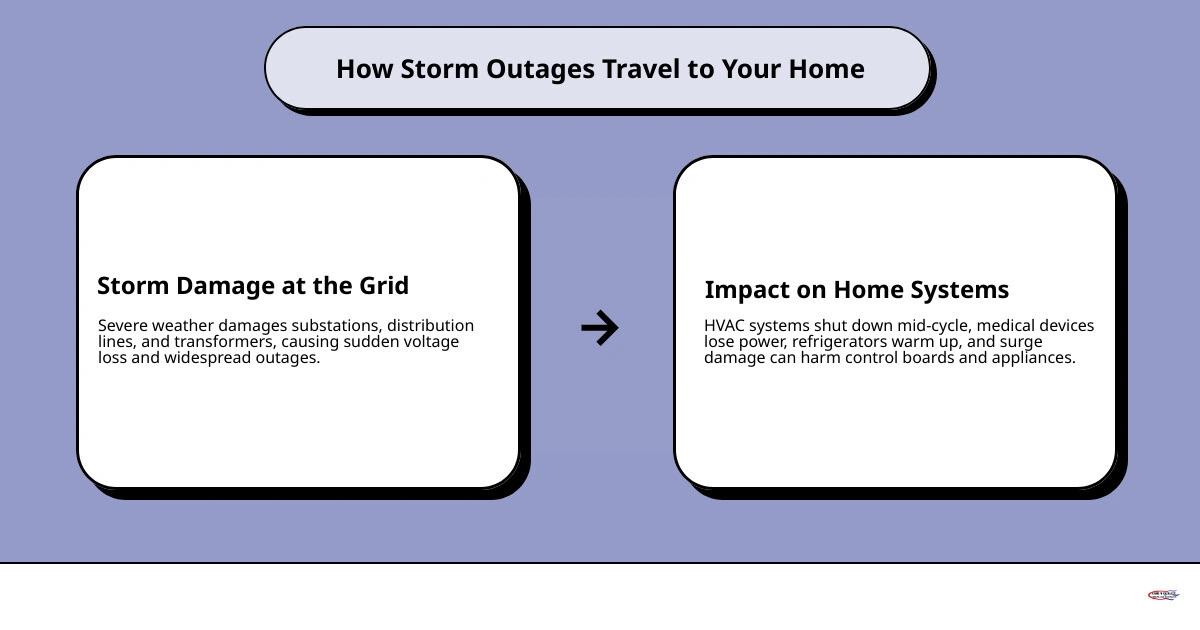
Storm outages start far away from your thermostat. A storm can damage transmission equipment, neighborhood distribution lines, transformers, and substations before the problem ever reaches your home. Then, once service drops or returns unevenly, your own equipment can take the hit.

How power outages from storms affect your system at the grid level
In our area, the biggest triggers are high winds, lightning, heavy rain, flooding, and hurricane-related damage. These events can:
- Knock trees or limbs into overhead lines
- Damage poles and transformers
- Flood substations or electrical components
- Trigger protective devices that intentionally shut off part of the grid to prevent bigger failures
- Cause repeated flickers as reclosers try to restore service
That last one matters. If your lights blink several times before going out, the grid may be trying to clear a fault automatically. Sometimes it works. Sometimes it locks out and leaves the neighborhood dark.
Distribution systems are especially vulnerable because they are the part of the grid closest to homes. Even when underground lines are used, flooding can still cause failures, and repairs can take time.
How power outages from storms affect your system inside the home
Once power is lost, your home systems do not all fail gracefully. Some stop safely. Others stop awkwardly, mid-task, and that is where trouble begins.
Common household impacts include:
- Thermostats going blank or losing programming
- HVAC systems stopping mid-cycle
- Refrigerators warming up
- Routers and internet service dropping
- Security systems switching to battery backup, then shutting down if backup is depleted
- Garage door openers becoming unusable without manual release
- Sump pumps and well pumps stopping immediately
- Smart home hubs, cameras, and home automation devices disconnecting
- Electronics experiencing surge damage when power returns
In plain English: the outage is bad, but the restart can be sneakier.
What Storm Outages Do to HVAC Performance and Reliability
Your heating and cooling system depends on stable electrical power. Storm outages interrupt that stability, and unstable restoration can be just as hard on the equipment as the outage itself.
Storms can leave an HVAC system with hidden issues even when it appears to restart normally. That is one reason preparation matters. For season-specific tips, see Safeguarding Your HVAC System for Hurricane Season and How to Prevent HVAC Emergencies with Maintenance.
Immediate HVAC problems after a storm-related outage
A sudden outage can leave your system dealing with:
- No cooling or no heating after power returns
- A blank or unresponsive thermostat
- Tripped breakers or disconnects
- Weak airflow
- Unusual buzzing, clicking, or rattling
- Outdoor unit not starting
- Indoor blower running without proper cooling
- Repeated breaker trips
Why does this happen? Because HVAC systems are designed to complete cycles in a controlled way. When power disappears mid-cycle, motors and compressors can be forced into a hard stop. If the power returns unevenly or too quickly, the restart can be rough on components.
Delayed HVAC damage from power surges and unstable restoration
This is the part many homeowners do not see coming.
A storm may pass, the AC comes back on, and everything seems fine. Then three days later the house is warm, the system short cycles, or the thermostat throws odd behavior. That is often delayed electrical damage.
Common delayed problems include:
- Control board damage from voltage spikes
- Thermostat communication faults
- Sensor errors
- Capacitor strain
- Compressor stress from hard restarts
- Reduced efficiency and longer run times
- Intermittent shutdowns
- Shortened equipment life
Power surges do not always destroy a system instantly. Sometimes they weaken electronics quietly. Think of it as your HVAC getting through the storm, then realizing a few days later that it absolutely did not enjoy the experience.
Safe homeowner checks before restarting the system
Before you turn the system back on, do a careful visual check first. If there was flooding, standing water, visible wiring damage, or impact damage from debris, stop and call for professional help.
Post-storm HVAC checks:
- Confirm power is stable and not flickering
- Check the thermostat screen and settings
- Replace or inspect the air filter
- Look around the outdoor unit for branches, leaves, or mud
- Make sure the condenser has breathing room
- Inspect for bent panels, exposed wires, or obvious damage
- Check that the condensate drain area is clear
- Listen for strange noises on startup
- Watch for weak airflow or warm air when cooling is expected
If your system will not restart properly, keeps tripping the breaker, smells burned, or was exposed to floodwater, do not keep trying. Helpful next steps are covered in When an HVAC Failure is a True Emergency and Emergency HVAC Repair Tips for Montgomery County Homeowners.
Health and Safety Risks During and After Storm Power Outages
Storm outages are not just inconvenient. They can become health emergencies, especially during extreme heat, severe cold, or long restoration times.
The most common health consequences communities face
Research on outages shows links to a wide range of health problems. The most common include:
- Carbon monoxide poisoning from unsafe generator use
- Heat-related illness when AC is unavailable
- Cold-related illness during winter outages
- Food-borne illness from spoiled food
- Unsafe water issues where pumping or treatment is interrupted
- Respiratory problems
- Cardiovascular events
- Kidney-related complications
- Accidental injuries during dark conditions or cleanup
- Mental health strain and anxiety
Some numbers are sobering. After the 2003 Northeast Blackout, accidental deaths in New York City more than doubled, and non-accidental mortality also rose. Studies in New York found that 23% of COPD hospitalizations on outage days could be attributed to the outage itself, especially in the first three days.
Carbon monoxide is one of the most preventable dangers. After the 2011 Great East Japan Earthquake, the odds of carbon monoxide poisoning in the disaster area were 13.5 times higher than the same period the following year. The lesson is simple: never run a generator inside a home, garage, or near doors and windows.
Who is most vulnerable during a prolonged outage
Not everyone experiences the same outage the same way.
Higher-risk groups include:
- Older adults
- Infants and young children
- Pregnant people
- People with COPD, asthma, or heart disease
- Dialysis users
- Oxygen concentrator and CPAP users
- People who rely on refrigerated medication
- Nursing home residents
- Low-income households
- Communities with limited transportation or limited backup power access
These households may have less ability to cool or heat safely, less access to generators or batteries, and fewer options to relocate quickly. Research also shows that long-duration outages often overlap with social and economic disadvantage.
Practical steps to reduce household health risks
A few simple actions can lower risk dramatically:
- Use generators outdoors only, at least 20 feet from openings
- Keep battery-powered carbon monoxide detectors working
- Keep refrigerator and freezer doors closed as much as possible
- Remember the food safety windows:
- Refrigerator: about 4 hours unopened
- Full freezer: up to 48 hours unopened
- Half-full freezer: about 24 hours unopened
- Store drinking water ahead of storms
- Identify one cooler room and one warmer room in the home if conditions turn extreme
- Keep medications and medical equipment plans ready
- Check on neighbors, especially older adults
- Charge devices fully before storms arrive
For more household guidance during dangerous indoor temperatures, read How to Stay Safe During a Heating or Cooling Emergency.
Why Some Neighborhoods Suffer More Than Others
Outages do not affect all communities equally. Two neighborhoods can face the same storm and have very different outcomes based on housing, infrastructure, transportation, health needs, and available backup resources.
| Factor | Higher exposure or risk | Lower exposure or risk |
|---|---|---|
| Housing quality | Older homes, weaker insulation, rental units | Newer homes, better insulation |
| Backup options | No generator or battery backup | Backup power available |
| Medical needs | Electricity-dependent equipment | Fewer critical electrical needs |
| Transportation | Limited ability to leave | Easier evacuation or relocation |
| Communication | Limited internet or alerts access | Multiple alert channels |
| Restoration resilience | Fewer local supports | Strong neighborhood support networks |
How income, race, and housing conditions shape outage impacts
Research has found that preparedness and recovery often vary by income, race, and housing conditions. In practice, that can mean:
- More difficulty buying backup power or extra supplies
- Greater exposure in older or less efficient housing
- Less flexibility to evacuate or stay elsewhere
- More dependence on nearby services that may also be offline
- Communication barriers that limit access to updates and aid
For homeowners and renters alike, the outage itself is only part of the problem. The bigger issue is what resources are available when the outage lasts longer than expected.
Why repeated outages can be worse than one major blackout
A single major blackout is disruptive. Repeated outages can be exhausting.
Multiple outages can cause:
- Repeated food spoilage
- Ongoing medication interruptions
- Sleep loss from heat and noise
- Extra wear on HVAC and appliances
- More stress and anxiety
- Ongoing work and school disruption
- Reduced trust in whether power will stay on after restoration
That cumulative stress matters. Studies of storm-related disruptions have linked outages not only to immediate health issues but also to lingering mental health effects and chronic disease management problems.
How Utilities and Communities Can Prepare for the Next Storm
The good news is that outages are not purely unavoidable fate. Utilities, local officials, neighborhoods, and homeowners can all reduce the impact.
Grid resilience strategies that reduce outage frequency and duration
Several strategies improve storm resilience:
- Vegetation management near power lines
- Stronger poles and hardened equipment
- Smart sensors that detect faults faster
- Sectionalizing circuits so smaller areas are affected
- Substation flood protection
- Battery storage and distributed energy resources
- Microgrids for critical facilities
- Demand response to reduce overload during extreme heat
Some grid improvements reduce how often outages happen. Others reduce how long they last. Underground lines can reduce outage frequency in some cases, though they are not immune to flooding and can take longer to repair when damaged.
Better homeowner and community response plans
We cannot harden the whole grid from our living room, but we can prepare smarter at home.
A solid storm outage plan should include:
- A list of critical loads such as refrigeration, medical devices, internet, and one cooling source
- Charged phones and battery packs
- Flashlights instead of candles
- A corded phone if landline service is available
- Printed emergency contacts
- A plan for garage door manual release
- Fuel and operating instructions for any backup power equipment
- Enrollment in local emergency alerts
- A neighborhood check-in plan for older adults and medically vulnerable residents
If your home depends heavily on cooling for safety, it is wise to plan before the first major storm watch, not while the wind is already rearranging patio furniture.
How better data improves public health response
One of the biggest lessons from recent research is that better outage data leads to better response.
Useful data sources include:
- Utility records showing outage location, duration, and affected customer counts
- Geospatial mapping to identify hot spots
- Remote sensing after storms
- Social media posts that reveal unmet needs quickly
- Health data that can be linked with outage timing
Why does this matter? Because emergency response works better when officials know where the longest outages are, which areas include more medically vulnerable households, and where conditions are worsening in real time.
Frequently Asked Questions about How Power Outages From Storms Affect Your System
Can a brief outage still damage my AC system?
Yes. A short outage or brownout can still create restart stress and surge exposure. Even a quick flicker can interrupt the compressor and electronics. If power returns several times in rapid succession, that can be especially hard on the system. After a brief outage, give the equipment time to stabilize before expecting normal operation.
Why does my HVAC seem fine right after the storm but fail days later?
Because some electrical damage is delayed. Power surges can weaken control boards, capacitors, sensors, and thermostat communication circuits without causing an immediate shutdown. The system may run for a while, then show symptoms like short cycling, poor cooling, longer runtimes, or random faults days later.
What should I do before turning my system back on after flooding or debris?
Do not restart it if floodwater reached the equipment or if debris caused visible damage. First, check for standing water, exposed wiring, blocked airflow, mud inside or around the unit, and damaged disconnects or panels. Clear only light debris you can remove safely. If there was flooding or any electrical concern, professional service is the safest next step.
Conclusion
Storm outages can affect far more than the lights. They can interrupt comfort, damage HVAC components, raise health risks, spoil food, disable important devices, and create hidden problems that show up days later. That is the real answer to how power outages from storms affect your system: the effects move from the grid to the home, then from the outage itself to the recovery period.
For homeowners in Conroe, Montgomery, Houston, The Woodlands, Tomball, Spring, Willis, and nearby communities we serve, the smartest approach is simple: prepare early, restart carefully, and treat post-storm HVAC issues seriously.
If you want more information about support in our service area, visit More info about x services.