

When an HVAC Failure Is a True Emergency (And When It's Not)
When an HVAC failure is a true emergency depends on one simple test: does the problem put your health, safety, or home at immediate risk? If the answer is yes — or even "maybe" — treat it as an emergency.
Here are the situations that qualify as a genuine HVAC emergency:
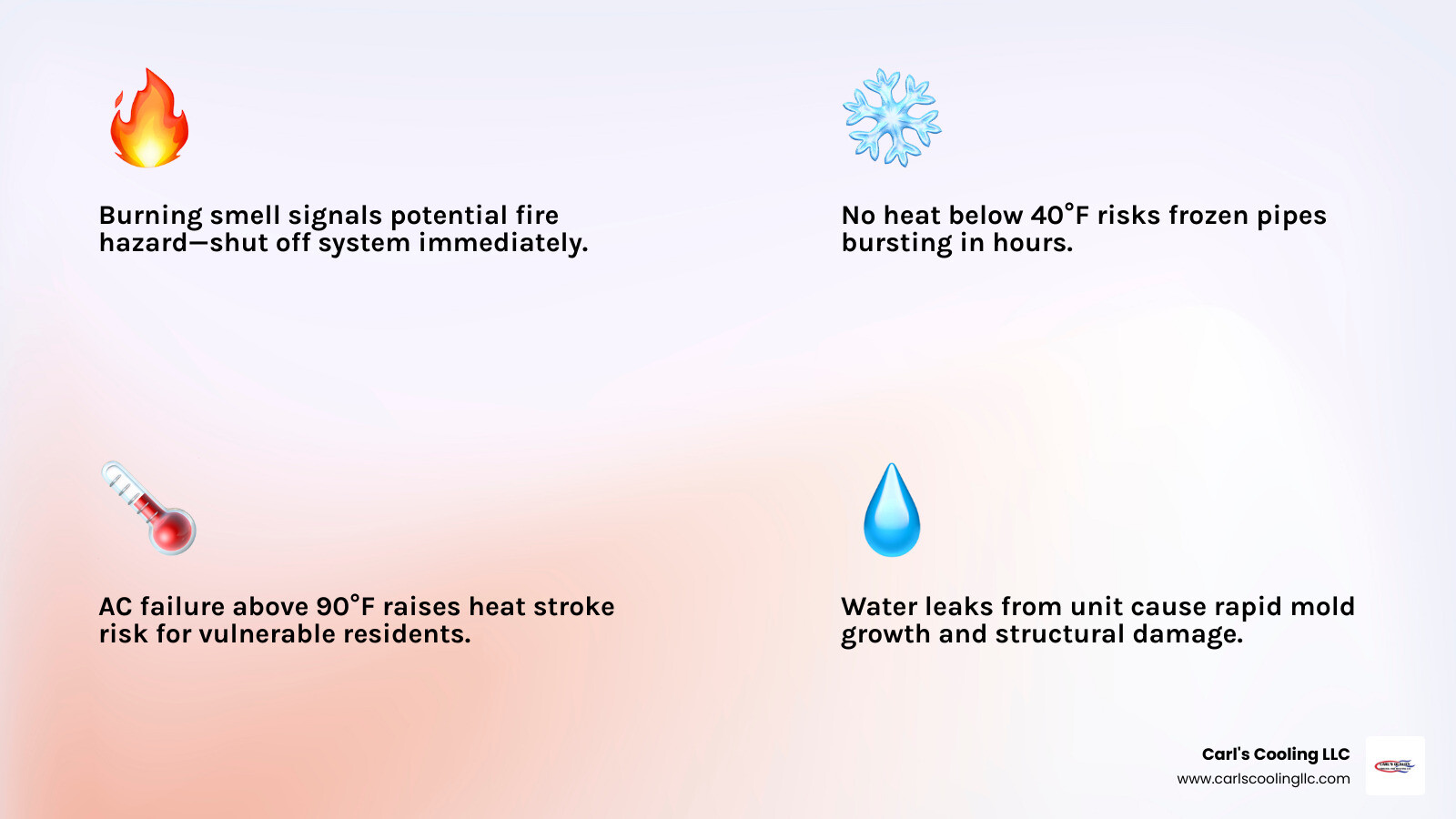
- Gas or carbon monoxide leak — evacuate immediately and call emergency services
- Complete heating loss when outdoor temps are below 40°F — pipes can freeze and burst within hours
- Complete cooling loss when outdoor temps are above 90°F — heat stroke risk, especially for children, elderly, or pets
- Burning smell or electrical odors — potential fire hazard; shut off the system now
- Smoke or sparking from the unit — shut off power and call immediately
- Significant water leak from the unit — risks mold growth and structural damage
- Carbon monoxide detector alarm — evacuate and call 911, do not re-enter
Issues that can usually wait until regular business hours include mild temperature fluctuations, slightly strange noises, minor airflow reductions, or thermostat glitches — as long as the weather is moderate and no one in the home is medically vulnerable.
It's 10 PM on a Friday night and your air conditioner just stopped running. The temperature inside is climbing, and you're stuck asking yourself: is this a real emergency or can it wait until Monday? That's exactly the question this article answers — clearly, and without the guesswork.
Not every HVAC problem deserves a panicked phone call. But some absolutely do. Knowing the difference can protect your family, your home, and your wallet. Below, we'll walk through the real warning signs that separate a true crisis from a minor inconvenience — so you can act fast when it matters and stay calm when it doesn't.
Defining When an HVAC Failure is a True Emergency
In our years of serving the Conroe and Montgomery areas, we’ve seen it all. We know that when the Texas humidity starts to feel like a heavy blanket, any AC failure feels like a crisis. However, from a technical and safety standpoint, there is a clear line between an "inconvenience" and a "true emergency."
An HVAC emergency refers to a system failure that creates an immediate safety risk, a health hazard, a threat of significant property damage, or a violation of legal habitability. For example, if you are a landlord in a place like The Woodlands, failing to provide heat during a freeze isn't just a bad review waiting to happen—it’s a safety violation.
To help you decide whether to hit the speed dial for emergency AC repair, check out this quick comparison:
| Symptom | Emergency Status | Why? |
|---|---|---|
| Rotten egg smell | TRUE EMERGENCY | Indicates a dangerous gas leak. |
| Sparking or smoke | TRUE EMERGENCY | High risk of electrical fire. |
| No AC (Outdoor temp 95°F+) | TRUE EMERGENCY | Risk of heat stroke and dehydration. |
| No Heat (Outdoor temp 35°F) | TRUE EMERGENCY | Risk of burst pipes and hypothermia. |
| Loud screeching or banging | TRUE EMERGENCY | Indicates imminent mechanical failure. |
| Slightly uneven cooling | Standard Repair | Likely a duct or insulation issue. |
| Small increase in bill | Standard Repair | System may need a simple tune-up. |
| Dusty smell on first start | Standard Repair | Usually just dust burning off the coils. |
When an HVAC Failure is a True Emergency in Extreme Weather
In April 2026, we’ve already seen how unpredictable our local weather can be. In Southeast Texas, "extreme weather" usually means one of two things: blistering heatwaves or sudden, bone-chilling freezes.
The 90°F Rule: When the mercury climbs above 90°F, your home can become dangerously hot in a matter of hours. Without cooling, indoor temperatures can quickly exceed 100°F, posing a direct threat of heat stroke. This is especially true in humid areas like Cypress and Spring, where the "feels like" temperature is even higher.
The 40°F Rule: On the flip side, if your furnace fails when it is 40°F or lower outside, you are in a race against time. Most modern homes only retain heat for about 8 to 12 hours. Once the internal temperature drops, your plumbing is at risk. Burst pipes can cause thousands of dollars in water damage in a single night. If your system quits during a cold snap, you need emergency furnace repair before the ice sets in.
Health Risks for Vulnerable Households
Urgency isn't just about the weather; it’s about who is inside the house. What might be a "sweat it out" situation for a healthy 25-year-old can be life-threatening for others. We always prioritize calls for households with:
- Infants and Toddlers: Small bodies cannot regulate temperature as efficiently as adults.
- Elderly Residents: Seniors are much more susceptible to heat exhaustion and respiratory distress.
- Medically Fragile Individuals: Those with chronic heart or lung conditions need stable climate control to stay safe.
- Pets: Dogs and cats can suffer from heatstroke just as easily as humans, especially in high-humidity environments.
Sensory Red Flags: Smells and Sounds You Can't Ignore

Sometimes your nose or your ears will tell you there’s an emergency before your thermostat does. If your system starts "talking" to you in strange ways, don't ignore it. For those living in Montgomery, following these emergency furnace repair montgomery tx tips can help you stay ahead of a total breakdown.
Dangerous Odors and Gas Leaks
If you smell something strange, your first job is to identify the source. Ensure the smell is coming from the vents and not a kitchen appliance.
- Rotten Eggs or Sulfur: Natural gas is odorless, so utility companies add a chemical called mercaptan to make it smell like rotten eggs. If you catch this scent, do not flip any light switches or use your phone inside. Evacuate immediately and call the gas company from outside.
- Burning Plastic or Electrical Ozone: This metallic-tinged burning smell indicates that wires are melting or a motor is overheating. This is a major fire hazard.
- Carbon Monoxide (CO): You can’t smell or see CO, which is why it’s known as the "silent killer." Unintentional CO poisoning sends over 100,000 Americans to emergency departments every year. Look for physical signs like soot buildup around the furnace or a yellow, flickering burner flame (it should be blue). If your CO detector goes off, get everyone out of the house immediately.
Mechanical Failures and Alarming Noises
Your HVAC system should run with a gentle hum. If it sounds like a heavy metal concert is happening in your attic, something is wrong.
- Intense Screeching: This often points to a failed fan belt or a motor bearing that has given up the ghost.
- Metal-on-Metal Grinding: This usually means the blower wheel has come loose and is shredding the housing.
- Loud Banging: This could be a "delayed ignition" in a furnace, where gas builds up before lighting, causing a small explosion.
If you hear these sounds, shut the system off at the breaker. Continuing to run a noisy unit can turn a simple part replacement into a total system replacement. If you're wondering why is my AC not cooling my home, these mechanical failures are often the culprit.
Visible Signs of a System Crisis and Property Risk
Not all emergencies are invisible gases or loud bangs. Sometimes, the evidence is right at your feet—literally.
Water Damage and Clogged Drain Lines
In our humid Texas climate, air conditioners pull an incredible amount of moisture out of the air. This water is supposed to flow through a condensate drain line. If that line clogs—which is common in places like Conroe due to algae and dust—the water has nowhere to go but into your home.
A clogged drain can lead to:
- Ceiling Collapses: If your unit is in the attic, water can soak through your drywall.
- Mold Growth: Standing water is a breeding ground for biological growth.
- Structural Rot: Constant moisture can weaken the wood framing of your home.
If you see water pooling around your indoor unit, shut it off. Many modern systems have a "float switch" that should kill the power automatically, but these can fail. For business owners, this is even more critical. If my restaurants walk-in is down who offers emergency commercial refrigeration repair in conroe, the risk isn't just property damage—it's thousands of dollars in lost inventory.
Why Short Cycling is an HVAC Emergency
Short cycling is when your system turns on and off every few minutes without ever completing a full cooling or heating cycle. Many homeowners ignore this, thinking the system is just "working hard." In reality, short cycling is an emergency because it places massive electrical stress on the compressor.
About 40% of HVAC emergencies begin with thermostat malfunctions or short cycling. If left unaddressed, the constant starting and stopping will burn out your motor. This is especially dangerous for commercial systems. If you need an emergency commercial heating carriage hills guide, you'll learn that short cycling can bring a business to a standstill by tripping breakers and overheating sensitive equipment.
Refrigerant leaks are another visible (or audible) crisis. If you hear a hissing sound and see ice forming on your evaporator coils, you likely have a leak. This isn't just a cooling issue; refrigerant can be harmful to your health and the environment. If you need emergency heat pump repair in magnolia tx, don't wait for the coils to turn into a block of ice—call us as soon as you see frost.
Immediate Steps to Take During a Heating or Cooling Crisis
When you realize you're facing a true emergency, your first instinct might be to panic. Don't. Follow these steps to stabilize the situation before the pros arrive:
- Safety First: If you suspect a gas leak or see smoke, evacuate the building immediately.
- Cut the Power: Turn the system off at the thermostat and the circuit breaker. This prevents further electrical damage.
- Shut the Gas: If you have a furnace and smell gas, turn off the main gas valve if it is safe to do so.
- Document the Issue: Note any error codes on your thermostat or specific sounds you heard. This helps our technicians diagnose the problem faster.
- Call for Help: Contact a 24/7 service provider. If my businesss heating system failed i need 24 hour commercial heating services in cypress tx immediately, make sure you mention that it is a commercial site so the right team is dispatched.
Troubleshooting Before Calling for Help
Sometimes, what looks like a disaster is actually a simple fix. Before you pay for an after-hours emergency visit, run through this 30-second checklist:
- Check the Thermostat: Are the batteries dead? Is it set to "Cool" or "Heat" correctly? You’d be surprised how often a child or a guest accidentally bumps the settings.
- Inspect the Breaker: Did a power surge trip the HVAC breaker? Flip it all the way to "Off" and then back to "On" once. If it trips again immediately, do not try a third time—that’s a sign of a serious electrical short.
- Look at the Air Filter: A filter that is completely clogged with pet hair and dust can choke your system, causing it to overheat and shut down.
- Clear the Outdoor Unit: Ensure that weeds, trash, or storm debris aren't blocking the airflow to your outdoor condenser.
How Maintenance Prevents Future Breakdowns
The best way to handle an HVAC emergency is to make sure it never happens in the first place. Statistics show that homeowners who invest in regular maintenance are 50% less likely to experience an emergency breakdown.
Think of an HVAC tune-up like an oil change for your car. During a seasonal inspection in the spring or fall, we:
- Tighten Belts: Preventing those scary screeching sounds.
- Lubricate Motors: Reducing friction and preventing overheating.
- Clear Drain Lines: Stopping water damage before it starts.
- Check Refrigerant Levels: Catching small leaks before the system freezes up.
- Test Safety Controls: Ensuring your system will shut down safely if a problem occurs.
By catching a worn capacitor or a loose wire in April, you avoid a total system failure in the middle of a July heatwave. Maintenance doesn't just prevent emergencies; it also extends the lifespan of your system and keeps your energy bills from skyrocketing.
Frequently Asked Questions about HVAC Emergencies
Is a burning smell always an emergency?
Not always, but you should treat it as one until proven otherwise. If you haven't turned your heater on in six months, a mild "dusty" burning smell is normal for the first 10 minutes as dust burns off the heat exchanger. However, if the smell is sharp, metallic, or smells like burning plastic, shut the system off immediately. That’s a sign of electrical failure or a seized motor.
How quickly should a professional respond to an emergency?
A reputable company should offer 24/7 availability for true emergencies. We strive for same-day service, especially during peak summer and winter months. We prioritize households with vulnerable members (infants, seniors, or those with medical conditions). When you call, be clear about the symptoms and if anyone in the home is at health risk.
When is it safe to wait for regular business hours?
If the outdoor temperature is between 60°F and 75°F, and your system is just making a slightly odd noise or isn't cooling quite as well as it used to, you can likely wait. Waiting for regular business hours can save you on emergency dispatch fees. If there's no smoke, no gas smell, and no risk to your home's structure, it's usually okay to keep the windows open and call us on Monday morning.
Conclusion
When an HVAC failure is a true emergency, time is of the essence. Whether you are in Conroe, Montgomery, or The Woodlands, you shouldn't have to guess if your family is safe. From gas leaks and electrical hazards to total system failures during a Texas heatwave, knowing the signs allows you to act with confidence.
At Carl's Cooling LLC, we are committed to keeping our community comfortable and safe. We pride ourselves on reliability, quality installations, and a professional response when things go wrong. Don't let a minor issue turn into a major disaster.
If you are seeing red flags like strange smells, loud noises, or a total loss of air, don't wait. Contact our emergency AC repair team today and let us bring the cool back to your home.