


Why Knowing How to Prevent HVAC Emergencies with Maintenance Could Save You This Season
Knowing how to prevent HVAC emergencies with maintenance is one of the most valuable things you can do as a homeowner — especially in Montgomery County, where summer heat and humidity push cooling systems to their limits.
Here's a quick answer to get you started:
How to prevent HVAC emergencies with maintenance:
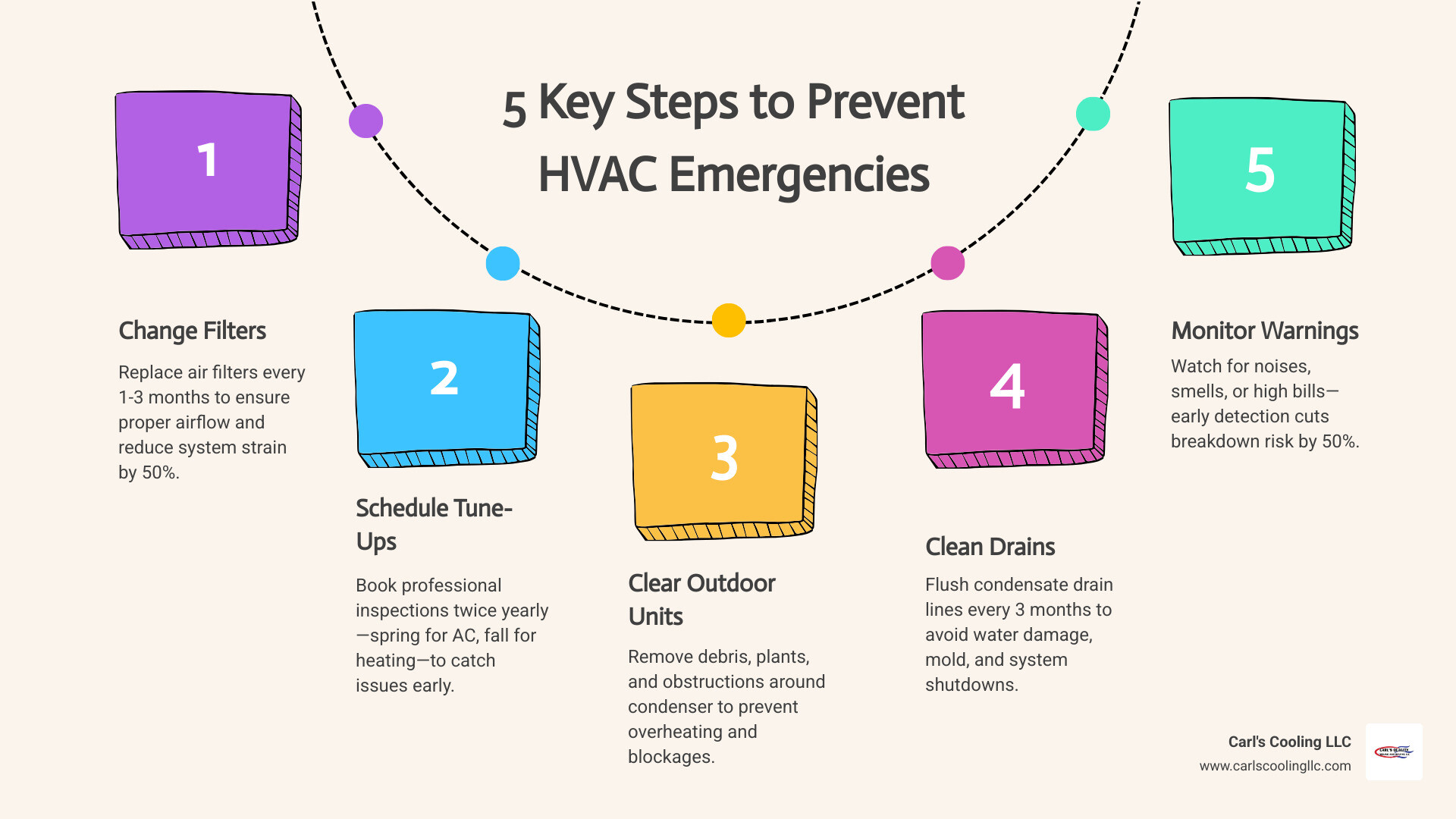
- Change air filters every 1-3 months to maintain airflow and prevent system strain
- Schedule professional tune-ups twice a year — spring for your AC, fall for your heating system
- Keep outdoor units clear of debris, plants, and obstructions
- Clean the condensate drain line every three months to prevent water damage and mold
- Monitor for warning signs like strange noises, burning smells, or rising energy bills
- Test your thermostat and replace batteries regularly
- Seal duct leaks to stop energy loss and reduce system workload
Most HVAC breakdowns don't happen out of nowhere. They start small — a clogged filter here, a dirty coil there — and build up quietly until the system fails on the hottest day of the year. In fact, 70% of homeowners experience an HVAC breakdown during peak seasons, and 42% have faced system issues specifically during heat waves. That kind of failure isn't just inconvenient. It can be a real health and safety risk, especially for children, elderly family members, or anyone with respiratory conditions.
The good news? Research consistently shows that homeowners who schedule regular HVAC maintenance are 50% less likely to face an emergency breakdown. A well-maintained system also runs 15-20% more efficiently, which means lower energy bills alongside fewer repair calls.
This guide walks you through exactly what to do — and when — so your system stays reliable all year long.
Defining HVAC Emergencies and Their Common Causes
When we talk about an HVAC emergency, we aren't just talking about a house that feels a little stuffy. A true emergency is any situation that poses a direct threat to your health, safety, or the structural integrity of your home. In the April 2026 climate of Southeast Texas, a failed AC during a triple-digit heatwave isn't just uncomfortable; it’s a medical hazard for vulnerable populations like infants and the elderly.
Common HVAC emergencies include:
- Safety Hazards: This includes gas leaks (often identified by a "rotten egg" smell), electrical burning odors, or smoke coming from the vents.
- Extreme Temperatures: If your furnace fails when temperatures dip toward freezing or your AC dies during a Magnolia heatwave, the interior of your home can quickly reach dangerous levels.
- Water Damage: A clogged condensate drain line can cause water to back up and overflow, leading to collapsed ceilings, ruined drywall, and toxic mold growth.
- Refrigerant Leaks: Beyond losing cooling power, leaking refrigerant is an environmental hazard and can damage the compressor, leading to a total system replacement.
Understanding Regular Maintenance to Prevent AC Repairs is the first step in ensuring these high-stakes scenarios never happen in your living room. Most of these "sudden" disasters are actually the result of long-term neglect, such as loose electrical connections that finally spark or a drain line that has been slowly filling with algae for months.
How to Prevent HVAC Emergencies with Maintenance and Early Detection
The secret to avoiding a midnight call for emergency service is learning to "listen" to your home. Your HVAC system is surprisingly communicative; it will usually tell you it’s struggling long before it finally gives up.
One of the biggest culprits of system failure is a simple lack of airflow. When air can't move freely, the system has to work twice as hard to achieve the same result. This puts immense strain on the motor and compressor. Imagine trying to run a marathon while breathing through a cocktail straw—that is exactly what your HVAC system feels like when it has a dirty filter.

Identifying Warning Signs to Prevent HVAC Emergencies with Maintenance
Before a total breakdown occurs, you will likely notice several "yellow flags." Paying attention to these can help you schedule a standard service call rather than an emergency one.
- Strange Noises: Banging, screeching, or grinding sounds often indicate a loose belt, a failing motor bearing, or a piece of hardware that has come adrift.
- Short Cycling: If your unit turns on and off every few minutes without ever reaching the desired temperature, it’s likely overheating or has a failing sensor.
- Weak Airflow: If you feel only a faint breeze coming from your registers, you could have a failing blower motor or significant ductwork issues.
- Inconsistent Temperatures: When one room is an ice box and the other is a sauna, your system is struggling to distribute air effectively.
For a deeper look at what to watch for, check out our Complete HVAC System Inspection Guide. Catching a small mechanical issue in April can prevent a total system seizure in July.
Why Regular Inspections are the Best Way to Prevent HVAC Emergencies with Maintenance
While DIY checks are great, there are technical aspects of your system that require a professional eye. During a precision tune-up, a technician does more than just "look" at the unit. We perform safety control testing to ensure your furnace won't leak carbon monoxide and check electrical connections that may have loosened due to standard system vibrations.
Loose connections are a leading cause of electrical fires and short circuits. Furthermore, sensor calibration ensures your thermostat and unit are "talking" to each other correctly. Without this, your system might run longer than necessary, driving up your bills and wearing out the parts years ahead of schedule. Investing in Professional HVAC Maintenance Solutions ensures that these hidden dangers are neutralized before they can cause a crisis.
Essential DIY Maintenance Tasks for Homeowners
You don't need a tool belt to be a hero for your HVAC system. There are several high-impact tasks you can perform yourself to ensure your home stays comfortable. These Essential AC Maintenance Tips are the foundation of a healthy home.
Your Monthly DIY Checklist:
- Filter Replacement: In the dusty, pollen-heavy environment of The Woodlands and Conroe, filters should be checked every 30 days. If you have pets or allergies, use a high-efficiency MERV 11 or 12 filter.
- Outdoor Clearance: Your outdoor condenser unit needs to "breathe." Ensure there is at least a two-foot clearance around the unit. Trim back shrubs, remove fallen leaves, and clear away grass clippings after mowing.
- Condensate Drain Maintenance: Every three months, pour a cup of white vinegar or a diluted bleach solution down your condensate drain line to kill algae and prevent clogs.
- Thermostat Check: If your thermostat has a screen, replace the batteries annually. A dead battery can lead to a "no-heat" or "no-cool" situation that is easily avoidable.
- Visual Duct Inspection: Check accessible ductwork in your attic or crawlspace for visible holes or disconnected sections. A typical home loses 20-30% of its conditioned air through duct leaks!
The Value of Professional Maintenance Plans
While DIY tasks keep the "dust at bay," professional maintenance goes deep into the machinery. Many homeowners wonder if a Maintenance Plan is worth it. When you consider that annual maintenance can literally double the remaining life of your HVAC equipment, the value becomes clear.
Here is how professional service compares to DIY efforts:
| Maintenance Task | Homeowner (DIY) | Professional Technician |
|---|---|---|
| Change Air Filters | Yes | Yes |
| Clear Debris from Outdoor Unit | Yes | Yes |
| Check Thermostat Batteries | Yes | Yes |
| Clean Evaporator & Condenser Coils | No | Yes |
| Measure Refrigerant Levels | No | Yes |
| Tighten Electrical Connections | No | Yes |
| Lubricate Moving Parts | No | Yes |
| Test Safety & Limit Controls | No | Yes |
| Inspect Heat Exchanger for Cracks | No | Yes |
Beyond the technical work, professional plans often include "perks" like priority scheduling. In the middle of a Houston heatwave, being at the front of the line for service is a massive advantage. Plus, most manufacturers require proof of annual professional maintenance to keep your equipment warranty valid. If a major component like a compressor fails, you don't want to lose out on warranty coverage because you skipped a tune-up.
Seasonal HVAC Maintenance Checklist for Year-Round Comfort
In our region, we don't just have "weather"—we have seasons that demand very different things from our HVAC systems.
Spring: The Cooling Countdown
Before the humidity of May hits, your AC needs to be ready. This is the time for a Spring Air Conditioning Maintenance visit. Technicians will clean the outdoor coils, which often get caked with pollen and dirt during the spring bloom. Clean coils can improve efficiency by up to 15%, saving you a fortune on summer cooling bills.
Summer: Peak Performance & Hurricane Prep
During the peak of summer, keep a close eye on your outdoor unit. If a storm is approaching, clear any loose lawn furniture or debris that could become a projectile and damage your condenser. If you live in coastal-adjacent areas like Humble or Spring, ensure your unit is securely anchored.
Fall: Heating Safety
Even though our winters are relatively mild, your furnace or heat pump still needs love. Knowing When to Schedule Fall AC Services is critical. We recommend scheduling this in October or November. For gas furnaces, this is a life-saving visit; we check for cracked heat exchangers that could leak carbon monoxide into your home.
Frequently Asked Questions about HVAC Prevention
What constitutes an HVAC emergency that requires immediate attention?
An emergency is any situation that threatens safety or property. This includes a total loss of heat during freezing weather, a total loss of cooling during a heatwave, the smell of gas or burning plastic, or a major water leak from the indoor unit. If you see sparks or smell smoke, turn the system off at the breaker immediately and call a professional.
How often should I change my air filters to avoid a breakdown?
For most homes in the Conroe and Woodlands area, we recommend checking the filter every 30 days. If the filter looks gray or "fuzzy," change it. At a minimum, filters should be replaced every 90 days. If you have multiple pets or suffer from severe allergies, you may need to change them every 30 to 45 days to prevent system strain.
How much can regular maintenance save in energy costs?
On average, a well-maintained HVAC system operates 15-20% more efficiently than a neglected one. This can translate to hundreds of dollars in savings over the course of a year. Furthermore, by doubling the lifespan of your unit (from 8-10 years to 15-20 years), you are delaying a massive capital expense, which is the ultimate form of saving.
Conclusion
At Carl's Cooling LLC, we’ve seen how a little bit of prevention goes a long way. We are proud to serve our neighbors in Conroe, Montgomery, The Woodlands, and throughout the surrounding communities. Our goal isn't just to fix your air conditioner when it breaks; it’s to make sure it stays running so you never have to deal with the stress of a breakdown in the first place.
By following the steps in this guide—changing your filters, keeping your outdoor unit clear, and partnering with us for biannual tune-ups—you are taking control of your home’s comfort and safety. Don't wait for the next heatwave to find out if your system is up to the task.
If you’re worried about a strange noise or if it’s been more than six months since your last professional check-up, reach out to us today. We’re here to provide the expert care your system needs to keep your family cool and comfortable for years to come. And if the unthinkable does happen, we offer Emergency AC Repair to get your life back to normal as quickly as possible.


