
Why HEPA Filtration System Benefits for Homeowners Matter More Than You Think
The hepa filtration system benefits for homeowners are real, measurable, and relevant to anyone who breathes indoor air — which, according to the EPA, is about 90% of your time. Here's a quick look at what HEPA filtration delivers:
- Cleaner air — captures 99.97% of particles 0.3 microns or larger, including dust, pollen, mold spores, and bacteria
- Allergy and asthma relief — removes common triggers affecting roughly 50 million allergy sufferers and 25 million asthma patients in the U.S.
- Mold spore reduction — traps airborne mold before it can settle and spread
- Pet dander control — catches microscopic fur and skin particles that standard filters miss
- No harmful byproducts — unlike ionizers or ozone generators, true HEPA filters clean air mechanically without releasing lung irritants
- Whole-home or room-level protection — works in portable purifiers or integrated into your HVAC system
If you live in Conroe or Montgomery County, where heat, humidity, and seasonal pollen are a year-round reality, the air inside your home may actually be more polluted than the air outside. That's not an exaggeration — the EPA consistently notes that indoor air can contain higher concentrations of certain pollutants than outdoor air.
Most people don't think much about what's floating around in their home until allergies flare up, a family member with asthma starts struggling, or a musty smell hints at mold. But tiny particles — some far smaller than a human hair — circulate constantly through your living spaces, settling in lungs and on surfaces alike.
HEPA filtration is one of the most proven tools available to reduce those invisible threats. And when it's paired with the right HVAC setup, the results go beyond comfort — they support your family's long-term health.
Understanding the Science: What is a HEPA Filter?
HEPA stands for "High-Efficiency Particulate Air." While the term is thrown around a lot in vacuum cleaner commercials, it actually refers to a very specific standard of air filtration originally developed in the 1940s to protect workers in nuclear facilities. To be a "True HEPA" filter, it must remove 99.97% of all particles that are 0.3 microns or larger.
To put that in perspective, a human hair is about 50 to 70 microns wide. We are talking about particles so small they are invisible to the naked eye. But how does a filter catch something that small without getting clogged instantly? The secret lies in its construction. HEPA filters are made of millions of microscopic glass or polypropylene fibers arranged in a dense, pleated "mat."
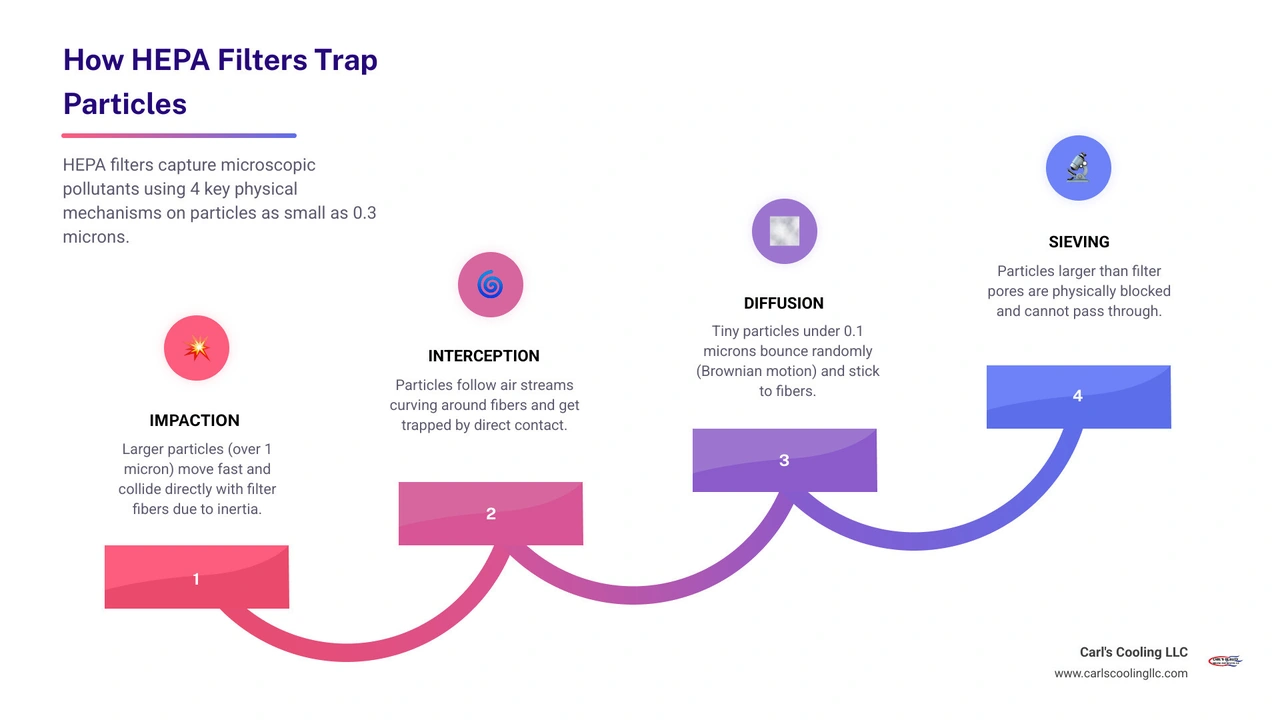
Unlike a fishing net that just catches things too big to fit through the holes, HEPA filters use three clever scientific methods:
- Interception: Mid-sized particles follow the air stream but get snagged when they brush against a fiber.
- Impaction: Larger particles are too heavy to follow the air's curves, so they crash directly into the fibers and get stuck.
- Diffusion: The smallest, tiniest particles (like viruses) bounce around erratically (Brownian motion). This zigzagging makes them much more likely to eventually hit and stick to a fiber.
Because of this design, HEPA filters are actually most efficient at capturing both very large and very small particles. The 0.3-micron size is actually the hardest size to catch, which is why it’s used as the benchmark for testing. For more on how this impacts your home, check out our guide on Indoor Air Quality or see our Common Questions About Media Air Filters.
The Top HEPA Filtration System Benefits for Homeowners
When we talk about the hepa filtration system benefits for homeowners, we aren't just talking about a cleaner-looking house. We’re talking about a fundamental shift in your living environment. In Texas areas like The Woodlands or Spring, where we deal with high humidity and heavy pollen counts, a standard furnace filter often isn't enough to keep the "tiny terrors" at bay.
The most significant benefit is the massive reduction in airborne pollutants. Research shows that people spend nearly 90% of their time indoors, where exposure to pollutants can be significantly higher than outdoors. By installing a HEPA system, you are creating a sanctuary. This is especially vital for the 25 million Americans living with asthma and the 50 million who suffer from allergies. Reducing the "particle load" in your home means your immune system doesn't have to work overtime just because you're sitting in your living room. You can learn more about this in our article on how to Enhance Well-Being with Home Air Quality and our deep dive into Indoor Air Quality Ensuring Health.
Improving Respiratory Health and Allergy Relief
For many of our neighbors in Montgomery and Willis, "allergy season" feels like it lasts all year. HEPA filters are the gold standard for Allergy Season Indoor Air Quality. They are incredibly effective at capturing:
- Pollen: Those yellow dust clouds don't stand a chance.
- Dust Mites: HEPA traps the microscopic waste these pests leave behind.
- Mold Spores: Considering that nearly 50% of homes have some form of mold issue, trapping spores before they land and grow is a huge win.
By removing these triggers, homeowners often report fewer sinus headaches, less nighttime coughing, and a generally better night's sleep. To take control of your environment, read about how to Tackle Indoor Air Pollution in Homes.
Maximizing HEPA Filtration System Benefits for Homeowners with Pets
We love our furry family members, but they are walking "pollutant factories." Between pet dander (microscopic skin flakes) and airborne fur particles, pets can quickly degrade indoor air quality. Standard filters often let dander pass right through because it is so small and light.
A HEPA Filtration System is specifically designed to catch these microscopic irritants. Additionally, while HEPA filters primarily target particles, many residential systems include a carbon pre-filter that helps neutralize pet odors, keeping your home smelling fresh even if you have multiple dogs or cats.
Choosing the Right System: CADR, MERV, and Room Size
Not all air cleaners are created equal. If you're looking for the best hepa filtration system benefits for homeowners, you need to understand the "alphabet soup" of ratings.
- CADR (Clean Air Delivery Rate): This tells you how quickly the unit can clean the air in a specific room size. A higher CADR means faster cleaning.
- MERV (Minimum Efficiency Reporting Value): This is usually used for HVAC filters. While a standard filter might be MERV 8, and a high-efficiency one might be MERV 13, a true HEPA filter is essentially off the charts, performing better than a MERV 16.
- Room Size: A portable HEPA unit built for a small bedroom won't do much in a large open-concept living room in Woodforest. You need to match the square footage to the machine's capacity.
Homeowners generally choose between portable units and whole-house systems. Portable units are great for targeted areas, but a whole-house system integrated into your HVAC provides consistent protection in every room. Explore our Indoor Air Quality Products or read the Ultimate Conroe Air Purification Guide to see which fits your lifestyle.
Key Considerations for HEPA Filtration System Benefits for Homeowners
One thing we always tell our clients in Magnolia and Tomball is to check system compatibility. Because HEPA filters are so dense, they can be harder for some older HVAC fans to "breathe" through. This is called static pressure. If you just slap a HEPA filter into a system not designed for it, you might restrict airflow and cause the AC to freeze up.
This is why professional installation is key. Often, we install a "bypass" system that allows your HVAC to work efficiently while still pulling a portion of the air through a medical-grade HEPA filter. Proper Ventilation ensures your home stays pressurized correctly while the air stays clean.
Installation and Maintenance: Keeping Your Air Clean
A HEPA filter is only as good as its maintenance. Because they are so efficient at catching "tiny terrors," they will eventually get full. Most HEPA filters in residential systems last between 2 to 3 years, but the pre-filters (the ones that catch the big dust bunnies) need to be changed or cleaned every 60 to 90 days.
Neglecting these changes can lead to "air bypass," where the air finds a gap around the filter because it’s too hard to go through it. This defeats the whole purpose! Keeping a Healthy Duct System Healthy Indoor Air Quality involves regular inspections to ensure seals are tight and filters are fresh.
Limitations and Comparisons: HEPA vs. Other Technologies
It is important to be honest: HEPA filters are amazing at catching particles, but they have limits.
| Technology | Best For | Limitations |
|---|---|---|
| HEPA Filter | Dust, Pollen, Dander, Mold Spores | Does not stop gases or VOCs on its own |
| Activated Carbon | Odors, Smoke, Chemicals (VOCs) | Does not catch dust or allergens well |
| Ionizers | Making particles clump together | Can produce harmful ozone; particles fall on furniture |
| UV Lights | Killing bacteria and viruses on coils | Doesn't "filter" the air of dust or debris |
To get the most comprehensive protection, many homeowners in Humble and Houston choose multi-stage systems. For example, Air Purifiers Against Winter Viruses often combine HEPA with UV light or carbon. You might also want to look into Why You Need an Aerus Air Scrubber, which uses active technology to clean surfaces as well as the air.
Frequently Asked Questions about HEPA Filtration
Can HEPA filters remove household odors and smoke?
By themselves, HEPA filters trap the particles in smoke (the stuff you see), but they don't trap the smell (the gas). To get rid of odors from cooking, pets, or smoke, you need a system that includes an activated carbon layer. Most high-quality residential HEPA systems we install include this.
Do HEPA filters produce harmful ozone?
No. True HEPA filtration is a purely mechanical process. It just uses fibers to catch "stuff." Unlike some electronic air cleaners or ionizers, HEPA filters do not produce ozone, which is a known lung irritant. This makes them the safest choice for people with sensitive respiratory systems.
How do I know if my HVAC system can handle a HEPA filter?
This requires a professional assessment of your system's "static pressure." If your fan isn't strong enough to pull air through a dense HEPA filter, we can often install a bypass HEPA system. This allows your main AC to run normally while a separate small fan pulls air through the HEPA filter and feeds it back into your ducts.
Conclusion
At Carl's Cooling LLC, we’ve seen how the right filtration can change a family's life. Whether you are in Conroe, The Woodlands, or any of our surrounding Montgomery County communities, you deserve to feel safe in your own home. We are a family-owned business, and we treat your home’s air quality with the same care we give our own.
If you’re ready to stop breathing in those "tiny terrors" and start enjoying the full range of hepa filtration system benefits for homeowners, we’re here to help. From professional assessments to expert installation, our team is dedicated to your comfort and health. Contact us today to learn more about our Indoor Air Quality Services and let's get you breathing easier.