

Hearing a Hum but Feeling No Air? Stop Your AC Now
The peak of summer cooling season is the worst possible time for an air conditioning failure, but it is exactly when systems are under maximum strain. You walk outside expecting to feel a breeze of warm exhaust air from your condenser unit, but instead, you are greeted by a distinct electrical humming or buzzing without fan rotation. If you are trying to figure out what it means when your AC fan stops working but you still hear humming, the short answer is that your system is in immediate distress and needs your intervention.
When your AC fan stops working but you hear a humming noise, it usually means the motor is receiving power but cannot start. This is typically caused by a failed run capacitor or a mechanically seized fan motor. You should immediately turn off power to the unit at the thermostat or breaker to prevent severe compressor damage.
If you need immediate assistance resolving this issue, explore our HVAC and cooling services or contact our repair team right away.
Why this happens during heatwaves: This specific failure often occurs during the hottest days of the year. When outdoor temperatures soar, your air conditioner runs in longer, more frequent cycles. This continuous heavy load pushes electrical components to their limits. The humming noise is a warning sign that a component has crossed that limit and failed, but the electrical current is still actively trying to force the system to run. Leaving it in this state is one of the fastest ways to destroy your entire cooling system.
The Immediate Steps You Must Take
Before you begin looking for the source of the problem, you must secure the equipment. Do not wait to see if the fan will eventually start spinning on its own. It will not.
• Step 1: Go to your indoor thermostat and switch the cooling setting to "OFF."
• Step 2: Locate your electrical panel and flip the dedicated breaker for the air conditioner to the "OFF" position.
• Step 3: If your system has an outdoor disconnect box near the condenser, pull the disconnect block or flip the switch to "OFF."
• Step 4: Do not attempt to push the fan blades with your fingers or a stick while the power is on.
Why You Must Shut Off Power Immediately to Save the Compressor
Understanding why your AC fan stopped but still humming requires a basic understanding of how your outdoor unit operates. The outdoor cabinet, known as the condenser, houses two primary moving parts: the fan motor and the compressor. The compressor is the heart of your entire cooling system, responsible for pumping refrigerant through the lines. The fan's job is to pull outside air across the condenser coils to dissipate the intense heat generated by the compressor.
When you hear a humming noise, it means electrical current is still flowing to the unit. The system is actively trying to run. However, without the fan spinning, the system completely loses its ability to reject heat.
The Chain Reaction of Overheating
Leaving the system running without a functional fan creates a rapid and dangerous chain reaction. Because the heat cannot escape, the temperature and pressure inside the sealed refrigerant lines skyrocket. The compressor, which relies on the cooling effect of the returning refrigerant, begins to rapidly overheat.
• Minutes 1-15 — What is Happening Inside the Unit: Fan is stopped; compressor continues running. Heat builds up rapidly in the condenser coils. — Potential Consequence: System runs inefficiently; indoor air stops feeling cold.
• Minutes 15-30 — What is Happening Inside the Unit: Internal pressures exceed safe operating limits. The compressor begins to severely overheat. — Potential Consequence: The compressor's internal thermal overload switch may trip (if functioning correctly).
• 1 Hour+ — What is Happening Inside the Unit: Continuous thermal cycling. The compressor turns on, overheats, shuts off, and repeats. — Potential Consequence: Electrical windings inside the compressor melt, leading to catastrophic compressor burnout.
The bottom line: Failing to flip the breaker or turn the thermostat to "off" can turn a relatively simple and affordable component failure (like a bad capacitor) into a catastrophic compressor burnout. Replacing a compressor is often so expensive that it requires replacing the entire outdoor unit.
Culprit 1: A Failed Start or Run Capacitor
Once the power is safely disconnected, a professional can begin diagnosing the root cause. One of the most frequent causes of sudden HVAC breakdowns is a failed capacitor. To understand why this causes a distinct electrical humming or buzzing without fan rotation, you have to understand what a capacitor does.
Think of a capacitor as a large, powerful battery that stores electrical energy. When your thermostat calls for cooling, the fan motor requires a massive initial jolt of energy to start spinning—much more energy than your home's standard electrical wiring can provide all at once. The capacitor delivers this high-voltage kick to get the heavy fan blades moving. Once the motor is running, a "run capacitor" provides a steady, continuous supply of power to keep it spinning smoothly.
When a capacitor fails, the motor receives standard voltage from the electrical grid, but it lacks the necessary torque to actually start spinning. The electricity hits the motor, creating a strong magnetic field, but nothing moves. That magnetic field vibrating against the stationary metal components is exactly what causes the loud humming sound.
How Heat Destroys Capacitors
During peak cooling seasons, continuous heavy loads take a toll on these electrical components. Capacitors are filled with a dielectric fluid that helps regulate their internal temperature. When the system runs constantly during a heatwave, this fluid breaks down rapidly. The internal pressure of the capacitor builds up until the component physically fails, often bulging at the top or leaking fluid.
It is worth noting that this symptom—a humming outdoor unit with no fan movement—is very specific to air conditioners. If you have a different type of system, you might experience different symptoms. For example, you might encounter a scenario where you have a heat pump fan spinning but compressor silent, which points to an entirely different set of diagnostic steps.
Signs Your Capacitor Has Failed
While only a licensed professional should test or replace a capacitor, homeowners can sometimes spot visual indicators of failure. If you look down through the top grill of your outdoor unit (with the power completely OFF), you might notice:
• Visual bulging: The top of the cylindrical capacitor looks swollen or domed, like a piece of popcorn ready to burst.
• Leaking fluid: An oily residue is visible on or around the capacitor housing.
• Rust and corrosion: Heavy rust on the electrical terminals indicating long-term wear and moisture damage.
• Short cycling sounds: The system tries to start, hums loudly for a few seconds, and then clicks off repeatedly.
Culprit 2: A Mechanically Seized Fan Motor
If the capacitor is functioning perfectly, the second primary diagnostic fork points to a mechanical failure of the fan motor itself. In this scenario, the AC fan stopped but still humming because the motor is physically locked up.
Fan motors endure harsh outdoor conditions year-round. They are exposed to rain, snow, dust, pollen, and extreme temperatures. Inside the motor, specialized bearings allow the central shaft to spin with minimal friction. Over time, the lubrication inside these bearings dries out, or dirt and debris bypass the seals and contaminate the housing.
When the bearings wear out or lose lubrication, the friction increases dramatically. Eventually, the metal components grind against each other until the motor locks up entirely. When the thermostat signals the unit to turn on, the capacitor delivers its jolt of electricity, but the frozen mechanism simply cannot turn. The humming you hear is the sound of electricity trying desperately to force a seized mechanism to move.
How a Seized Motor Differs from a Bad Capacitor
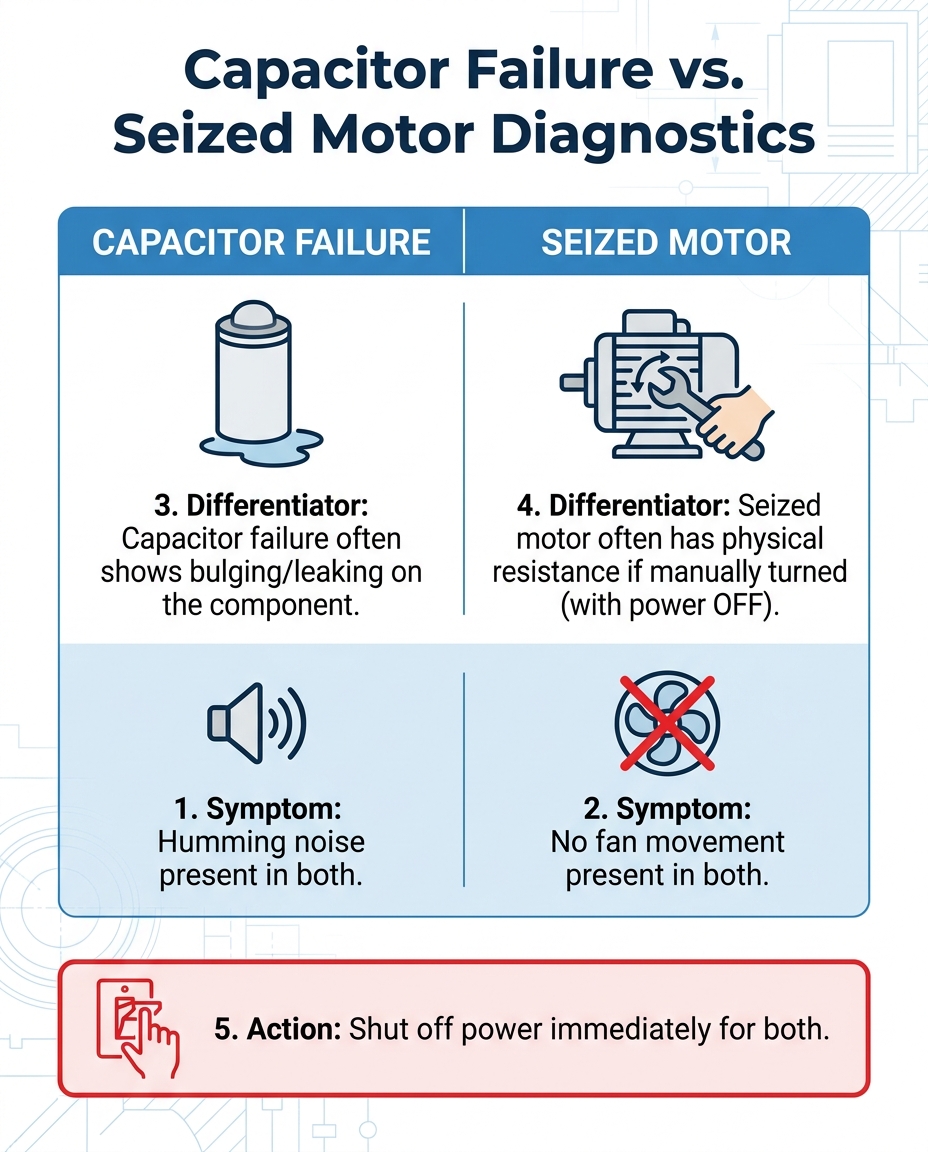
To an untrained ear, a bad capacitor and a seized motor sound identical—both produce a loud electrical hum. However, the physical state of the equipment is entirely different.
• The Capacitor Scenario: The motor is perfectly healthy, but it is being starved of the startup energy it needs. If you were to push the fan blades with a stick (which you should never do while power is on), they would spin freely because there is no mechanical resistance.
• The Seized Motor Scenario: The motor is receiving plenty of power, but it is physically jammed. Even with the power off, the fan blades would be incredibly stiff or impossible to turn by hand.
Lack of routine maintenance is the leading contributor to motor seizure. Regular tune-ups ensure that debris is cleared away from the motor housing and that systems are operating within safe friction tolerances.
Understanding 'Locked Rotor Amps' (LRA) and the Humming Sound
To truly grasp why a distinct electrical humming or buzzing without fan rotation is such an urgent warning sign, it helps to understand a concept known in the HVAC industry as "Locked Rotor Amps" or LRA.
Every electrical motor has two different amperage ratings: Running Load Amps (RLA) and Locked Rotor Amps (LRA). Amperage is simply a measurement of how much electrical current the motor pulls to do its job.
• Running Load Amps (RLA): This is the moderate, steady amount of electricity the motor uses while it is spinning normally and keeping your house cool.
• Locked Rotor Amps (LRA): This is the massive, surging amount of electricity the motor demands for a fraction of a second just to break inertia and start spinning.
When your AC fan is unable to spin—whether because of a dead capacitor or a seized bearing—the motor gets stuck in the startup phase. It continuously pulls Locked Rotor Amps from your home's electrical grid. Because the motor isn't spinning, that massive influx of electrical energy has nowhere to go. It instantly converts into extreme heat.
What Exactly is the Humming Noise?
The humming sound you hear is not just a general noise; it is a physical vibration. Inside the motor are coils of copper wire called windings. When the motor pulls Locked Rotor Amps but cannot turn, the intense magnetic field causes these copper windings to vibrate violently against the steel core of the motor.
This extreme electrical stress generates heat so rapidly that it can melt the protective insulation coating the copper wires. Once that insulation melts, the wires touch each other, creating an electrical short. This is why shutting off the power is not just a suggestion—it is the only way to stop the LRA from melting your motor's internal wiring and causing an electrical fire hazard.
Why Capacitor and Motor Diagnostics Require a Pro (No DIY)
When you discover your AC fan stopped but still humming, the temptation to search for a quick DIY fix is strong. However, diagnosing and repairing the outdoor condenser unit is strictly professional territory due to the severe risks of electrocution and permanent equipment damage.
We believe in providing honest, transparent diagnostic logic to empower homeowners. We want you to understand exactly what our technicians are doing and why they are doing it, so you have complete peace of mind when we recommend a repair.
The Danger of Stored Voltage
The primary reason you must never attempt to replace a capacitor yourself is that capacitors store lethal amounts of voltage. Even after you have flipped the breaker and completely disconnected power to the air conditioner, a capacitor can hold a high-voltage charge for days. Touching the wrong terminals can result in a severe or fatal electrical shock.
Our technicians use specialized, insulated tools to safely discharge the capacitor before ever touching it. Once discharged, they use professional multimeters to test the microfarad readings. A microfarad is the unit of measurement for electrical capacitance. If the capacitor is rated for 45 microfarads but tests at 12, our technician knows definitively that the component has failed and must be replaced.
The Complexity of Motor Replacement
If the diagnostic process reveals a seized motor, replacing it is not as simple as swapping a part. A technician must carefully match the new motor to the specific requirements of your system, including:
• Horsepower (HP): Ensuring the motor has the exact strength required to turn the specific fan blade.
• Revolutions Per Minute (RPM): Matching the speed so the system moves the correct volume of air over the condenser coils.
• Frame size and mounting: Ensuring the motor fits securely in the cabinet to prevent severe vibration.
• Capacitor pairing: A new motor almost always requires a new, precisely matched capacitor to ensure it receives the correct startup voltage.
Professional diagnostics ensure that the root cause of the humming is properly identified and fixed, rather than just treating a symptom and hoping for the best.
Frequently Asked Questions About Humming AC Units
When dealing with a distinct electrical humming or buzzing without fan rotation, homeowners often have immediate, pressing questions. Here are the most common queries answered directly.
Why is my outside AC unit humming but the fan isn't turning?
When your outside AC unit hums but the fan isn't turning, it means the system is receiving electrical power but lacks the ability to spin. This is almost always caused by a failed start/run capacitor that cannot provide the necessary startup jolt, or a mechanically seized fan motor that is physically stuck.
Should I turn off my AC if it's humming?
Yes, you must turn off your AC immediately if it is humming without the fan spinning. Leaving the system running prevents it from dissipating heat, which will cause the compressor to rapidly overheat. Shutting off the power at the thermostat or breaker prevents catastrophic, expensive secondary damage to the compressor.
Can a bad capacitor cause a humming noise?
Yes, a bad capacitor is the most common cause of a humming noise in an AC unit. The capacitor acts as a battery to start the fan motor. When it fails, the motor receives standard voltage but no startup torque. The resulting magnetic vibration creates a loud humming or buzzing sound.
What happens if the AC fan stops spinning?
If the AC fan stops spinning, the outdoor unit loses its ability to pull air across the condenser coils. Without airflow, the intense heat generated by the compressor cannot escape. The internal temperatures and pressures will spike rapidly, leading to system inefficiency, thermal overload, and eventually, total compressor failure.
How long can an AC run with a broken fan before the compressor dies?
An AC should never be allowed to run with a broken fan for any length of time. While a compressor might survive a few minutes before its internal thermal overload switch trips, repeated thermal cycling over an hour or more will melt the internal electrical windings, permanently destroying the compressor.
Is a humming AC unit dangerous?
A humming AC unit can be dangerous to the equipment and poses an electrical hazard. The humming indicates the motor is pulling "Locked Rotor Amps," generating massive amounts of heat. If left running, this can melt internal wiring, create electrical shorts, and potentially cause electrical fires within the unit's housing.
Get Expert Help for Your Humming AC Unit Today
Walking outside to find your AC fan stopped but still humming is a stressful experience, especially during the heat of summer. However, by acting quickly and shutting off the power at the thermostat or breaker, you have already taken the most important step to protect your investment and prevent catastrophic compressor damage.
Whether the issue stems from a simple, affordable capacitor swap or requires a full motor replacement, proper diagnostics and safe electrical handling require professional expertise. Do not risk your safety or your system's longevity by ignoring the problem or attempting a DIY fix. Reach out to our team for a transparent, accurate diagnostic assessment, and contact our repair team today to restore your home's cooling safely and effectively.