
Why Finding the Best Air Filter for Your Home Matters More Than You Think
Finding the best air filter for your home is one of the simplest ways to protect your family's health and keep your HVAC system running smoothly. According to the EPA, indoor air can carry pollutants at concentrations two to five times higher than outdoor air — and your air filter is your first line of defense against that buildup.
Not all filters are created equal. The right choice depends on your household's specific needs, your HVAC system's design, and how often you're willing to swap filters out.
Here's a quick look at the top filter options by home situation:
| Home Situation | Recommended Filter Type | Minimum MERV Rating |
|---|---|---|
| Most households | 1-inch pleated filter | MERV 8-11 |
| Allergies or asthma | Media cabinet filter | MERV 11-13 |
| Pets and heavy shedding | Pleated + frequent changes | MERV 8-11 |
| Wildfire smoke or fine particles | Thick media or HEPA room unit | MERV 13 |
| Odors and VOCs | Carbon-layer filter | MERV 8+ with carbon stage |
| Budget-conscious households | Standard pleated, bought in bulk | MERV 8 |
Whether you're dealing with allergy season, pet dander, or smoky air from outdoor events, picking the right filter — and replacing it on schedule — makes a real difference in how clean and comfortable your home feels.
Read on for a full breakdown of every filter type, rating system, sizing consideration, and replacement schedule you need to know.
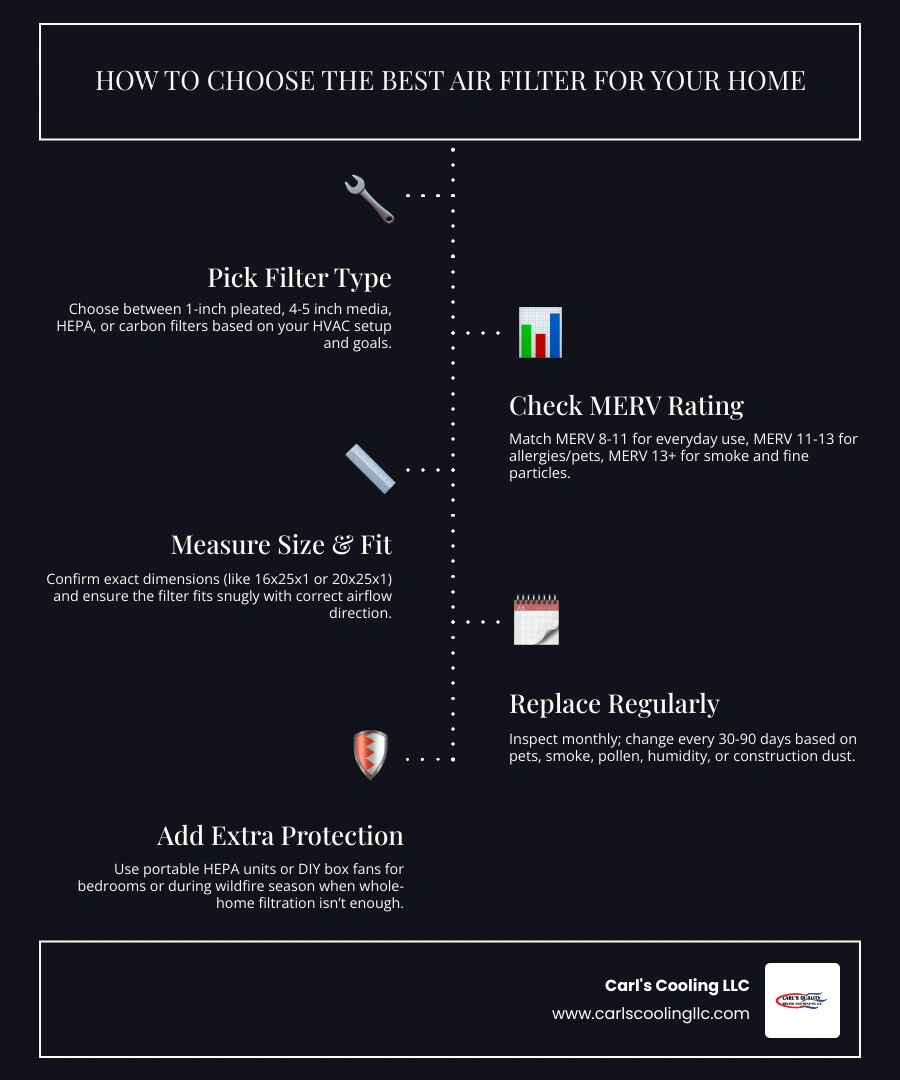
Best Air Filter for Your Home: Start With the Right Filter Type
When we talk about the best air filter for your home, we aren't just talking about a single product. There are several categories of filters designed for different HVAC setups and air quality goals. Understanding the physical construction of these filters is the first step in making a smart purchase.
The most common types include:
- 1-Inch Pleated Filters: These are the standard filters found in most retail stores. They use folded media to increase surface area, allowing them to trap more dust than old-school fiberglass filters without immediately choking off airflow.
- Media Filters: These are much thicker, typically 4 to 5 inches. They require a special cabinet but offer vastly superior filtration and a longer lifespan.
- HEPA Filters: High-Efficiency Particulate Air filters are the gold standard, capable of trapping 99.97% of particles as small as 0.3 microns. However, most standard home HVAC systems cannot handle a HEPA filter directly because they are too restrictive.
- Activated Carbon Filters: These include a layer of charcoal to help neutralize odors and volatile organic compounds (VOCs) from cooking, cleaning products, or smoke.
Best air filter for your home if you have a standard HVAC return
If your filter slides into a slot in your ceiling, wall, or the side of your furnace, you likely need a 1-inch pleated filter. For these systems, the key is the "pleat." Unlike flat fiberglass filters that only stop "boulders" (large dust bunnies), pleated filters have enough surface area to catch smaller allergens like pollen and pet dander.
When buying these, ensure you have the exact size. A filter that is even a quarter-inch too small will allow "air bypass," where dirty air simply whistles around the edges of the filter, leaving your coils dirty and your air unpurified.
Media filters vs 1-inch filters
If you are looking for the absolute best air filter for your home in terms of performance and convenience, media filters are the clear winner. Because they are 4 or 5 inches thick, they have significantly more surface area than a 1-inch filter.
This depth allows them to trap more particles without creating a "wall" that stops airflow. While a 1-inch filter might need replacing every 30 to 90 days, a high-quality media filter can often last 6 to 12 months. If your current system only accepts 1-inch filters, we can often perform a retrofit to install a media cabinet. For more details, check out Common Questions About Media Air Filters.
HEPA filters, bypass systems, and when they make sense
True HEPA filtration is incredible for health, but it’s very dense. If you tried to put a HEPA filter in a standard 1-inch slot, your blower motor would likely burn out trying to pull air through it. To get HEPA-level cleaning for the whole house, we typically install a bypass system.
A bypass system pulls a portion of the air out of your main ductwork, runs it through a medical-grade HEPA filter in a separate powered cabinet, and then feeds the ultra-clean air back into the stream. This provides hospital-grade air without straining your AC. Learn more about our HEPA Filtration System options.
DIY and portable add-on options for extra particle removal
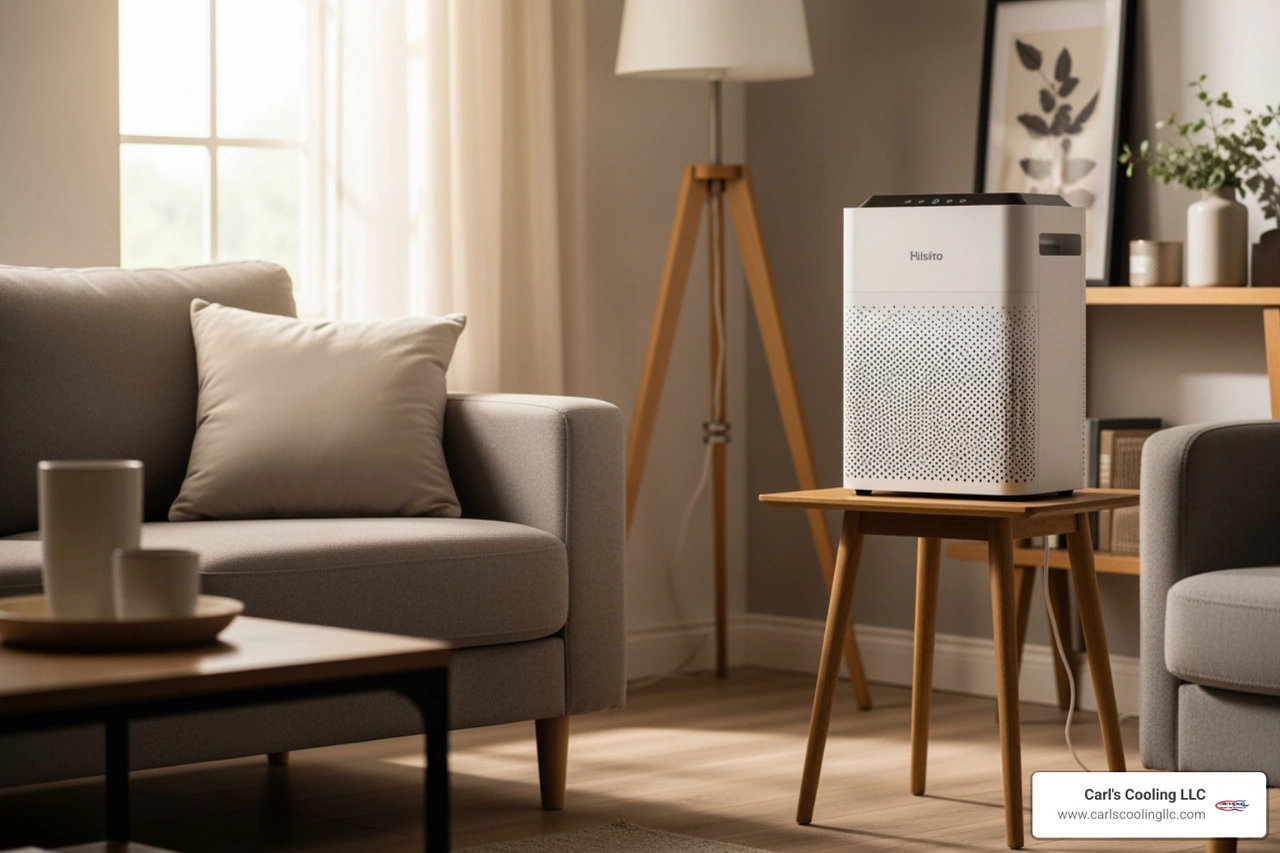
Sometimes the HVAC filter needs a little help, especially during May 2026 wildfire smoke events or peak allergy seasons in Houston and Conroe. Portable air purifiers, such as the Levoit Vital 200S or the Coway Airmega, are excellent for bedrooms.
For a budget-friendly boost, many homeowners use "Corsi-Rosenthal Boxes"—a DIY setup using a box fan and four high-MERV filters. While not a replacement for your HVAC filter, these are great for localized "scrubbing" of the air in a specific room.

Understanding Ratings: MERV, MPR, and FPR Without the Confusion
If you’ve ever stood in a hardware store aisle feeling dizzy looking at different numbers, you aren't alone. There are three main rating systems you'll encounter:
- MERV (Minimum Efficiency Reporting Value): The industry standard (ASHRAE). It scales from 1 to 20. Most homes do best with MERV 8 to 13.
- MPR (Microparticle Performance Rating): A 3M/Filtrete brand scale. Higher numbers (like 1900 or 2500) indicate better filtration of tiny particles.
- FPR (Filter Performance Rating): The Home Depot brand scale (1 to 10).
Best air filter for your home based on allergies, pets, smoke, and odors
- Allergies/Pets: Look for MERV 11. This rating is high enough to catch pet dander, mold spores, and fine dust.
- Smoke/Viruses: You’ll want MERV 13. This is the sweet spot for capturing the microscopic particles found in wildfire smoke or respiratory droplets.
- Odors: Ratings don't measure odor removal. For that, you need a filter that specifically mentions "Activated Carbon" or "Charcoal."
When a higher rating can hurt airflow
It is a common myth that a higher MERV rating is always "better." In reality, the higher the MERV, the smaller the holes in the filter. If those holes are too small for your specific HVAC system’s blower power, it creates "static pressure."
This is like trying to breathe through a thick wool blanket. It makes your system work harder, increases energy bills, and can even cause your cooling coils to freeze up in our humid Gulf Coast climate. If you want high filtration without the airflow drop, a thicker media filter is usually the answer. We explain more about this in our guide on how to Tackle Indoor Air Pollution in Homes.
Sizing, Thickness, and Compatibility: What Most Homeowners Get Wrong
One of the most frequent calls we get in areas like The Woodlands or Spring involves systems shutting down because of the wrong filter.
What size and thickness fit most systems
Filters have two sets of dimensions: Nominal and Actual. The nominal size is what is printed in big bold letters (e.g., 20x25x1). The actual size is usually about 1/4 to 1/2 inch smaller. Always buy based on the nominal size your system is designed for.
Common sizes include:
- 16x25x1
- 20x25x1
- 20x20x1
If you force a 1-inch filter into a slot designed for a 4-inch filter, air will simply leak around it, rendering the filter useless.
When to retrofit for a thicker media filter
If you find yourself changing your 1-inch filter every 20 days because it's clogged with pet hair, or if someone in your home has severe asthma, it’s time to consider a retrofit. We can install a Whole Home Air Purification System that accommodates a 5-inch media filter. This provides much better filtration with far less resistance to airflow.
Installation mistakes that reduce performance
Even the best air filter for your home won't work if it's installed backward. Look for the arrow on the frame; it must point toward the furnace/air handler (the direction the air is moving).
Other common mistakes include:
- Leaving gaps: If the filter doesn't fit snugly, dust will bypass it.
- Ignoring the ducts: A high-end filter can't fix air that is being contaminated by dirty ductwork. If you see dust blowing out of your vents, consider the Professional Ductwork Cleaning Benefits.
- Blocked returns: Don't push a couch right up against your return air grille.
For a healthy home, ensure you have a Healthy Duct System Healthy Indoor Air Quality.
Replacement Schedule, Airflow, and Maintenance for Better Results
How often should you change your filter? The "every 90 days" rule is a general guideline, but in May 2026, real-world factors often demand a faster schedule.
How often should you change your air filter
- 1-inch filters: Check every 30 days. Replace every 30-90 days.
- Media filters (4-5 inch): Replace every 6-12 months.
- During renovations: Change weekly to catch drywall dust.
What affects replacement frequency most
Our local environment in places like Conroe and Humble plays a huge role. Factors that shorten filter life include:
- Multiple Pets: Fur and dander clog pleats quickly.
- High Occupancy: More people mean more skin cells and dust.
- Coastal Humidity: High humidity can make dust "sticky," causing it to mat on the filter surface faster.
- Heavy Runtime: During a hot Texas summer, your AC runs more, meaning more air (and dust) passes through the filter.
Smart filters vs calendar reminders
Smart filters use sensors to tell you when the pressure drops, signifying a clog. While convenient, they can be pricey. A simple recurring alert on your phone or a Professional Air Purifier Maintenance Tips checklist is usually enough. If you notice Declining Air Purifier Performance Reasons, the filter is almost always the first culprit.
Particle Filtration vs Odor Control: When You Need One or Both
The best air filter for your home for dust might be terrible for odors. Particles (pollen, dander, dust) are physical objects. Odors and VOCs are gases.
Filters for dust, pollen, pet dander, and smoke
For these, a high MERV rating (11-13) is best. These filters use electrostatically charged fibers to "grab" particles out of the air. This is crucial during Allergy Season Indoor Air Quality peaks. To get the most out of them, see our tips on Maximizing Your Air Purifier Efficiency.
Filters for cooking smells, musty odors, and VOCs
Standard filters don't stop smells. You need Activated Carbon. Carbon has millions of tiny pores that chemically bond with gas molecules. This is vital for removing "new car smell" (VOCs) from furniture or lingering kitchen odors. Proper Air Quality - Ventilation also helps move these gases out of your home.
When whole-home filtration is not enough by itself
Sometimes, a filter alone can't keep up with high levels of mold or bacteria. In these cases, we recommend an Aerus Air Scrubber. This technology goes beyond filtration to actively "seek out" and neutralize contaminants in the air and on surfaces. Learn Why You Need an Aerus Air Scrubber for that extra layer of protection. For a complete list of options, visit our Indoor Air Quality Services page.
Top Picks by Home Need: The Best Air Filter for Your Home
To make your decision easier, here are our expert recommendations for households in the Conroe and Greater Houston area:
- Best for Most Households: A MERV 8 or 11 pleated 1-inch filter. It provides a great balance of protection and airflow.
- Best for Allergies and Asthma: A 4-inch or 5-inch media filter (MERV 13). It captures the finest particles without straining your HVAC system.
- Best for Pets: A MERV 11 filter, but checked monthly. High-capacity pleated filters are better at handling the extra dander.
- Best for Wildfire Smoke: A MERV 13 filter combined with a portable HEPA room purifier in the bedroom.
- Best for Odors: A dual-stage filter with a pleated MERV 8 layer and a thick activated carbon layer.
- Best Budget Option: Buying standard MERV 8 pleated filters in bulk (packs of 6 or 12) and setting a strict 60-day replacement reminder.
Frequently Asked Questions About the Best Air Filter for Your Home
Can I use the highest-rated filter my system can physically fit?
Not necessarily. Always check your system's manual or ask a technician. Using a MERV 16 filter in a system designed for MERV 8 can lead to expensive repairs due to restricted airflow.
Is a washable filter a good alternative to disposable pleated filters?
Generally, no. Washable filters usually have very low MERV ratings (around MERV 4-5). They also must be 100% dry before being reinstalled; otherwise, you risk growing mold inside your dark, cool HVAC system.
Will a better air filter fix dust problems everywhere in the house?
A filter only cleans the air that passes through it. If you have dust on your shelves, it’s often because of "settled" dust or leaks in your return ducts that are pulling in attic insulation and dust. A filter is part of the solution, but source control and duct sealing are also required.
Conclusion
Creating a sanctuary starts with the air you breathe. By choosing the best air filter for your home—whether that's a high-performance 1-inch pleated filter or an upgraded whole-home media system—you are investing in both your health and the longevity of your HVAC equipment.
If you aren't sure which filter is right for your specific unit, or if you're interested in upgrading to a higher level of filtration, we are here to help. From Willis to The Woodlands and everywhere in between, our team specializes in Indoor Air Quality Products that keep your home fresh.
Don't let your air quality fall by the wayside. Consider joining our Maintenance Plan to ensure your filters are always fresh and your system is always efficient. Give us a call today!