
Facing a Major AC Breakdown Just Before Fall
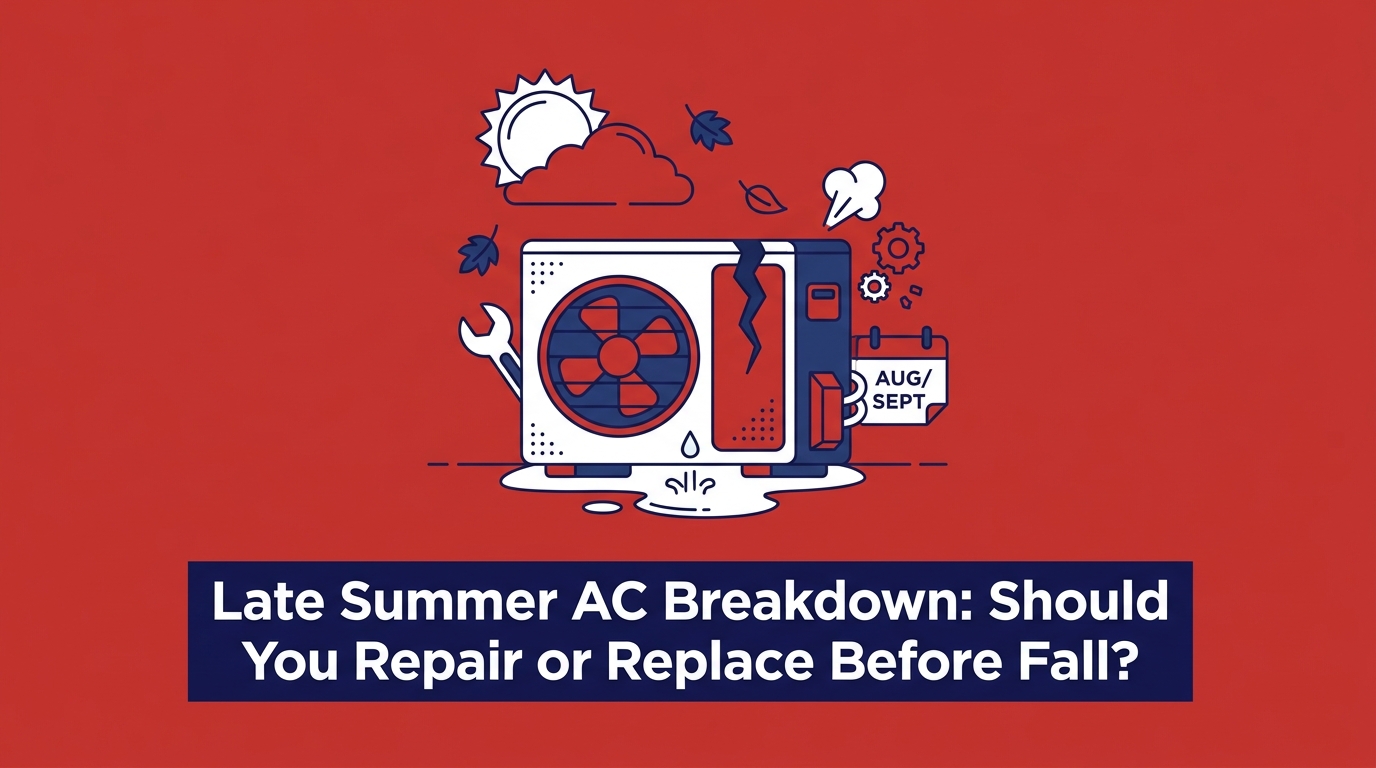
The late August back-to-school transition is officially here in Conroe, TX, and if you are dealing with a Late Summer AC Breakdown: Should You Repair or Replace Before Fall?, you know the struggle well. Your air conditioner has been running nonstop for months, and losing cooling power during some of the most intense heat of the year is incredibly frustrating. When your system suddenly shuts down or stops blowing cold air right as the kids head back to class, you are immediately forced into a tough dilemma. Do you sink money into a major repair right now just to restore your comfort, or do you hold off, save that money, and invest in a full system replacement?
Making an informed decision requires looking beyond the immediate discomfort of a hot house. You need to consider the long-term financial health of your household and the overall lifespan of your equipment. In our experience, the best way to get clarity is to rely on professional HVAC services to accurately assess the internal damage. By bringing in our expert technicians who handle comprehensive AC repair and replacement services, you get the objective facts you need to make the right choice for your home and your budget.
Why Late Summer Puts Maximum Strain on Aging AC Units
Our technicians can tell you it is no coincidence that so many air conditioners fail in August. By the time the late summer rolls around, your system has endured months of continuous operation. In a subtropical climate like Conroe TX, the environment itself is working against your equipment. The combination of intense, baking heat and heavy moisture in the air creates the perfect storm for mechanical failure.
1. Relentless Cooling Cycles: To combat severe heat, your system has to run in much longer cooling cycles. This constant operation gives the internal motors and compressors very little time to cool down, leading to accelerated wear and tear.
2. High Humidity Hurdles: Air conditioners do more than just lower the temperature; they also dehumidify the air. High humidity forces the system to work overtime to pull moisture out of your home before it can even begin to effectively cool the space.
3. Component Fatigue: Parts that were already weakening in May or June finally reach their breaking point. Failing components, such as aging capacitors, contactors, or blower motors, often give out entirely under this maximum seasonal load.
During the intense Texas heat, our team recently helped a local homeowner who dealt with a faulty AC unit that simply couldn't keep up with the weather. We serviced the system and performed the necessary work correctly and at a fair price, but this situation is a stark reminder of what this climate does to aging equipment. The strain is constant, and older units are the most vulnerable.
The Compounding Effect of Texas Heat
We consistently find that the true danger to your system is the compounding effect of the weather. Continuous operation degrades aging capacitors and stresses blower motors day after day. Furthermore, the lack of recovery time during warm nights accelerates component failure. When the temperature barely drops after the sun goes down, your air conditioner never truly gets to rest, pushing older parts past their operational limits.
Evaluating the Conceptual Math of a Major AC Repair
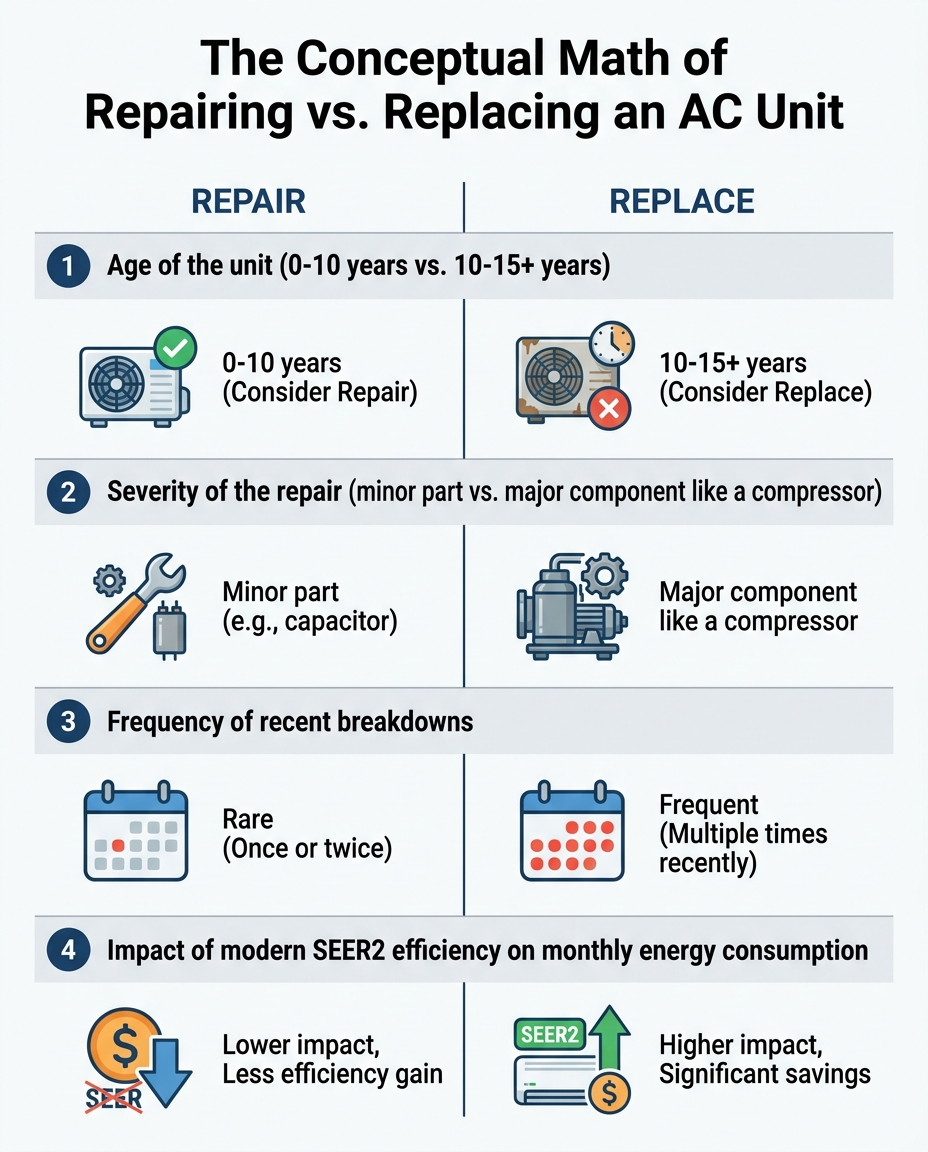
When one of our technicians hands you an estimate for a major repair during the late August back-to-school transition, you need a reliable way to decide if the investment is worth it. Industry professionals often use a conceptual formula: multiply the age of the unit in years by the severity of the repair. If the resulting calculation is excessively high, fixing the unit is likely a poor financial decision.
Older units—especially those in the 10 to 15-year range—often do not justify the investment of replacing a major component like a compressor or an evaporator coil. You must also factor in the frequency of recent repairs. If you have already paid for multiple service calls with us this season, sinking more funds into an obsolete system yields diminishing returns. As a veteran-owned company, our team at Carl's Quality Cooling and Heating LLC applies the same level of discipline, straight-shooting honesty, and accountability that military service demands. We provide objective advice on whether a repair is truly worth your investment, ensuring you do not throw good money after bad.
When a Repair is Just a Band-Aid
In our daily service calls, we emphasize how vital it is to identify the signs of systemic failure versus isolated part issues. An isolated issue, like a blown dual capacitor, is an easy fix. However, a failing compressor often indicates systemic wear. There is a serious risk of a domino effect where installing one brand-new, high-pressure part stresses the surrounding old, brittle components, causing them to fail shortly after.

The Risks of 'Limping Along' Until the Weather Cools
Our team completely understands the temptation to apply a cheap, temporary fix just to survive until the fall. The strategy of trying to make it to the off-season sounds great in theory, but we have seen firsthand how it carries significant hidden risks.
The Threat of Catastrophic Failure: When you patch up a struggling unit in Conroe TX, you run the risk of catastrophic failure leaving your home completely without cooling during peak heat. A temporary fix can fail at the worst possible moment, leaving your family sweltering.
Spiked Utility Bills: Struggling units consume significantly more energy. When your air conditioner is limping along, it runs longer cycles and draws more electricity, leading to shockingly high utility bills that drain your wallet while providing subpar comfort.
The Limits of Maintenance: While proactive care and a routine AC maintenance plan can sometimes extend a unit's life temporarily, it is not a long-term solution for a dying system. Maintenance prevents future issues; it cannot resurrect a compressor that is already failing.
Strategic Advantages of an Off-Season System Replacement
If your current unit can safely make it through the late August back-to-school transition without a massive cash injection, waiting for the fall transition can be highly beneficial. The shift to cooler weather reduces the immediate, desperate urgency for cooling, allowing you to make a calm, calculated decision.
• Scheduling — Emergency Summer Replacement: Subject to peak-season rush and limited availability. — Planned Off-Season Replacement: Flexible installation timelines that fit your schedule.
• System Options — Emergency Summer Replacement: Limited to what is currently in stock at the warehouse. — Planned Off-Season Replacement: Time to research, order, and select the exact ideal system.
• Stress Level — Emergency Summer Replacement: High stress, hot house, rushed decisions. — Planned Off-Season Replacement: Low stress, comfortable home, deliberate choices.
• Peace of Mind — Emergency Summer Replacement: Immediate relief, but a stressful process. — Planned Off-Season Replacement: Entering the next cooling season with a fully warrantied system.
We often find that off-season scheduling allows for more flexible installation timelines, meaning you will not have to take time off work at the last minute to meet an installer. You also gain the peace of mind that comes with entering the next cooling season with a reliable, fully warrantied system. Contrasting a rushed emergency installation with a carefully planned system upgrade highlights why patience pays off—if your current equipment allows for it.
How Efficiency Upgrades and Energy Rebates Change the Equation
When you are weighing a repair against a replacement, you must factor in the advancements in modern cooling technology. The recent shift to higher SEER2 efficiency standards means that brand-new units consume significantly less energy to produce the same amount of cooling. Upgrading an obsolete system can offset the initial investment over time through substantial utility savings.
Furthermore, generic state and federal energy rebates or tax credits may apply to qualifying high-efficiency systems. These incentives are designed to encourage homeowners to transition away from energy-hogging legacy units. Because these programs frequently update, we strongly advise readers to consult with our professionals to understand which generic incentives their new system might qualify for. You can learn more about navigating these opportunities by reviewing our guide on Texas energy rebates for HVAC upgrades.
Understanding SEER2 Ratings
SEER2 stands for Seasonal Energy Efficiency Ratio 2, and it represents a stricter, more accurate testing standard for modern air conditioners. When we install new systems for homeowners in Conroe TX, we explain that a higher SEER2 rating translates directly to better daily comfort and lower energy consumption. Modern units handle humidity much better than legacy systems, utilizing variable-speed technology to extract moisture from the air without overcooling the room.
Making the Final Call: When to Cut Your Losses
Eventually, every homeowner reaches a tipping point where repair costs and unit age make replacement the only logical choice. If your system is over a decade old, uses outdated refrigerant, and requires a major component replacement during the late August back-to-school transition, it is time to cut your losses.
1. Assess the Immediate Need: Determine if the house is safe and comfortable. Just last season, our team responded to a local family whose air conditioner went out on a holiday weekend during extreme summer heat. We came out quickly, assessed the need for a new unit, and installed it the next morning, providing immediate relief from the dangerous temperatures.
2. Review the Financial Options: Reassure yourself that a sudden replacement does not have to be an unmanageable burden. The availability of flexible HVAC financing options makes immediate replacement accessible, allowing you to pay over time while enjoying high-efficiency cooling today.
3. Get a Swift Assessment: We always highlight the value of a fast, professional diagnostic when the system fails during extreme heat. Knowing exactly what is wrong prevents you from guessing and stressing.
Get Honest Advice on Your AC Repair or Replace Decision
At Carl's Quality Cooling and Heating LLC, we know every home, budget, and HVAC system is unique, meaning there is no one-size-fits-all answer to a late-summer breakdown. If you are struggling with an unreliable unit in Conroe TX, the smartest move you can make is to schedule a professional diagnostic with us to get straight-shooting, honest advice. Do not wait until a minor issue turns into a total system failure. Reach out to our team before the late-summer heat causes further damage, and let us provide the clear conceptual framework you need to make a confident decision about your Late Summer AC Breakdown: Should You Repair or Replace Before Fall?
Frequently Asked Questions
Is it cheaper to replace an AC in the fall?
Replacing your air conditioner in the fall can often provide strategic advantages and scheduling flexibility. Because the peak summer rush has ended, HVAC companies like ours generally have more open appointments, allowing for a relaxed, pressure-free installation process. Additionally, manufacturers occasionally offer off-season promotions to clear out inventory before winter.
How do I know if my AC needs replacing or just repair?
Our technicians evaluate the need for replacement by looking at the unit's age, repair history, and the severity of the current breakdown. If your system is over 10 to 15 years old and requires a major component like a compressor, replacement is usually the wiser choice. Conversely, if the unit is relatively new and only needs a minor electrical part, a simple repair is highly recommended.
Should I fix a 15-year-old AC unit?
Fixing a 15-year-old air conditioner is generally not recommended if the repair involves major internal components. At this age, the system has outlived its expected lifespan, and its internal parts are prone to cascading failures. Investing in a new, high-efficiency system will provide better reliability, stronger warranties, and lower monthly utility bills.
When is an AC repair not worth the investment?
An AC repair is not worth the investment when the cost of the fix approaches half the value of a brand-new system, especially on an aging unit. It is also unwise to keep repairing a system that breaks down multiple times a season or uses obsolete, phased-out refrigerant. In these cases, you are simply delaying an inevitable replacement while paying high energy bills.
How does high humidity affect an aging AC unit in Texas?
High humidity forces an air conditioner to work significantly harder, as it must remove thick moisture from the air before it can effectively lower the temperature. For an aging unit, this extra workload leads to longer cooling cycles, increased wear on the blower motor, and a higher risk of component failure. Older systems simply lack the efficiency to manage the heavy latent heat load found in a Texas summer.