

The Invisible Threat to Your Cooling System This August
If your air conditioner is running nonstop but your house still feels warm this August, you need to understand exactly why pine needles are the silent killer of Conroe AC units. The culprit might be hiding right inside your equipment. At Carl's Quality Cooling and Heating LLC, our team frequently responds to late-summer service calls where homeowners assume that as long as grass clippings and oak leaves are cleared away from the outside cabinet, their cooling system has plenty of airflow. Unfortunately, the unique environment of the Piney Woods presents a much more insidious threat that easily bypasses standard exterior defenses.
For comprehensive solutions, explore our air conditioning services designed to handle local environmental challenges.
During the brutal late-summer heat of August, your air conditioner is already operating at maximum capacity. Every component is stressed, and the system relies entirely on unobstructed airflow to exhaust the heat it removes from your home. This is exactly when hidden debris causes the most catastrophic damage. East Texas pine needles are incredibly fine and lightweight. They slip effortlessly through the standard condenser grilles designed to block larger yard waste, steadily building up inside the unit. Over time, these needles form a dense, suffocating mat directly against the delicate aluminum coils.
This creates a critical decision point for homeowners. You must choose between merely brushing the outside of the cabinet—a surface-level fix that ignores the internal blockage—or scheduling a deep, professional coil cleaning to extract the matted debris. Standard maintenance advice often overlooks this specific regional threat, leaving many local systems vulnerable. By the time late summer arrives, that hidden layer of pine needles can force a compressor into total thermal failure.
The Anatomy of a Pine Needle Invasion
To understand why this specific type of debris is so dangerous, you have to look at the physical mechanics of your outdoor cooling equipment. The East Texas Piney Woods ecoregion is dominated by loblolly and shortleaf pines. These magnificent trees are a beautiful part of the Conroe landscape, but they shed incredibly fine, slender needles year-round. While a broad oak leaf or a clump of wet grass will simply stick to the outside of your AC unit, our technicians have seen firsthand how a pine needle behaves very differently.
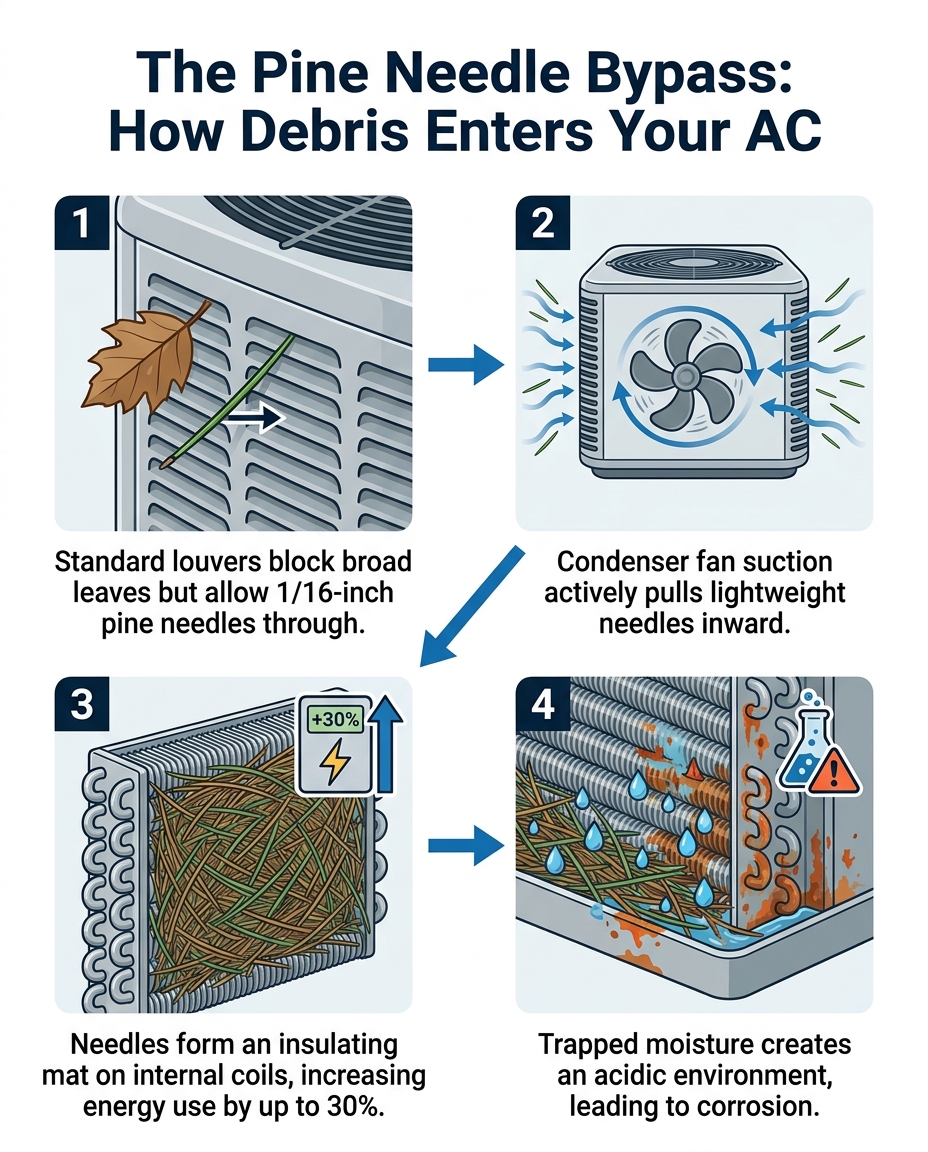
The standard louvers and grilles on an HVAC condenser cabinet are engineered with a specific mechanical purpose: to protect the internal components from large projectiles, hail, and broad yard debris. They are fundamentally flawed when it comes to defending against slender pine needles. The gaps in the metal are simply too wide to stop something that is only a fraction of an inch thick.
The Mechanics of Intrusion:
• Active Suction: Your outdoor unit contains a massive condenser fan that pulls thousands of cubic feet of air through the side grilles and exhausts it out the top. This active suction aggressively pulls lightweight pine needles right through the gaps in the louvers.
• The Trapping Effect: Once inside the cabinet, the needles are drawn directly against the tightly spaced aluminum fins of the condenser coil. Because the needles are so fine, they wedge themselves deeply between the fins.
• The Layering Process: As more needles are pulled in, they begin to weave together. They catch dust, dirt, and cottonwood seeds, eventually forming a solid, felt-like mat that blocks air from passing through the coil.
It is crucial to contrast visible yard debris with this invisible accumulation. You might look at your unit, see a clean metal exterior, and assume the system is breathing fine. Meanwhile, deep inside the cabinet in the Conroe and East Texas Piney Woods environment, a suffocating wall of pine needles is slowly cutting off your system's ability to cool your home.

How a Needle Mat Suffocates Compressor Efficiency
Your air conditioner does not actually "create" cold air; it moves heat. The primary function of the outdoor condenser coils is to take the heat that the refrigerant absorbed from inside your home and exhaust it into the outdoor air. This heat transfer requires a massive, continuous volume of fresh air moving across the bare aluminum fins. When a matted layer of pine needles covers those fins, it acts just like a thick, insulating winter blanket wrapped around a radiator.
Instead of dissipating into the atmosphere, the heat remains trapped inside the system. According to data from the Department of Energy, restricted airflow across condenser coils can increase compressor energy consumption by up to 30%. The system is forced to run longer cycles, consume more electricity, and work significantly harder just to achieve basic cooling. During the peak of late summer in August, this restriction becomes incredibly dangerous.
During a recent late-summer maintenance visit, our lead technician Issac encountered a system struggling with this exact thermal restriction. He performed a thorough inspection, documented the hidden layer of pine needles suffocating the coils, and explained the possible problems and options to the homeowner. By seeing the hidden damage firsthand, the customer was able to decide on the best course of action to save their compressor before it failed completely.
The Chain Reaction of Thermal Overload
When the condenser cannot reject heat efficiently, a destructive chain reaction begins deep inside the equipment. This is not a gradual decline; it is a compounding failure that accelerates rapidly during extreme heat.
1. Elevated Refrigerant Pressures: Because the heat cannot escape, the temperature of the refrigerant remains too high. This causes the internal pressure of the entire system to spike well beyond safe operating limits.
2. Increased Amperage Draw: The compressor—the heart of your AC system—must now pump against this abnormally high pressure. To do this, it draws significantly more electrical current (amperage), causing its internal motor windings to run dangerously hot.
3. Internal Component Degradation: As the compressor runs hotter and longer, the lubricating oil begins to break down. The risk of catastrophic compressor burnout skyrockets, turning a routine cleaning issue into a massive system replacement.
The Hidden Threat: Moisture, Acidity, and Galvanic Corrosion
While thermal overload is the most immediate danger to your compressor, pine needles introduce a secondary, highly destructive threat that most homeowners completely overlook: chemical corrosion. Pine needles are unique because they decompose very slowly compared to broad leaves. As they break down, they become highly effective at absorbing and trapping water.
The climate in Conroe plays a massive role in this destructive process. Our high summer humidity provides a constant, daily source of moisture. Every morning, dew collects on the unit, and during operation, condensation can form. The matted pine needles act like a dense sponge, soaking up this moisture and holding it directly against the metal components of your air conditioner for weeks at a time.
In our years of repairing AC systems across Montgomery County, we've found that this moist, rotting organic matter creates a highly acidic environment. When you combine acidic moisture with the dissimilar metals inside your AC unit—specifically the copper tubing and the aluminum fins—you create the perfect conditions for galvanic corrosion. The acid essentially eats away at the metal at a microscopic level. Over time, this constant chemical attack weakens the copper lines, leading to inevitable, hard-to-find refrigerant leaks that destroy the system's capacity to cool.
• Dry Oak Leaves — Moisture Retention: Low (dries quickly in sun) — Decomposition Acid Level: Mild — Corrosion Risk to Coils: Low (mostly airflow restriction)
• Grass Clippings — Moisture Retention: Moderate (mats on exterior) — Decomposition Acid Level: Moderate — Corrosion Risk to Coils: Medium (usually washes off)
• Wet Pine Needles — Moisture Retention: High (acts as a dense sponge) — Decomposition Acid Level: Highly Acidic — Corrosion Risk to Coils: Severe (accelerates galvanic corrosion)
Why Surface Sweeping and DIY Washing Fail
Homeowners in Conroe are often proactive about yard maintenance, which is excellent. Clearing a two-foot perimeter around your outdoor unit, trimming back bushes, and sweeping away loose debris are all vital steps for basic system health. However, when dealing with the specific threat of East Texas pine needles, these surface-level actions are entirely insufficient. The real danger is already inside the cabinet, beyond the reach of a broom or a leaf blower.
Before attempting any exterior washing, review the right approach to cleaning your AC unit safely. Many well-meaning homeowners attempt to solve the problem by grabbing a high-pressure garden hose and blasting water through the side grilles. This is one of the most damaging mistakes you can make.
The Dangers of DIY Washing:
• Pushing Debris Deeper: High-pressure water does not dissolve pine needles. Instead, the force of the water simply drives the fine needles deeper into the center of the coil, compacting the mat and making the blockage exponentially worse.
• Bending Delicate Fins: The aluminum fins on a condenser coil are incredibly thin—often thinner than a heavy piece of foil. A strong jet from a garden hose or a pressure washer will instantly bend and crush these fins flat, permanently blocking airflow even after the debris is gone.
• Electrical Hazards: Spraying high-volume water indiscriminately into an assembled cabinet risks forcing moisture into the electrical contactor, capacitor, or fan motor housing, potentially shorting out the system.
By late summer, the needle mat is usually so firmly wedged into the fins that no amount of exterior spraying will dislodge it. The unit must be opened to address the root cause.
The Meticulous Approach to Precision Coil Teardowns
Because pine needles weave themselves into a tight, acidic mat deep inside the fin pack, the only safe and effective way to remove them is through a professional coil teardown. This is a far cry from the "blow and go" maintenance visits offered by budget services, where a technician simply sprays the outside of the box and leaves. True restoration requires discipline, specialized tools, and a methodical approach.
At Carl's Quality Cooling and Heating LLC, working with our veteran-owned team means you're getting the same level of discipline and accountability that military service demands applied directly to your home comfort. A precision teardown begins with safely isolating the high-voltage electrical supply. From there, the technician must carefully remove the outer protective cabinet, the top fan assembly, and the protective grilles to fully expose the raw condenser coils. This process provides direct access to the interior face of the coils, where the vast majority of the pine needle matting occurs.
Once exposed, the technician uses a specialized, low-pressure chemical cleaning process. These foaming agents are specifically formulated to safely neutralize the acidic residue left by the rotting pine needles. The foam expands between the delicate fins, lifting the embedded dirt, sap, and needle fragments outward without requiring damaging high-pressure water. Finally, the system is gently rinsed from the inside out, pushing the remaining debris away from the fins rather than deeper into them.
This level of detailed work is exactly why you need professional AC repair services. A disciplined, methodical approach ensures that every panel is reassembled correctly, every screw is tightened to prevent rattling, and the system's operating pressures are calibrated to verify that full heat-exhaust capability has been restored.
Long-Term Defense Strategies for Conroe Homeowners
While you cannot change the local flora of the East Texas Piney Woods, you can implement specific strategies to defend your cooling system against the constant shedding of pine needles. The goal is to minimize the volume of debris reaching the unit while maintaining a strict schedule for professional oversight.
A pattern we see often is systems failing right when the weather shifts. One local homeowner called us out right before a severe late-summer thunderstorm when their system suddenly stopped cooling. Technician Issac diagnosed a severe airflow restriction caused by heavy seasonal pine debris, repaired the unit, and had the AC running perfectly within an hour of arrival. Catching these issues early is always better than waiting for a complete breakdown.
Effective Preventative Measures:
• Strategic Landscaping: The most effective defense is physical distance. Trim any overhanging pine branches that drop needles directly onto the top of the unit. Ensure that lawnmowers and weed trimmers are pointed away from the AC to avoid throwing loose needles into the side grilles.
• Monitor Aftermarket Mesh Screens: Some homeowners install aftermarket mesh wraps around their condensers. While these can catch pine needles, they come with a major warning: the screen itself will quickly clog and restrict airflow. If you use one, you must brush it clean every few days during peak shedding seasons.
• Check Indoor Filters Frequently: When the outdoor unit struggles to exhaust heat, the indoor blower runs longer to try and cool the house. This increased run time pulls more dust and pet dander through your indoor filter. Check and replace your indoor filters more frequently to avoid compounding the airflow restrictions.
• Establish a Consistent Cleaning Schedule: The ultimate defense is routine professional care. By enrolling in a routine maintenance plan, you ensure that a technician is actively monitoring the internal state of your coils, catching accumulation before it causes thermal overload in August.
Frequently Asked Questions About Pine Needles and AC Units
How do pine needles damage an AC condenser?
Pine needles damage an AC condenser by slipping through the outer grilles and forming a dense mat against the delicate aluminum fins. This mat acts as an insulator, trapping heat inside the system and forcing the compressor to run at dangerously high pressures. Over time, the trapped moisture in the needles also creates an acidic environment that causes the metal coils to corrode and leak refrigerant.
Why shouldn't I clean internal AC coils myself?
You should never clean internal AC coils yourself because it requires dismantling the cabinet and working around high-voltage electrical components. The aluminum fins on the coils are incredibly thin and easily crushed by improper tools, which can permanently ruin the unit's efficiency. A licensed professional has the training to safely open the system and the specialized chemicals needed to dissolve debris without damaging the metal.
Can I wash pine needles out of my AC condenser with a hose?
No, using a garden hose to wash pine needles out of your AC condenser usually makes the problem much worse. High-pressure water simply forces the fine needles deeper into the center of the coil fins, creating a tighter, more compacted blockage. To properly remove the needles, the cabinet must be opened so the coils can be safely washed from the inside out by a professional.
How do I protect my air conditioner from pine needles?
The best way to protect your air conditioner from pine needles is through strategic landscaping, such as trimming overhanging pine branches away from the unit. You can also use a breathable mesh screen, provided you commit to brushing it off every few days so it doesn't restrict airflow itself. Ultimately, scheduling a professional deep clean before the extreme late-summer heat is the most reliable protection.
Does trapped pine straw cause AC refrigerant leaks?
Yes, trapped pine straw can absolutely cause AC refrigerant leaks over time. As pine needles decompose inside the damp environment of the AC cabinet, they release acidic compounds that sit directly against the copper tubing and aluminum fins. This accelerates galvanic corrosion, eating away at the metal until microscopic holes form and the pressurized refrigerant escapes.
How often should Conroe homeowners have their AC coils professionally cleaned?
Conroe homeowners should have their AC coils professionally inspected and cleaned at least once a year, ideally in the spring before the heavy summer cooling season begins. However, if your unit is located directly under large loblolly or shortleaf pines, you may need a mid-season checkup in late summer to ensure needles haven't choked the system during peak operation.
Protect Your Compressor from the East Texas Pines
Understanding exactly how pine needles bypass your outer grille is the first and most crucial step in protecting your expensive cooling equipment. The fine, acidic debris dropping from the trees in the Piney Woods isn't just a cosmetic nuisance; it is a mechanical threat that slowly suffocates your compressor, spikes your energy bills, and rots your coils from the inside out. Knowing why East Texas pine needles are the silent killer of Conroe AC units allows you to take proactive steps before the damage is irreversible.
Surface sweeping and hosing down the exterior cabinet simply aren't enough to prevent a late-summer compressor failure. If your system has been running hard through August and you have pine trees on your property, don't wait for the unit to shut down completely. Schedule a thorough inspection and professional AC cleaning in Conroe with our team today to ensure your system can breathe freely and survive the heat.