
Why How Proper Wine Cellar Cooling Preserves Wine Quality Starts With the Right Environment
Understanding how proper wine cellar cooling preserves wine quality comes down to a few key environmental factors working together. Here's a quick breakdown:
| Factor | Ideal Range | Why It Matters |
|---|---|---|
| Temperature | 55–58°F (13–14°C) | Controls aging rate; prevents premature breakdown of flavors and aromas |
| Humidity | 60–70% RH | Keeps corks sealed and elastic; prevents oxygen from entering bottles |
| Airflow | Low-velocity, even circulation | Eliminates hot/cold spots; prevents mold and stale air pockets |
| Light exposure | Minimal or zero UV | Prevents "light strike" fault and chemical degradation |
| Vibration | As low as possible | Protects sediment and slow aging processes inside the bottle |
| Temperature stability | ±1–2°F variation | Prevents cork stress from expansion and contraction cycles |
Wine is a living product. Even after the bottle is sealed, the wine inside continues to change — slowly reacting, developing, and evolving. That process is either helped or hurt by the environment around it.
The problem is that most spaces in a home — a basement corner, a converted closet, a spare room — were never designed to hold temperature and humidity steady enough for wine. Without a proper cooling system, even a well-intentioned storage area can swing several degrees throughout the day or across seasons. And those swings add up fast.
When temperatures rise above 70°F, wine ages at a much faster rate than intended. When they fluctuate repeatedly, the wine inside the bottle expands and contracts — pushing against the cork, creating microscopic gaps, and letting small amounts of oxygen in. Over time, that oxygen exposure flattens flavors, dulls aromas, and turns a carefully chosen bottle into a disappointment.
A dedicated wine cellar cooling system solves this by maintaining the stable, controlled environment that wine needs to age properly — not just for days or weeks, but for years.
How Proper Wine Cellar Cooling Preserves Wine Quality
At its core, wine storage is chemistry. Temperature affects how quickly reactions happen inside the bottle. Oxygen exposure affects aroma and flavor development. Humidity affects the cork. Air movement affects consistency throughout the room. Put simply, the cellar environment decides whether wine matures gracefully or gets old before its time.
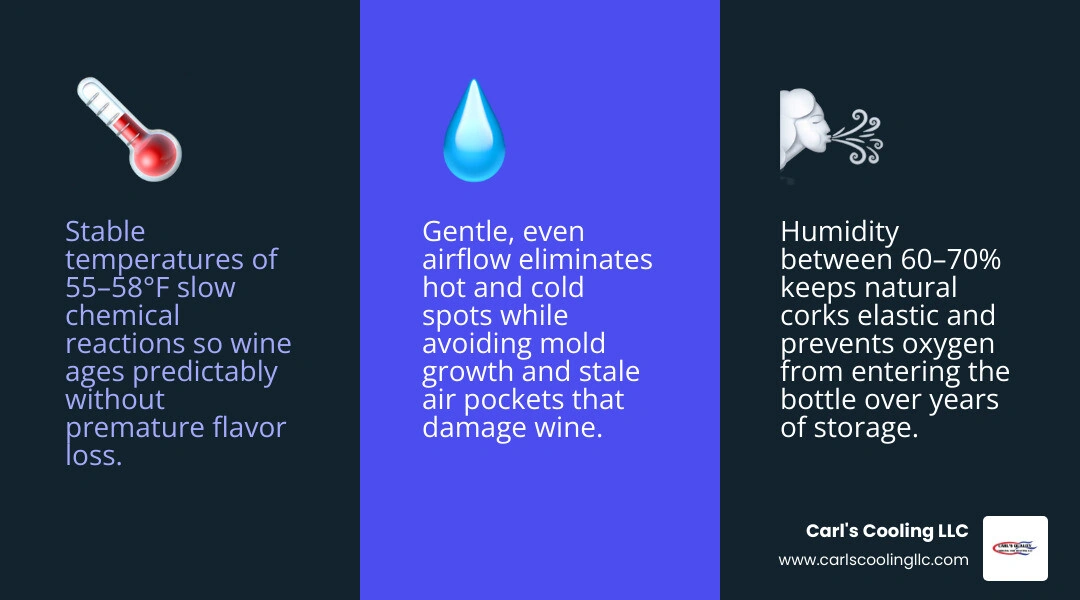
For most mixed collections, 55°F is the classic target because it supports slow, predictable aging. A stable range of roughly 50°F to 59°F can still work well, but consistency matters more than chasing the perfect number. If you want a deeper look at why swings are so damaging, our guide on temperature fluctuations in wine cellars explains the problem in more detail.
Why temperature control is the foundation of wine preservation
Heat speeds up wine aging. That sounds harmless until you realize accelerated aging is not the same as good aging. Wine stored above 70°F can lose delicate aromas, flatten in flavor, and develop tired, cooked notes much earlier than expected.
Repeated temperature changes are just as harmful. As wine warms, it expands. As it cools, it contracts. That movement creates pressure against the cork and can slowly weaken the seal. Once that happens, oxygen has an easier path into the bottle. And oxygen is great for a campfire, but not for your Cabernet.
For long-term storage, a dedicated cellar system is designed to hold a narrow range, usually around 55°F to 58°F, with minimal variation. That steady environment protects structure, aroma, color, and aging potential.
How proper wine cellar cooling preserves wine quality through long-term stability
This is where stability beats perfection. A cellar that stays close to 58°F year-round will usually protect wine better than one that bounces between 52°F and 60°F.
Purpose-built wine cellar cooling units are designed to maintain conditions tightly, often within about ±1 to 2°F. That matters because tiny repeated fluctuations, sometimes called microfluctuations, can still stress corks and create uneven aging over time.
Stable cooling also helps preserve collector value. Whether your bottles are everyday drinkers or long-term hold wines, predictable storage conditions reduce the risk of oxidation, seepage, label damage, and surprise disappointment on opening day.
Ideal temperature and humidity ranges for mixed collections
For most homeowners storing a mix of reds, whites, rosés, and sparkling wines for aging rather than service, these targets work well:
- Temperature: 55°F to 58°F ideal
- Acceptable stable range: 50°F to 59°F
- Humidity: 60% to 70% relative humidity
Natural cork bottles should be stored horizontally so the wine keeps the inside face of the cork moist. But that alone is not enough. The outer side of the cork still depends on cellar humidity to stay elastic and sealed.
Humidity, Airflow, and Ventilation: The Overlooked Protectors of Your Collection
Temperature gets most of the attention, but humidity and airflow do a lot of quiet work in the background. Ignore them, and your cellar can develop dry corks, musty odors, mold growth, stale air pockets, or uneven conditions from one rack to the next.
For practical upkeep ideas, see our year-round wine cellar cooling tips.
How humidity management protects corks and prevents oxidation
Humidity between 60% and 70% helps corks stay slightly expanded and flexible. When the air gets too dry, corks can shrink. Even minor shrinkage can allow oxygen into the bottle, which speeds spoilage and dulls the wine's intended character.
Too much humidity causes a different set of problems. Persistent moisture can encourage mold, mildew, and label damage. So the goal is balance, not tropical rainforest.
A simple hygrometer helps monitor conditions. If your cellar routinely drops below 60% RH, you may need humidity support or envelope improvements to keep moisture from escaping.
How proper wine cellar cooling preserves wine quality with balanced airflow
Good airflow is gentle, not gusty. You want low-velocity circulation that keeps temperature and humidity even throughout the cellar without blowing directly on bottles or corks.
Balanced airflow helps by:
- Reducing hot spots near ceilings, glass, or exterior walls
- Preventing damp corners and humidity pockets
- Moving stale air out of dead zones
- Supporting more even cooling system performance
This is especially important in larger rooms, glass-front displays, and cellars with dense racking where air can get trapped.
Passive vs active ventilation for different cellar types
Passive ventilation relies on natural air movement through vents or openings. It can work in very small, lightly loaded cellar spaces where temperature demands are modest and the room is not tightly sealed.
Active ventilation uses fans or system-driven air movement to control airflow more predictably. This is usually the better choice for sealed wine rooms, finished interiors, basement conversions, or any cellar using mechanical cooling.
In practical terms:
- Passive ventilation may suit small closet cellars with careful design
- Active ventilation is usually better for larger or fully enclosed cellars
- Door vents or ceiling vents can help relieve trapped air in some layouts
- Ducting kits can help route excess heat away from the cooling unit
The right approach depends on cellar size, insulation, heat load, and how tightly the space is built.
What happens when ventilation is too low or too high
Too little ventilation can lead to:
- Musty odors
- Mold and mildew
- Warm equipment areas
- Uneven room conditions
- Overworked cooling units
Too much ventilation can lead to:
- Dry air that shrinks corks
- Unwanted odor infiltration from garages, kitchens, or storage areas
- Label damage from excess air movement
- Reduced humidity control
Wine breathes through the cork over time, so the air in the cellar matters. You want fresh, clean, neutral air, not a cellar that smells like paint cans, lawn equipment, or last night's fajitas.
Choosing the Right Cooling System for Your Cellar Design
Not every wine cellar needs the same type of cooling setup. The right system depends on room size, how finished the space is, where heat can be rejected, how much noise you can tolerate, and whether the equipment needs to stay hidden.
For more local guidance, visit our Wine Cellar Cooling Conroe Guide and Custom Wine Cellar Cooling Conroe Tips.
| System type | Best for | Noise | Installation | Performance notes |
|---|---|---|---|---|
| Through-the-wall | Small to mid-size cellars | Moderate | Simpler | Direct, effective, needs proper exhaust space |
| Split system | Finished cellars, quieter interiors | Low inside cellar | More complex | Flexible placement, precise control |
| Ducted system | Large or showpiece cellars | Very low in cellar | Most complex | Hidden equipment, even airflow, strong aesthetic integration |
Through-the-wall systems: simple installation for smaller spaces
Through-the-wall units are self-contained systems installed directly into or through a wall. They can be a solid option for compact cellars and straightforward layouts.
Their biggest strengths are simplicity and direct cooling. But they do need somewhere for the rejected heat to go. If the exhaust side does not have adequate ventilation or clearance, performance can suffer quickly. Noise is usually more noticeable than with split or ducted designs since the mechanical components are closer to the cellar.
Split systems: quieter operation with flexible placement
Split systems separate the evaporator inside the cellar from the condenser outside the room. That means quieter cellar operation and more flexibility in finished spaces where appearance matters.
These systems are often a smart fit for homeowners who want better noise control, cleaner aesthetics, and more installation options. Because components are separated, professional design and installation become more important, especially for refrigerant line routing and system sizing.
Ducted systems: hidden equipment for larger or showpiece cellars
Ducted systems are often chosen when the goal is invisible climate control. Equipment can be placed away from the cellar while supply and return air move through ducts and discreet grilles.
They work especially well in:
- Larger wine rooms
- High-end display cellars
- Glass-enclosed designs
- Spaces where equipment visibility would disrupt the look
They also help distribute air more evenly, though long duct runs and layout details need to be planned carefully.
When system sizing and layout matter more than unit type
A perfectly good system can still fail if it is the wrong size or installed in the wrong layout. Sizing depends on more than room dimensions. It should account for:
- Cellar volume
- Insulation quality
- Vapor barrier quality
- Glass area
- Door opening frequency
- Lighting heat
- Exterior wall exposure
- Bottle density and rack layout
In other words, the unit type matters, but correct load calculation matters more.
Cellar Construction Details That Make or Break Cooling Performance
Even the best cooling unit cannot overcome a poorly built cellar envelope. If the room leaks air, absorbs heat, or allows moisture intrusion, the system has to work harder and the wine gets less protection.
Why poor insulation and air leaks lead to unit failure and wine spoilage
Warm air leaks and poor insulation increase runtimes, create temperature swings, and force the cooling system into constant stress. Over time, that can lead to short cycling, icing, moisture problems, and premature wear.
Air leaks are one of the most common reasons a cellar underperforms. If warm, humid air from the surrounding home keeps entering the cellar, the unit has to remove both heat and moisture again and again. That strain affects equipment life and storage conditions at the same time.
Best envelope practices for reliable cooling and humidity control
For many residential wine cellars, solid envelope practices include:
- R-19 insulation in walls
- R-30 insulation in ceilings
- A vapor barrier on the warm side of the insulation
- A properly sealed, insulated door
- Quality weatherstripping
- Attention to thermal breaks and framing transitions
These details help hold steady temperature and humidity so the cooling unit can do its job without fighting the room all day.
Light and vibration risks that quietly damage aging wine
Light and vibration are sneaky troublemakers.
UV light can trigger chemical damage often called light strike, which can produce unpleasant aromas and flatten freshness. That is why low-UV LED lighting is preferred, ideally on timers or motion sensors so the cellar stays dark most of the time.
Vibration is another issue. Constant vibration can disturb sediment and interfere with the slow settling and aging process, especially in older wines. Good cellar design keeps bottles away from mechanical vibration sources and avoids harsh air movement or rattling equipment nearby.
Signs your cellar environment needs troubleshooting
Watch for these warning signs:
- Noticeable temperature swings
- Humidity staying below 60% or climbing too high
- Condensation on walls, glass, or the unit
- Musty smells
- Water leaks
- Excessive noise
- Corks protruding or labels peeling
- A unit that seems to run nonstop or shut down repeatedly
Those symptoms usually point to airflow, sealing, sizing, drainage, or equipment issues that should be addressed before the collection is affected.
Maintenance and Monitoring for Reliable Year-Round Protection
Wine cellar cooling is not a set-it-and-forget-it system. Even a well-designed setup needs regular care to stay stable through changing outdoor conditions in Conroe, Montgomery, The Woodlands, Spring, Tomball, Cypress, and nearby communities we serve.
For service details, visit Wine Cellar Cooling Conroe TX.
Monthly and seasonal maintenance steps homeowners should not skip
A simple routine goes a long way:
- Clean or replace filters on schedule
- Inspect and clean vents so airflow is not blocked
- Check the drain line and pan for clogs or standing water
- Inspect door gaskets and weatherstripping
- Verify temperature and humidity readings with a reliable meter
- Look for dust buildup on accessible coils or intake areas
- Review seasonal changes that may affect cellar performance
If your cellar includes a humidifier, it also needs regular cleaning and inspection.
How to monitor temperature and humidity before wine is affected
The best approach is to monitor conditions continuously or at least weekly. Place sensors at bottle height, not just near the ceiling, and consider checking corners or areas farthest from the unit to catch hidden hot or damp zones.
Helpful tools include:
- Digital thermometer/hygrometer combinations
- Data loggers
- Smart monitors with alerts
- Separate spot checks for different rack zones
If readings start drifting, early action can prevent wine damage. Wine rarely sends a warning text on its own.
When to call a professional for design, sizing, or repairs
Professional help makes sense when you have:
- Persistent temperature fluctuations
- Humidity that will not stabilize
- Mold odors or recurring condensation
- Icing on the unit
- Repeated shutdowns or error conditions
- A planned retrofit or new cellar build
- A glass-enclosed cellar or unusual layout
- Questions about proper sizing or ventilation
This is especially important for cellars in warmer, humid parts of Montgomery County where insulation, vapor control, and equipment selection need to work together.
Frequently Asked Questions About How Proper Wine Cellar Cooling Preserves Wine Quality
Can I use a standard home air conditioner for a wine cellar?
Usually, no. Standard home AC systems are designed for comfort cooling, not long-term wine storage. They tend to remove too much humidity, cycle differently, and are not built to hold the lower, tighter conditions a wine cellar needs. A cellar-rated system is designed for steadier temperature control and better humidity balance.
Is a slightly warmer but stable cellar better than a cooler fluctuating one?
Yes. In most cases, a steady 58°F cellar is better for long-term preservation than a cellar that swings widely around a cooler average. Stability protects corks, limits oxygen exchange, and supports more predictable aging.
Do small wine rooms and closet cellars still need ventilation and airflow planning?
Absolutely. Small spaces can develop hot spots, stale pockets, and humidity imbalance surprisingly fast. Even a compact cellar needs airflow planning, adequate exhaust clearance, and the right mix of passive or active ventilation for the design.
Conclusion
Wine rewards patience, but only when the storage environment cooperates. Proper temperature control slows aging to the right pace. Humidity protects corks. Airflow keeps conditions even. Good construction reduces stress on the equipment. And regular maintenance keeps the entire system dependable year-round.
That is the real answer to how proper wine cellar cooling preserves wine quality: it creates a stable environment where wine can evolve the way it was meant to.
If you are planning a new cellar, upgrading an existing one, or troubleshooting a room that never seems to stay consistent, professional guidance can save a lot of frustration and a lot of spoiled bottles. For more information, explore our wine cellar cooling services in The Woodlands, TX.