

Why Ductwork Planning for New Homes Can Make or Break Your Comfort for Decades
Ductwork planning for new homes is one of the most important decisions you'll make during a build — and one of the easiest to overlook until it's too late.
Here's a quick overview of what proper ductwork planning involves:
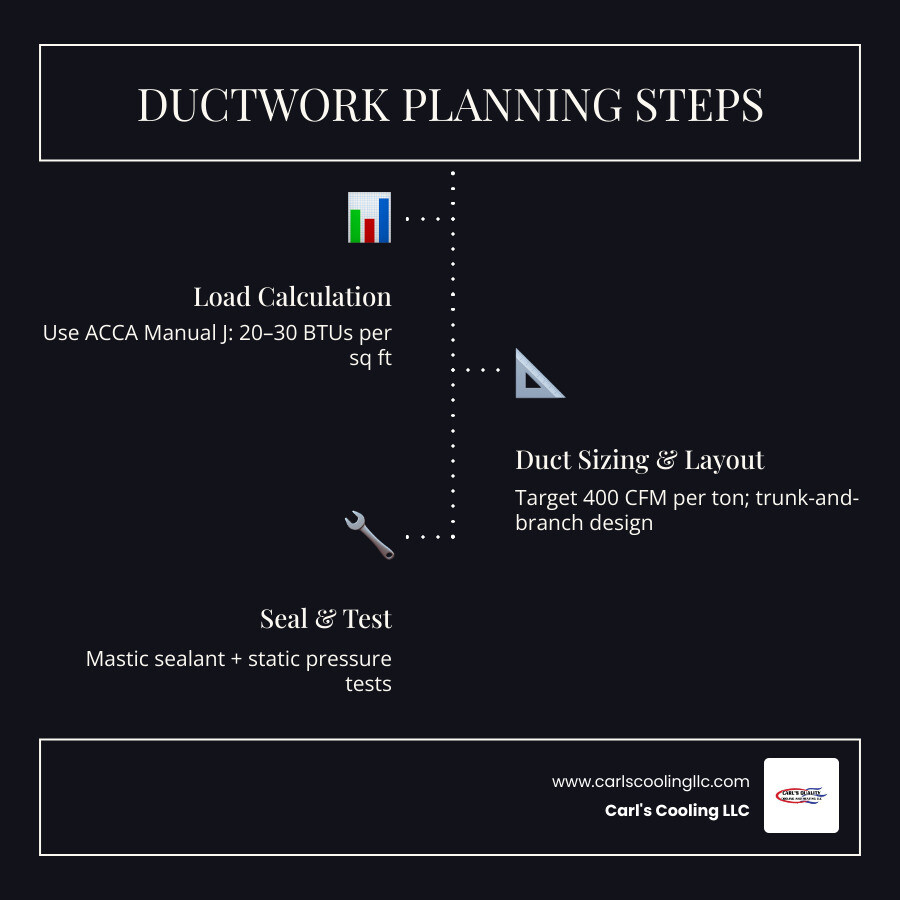
- Calculate heating and cooling loads using ACCA Manual J (20–30 BTUs per square foot)
- Select the right layout — trunk-and-branch, radial, or compact — based on your floor plan
- Size ducts correctly targeting 400 CFM per ton of cooling capacity
- Place ductwork inside conditioned spaces to avoid energy losses from attic heat gain
- Install return air vents in every room to prevent pressure imbalances
- Seal all joints with mastic or UL-181 rated tape to stop airflow leaks
- Commission the system with static pressure tests and room-by-room airflow balancing
Most people focus on countertops, flooring, and fixtures when designing a new home. The ductwork hiding inside the walls and ceilings rarely makes the list — until something goes wrong.
That's a costly mistake. Poor HVAC design and installation can slash your system's energy efficiency by up to 30%. Leaky or undersized ducts alone can waste up to 20% of your total airflow, meaning your brand-new HVAC unit works harder, costs more to run, and still leaves rooms uncomfortable.
Think of your HVAC unit as the lungs and your ductwork as the circulatory system. One simply can't perform without the other. Once the walls are closed and the framing is done, fixing a bad duct system becomes an expensive, invasive process. Getting it right from the start — during the design phase, before a single stud goes up — is the only way to lock in real comfort and efficiency for the life of your home.
Why Ductwork Planning for New Homes is Your Most Critical First Step
When we talk to homeowners in Conroe or The Woodlands who are about to break ground, we always emphasize that the HVAC system should never be an afterthought. In the past, builders might have "thrown in" the ducts after the framing was done, forcing the pipes to twist like pretzels around structural beams. In May 2026, building standards demand better.
Early integration is the secret to a high-performance home. By coordinating with your architect and framing crew during the design phase, we can reserve dedicated chases and soffits for your air distribution. This prevents the "convoluted duct" syndrome where air has to fight through unnecessary bends. Following a New Construction HVAC Design Conroe Guide ensures that the mechanical system is woven into the home’s DNA, not just slapped onto the walls.
If you skip this step, you risk significant zone pressure imbalances. When air is pushed into a room but has no clear path back to the air handler, the room becomes pressurized. This can actually force conditioned air out through cracks in your windows and pull unconditioned, humid Texas air in from the outside. More dangerously, improper pressure can lead to combustion fume backdrafting, where exhaust from gas water heaters or furnaces is pulled back into the living space instead of being vented safely outside. Proper Ductwork Installation New Construction Conroe Guide protocols prevent these safety risks while protecting you from that 30% efficiency loss often seen in "slapdash" installations.
Engineering Precision with ACCA Manuals J, S, and D
We don't guess when it comes to your comfort. Professional ductwork planning for new homes relies on three industry-standard manuals from the Air Conditioning Contractors of America (ACCA):
- Manual J (Load Calculation): This determines exactly how much heat your home gains in the summer and loses in the winter. We look at square footage, window types, insulation R-values, and even the direction your home faces. Most homes require between 20 to 30 BTUs per square foot, but a precise calculation is mandatory to avoid oversizing.
- Manual S (Equipment Selection): Once we know the load, we select the unit that matches those needs perfectly.
- Manual D (Duct Design): This is the blueprint for the ducts themselves. It calculates the friction loss and static pressure to ensure every room gets the exact amount of air it needs.
Whether you are building in a sprawling estate or a cozy cottage, using these standards for Duct Work Magnolia TX ensures your system operates quietly and efficiently.
Choosing the Right Layout and Materials for Optimal Airflow
The geometry of your ductwork is just as important as the size of your AC unit. There are three primary layouts we consider for new builds:
- Trunk-and-Branch: A large "trunk" line runs through the center of the home, with smaller "branches" extending to individual rooms. This is excellent for balanced airflow in traditional layouts.
- Radial: Multiple ducts run directly from a central plenum to each room. This is often used in smaller or open-concept homes.
- Compact Duct Design: A modern favorite for high-performance homes. By placing the air handler centrally, we use very short duct runs. This reduces the surface area where energy can be lost and is much easier to keep within the home's conditioned envelope.
When planning the trunk line, we follow the 4:1 height-to-width ratio rule. Ideally, we aim for a 2:1 or 3:1 ratio to keep airflow smooth. If a duct is too flat and wide, the air encounters more friction, slowing it down and making the system work harder. Avoiding these AC Ductwork Problems Signs Solutions starts with a smart layout on the blueprints.
Material Selection: Rigid Steel vs. Flexible Ducting
The materials we choose impact both the longevity and the quietness of your system.
- Rigid Galvanized Steel: This is the gold standard for main trunk lines. It has a smooth interior, meaning very low friction loss. It’s durable, doesn't sag, and is easy to seal.
- Flexible Ducting: While convenient for navigating tight spots, flex duct can be an airflow killer if installed poorly. We use it sparingly for final connections to registers. To prevent "kinks" that act like a clog in a garden hose, flex ducts must be supported with wide straps at 5-foot intervals.
For homeowners looking for Ductwork Repair Conroe TX later in life, they often find that systems built with more rigid steel require far less maintenance and have fewer airflow restrictions.
Strategic Ductwork Planning for New Homes: Conditioned Space Placement
One of the most effective ways to save money on your utility bills is to keep your ducts out of the attic. In the Texas heat, an attic can reach 140°F. If your ducts are sitting in that heat, the cold air inside them warms up before it ever reaches your bedroom.
We highly recommend placing ductwork within "conditioned space"—meaning inside the insulated thermal envelope of the home. This might involve using dropped soffits, open-web floor joists, or moving the insulation to the roofline. By keeping ducts in a 75°F environment instead of a 140°F attic, you eliminate the massive thermal gain that forces your AC to run longer. If ducts must go in unconditioned spaces, they should be insulated to at least R-8. We specialize in these strategic placements for Duct Work Montgomery TX to ensure your home stays cool without the sky-high energy bills.
Maximizing Efficiency Through Balanced Pressure and Sealing
A common mistake in new construction is relying on a single "central return" vent in a hallway. While this is cheaper to install, it often leads to "stuffy room" syndrome. When you close your bedroom door, the supply vent keeps pumping air in, but that air has no way to get back to the AC unit. The pressure rises, the airflow stalls, and the room gets warm.
The solution is individual room returns or "transfer grilles." By providing a return path in every occupied room, we ensure balanced pressure. This allows the system to move the required 400 CFM (Cubic Feet per Minute) per ton of cooling capacity effortlessly. This level of Professional Ductwork Solutions Montgomery ensures that whether doors are open or closed, your comfort remains consistent. We implement these balanced designs for Duct Work Bentwater TX to keep every corner of the home perfectly tempered.
Sealing and Insulation Standards for 2026
Even the best-designed ducts won't perform if they leak. Statistics show that leaky ducts can lose up to 20% of total airflow. That’s air you’ve paid to cool that is simply escaping into your wall cavities or attic.
In 2026, we use advanced sealing methods to ensure every joint is airtight. This includes:
- Mastic Sealant: A thick, paintable paste that hardens to create a permanent, flexible seal.
- UL-181 Rated Tape: Specifically designed for HVAC use, unlike standard "duct tape" which actually fails quickly under heat.
By sealing every plenum, boot, and joint, we prevent energy waste and ensure the air you pay for actually reaches your living space. Learning to Identify Fix Common Air Duct Issues often reveals that sealing is the most cost-effective upgrade a homeowner can make.
The Impact of Ductwork Planning for New Homes on Indoor Air Quality
Proper ductwork planning for new homes isn't just about temperature; it’s about the air you breathe. When ducts are leaky or located in dusty attics, they can pull allergens, insulation fibers, and mold spores into your home’s air supply.
By designing a sealed system with high-quality filtration (at least MERV 8), we can significantly reduce indoor pollutants. A well-planned layout also prevents "dead zones" where air becomes stagnant and dust accumulates. For residents in areas like Duct Cleaning The Woodlands TX or those looking for Ductwork Cleaning Spring TX, starting with a clean, sealed, and well-designed system is the best way to ensure long-term respiratory health and a cleaner home.
The Commissioning Process: Ensuring Performance Post-Installation
The job isn't done just because the ducts are hung. The final, and perhaps most critical, step is "commissioning." This is where we test the system to ensure it actually performs as the engineering software predicted.

During this phase, we perform a static pressure test. Think of this as checking the "blood pressure" of your HVAC system. If the pressure is too high, the blower motor will overwork and fail prematurely. If it’s too low, air won't reach the furthest rooms. We also use airflow balancing to adjust the dampers in each branch, ensuring the master bedroom and the kitchen get exactly the right amount of air. This process is standard for our Ductwork Cleaning Cypress TX and installation teams to ensure the system is "tuned" for peak performance.
Final Testing and Airflow Balancing
Final testing involves checking the air velocity (measured in FPM or Feet Per Minute) at each register. If the air is moving too fast, it will be noisy; too slow, and it won't "throw" across the room to mix the air properly. By adjusting branch dampers—never the supply grilles themselves—we can quiet the system and eliminate hot spots. These Professional Ductwork Cleaning Benefits and balancing steps are what separate a "builder-grade" house from a truly comfortable home.
Frequently Asked Questions about Residential Duct Design
Why should dampers be installed in branch ducts instead of supply grilles?
You might be tempted to just close the louvers on the vent in the floor or ceiling to adjust air in a room. However, this often causes a whistling or rattling noise because the air is being restricted right at the exit. By installing dampers further back in the branch ducts, we can balance the airflow silently and more precisely. This is a key detail we address during Ductwork Cleaning Tomball TX inspections and new installs.
How does total effective length impact my HVAC system's lifespan?
In ductwork planning for new homes, we calculate the "total effective length" of a duct run. This isn't just the physical footage; it includes the "equivalent length" of every elbow and fitting. A single 90-degree turn can add the equivalent of 30 feet of straight pipe in terms of friction. If the effective length is too high, the static pressure skyrockets, causing the blower motor to burn out years earlier than it should. We focus on these calculations for Ductwork Cleaning Klein TX customers to help extend their equipment's life.
Is it better to have a central return or returns in every room?
While a central return is simpler, returns in every room are far superior for comfort and efficiency. It prevents pressure build-up when doors are closed and eliminates the need for large "undercuts" at the bottom of your doors (which can look unsightly and let in light/noise). For the best results in Ductwork Cleaning Jersey Village TX, we always advocate for a fully ducted return system.
Conclusion
Building a new home is an exciting journey, and we want to make sure your comfort lasts as long as your mortgage. By prioritizing ductwork planning for new homes, you are investing in lower utility bills, better air quality, and a quieter, more comfortable environment for your family.
At Carl’s Cooling LLC, we bring years of expertise to every Conroe, Montgomery, and The Woodlands project. We don't just "install AC"—we engineer air distribution systems that work. From the initial load calculations to the final static pressure test, we handle every detail with professional precision.
Don't let bad ductwork drain your budget or your comfort. Whether you need a Professional Ductwork Maintenance Guide or a full HVAC Installation New Construction Conroe, our team is ready to help. Start your project with our New Construction HVAC experts today and ensure your new build is as efficient as it is beautiful.