

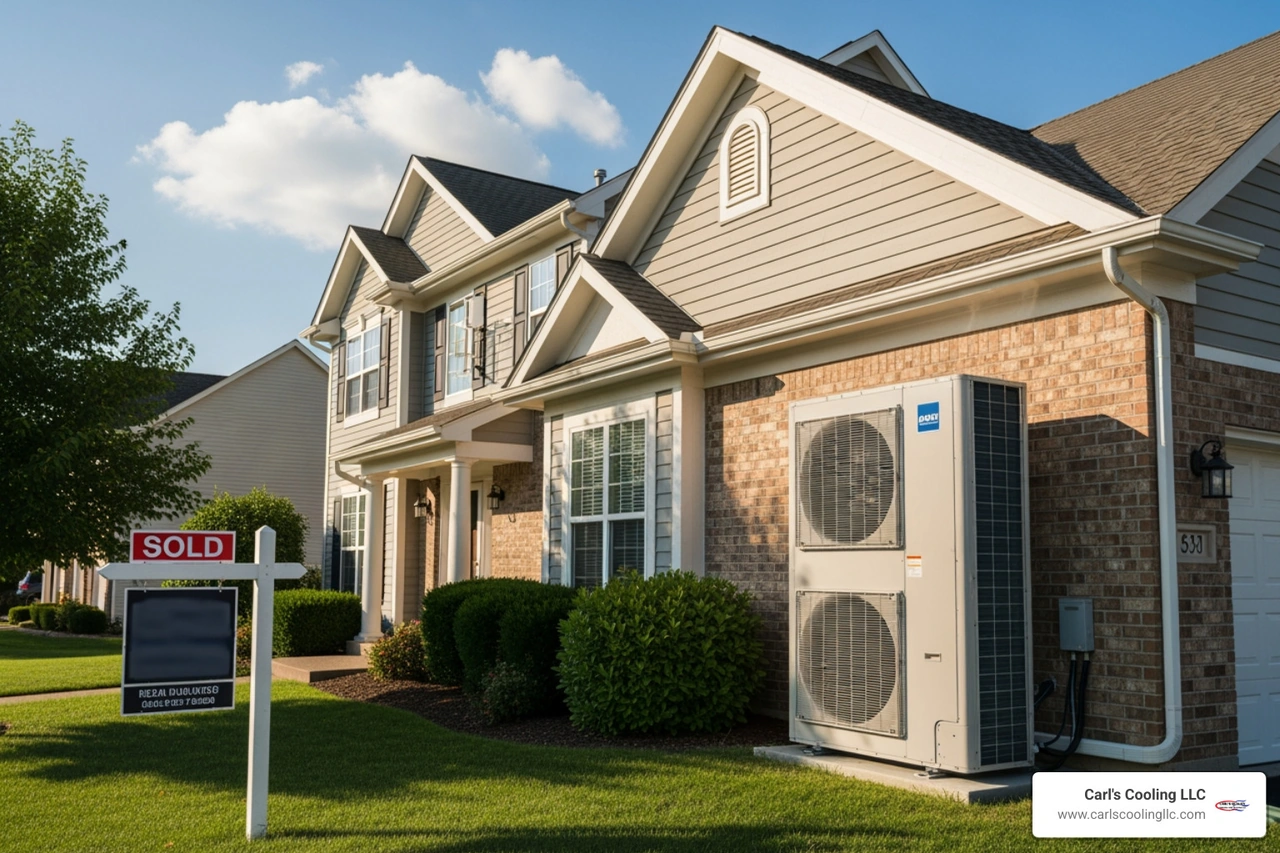

Does a New HVAC Help Sell Your Home Faster? Here's What Sellers Need to Know
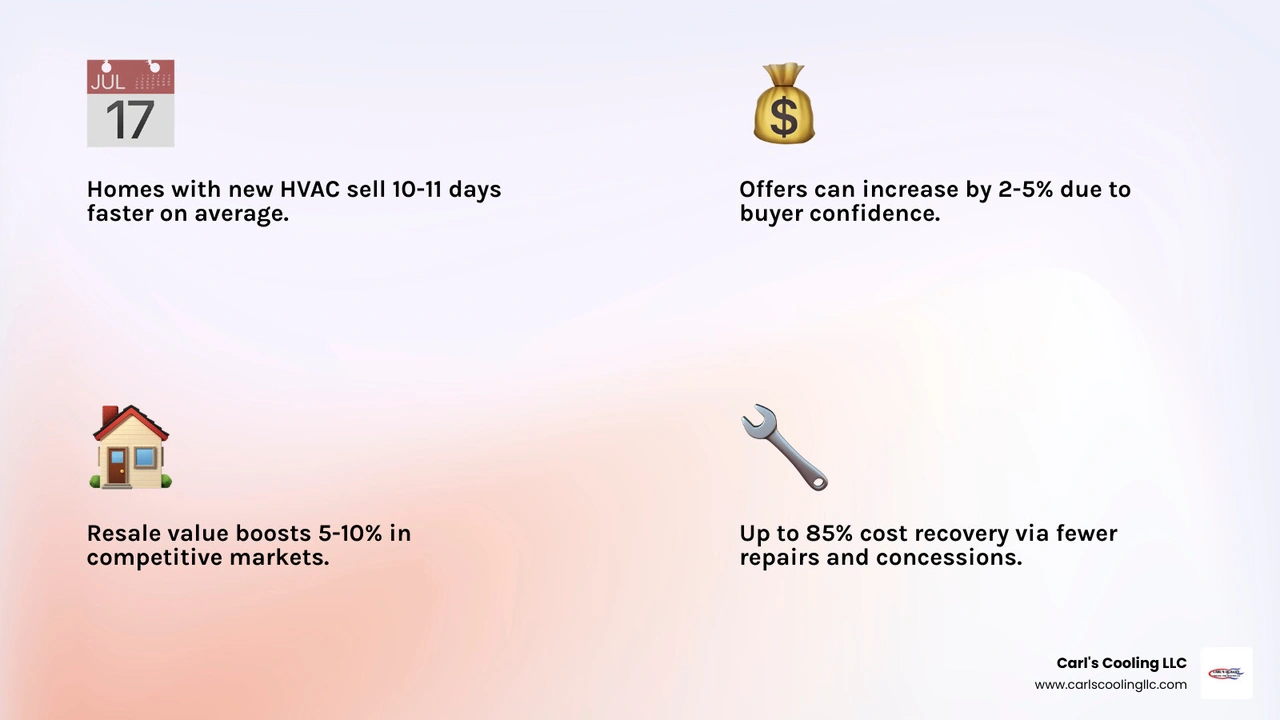
Does a new HVAC help sell your home faster? Yes — and the data backs it up. Homes with newer HVAC systems tend to sell 10 to 11 days faster than comparable homes with aging equipment. A well-functioning, efficient system reduces buyer hesitation, helps homes pass inspection cleanly, and can increase offer strength by 2% to 5%, according to surveys of real estate professionals.
Here's a quick summary of how a new HVAC impacts your home sale:
| Factor | Impact of New HVAC |
|---|---|
| Days on market | Sells ~10–11 days faster |
| Offer strength | Can boost offers by 2%–5% |
| Resale value | Adds roughly 5%–10% in key markets |
| Cost recovery | Up to 85% of replacement cost recouped |
| Inspection risk | Fewer red flags, cleaner reports |
| Buyer confidence | Reduces fear of surprise breakdowns |
When buyers tour a home, they're mentally calculating risk. An HVAC system that's 15 or 20 years old — or one that's been patched together with repairs — signals future expense. That worry quietly chips away at offer prices and sometimes kills deals altogether.
A newer system flips that narrative. It tells buyers the home has been cared for, that they won't be writing a big check the first summer they move in, and that the lender isn't going to flag a non-functional system during underwriting. In competitive markets like Conroe and Montgomery County, where summer heat is no joke, that peace of mind can be the difference between a fast, clean sale and weeks of negotiations.
This guide walks you through exactly when a new HVAC makes sense before listing, what kind of return you can realistically expect, and what buyers actually care about when they look at your system.
Does a New HVAC Help Sell Your Home Faster?
In most cases, yes. A newer HVAC system helps a home feel more move-in ready, and buyers love move-in ready almost as much as they love a cold house in August.
The biggest reason is simple: HVAC is a major house system, not a decorative upgrade. Buyers may gush over paint colors and countertops, but they worry about roofs, plumbing, electrical, and heating and cooling. If the HVAC looks old, sounds rough, cools unevenly, or shows signs of poor maintenance, buyers start budgeting for replacement before they even make an offer.
That changes behavior in a few important ways:
- Some buyers lower their offer to account for future replacement
- Some ask for credits or repairs after inspection
- Some choose a comparable home with fewer big-ticket worries
- Some walk away entirely if they think the system is near end-of-life
That is why does a new HVAC help sell your home faster is really a question about confidence. The newer and more reliable the system appears, the less friction there is between showing and closing.
Does a new hvac help sell your home faster in real-world market conditions?
Yes, but the size of the benefit depends on the market.
In a seller's market, homes may sell quickly anyway. Even then, a new HVAC can still reduce renegotiation, help support stronger offers, and make your listing stand out against similar homes with aging systems.
In a buyer's market, the benefit is usually bigger. Buyers have more choices, so they compare risk more carefully. If two homes are similar and one has a newer HVAC, that home often feels like the safer buy.
This matters even more across Conroe, Montgomery, Magnolia, The Woodlands, Willis, Spring, Tomball, Cypress, and nearby communities where cooling is not optional for much of the year. In hot and humid Southeast Texas conditions, buyers are not looking at HVAC as a luxury. They are looking at it as survival with better humidity control.
A newer system tends to help most when:
- Comparable homes nearby have more updated mechanical systems
- Your current equipment is visibly old or over 12 to 15 years old
- The home will be listed during warmer months
- Buyers expect turnkey condition
- The existing system has uneven cooling, noise, or humidity issues
Why does a new hvac help sell your home faster even if it does not transform appraised value?
This is where many sellers get confused.
Appraised value and marketability are not the same thing.
An appraiser usually looks at comparable sales and overall condition. If the HVAC works, the appraiser may not give a huge line-item bump just because it is new. They may note that the system is newer, efficient, or in above-average condition, but that does not always mean a full-dollar increase equal to the installation cost.
Buyers, however, are emotional risk managers. They are asking:
- Will this break right after closing?
- Will summer electric bills be high?
- Will the inspector flag this?
- Will I have to replace it soon?
- Is this home hiding other deferred maintenance?
A new HVAC answers those worries before they grow legs and run straight into your negotiations.
It also helps with inspections and, in some cases, financing. A non-functional or obviously failing system can trigger repair demands or lender concerns. A clean, working, recently installed system makes the transaction smoother.
How Much Value and ROI Can a New HVAC Add Before You Sell?
A new HVAC can add resale value, but not always in a neat, one-size-fits-all way.
Research used for this article shows several useful benchmarks:
- Efficient HVAC can help increase offers by 2% to 5%
- Some markets see value gains in the 5% to 10% range
- Sellers may recover up to 85% of replacement cost
- Homes with updated HVAC often sell faster and with fewer concessions
The key idea is that ROI is both direct and indirect.
Direct return is the extra value buyers are willing to pay.Indirect return is what you avoid losing through repair credits, price reductions, long market time, and deals that get shaky after inspection.

Does a new HVAC system directly increase a home's appraised value?
Sometimes, but usually not dollar-for-dollar.
A new HVAC system is often treated as a condition and marketability improvement rather than a dramatic standalone value jump. Appraisers generally care that the system is:
- Operational
- Appropriate for the home
- Professionally installed
- In line with neighborhood expectations
- More efficient or updated than competing homes
If your old system was failing, obsolete, or clearly beyond normal life expectancy, replacement can absolutely help protect value. It can also prevent negative adjustment in a buyer's mind, which may matter just as much as an appraisal note.
Features that can strengthen the case include:
- Strong efficiency ratings such as SEER2
- Consistent whole-home comfort
- Proper sizing
- Clean installation documentation
- Transferable warranty coverage
What is the typical ROI on HVAC replacement when selling a home?
Typical ROI depends on the age and condition of the old system, local market conditions, and buyer expectations. Based on the research, homeowners can recover a substantial share of replacement cost, with some reports placing cost recovery as high as 85%.
But the bigger picture is this: HVAC ROI is rarely just about resale price.
A newer system can deliver value by:
- Helping the home sell 10 to 11 days faster
- Reducing post-inspection repair requests
- Preventing large buyer credits
- Making your listing look better online and in person
- Improving trust during showings
In other words, a new HVAC often protects your net proceeds by shrinking the pile of reasons buyers use to negotiate.
How much can a new HVAC add to resale price versus negotiation savings?
That depends on what would have happened with the old system.
If the existing unit is old but still running, a replacement may add modest sale-price strength while also reducing negotiation pressure. If the old unit is near failure, the negotiation savings can be even more important than any headline price increase.
Here is a practical comparison:
| Scenario | New HVAC Before Listing | Maintained Older HVAC Before Listing |
|---|---|---|
| Buyer reaction | More confidence, less hesitation | More questions, more caution |
| Inspection outcome | Fewer red flags | Possible age/condition comments |
| Offer strength | Better chance of stronger offers | More likely buyer discounting |
| Negotiation risk | Lower | Higher |
| Days on market | Often shorter | Often longer |
| Overall sale experience | Smoother | More variable |
When Should You Replace HVAC Before Listing Your Home?
You do not need to replace every system before selling. If your unit is newer, reliable, and well-maintained, replacement may not be the smartest pre-sale move.
But replacement deserves serious consideration when the current system shows clear end-of-life signs.
General industry guidance from the research points to a lifespan of about 10 to 15 years for many systems, with some lasting longer if properly maintained. Once a unit gets into the 15- to 20-year range, buyer concern rises fast.
Does a new hvac help sell your home faster when the current unit is over 12 to 15 years old?
Usually, yes.
Once a system is over 12 to 15 years old, buyers and inspectors start reading it as a near-term expense, even if it still works. In our local climate, that matters because cooling equipment works hard for much of the year.
A replacement makes the most sense when the existing system is:
- Over 12 to 15 years old
- Using outdated refrigerant such as R-22
- Needing frequent repairs
- Struggling to keep temperatures even
- Making unusual noise
- Producing humidity problems or weak airflow
If your system is in this category, replacing before listing can remove a major objection and help your home compete more effectively.
Replace, repair, or tune up: which pre-sale move makes the most sense?
This depends on the age and health of the equipment.
If the system is under about 10 years old and has been reliable, a professional tune-up, fresh filter, coil cleaning, and service records may be enough. Our Ultimate HVAC Maintenance Guide Montgomery County is a good starting point for that prep work.
If the system is older but still serviceable, a pre-listing repair may make sense when it fixes a specific issue without trying to perform CPR on a unit that has already written its farewell speech.
Replace the system before listing when you see signs like:
- Refrigerant leaks
- Repeated compressor or blower issues
- Repair history that keeps growing
- Poor cooling during hot weather
- Large comfort differences from room to room
- Obsolete parts or refrigerant concerns
- Inspector comments from a prior failed sale
What buyers worry about most when they see an older HVAC system
Buyers are usually not HVAC experts, but they know enough to worry when a unit looks old.
Their biggest concerns tend to be:
- High utility bills
- Surprise breakdowns after closing
- Poor airflow or hot spots
- Humidity and comfort problems
- Indoor air quality concerns
- Limited warranty protection
- Hard-to-find parts for older equipment
A new system or a well-documented, well-maintained existing system helps calm those concerns. So does a clean inspection. For more on what inspectors notice, see AC Home Inspections: Reliable and Efficient.
Which HVAC Features Matter Most to Buyers?
Most buyers do not need a spaceship disguised as an air conditioner.
What they want is a system that feels reliable, efficient, quiet, and easy to trust.
Is a basic reliable system enough, or should you install high-efficiency equipment?
In most resale situations, a basic reliable system or a solid mid-range efficient system is enough.
That is because buyers generally expect HVAC to work well. They may appreciate higher efficiency, quieter operation, or smart controls, but ultra-premium features do not always create matching resale value.
The sweet spot is usually:
- Reliable equipment
- Good efficiency
- Professional installation
- Clear documentation
- Familiar, practical features
High-efficiency equipment can still help, especially in our climate where cooling costs matter. But sellers should think in terms of sensible upgrades, not over-improving for features buyers may never fully value.
How location, climate, and system type affect added value
Location matters a lot here.
In Conroe, Montgomery County, Magnolia, Willis, and surrounding areas, cooling performance and humidity control carry real weight because summers are hot and long. Buyers are more likely to care about AC age and efficiency than they would in a milder climate.
System type matters too:
- Central AC is often expected in many homes
- Heat pumps can be attractive for efficiency
- Ductless systems can add value in additions, older homes, or targeted zones
- Good humidity control can improve comfort and perceived quality
If your home has comfort issues tied to layout, age, or renovation history, the problem may be more than just the outdoor unit. Our resources on AC Installation for Older Homes and Conroe TX Home Construction Renovations Guide explain why system design matters.
What paperwork and features make a new HVAC more appealing to buyers?
Documentation can turn "new unit" into "credible value."
Gather these items before listing:
- Installation invoice or receipt
- Permit records, if applicable
- Warranty details and transfer information
- Model and serial numbers
- Efficiency information such as SEER2 rating
- Maintenance records
- Filter replacement schedule
- Any recent inspection or tune-up report
For ongoing upkeep tips, see HVAC Maintenance Tips for Homeowners.
Cost-Effective Alternatives to Full Replacement Before Selling
Not every pre-sale HVAC strategy needs to end in full replacement.
Sometimes the better move is making the current system look, sound, and perform like something buyers will not fear.
Low-cost improvements that can reduce buyer objections
If the system is still fundamentally sound, these improvements can help:
- Replace dirty filters
- Clean supply and return vents
- Clear the condensate drain
- Calibrate the thermostat
- Reduce rattles or vibration noise
- Clean coils and key components
- Address obvious airflow problems
- Make sure the outdoor unit area is tidy
These steps improve presentation and help the home feel cared for. If your property has older design challenges, AC Installation for Older Homes offers helpful context.
When ductwork or design problems matter as much as the equipment itself
Sometimes the equipment is not the real issue.
If buyers notice rooms that never cool well, weak airflow, or hot spots, the problem may be:
- Leaky ductwork
- Poor duct design
- Wrong equipment sizing
- Airflow imbalance
- Renovations that changed load requirements
These issues can drag down buyer confidence even if the main system is newer. Helpful resources include Ductwork Installation New Construction Conroe Guide and New Construction HVAC Design Conroe Guide.
How inspections, appraisals, and negotiations change when the HVAC is well maintained
Well-maintained HVAC gives everyone in the transaction less to argue about.
A documented service history can support:
- Cleaner inspection reports
- Fewer repair requests
- Better buyer confidence
- Less dramatic negotiation after option period
- Stronger support for overall condition
If the home is newer or recently updated, proper HVAC design and installation history can also strengthen the story of the property. See HVAC Installation New Construction Conroe.
Frequently Asked Questions About Selling a Home With an HVAC Upgrade
Will a new HVAC guarantee a higher sale price?
No. Nothing in real estate is guaranteed except that someone will open a closet during a showing at the worst possible moment.
A new HVAC improves your position. It can support stronger offers, reduce objections, and help your home sell faster, but final sale price still depends on comparables, market conditions, location, and overall house condition.
Is it worth replacing HVAC in a seller’s market?
Sometimes, yes.
In a hot seller's market, you may still sell with an older system. But replacement can be worth it if the current equipment is likely to trigger inspection issues, buyer hesitation, or repeated negotiation. Even when demand is high, buyers do not suddenly stop caring about major systems.
Should I replace my HVAC if I plan to sell soon in Conroe or Montgomery County?
If the system is aging, unreliable, or struggling in summer conditions, it is worth getting a pre-listing HVAC evaluation. In our area, buyers expect strong cooling performance, and older systems can feel like a looming expense.
If your unit is still in solid shape, a tune-up and clean documentation may be enough. If it is near end-of-life, replacement may help your home sell faster and more smoothly. For local service support, visit HVAC Service Woodforest TX.
Conclusion
A new HVAC does not always create a massive appraisal jump, but it often does something just as important: it removes fear. And in real estate, fear is expensive.
For homeowners in Conroe, Montgomery, Magnolia, The Woodlands, Willis, Spring, Tomball, Cypress, and nearby communities, a newer HVAC can mean fewer inspection problems, stronger buyer confidence, shorter time on market, and less negotiation drama. That is why the answer to does a new HVAC help sell your home faster is so often yes.
If you are getting ready to list, the smart move is not automatically replacement. It is evaluation. Sometimes a tune-up is enough. Sometimes targeted repairs solve the problem. And sometimes replacing an aging system is the move that helps your home feel truly ready for the next owner.
For more guidance on HVAC upgrades and home comfort planning, explore Carl's Cooling LLC HVAC services, Conroe TX Home Construction Renovations Guide, and Magnolia TX Construction Renovation Guide.


