


The Hidden Impact of a 21,000-Acre Moisture Source on Your AC
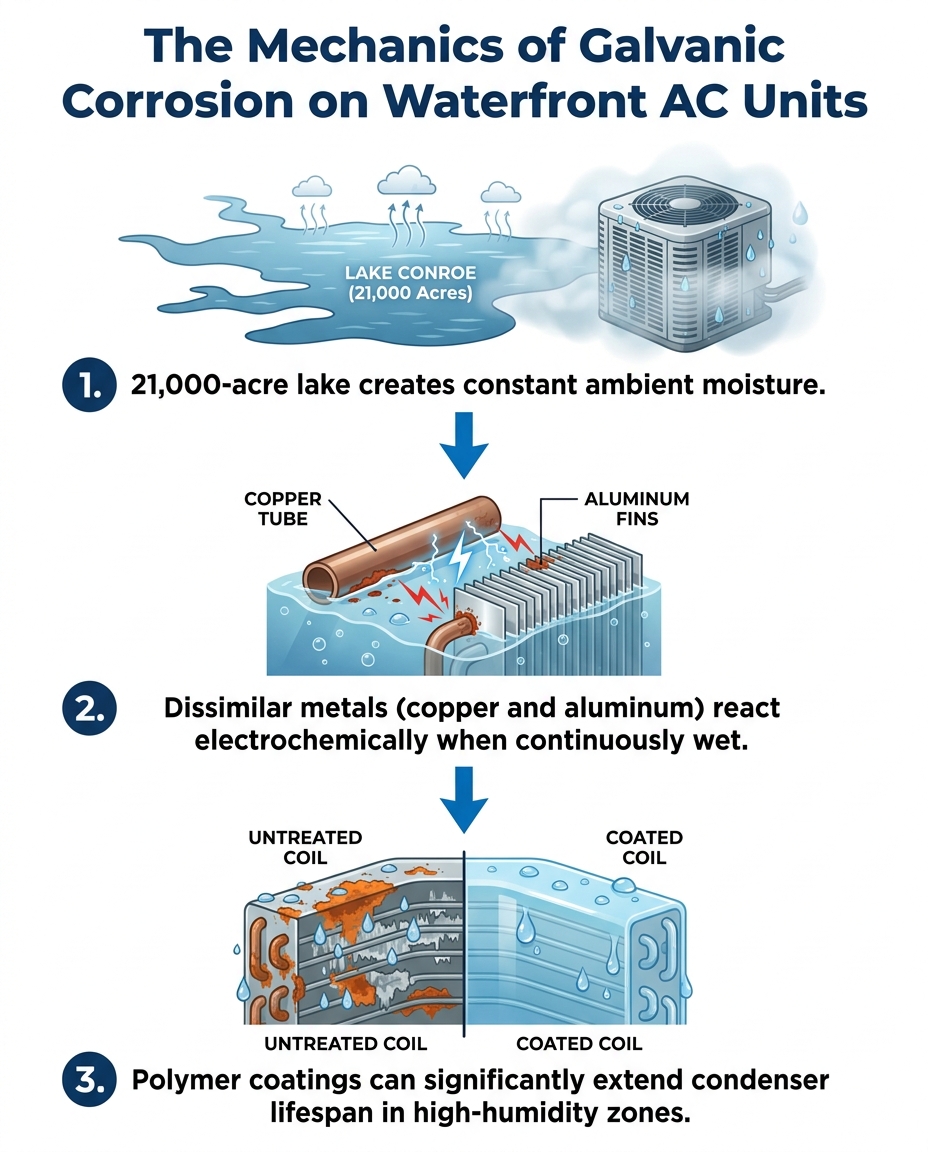
A 21,000-acre body of water does more than provide a scenic backdrop for your property—it fundamentally alters the atmosphere around your home. If you have ever wondered how proximity to Lake Conroe accelerates AC condenser corrosion, the answer lies in this massive, continuous source of ambient moisture. The lake creates a localized weather system that drastically changes how your outdoor HVAC equipment operates, ages, and ultimately degrades.
For homes situated in the Lake Conroe waterfront and adjacent communities, this constant environmental moisture prevents outdoor condenser coils from ever fully drying out. This continuous dampness triggers accelerated pitting and degradation of the metal components inside your system. The core decision for homeowners in this specific zone is determining whether their property requires specialized protective coil coatings compared to standard inland installations.
Addressing this environmental reality requires professional air conditioning services and a proactive routine AC maintenance plan tailored specifically to waterfront living. Standard equipment simply is not built to handle a microclimate that never dries out.
The Physics of Waterfront Evaporation
To understand the toll this takes on your equipment, you have to look at the sheer volume of water evaporating daily. Millions of gallons of water evaporate from the lake surface directly into the surrounding air. This localized high-moisture zone means the relative humidity immediately adjacent to the water is consistently higher than it is just a few miles down the road. When your air conditioner's condenser fan pulls this heavy, moisture-laden air across its metal fins, it coats the entire assembly in a microscopic layer of water that refuses to evaporate.
The Science of Galvanic Corrosion in High-Moisture Environments
When metal components break down rapidly outdoors, the culprit is usually a process called galvanic corrosion. This is an electrochemical reaction that occurs when two dissimilar metals are physically connected in the presence of an electrolyte. In almost all modern air conditioning systems, the outdoor condenser coils consist of copper tubing surrounded by thin aluminum fins.
Most homeowners associate this type of rapid metal degradation strictly with coastal saltwater. Salt is a highly conductive electrolyte, which is why oceanfront units rust so quickly. However, the constant freshwater humidity generated by the lake provides enough continuous moisture to act as a highly effective electrolyte on its own. During the high-humidity summer months, this moisture blankets the copper and aluminum, allowing a weak electrical current to flow between them. Because aluminum is the less "noble" metal in this pairing, it sacrifices itself to the copper, causing the aluminum fins to corrode, pit, and eventually turn to dust.
ASHRAE Guidelines and Formicary Differences
According to ASHRAE (American Society of Heating, Refrigerating and Air-Conditioning Engineers) guidelines on environmental degradation, continuous dampness is one of the primary accelerators of this chemical reaction. The longer a unit stays wet, the faster the chemical reaction eats away at the metal.
Key differences in AC corrosion types:
• Galvanic Corrosion: Occurs outdoors. Caused by dissimilar metals (copper and aluminum) reacting via an electrolyte (constant lake moisture). Destroys the outer fins first.
• Formicary Corrosion: Occurs indoors. Caused by household volatile organic compounds (VOCs) like hairsprays, cleaners, and building materials reacting with the indoor evaporator coil. Creates microscopic pinhole leaks in the copper tubing itself.
Understanding this distinction is vital, because treating an outdoor moisture problem requires an entirely different strategy than fixing an indoor air quality issue.

Lakefront vs. Inland: Understanding Conroe's Microclimate
It is easy to assume that all homes in Montgomery County experience the exact same weather. While the general forecast might look identical, the reality on the ground is very different. Properties located within the Lake Conroe service area directly on the water exist in a specific microclimate. This zone is characterized by higher ambient moisture, localized morning fog, and prolonged dew points that specifically affect equipment sitting outside.
With the intense, hot Gulf Coast climate, you might expect morning dew to burn off quickly. Inland homes experience exactly that—the intense heat bakes the moisture off the outdoor units by mid-morning. However, directly on the water, the continuous evaporation from the lake during peak July heat prevents condensation from ever fully evaporating off your outdoor system. Your condenser spends its entire working life in a damp state.
Comparing the Operating Environments
• Morning Condensation — Inland Conroe Neighborhoods: Evaporates quickly as temperatures rise. — Lakefront Properties: Lingers due to high ambient lake humidity.
• Evening Dew Point — Inland Conroe Neighborhoods: Drops slightly, allowing equipment to dry. — Lakefront Properties: Remains elevated, keeping coils damp overnight.
• Airflow Composition — Inland Conroe Neighborhoods: Standard suburban dust and pollen. — Lakefront Properties: Heavy, moisture-saturated air carrying organic lake matter.
• Corrosion Risk — Inland Conroe Neighborhoods: Standard wear-and-tear timeline. — Lakefront Properties: Accelerated galvanic reaction risk.
This combination of relentless Gulf Coast heat and the lake's continuous evaporation creates a perfect storm for metal wear. Standard HVAC wear-and-tear models are based on inland averages. When manufacturers estimate a unit will last 12 to 15 years, they are not factoring in the reality of the Lake Conroe waterfront and adjacent communities.
Why Standard Condenser Installations Fail Prematurely on the Water
When a builder or a homeowner installs a standard, factory-basic air conditioner on a lakefront property, they are putting vulnerable equipment into a hostile environment. Basic condenser models lack the robust, factory-applied polymer coatings required to withstand continuous moisture exposure. The bare aluminum and copper are left completely exposed to the elements.
This creates a severe compounding effect. During extreme summer heat, your air conditioner runs continuously under a heavy load to keep your house cool. Because of the microclimate, it is doing this while remaining constantly damp. The physical toll on the system accelerates rapidly. As the galvanic corrosion takes hold, the thin aluminum fins begin to pit and rust away. These fins are responsible for dissipating the heat from your home into the outside air. When they degrade, the system loses its energy efficiency.
The downward spiral of efficiency:
• Reduced surface area: As fins crumble, there is less metal available to release heat.
• Increased compressor strain: The compressor has to work twice as hard and run twice as long to achieve the same cooling result.
• Higher energy bills: Longer run times directly translate to increased monthly electricity usage.
• Premature failure: The overworked compressor eventually burns out years before its time.
This constant strain often leads to sudden, inconvenient breakdowns. For example, one local homeowner experienced a complete AC failure right before a severe thunderstorm rolled in. A technician arrived as soon as it was safe, diagnosed the heavily stressed and corroded components, and got the system repaired efficiently within an hour. While a fast fix restores comfort, ignoring the microclimate factors during installation leads to a financial reality of shortened lifespans and frequent repairs.
Identifying Early Signs of Outdoor Coil Degradation
Catching the early onset of galvanic corrosion can save you from catastrophic equipment failure. Because the degradation happens slowly over the high-humidity summer months, homeowners often miss the subtle visual cues until the system stops cooling entirely. Knowing what to look for allows you to intervene before the structural integrity of the coil is compromised.
As a veteran-owned company, we apply strict discipline and firsthand diagnostic experience to accurately identify these exact waterfront wear patterns. Accurate diagnosis matters. Recently, a waterfront customer called for a routine inspection. The technician performed a thorough check, identified early-stage galvanic pitting on the condenser, and clearly explained the findings. By offering honest recommendations before the coils failed completely, the homeowner was able to make an informed decision about their equipment.
What to Look For on Your Outdoor Unit
• White, powdery deposits: This is aluminum oxide. It looks like a light dusting of white powder on the silver fins, signaling that the aluminum is actively corroding.
• Blue-green scaling: Found on the copper refrigerant lines or at the junction where copper meets aluminum. This indicates the copper is reacting to the moisture.
• Brittle or crumbling fins: If you lightly brush your finger against the aluminum fins and they flake away or crumble into dust, the galvanic reaction has severely compromised the metal.
• Noticeable performance drops: The system runs much longer than it used to just to reach the thermostat setting, or the air coming from the vents feels less cold.
• Increased operational noise: As the compressor struggles against the restricted heat transfer, the unit may sound louder or hum more aggressively than usual.
If you notice any of these signs on a property in the Lake Conroe waterfront and adjacent communities, expert diagnosis is required. Guessing whether the wear is superficial or structurally compromising often leads to unnecessary replacements or missed opportunities to save the unit.
Protective Strategies: Coil Coatings and Specialized Units
If you live on the water, you do not have to simply accept that your air conditioner will rust out every few years. There are authoritative, proven solutions designed specifically to combat high-moisture environments. The goal is to create a physical barrier between the dissimilar metals and the constant ambient moisture.
Homeowners generally have two main protective strategies: applying a protective coating to a standard unit, or investing in a specialized coastal-grade condenser built specifically for harsh environments.
Comparing Your Protective Options
• Standard Aftermarket Sprays — How It Works: A liquid anti-corrosion spray applied by a technician in the field. — Best Application: Older units showing very early signs of wear where a full replacement isn't justified yet.
• Factory-Applied Polymer Coatings — How It Works: A micro-thin epoxy/polymer baked onto the coils at the manufacturing facility before assembly. — Best Application: New installations on waterfront properties. Provides excellent protection without insulating the coil.
• Coastal-Grade Condensers — How It Works: Units engineered from the ground up with robust materials, coated coils, and weather-resistant cabinetry. — Best Application: Homes directly on the water facing the highest levels of continuous moisture and environmental stress.
The importance of heat transfer efficiency: When evaluating coatings, you must ensure the protective layer does not interfere with the unit's ability to release heat. A poorly applied, thick aftermarket spray acts like a heavy blanket, insulating the coil and ruining the system's efficiency. Factory-applied polymer coatings are engineered to be microns thin, providing a flawless moisture barrier while maintaining the exact heat transfer coefficient the system requires.
When analyzing the long-term return on investment, choosing specialized protection upfront almost always costs less than replacing a standard, unprotected unit prematurely.
Adjusting Preventative Upkeep for Waterfront Systems
Upgrading to coated coils or coastal-grade equipment is only half the battle. To truly protect your investment, you must adjust your preventative upkeep routine. Standard inland maintenance schedules are entirely insufficient for units fighting constant lakeside humidity.
During the high-humidity summer months, your outdoor unit acts like a vacuum, pulling in organic debris, pollen, cottonwood seeds, and dirt. When this debris sticks to the wet coils, it creates a sponge effect. This damp organic matter traps moisture directly against the metal, accelerating corrosion even on coated systems. Safely removing this debris is critical.
Waterfront Maintenance Protocols
1. Increase inspection frequency: Waterfront systems benefit from rigorous inspections twice a year, rather than the standard annual check. Catching debris buildup early prevents moisture trapping.
2. Clear the perimeter: Keep all landscaping, tall grass, and bushes at least two feet away from the unit. This improves airflow and helps the unit dry out faster when the fan is running.
3. Implement safe cleaning protocols: Cleaning your AC unit requires specific techniques. Professional technicians use low-pressure water and specialized, non-corrosive foaming cleaners to push dirt out from the inside.
4. Avoid harsh chemicals: Never use off-the-shelf acidic or highly alkaline coil cleaners. These harsh chemicals strip away protective factory coatings and actually trigger the exact corrosion you are trying to prevent.
5. Monitor for biological growth: The constant moisture near the lake can encourage algae or mold growth on the lower base pan of the condenser. Keeping the drain ports clear ensures standing water doesn't pool at the bottom of the unit.
By tailoring your upkeep to the realities of the Lake Conroe waterfront and adjacent communities, you ensure your system operates at peak efficiency regardless of the environmental challenges.
Frequently Asked Questions
Why is my outdoor AC unit rusting so fast?
Your unit is likely experiencing galvanic corrosion accelerated by constant environmental moisture. When copper and aluminum are continuously wet, a chemical reaction occurs that causes the aluminum fins to break down and pit. If your unit never fully dries out, this rusting process happens much faster than normal.
Does high humidity damage AC units?
Yes, continuous high humidity can severely damage standard outdoor AC units. The constant ambient moisture acts as an electrolyte, bridging the gap between dissimilar metals and causing them to degrade. Over time, this humidity eats away at the thin aluminum cooling fins, drastically reducing the system's efficiency.
How do you protect an AC condenser from rust?
The most effective protection is applying a specialized polymer coil coating or installing a coastal-grade unit designed for high-moisture environments. Additionally, keeping the coils completely free of dirt and organic debris prevents moisture from being trapped against the metal surfaces.
Are AC coil coatings worth it?
For homes located near large bodies of water or in continuous high-humidity microclimates, coil coatings are absolutely worth the investment. A proper factory-applied coating prevents premature equipment failure, maintains the unit's energy efficiency, and saves you from the cost of replacing the system years before its expected lifespan.
Does living near a freshwater lake cause the same AC corrosion as the ocean?
While oceanfront saltwater is highly corrosive, the constant freshwater humidity from a large lake causes a very similar, though slightly slower, galvanic reaction. The sheer volume of continuous moisture prevents the unit from drying, which is all the chemical reaction needs to destroy the aluminum fins over time.
Protecting Your Waterfront Comfort
Understanding exactly how proximity to Lake Conroe accelerates AC condenser corrosion is the first step in protecting your home's comfort. By recognizing the environmental mechanics destroying standard coils, you can make an informed choice about your next installation. Whether you need an expert assessment of your current unit's wear or a clear, actionable recommendation on protective coatings, choosing equipment built for your specific microclimate ensures reliable, efficient cooling for years to come.


