



The Immediate Threat of a Heat Pump Pumping Hot Air
You set your thermostat to a comfortable 72 degrees, but the air blasting out of your vents feels like an oven, dropping you right into the reversing valve trap: why heat pumps suddenly stop blowing cold. During a brutal Texas summer, realizing your cooling system is actively heating your house creates an immediate sense of panic. At Carl's Quality Cooling and Heating LLC, our technicians respond to this exact scenario every July across Conroe. You might wonder if you pressed the wrong button on the thermostat or if the entire system is failing, but in our experience, this specific issue is almost always a mechanical failure, not user error.
When a heat pump fails in this particular way, it stops being a minor inconvenience and quickly becomes an active threat to your home's comfort and your equipment's survival. The system is consuming massive amounts of electricity to pull heat from the outside air and pump it directly into your living space. If you leave the system running while hoping it will eventually cool down, you risk catastrophic damage to the compressor.
The most important decision you can make in this moment is to shut the system down completely. Turning the unit off at the thermostat or the breaker stops the immediate influx of heat and protects the internal components from burning out under the strain. When you need professional HVAC services, understanding this specific mechanical threat helps you take the right first step to protect your investment.
Understanding the Reversing Valve Trap
To understand why your system is behaving this way, you have to look at the component that makes a heat pump unique. Unlike a standard air conditioner that only cools, a heat pump can both heat and cool your home. The component responsible for switching the flow of refrigerant between these two modes is the reversing valve. When this valve fails, our team typically sees a highly specific set of symptoms.
Many major heat pump brands design their reversing valves to default to the heating position as a built-in fail-safe. This means that if the valve loses electrical power or the internal mechanism gets stuck, the system automatically reverts to pumping hot air. The compressor is still doing its job, and the fans are still moving air, but the refrigerant is flowing in the wrong direction for summer weather. If you notice a heat pump fan spinning but compressor silent, that points to a different electrical issue, but if the compressor is roaring and the vents are blowing hot air, the reversing valve is almost certainly trapped in its default heat mode.
How the Reversing Valve Controls Comfort
The shift in refrigerant flow: The reversing valve sits on the refrigerant line near the compressor. When you switch your thermostat from heat to cool, the valve physically redirects the high-pressure, high-temperature refrigerant gas. Instead of sending it inside to warm your house, it sends it outside to release heat into the Texas summer air.
The physical sliding mechanism: Inside the brass body of the reversing valve is a small internal slider. This slider moves back and forth to open and close different ports. When the system is operating normally, a pressure differential pushes the slider smoothly into place. When it gets stuck, the refrigerant continues flowing through the heating ports, trapping your home in a perpetual heating cycle regardless of what the thermostat says.
Electrical Solenoid Failure vs. Mechanical Jams
When a heat pump is trapped in heating mode, the root cause usually falls into one of two categories: an electrical failure at the solenoid or a mechanical jam inside the valve itself. Differentiating between the two requires careful, step-by-step troubleshooting.
The solenoid is an electromagnetic coil attached to the outside of the reversing valve. When your thermostat calls for cooling, it sends a 24-volt electrical signal to this coil. The energized coil creates a magnetic field that moves a tiny pilot valve, which then changes the pressure inside the main valve body to shift the slider. If the solenoid burns out, or if there is a wiring issue at the thermostat's O/B terminal, that 24-volt signal never arrives. Because the valve defaults to heating, a simple electrical failure immediately traps the system in heat mode.
A mechanical jam is a completely different problem. In this scenario, the solenoid receives the electrical signal and attempts to shift the valve, but the internal slider is physically stuck. This can happen due to internal wear over time, a loss of refrigerant pressure, or microscopic debris floating through the refrigerant lines that scores the delicate internal surfaces of the valve.
As a veteran-owned company, our team applies military-level precision and discipline to our diagnostics. Professional troubleshooting demands checking the 24-volt signal first. Throwing parts or adding refrigerant to a system without testing the solenoid is a sloppy diagnostic approach that wastes time and money. We ensure the problem is fixed right the first time without guesswork.
• Electrical Solenoid — Primary Cause: Burned out coil or bad wiring — Diagnostic Step: Test 24-volt signal from thermostat — Typical Solution: Replace the external coil (No refrigerant work needed)
• Mechanical Jam — Primary Cause: Internal wear, debris, or low pressure — Diagnostic Step: Verify solenoid works, check refrigerant charge — Typical Solution: Replace entire valve (Requires recovering refrigerant)
The Compounding Heat Hazard in High-Humidity Climates
A heat pump stuck in heating mode is frustrating anywhere, but in the brutal heat and high humidity of a Conroe, TX July, it rapidly escalates into a dangerous indoor environment. When the outside temperature is pushing 95 degrees, your home is already fighting a massive thermal load. Actively pumping 100-plus degree air into the living space compounds that heat hazard exponentially.
High humidity makes the situation significantly worse. In Southeast Texas, heavy moisture in the air prevents your home from naturally dissipating heat. It also prevents human skin from evaporating sweat efficiently, meaning the indoor temperature feels much hotter than the thermometer indicates. Within just a few hours of a reversing valve failure, an insulated home can become dangerously hot, putting vulnerable family members and pets at risk.
We see this urgency across all our Montgomery County service areas. Rapid response is critical when cooling systems fail during peak heat events or holidays. During a recent July 4th holiday marked by extreme heat, our installation team responded to a local homeowner facing a total cooling failure when their system went out. One of our technicians arrived quickly, assessed that the aging unit was beyond a simple component repair, and had a completely new, reliable system installed by the next morning to restore safe indoor temperatures.
You cannot afford to wait out a reversing valve failure in this climate. The longer the system runs in the wrong mode, the more heat gets trapped in your drywall, furniture, and flooring, meaning your system will have to work twice as hard to remove that heat once it is finally repaired.
Immediate Triage: Shutting Down to Protect the Compressor
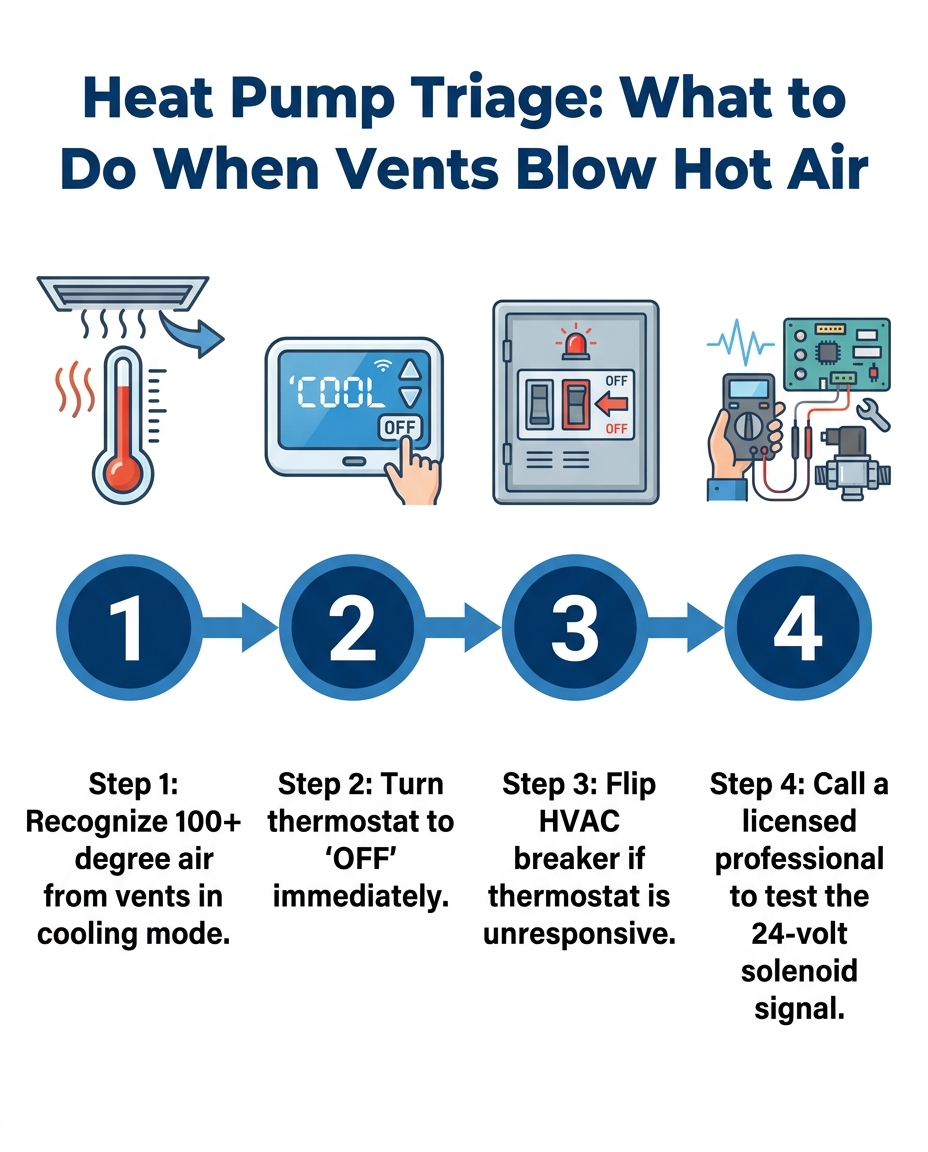
If you discover your vents are blowing hot air during a Texas summer, you must take immediate action to protect your equipment. In our extensive experience, allowing the system to run while trapped in the wrong mode places immense strain on the compressor, risking a total system failure that requires a costly replacement. Follow these immediate triage steps to secure your system:
1. Turn the thermostat to the "Off" position immediately: Do not just turn the temperature down lower. Lowering the temperature will only force the system to run longer, pumping more hot air into the home. Switch the system mode entirely to "Off."
2. Flip the dedicated HVAC breaker: If the thermostat is unresponsive, or if the outdoor unit continues to run after you turn the thermostat off, go to your electrical panel. Locate the dedicated breaker for the air handler and the outdoor heat pump, and flip them both to the "Off" position.
3. Check the outdoor unit for unusual sounds: Once the power is off, note if the outdoor unit was making a loud hissing sound or a repetitive clicking noise before it shut down. This information is highly valuable for your technician.
4. Call a licensed professional: Do not attempt to fix a reversing valve yourself. While replacing a solenoid is an electrical task, replacing a mechanically jammed reversing valve requires recovering the refrigerant, un-brazing the old valve with a torch, brazing in a new one, and recharging the system—tasks exclusively for licensed professionals.
Taking these steps immediately stops the influx of heat and prevents the compressor from overheating and burning out its internal windings.

Professional Diagnostics: Why Guesswork Fails
When a Carl's Quality Cooling and Heating LLC technician arrives at your home, the diagnostic process must be thorough and disciplined. Assuming the unit just "needs Freon" when it is actively blowing hot air is a dangerous misdiagnosis. Our skilled professionals follow a strict order of operations to isolate the exact cause of the failure.
First, the technician verifies the thermostat signals. They will check the O/B terminal to ensure the thermostat is actually asking the reversing valve to switch to cooling mode. Next, they test the solenoid for electrical continuity. If the coil is receiving the 24-volt signal but not generating a magnetic field, the coil is dead and can be replaced relatively quickly. Finally, if the electrical components are working perfectly, the technician will check the refrigerant charge and pressure differentials to confirm a mechanical jam inside the valve body.
Thorough diagnostics matter because they prevent recurring issues and ensure the system operates efficiently. For example, a homeowner who purchased a post-Harvey house in January noticed a significant temperature differential between floors. Rather than just guessing at a quick fix, our technician performed a full evaluation, ultimately designing and installing a new HVAC system to solve the root airflow and capacity issues permanently. Accurate heat pump and heating services depend on this disciplined approach. Same-day, accurate diagnosis is the only way to restore safe temperatures quickly without wasting money on unneeded parts.
Frequently Asked Questions: Heat Pumps and Cooling Failures
Why is my heat pump blowing hot air on cool?
Your heat pump is likely blowing hot air because the reversing valve has defaulted to its heating position. Many heat pumps are designed to fail-safe into heating mode if they lose electrical communication. This usually means the solenoid coil has burned out, the thermostat wiring is faulty, or the internal valve mechanism is physically jammed and cannot shift the refrigerant flow back to cooling.
How do I know if my reversing valve is stuck?
The most obvious sign of a stuck reversing valve is feeling hot air coming from your vents when the thermostat is set to cool. You might also hear a repetitive clicking noise at the outdoor unit as the solenoid struggles to shift the valve. In some cases, a stuck valve can disrupt refrigerant pressures so severely that you will see thick ice and frost building up on the outdoor coils during a Texas summer.
Why is my heat pump running but not cooling?
If your heat pump is running but not cooling, you could be dealing with a stuck reversing valve, a dead compressor, or a severe refrigerant leak. If the air coming out of the vents is actively hot, the reversing valve is the prime suspect. If the air is just room temperature, the compressor might not be engaging at all, or the system may lack the refrigerant needed to absorb heat from your home.
Can a heat pump reversing valve be fixed?
If the failure is electrical, the external solenoid coil can be replaced quickly and affordably without opening the refrigerant lines. However, if the reversing valve is mechanically jammed inside, it cannot be repaired. A licensed professional must completely remove the old valve with a brazing torch and weld a new one into place, which is a major repair requiring specialized equipment.
Is it safe to leave my heat pump running if it's blowing hot air?
Absolutely not. Leaving your heat pump running while it blows hot air damages the compressor and creates a severe heat hazard indoors. The system is working against itself, placing extreme electrical and mechanical strain on the outdoor unit. You should turn the system off immediately at the thermostat or the breaker to prevent permanent equipment damage.
Securing Your Home's Comfort with Precision
Understanding the reversing valve trap: why heat pumps suddenly stop blowing cold gives you the knowledge to protect your home when disaster strikes. This specific mechanical issue is a serious threat during the peak of summer, requiring an immediate shutdown to save your compressor from burning out. By turning the system off at the first sign of hot air, you prevent a bad situation from becoming a catastrophic equipment failure.
You do not have to settle for guesswork when it comes to your home's comfort. With clear, jargon-free explanations and our disciplined diagnostics, the root cause of a stuck valve can be identified and resolved efficiently. If you suspect your system is trapped in heating mode, securing prompt air conditioning repair services provides a validated, clear path forward. You deserve the peace of knowing your system is fixed right the first time, keeping your Conroe home safe and cool all summer long.


