


Is the Cost of Repairing Old HVAC vs Buying a New System Actually Worth It?
The cost of repairing old HVAC vs buying new system is one of the most consequential decisions a homeowner can face — especially when your house is heating up fast and a technician is waiting for an answer.
Here is a quick breakdown to help you decide:
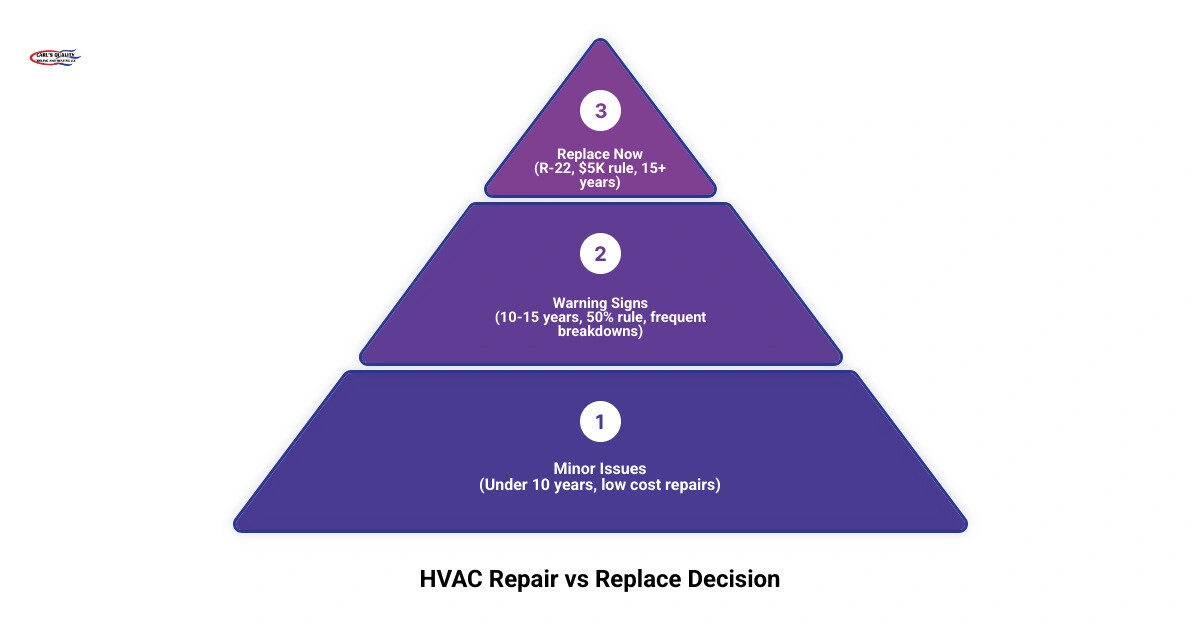
| Situation | Recommended Action |
|---|---|
| System under 10 years old, minor repair | Repair |
| Repair cost exceeds 50% of new system cost | Replace |
| Age × repair cost exceeds $5,000 | Replace |
| System uses R-22 refrigerant | Replace |
| Three or more repairs in the last three years | Replace |
| System is 15+ years old | Replace |
| Minor wear item (capacitor, thermostat) any age | Repair |
For most homeowners in Conroe and Montgomery County, the math points to replacement once a system crosses the 10-to-12-year mark and starts needing significant work. But the full picture is a little more nuanced — and getting it wrong either way can cost you thousands.
Here is the core problem: most people compare the repair quote to the replacement quote and stop there. That misses the bigger financial story. An older, inefficient system quietly drains money every single month through higher utility bills — a "slow bleed" that rarely shows up as one obvious expense. As one homeowner noted in a community discussion, their bills had been creeping up for years before they realized their aging AC was the culprit.
This guide walks you through the real math so you can make a confident, informed decision.
Understanding HVAC Lifespan in the Texas Climate
When we talk about the lifespan of an air conditioner or furnace, we have to talk about geography. A system in a mild climate might hum along for 20 years without a care in the world. However, here in the Conroe and Montgomery area, our HVAC systems work overtime.
The typical lifespan of a central AC unit is between 12 and 15 years, while a furnace might last 15 to 20. But in the intense heat of a Texas summer, your outdoor condenser unit is under immense pressure. We often see units in our service area, from The Woodlands to Willis, reach a "late-life" stage as early as year 10.
The 12-Year-Old Unit Milestone
If your system is 12 years old, it has reached a critical pivot point. At this age, the internal components — specifically the compressor and the evaporator coils — have endured thousands of cycles. Efficiency degradation is a real factor; an older unit may still be "running," but it might only be operating at 70% of its original capacity. This means it has to run longer to reach the same temperature, which accelerates wear and tear.
Knowing the Signs You Need Ac Replacement is vital at this stage. If you start noticing that some rooms are warmer than others or the system seems to be "short-cycling" (turning on and off rapidly), these are indicators that the mechanical components are struggling to keep up with the Montgomery County humidity.

The Financial Math: Cost of Repairing Old HVAC vs Buying New System
When deciding on the cost of repairing old HVAC vs buying new system, we recommend using a few established "rules of thumb" to remove the emotion from the decision. It’s easy to feel like a repair is the "cheaper" option because the immediate bill is lower, but this can lead to the "sunk cost fallacy" — the idea that you should keep spending money on something just because you’ve already spent money on it in the past.
The $5,000 Rule
This is one of the most reliable formulas in the industry. You multiply the age of your equipment by the estimated repair quote. If the result is over $5,000, replacement is usually the smarter financial move.
- Scenario A: A 12-year-old AC needs a $450 repair. (12 x 450 = 5,400). Since this is over 5,000, you are entering the "replace" zone.
- Scenario B: A 5-year-old AC needs a $600 repair. (5 x 600 = 3,000). This is well under the threshold, so a repair makes perfect sense.
The 10% Tipping Point
Another way to look at it is the 10% rule. If a single repair on a unit over a decade old costs 10% or more of what a brand-new system would cost, it’s often a sign that the unit is becoming a "money pit." For example, if a new installation is quoted at a certain amount and your repair is one-tenth of that, you’re essentially paying a 10% down payment on a system you don't even get to keep.
Check out these Replace Your Old Ac Unit Signs to see where your system stands.
Applying the 50% Rule to the Cost of Repairing Old HVAC vs Buying New System
The 50% rule is straightforward: If the repair cost exceeds 50% of the price of a new system, you should almost always replace it. Major component failures, such as a cracked heat exchanger or a dead compressor, often fall into this category.
A compressor is the "heart" of your AC. If it fails on a unit that is 12 years old, the labor and parts required to fix it are so extensive that you’re better off putting that investment toward a new, warrantied system. Similarly, if you're looking at your heating system, you need to decide whether to Repair Or Replace Your Furnace based on how much life is left in the heat exchanger. A failure there can be a safety risk, not just a financial one.
Long-Term ROI: Analyzing the Cost of Repairing Old HVAC vs Buying New System
The most overlooked part of the cost of repairing old HVAC vs buying new system is the Return on Investment (ROI) through energy savings.
As of May 2026, efficiency standards have moved from the old SEER ratings to the new SEER2 standards. An older unit might have a SEER rating of 10 or 13. A modern, high-efficiency SEER2 system can easily reach 18 to 25.
What does that mean for your wallet in Houston or Spring?
- Monthly Savings: Upgrading from a SEER 10 to a SEER2 16+ can reduce your cooling expenses by 20% to 40%.
- Variable-Speed Technology: Modern systems use variable-speed compressors. Unlike old systems that are either "all on" or "all off," these units adjust their speed to match the cooling needs of your home precisely. This significantly improves humidity control — a must-have for our North Houston climate.
If you are constantly calling for service, it might be Time For A Furnace Replacement or AC upgrade simply to stop the "slow bleed" of high utility bills and frequent service call fees.
Critical Signs Your System is Nearing Retirement
Sometimes the math isn't just about the dollars; it's about the "headache factor." If you are on a first-name basis with your HVAC technician because they are at your house every other month, your system is telling you it’s tired.
Frequent Breakdowns and "The Slow Bleed"
If you’ve had three or more repairs in the last three years, you are likely experiencing the "slow bleed." You might spend $300 here and $500 there, thinking you’re saving money. In reality, you’ve spent $1,500 over three years on a system that is still old, out of warranty, and likely to break down again during the next 100-degree July day.
Unusual Noises and Humidity Issues
Your HVAC system should be seen and not heard (mostly). Grinding, squealing, or banging noises often point to failing motors or loose internal components. Furthermore, if your home feels "sticky" or humid despite the AC running, the system is no longer effectively removing moisture from the air.
Safety Risks: The Cracked Heat Exchanger
For furnaces, a cracked heat exchanger is a "terminal" diagnosis. This component separates the combustion gases (like carbon monoxide) from the air blown into your home. If it cracks, there is a risk of carbon monoxide leaking into your living space. In these cases, we almost always recommend replacement, regardless of the system's age. It's best to look for Replace Heating System Before Spring Signs so you aren't caught in a winter emergency.
Refrigerant Regulations and Efficiency Standards in 2026
The landscape of HVAC repair changed significantly between 2020 and 2026. If your system was installed before 2010, it likely uses R-22 refrigerant (often called Freon). The EPA phased this out completely, meaning it is no longer manufactured or imported.
If an R-22 system develops a leak today, the cost of the reclaimed refrigerant alone can be astronomical — sometimes $100 to $150 per pound. Since a typical unit might need 6 to 12 pounds, a simple recharge can cost more than some minor repairs combined. This "refrigerant penalty" often makes the cost of repairing old HVAC vs buying new system lean heavily toward replacement.
The 2025/2026 Transition
Starting in 2025 and continuing through 2026, the industry has transitioned to even more sustainable refrigerants like R-454B and R-32. These new standards are designed to be better for the environment and more energy-efficient. Investing in a new system now "future-proofs" your home, ensuring that parts and refrigerant will be readily available and affordable for the next 15 years. If you're unsure of your current refrigerant type, it's a good time to ask When To Replace Your Heater or AC unit before the next major breakdown.
Frequently Asked Questions
Is it worth repairing a 12-year-old HVAC system?
In the Texas climate, a 12-year-old system is in its "late-life" stage. While a minor repair like a capacitor or a thermostat is almost always worth it, major repairs (anything over $1,000) are generally not recommended. The risk is that you spend a significant amount on a repair today, only for another major component to fail next year, all while paying higher energy bills due to the unit's age.
How much can a new high-efficiency system save on monthly bills?
On average, homeowners in areas like Magnolia, Montgomery, and Conroe see a 20% to 40% reduction in their cooling costs when moving from an old SEER 10-13 unit to a modern SEER2 17+ system. When you factor in smart thermostat integration, which learns your schedule and optimizes run times, the savings can be even higher. Over five years, these savings can often offset a significant portion of the initial installation cost.
What are the most common signs of a failing compressor?
The compressor is the most expensive part of your AC. Signs of failure include:
- Hard Starting: The outdoor unit stutters or makes a loud noise when trying to turn on.
- Tripping the Breaker: A failing compressor often draws too much electricity, causing your circuit breaker to trip.
- Warm Air: If the fan is blowing but the air isn't cold, the compressor may not be pumping refrigerant properly.
- Electrical Issues: Burnt wires or a "burnt" smell near the outdoor unit often indicate a terminal electrical failure in the compressor.
Conclusion
Choosing between the cost of repairing old HVAC vs buying new system isn't just about fixing a mechanical problem; it's about making a strategic decision for your home’s future. A new system provides more than just cold air; it offers lower monthly bills, improved indoor air quality, and the peace of mind that comes with a 10-year manufacturer warranty.
At Carl's Cooling LLC, we live and work in the same communities you do — from April Sound to Woodforest. We understand the unique demands the Texas heat puts on your home. Our goal is to provide honest, transparent advice so you can choose the path that makes the most sense for your budget and your comfort.
Whether you need a precision repair to get through the season or a high-efficiency installation to save for the next decade, we are here to help. More info about HVAC services is available on our service page, or you can reach out to us for a professional diagnostic of your current system.


