

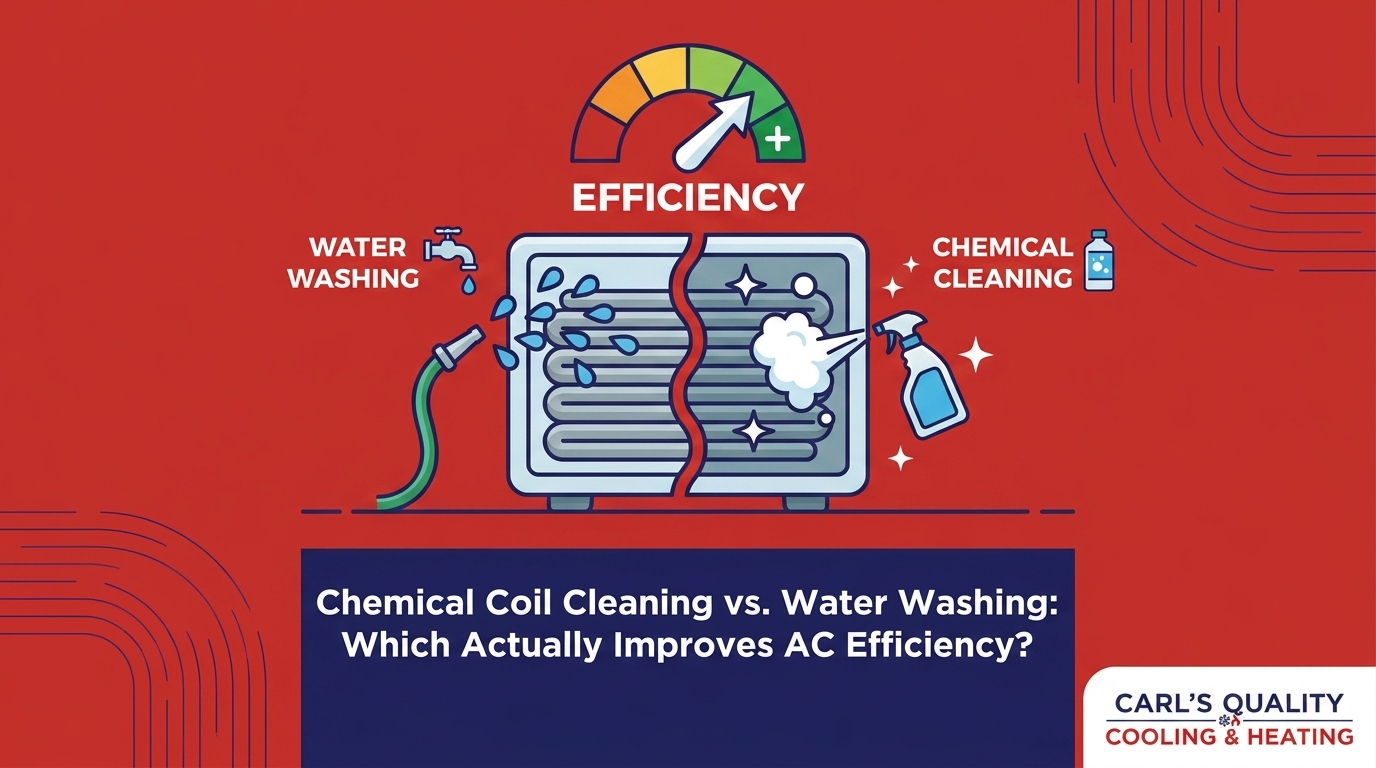

The Myth of Aggressive AC Maintenance
There is a widespread misconception that harsher chemicals automatically yield a cleaner, more efficient cooling system. When our team at Carl's Quality Cooling and Heating LLC discusses Chemical Coil Cleaning vs. Water Washing: Which Actually Improves AC Efficiency?, we often find Conroe homeowners assume that heavy, bubbling chemical foams are always required to restore performance. The reality is far more nuanced. Deciding whether heavily impacted dirt necessitates aggressive chemical agents or if a gentle water wash is sufficient is a critical diagnostic step, particularly during the critical pre-summer AC prep season.
Applying industrial-strength cleaners to delicate HVAC components without assessing the actual debris type can do more harm than good. Maximizing energy efficiency under peak July cooling loads means protecting the structural integrity of your equipment, not just making it look shiny. If you are exploring air conditioning services, understanding the objective differences between these two cleaning methods is the first step toward safeguarding your investment and ensuring reliable summer comfort.
How Dirt Impacts Standard Aluminum Fin Condenser Units
To understand why coil cleanliness dictates energy efficiency, you have to look at the mechanics of heat transfer. The outdoor unit of your air conditioner does not actually create cold air; it acts as a thermal exhaust system. It collects the heat from inside your home and releases it into the outdoor air. Standard aluminum fin condenser units are engineered specifically for this purpose, utilizing hundreds of paper-thin metal ridges to maximize the surface area available for heat dissipation.
When these microscopic spaces become clogged with debris, the entire refrigeration cycle is compromised. The Department of Energy (DOE) notes that a buildup of just 0.01 inches of dirt on a condenser coil can reduce system efficiency by 5% and increase energy consumption by up to 30%. Here is exactly how that restriction causes cascading failures within the system:
1. Airflow restriction: Dirt and grime form an insulating blanket over the standard aluminum fin condenser units, blocking the fan from pulling sufficient air across the hot metal.
2. Trapped heat: Because the heat cannot escape into the surrounding air, the refrigerant inside the copper tubes remains too warm as it cycles back into your house.
3. Compressor strain: To compensate for the lack of heat transfer, the system runs longer cycles. The compressor, the most expensive component in the unit, is forced to work exponentially harder.
4. Thermal overload: Under maximum summer load, this continuous strain significantly increases the risk of the compressor overheating, leading to abrupt system failure right when you need cooling the most.
Framing maintenance as a matter of technical performance rather than simple aesthetics reveals why keeping these coils clear is non-negotiable. If you are considering a routine AC maintenance plan, ensuring the coils are cleaned using the correct method is the single most important factor for long-term reliability.
Water Washing: When Gentle Pressure is the Optimal Choice
In many scenarios, plain water is the safest and most effective method for clearing standard aluminum fin condenser units. When a system is maintained regularly, the debris that accumulates is typically superficial. Gentle water washing focuses on removing this barrier without introducing corrosive variables into the sensitive metal ecosystem.
The Pros and Cons of Water Washing:
• Pro: Protects microscopic integrity. Gentle water pressure preserves the delicate structure of the fins, preventing them from folding over and permanently blocking airflow.
• Pro: Zero chemical residue. Water leaves nothing behind. Unrinsed chemicals can actually become sticky over time, attracting more dirt and accelerating future clogs.
• Pro: Environmentally neutral. Plain water runoff does not harm the landscaping or soil surrounding your outdoor unit.
• Con: Ineffective on grease. Water alone cannot break down oily residues or heavy biological growth that has baked onto the metal.
The types of debris best suited for water washing include loose dry particulate, standard yard dust, cottonwood seeds, and grass clippings. However, even plain water requires precision. Professional water washing involves specific nozzle angles and calibrated pressure to prevent bending the fins. Blasting a coil with a high-pressure power washer will instantly flatten the aluminum, destroying the unit's ability to transfer heat. This is why proper AC unit cleaning relies on specialized wands that push water straight through the fins, rather than striking them at a destructive angle.
Chemical Coil Cleaners: Penetrating Impacted Grime
While water is ideal for loose dust, there are specific, technical criteria that make chemical foaming agents strictly necessary. Chemical use should always be a targeted intervention rather than a default maintenance step, reserved for buildups that water simply cannot penetrate.
The Problem: Over time, especially in areas near kitchens, dryer vents, or heavy foliage, standard aluminum fin condenser units accumulate impacted grime, airborne grease, and biological growth. This material bakes onto the coils, forming a hardened, sticky crust that repels plain water.
The Cause: Moisture acts as a binding agent. When morning dew or rain mixes with airborne pollutants, it creates a sludge that lodges deep within the coil bed. Because the coils are heavily layered, this sludge gets trapped in the center of the unit, completely out of reach of a standard water spray.
The Solution: Professional-grade chemical foaming agents are engineered to break this specific bond. Technicians utilize highly calibrated acidic, alkaline, or neutral cleaners depending on the exact nature of the grime. When applied, these chemicals undergo a rapid expansion process. The resulting heavy foam pushes deep into the center of the coil bed, lifting impacted dirt, grease, and biological growth outward toward the surface where it can be safely rinsed away. The professional methodology requires precise application timing and immediate neutralization to ensure the standard aluminum fin condenser units are not structurally compromised during the process.
The Hidden Risks of Chemical Overuse on Aluminum Fins
The satisfying visual of heavy foam pushing dirt out of an air conditioner often leads to the dangerous assumption that stronger chemicals are always better. In reality, the indiscriminate use of harsh cleaners introduces severe risks to the equipment, often negating any short-term efficiency gains.
Premature degradation is the most immediate threat. Highly acidic or alkaline cleaners are highly effective at stripping grease, but they do not differentiate between dirt and the metal itself. If used unnecessarily, these chemicals strip away the protective factory coating applied to standard aluminum fin condenser units. Once this microscopic protective layer is gone, the raw aluminum is exposed directly to the elements, drastically reducing the unit's operational lifespan.
Galvanic corrosion occurs when dissimilar metals interact in the presence of an electrolyte—in this case, harsh, unrinsed chemical residue. Because condenser coils feature copper tubes wrapped in aluminum fins, leaving highly reactive chemicals on the surface creates a tiny electrical current between the two metals. This process literally eats away at the aluminum over time, causing the fins to turn into a brittle white powder that crumbles at the slightest touch.
ASHRAE standard maintenance guidelines strongly emphasize the importance of chemical neutralization. If a foaming agent is used, it must be thoroughly rinsed and neutralized to halt the chemical reaction. Relying on professional HVAC services ensures that chemical applications are handled with the exact chemistry and timing required to clean the unit without triggering irreversible corrosion.
Assessing Condenser Debris in High-Humidity Environments
Environmental factors heavily influence the type of debris that accumulates on outdoor units, meaning that diagnostic assessments must account for geographic location. What works in a dry desert climate will not necessarily work in a humid coastal region.
In Conroe's Gulf Coast climate, average summer humidity levels frequently exceed 70%. Our technicians see first-hand how this heavy moisture fundamentally changes how dirt interacts with your HVAC equipment. Instead of remaining a dry, loose particulate that can easily blow away or be rinsed off, the high humidity turns everyday dust into a thick, sticky mud. More importantly, this constant dampness creates the ideal breeding ground for biological buildup on the coils.
During the transition from the pre-summer AC prep season to peak July heat, this biological growth accelerates rapidly if left unchecked. The combination of high ambient temperatures, constant moisture, and organic food sources (like pollen and grass) allows heavy biofilms to coat the condenser. Plain water often glides right over these biological layers without removing them. Therefore, climate assessment is a critical part of our professional diagnostic process. Recognizing that Gulf Coast humidity breeds impacted grime allows us to select the appropriate cleaning method before the system is pushed to its limits under peak summer load.
Criteria for Choosing the Optimal Coil Cleaning Method
Choosing between water and chemicals requires an objective diagnostic framework. Relying on visual assessment guidelines prevents unnecessary chemical application while ensuring severe blockages are properly addressed.
• Gentle Water Washing — Target Debris Type: Loose dust, grass clippings, pollen, dry dirt — Risk to Equipment: Low (preserves factory coatings) — Ideal Scenario: Routine seasonal maintenance on standard aluminum fin condenser units
• Neutral Chemical Cleaners — Target Debris Type: Light biological growth, moderate stubborn dirt — Risk to Equipment: Moderate (requires thorough rinsing) — Ideal Scenario: Units exposed to high humidity but free of heavy grease
• Alkaline/Acidic Foams — Target Debris Type: Impacted grime, heavy grease, severe biofilms — Risk to Equipment: High (risk of corrosion if not neutralized) — Ideal Scenario: Severely neglected units with critical airflow restriction
Professional Diagnostic Steps:
• Visual baseline check: Inspecting the standard aluminum fin condenser units for discoloration, which indicates biological growth rather than just dry dust.
• Airflow measurement: Checking the temperature and volume of the air exhausting from the top of the unit to gauge internal restriction.
• Residue testing: Determining if the debris is oily (requiring chemicals) or dry (water sufficient).
• Age assessment: Factoring in the age of the unit, as older fins are more susceptible to chemical degradation.
Relying on objective diagnostics rather than default upselling protects your equipment. If you notice your system struggling to keep up with the heat, it is time to contact our technicians for a proper evaluation.

Expert Answers to Common Coil Cleaning Questions
Can you just spray AC coils with water?
Yes, spraying AC coils with water is highly effective for removing loose, dry debris like dust and grass clippings. However, it is generally insufficient for impacted grime or heavy biological growth. Furthermore, it must be done with the correct nozzle angle and pressure to avoid bending the delicate aluminum fins and permanently restricting airflow.
Is chemical coil cleaner safe for aluminum fins?
Chemical coil cleaner is safe only when applied, neutralized, and rinsed correctly by a professional. If harsh acidic or alkaline cleaners are left on the standard aluminum fin condenser units without proper neutralization, they pose a high risk of stripping the factory coating and causing severe galvanic corrosion over time.
Do AC coils need to be chemically cleaned?
Not always; chemical cleaning is a targeted solution for specific impacted grime, not a mandatory baseline requirement. If a system receives regular maintenance and only suffers from light dust accumulation, a gentle water wash is often the safest and most optimal choice to preserve the equipment's lifespan.
What is the best way to clean AC condenser coils?
The best way to clean AC condenser coils is through a professional assessment that matches the cleaning agent to the specific debris type. A technician will evaluate whether the unit requires the deep penetration of a foaming agent for heavy grease, or if a low-pressure water wash is sufficient to restore efficiency without risking chemical damage.
When should you use foaming coil cleaner?
Foaming coil cleaners should be used when the condenser is suffering from severe blockages, heavy biological growth, or oily residues. The expanding action of the foam is specifically designed to push impacted dirt out from the deep center of the coil bed where plain water cannot reach.
How does high humidity affect AC coil dirt buildup?
High humidity significantly alters how dirt accumulates by acting as a binding agent. The constant moisture turns dry dust into a sticky, impacted grime and creates an ideal environment for biological growth, often requiring a different cleaning approach than units in dry climates.
Prioritizing Equipment Lifespan and Peak Efficiency
Ultimately, the right maintenance method does more than just make your outdoor unit look clean; it protects your investment and ensures peak cooling performance when the summer heat is at its worst. Standard aluminum fin condenser units require precise, thoughtful care rather than default chemical dousing. Applying harsh foams without a clear diagnostic reason can strip protective coatings, accelerate corrosion, and shorten the life of the very equipment you are trying to maintain.
As a veteran-owned business, our team at Carl's Quality Cooling and Heating LLC operates with an ethos of integrity, which means recommending honest, no-nonsense maintenance that prioritizes your equipment's lifespan over unnecessary chemical upsells. We believe in doing the job right the first time, using the safest, most effective method tailored specifically to your unit's condition. If you want to ensure your system is prepared for the heavy lifting ahead, reach out to schedule a thorough, objective assessment with our knowledgeable technicians.


