


Why Choosing a Trusted Local HVAC Provider Is One of the Most Important Decisions You'll Make
Choosing a trusted local HVAC provider is the single best thing you can do to protect your home's comfort, your energy bills, and your investment in new or repaired equipment. Get it right, and your system runs reliably for 15 to 20 years or more. Get it wrong, and you could face surprise breakdowns, inflated energy bills, and repairs that never quite solve the problem.
Here is a quick overview of what to look for:
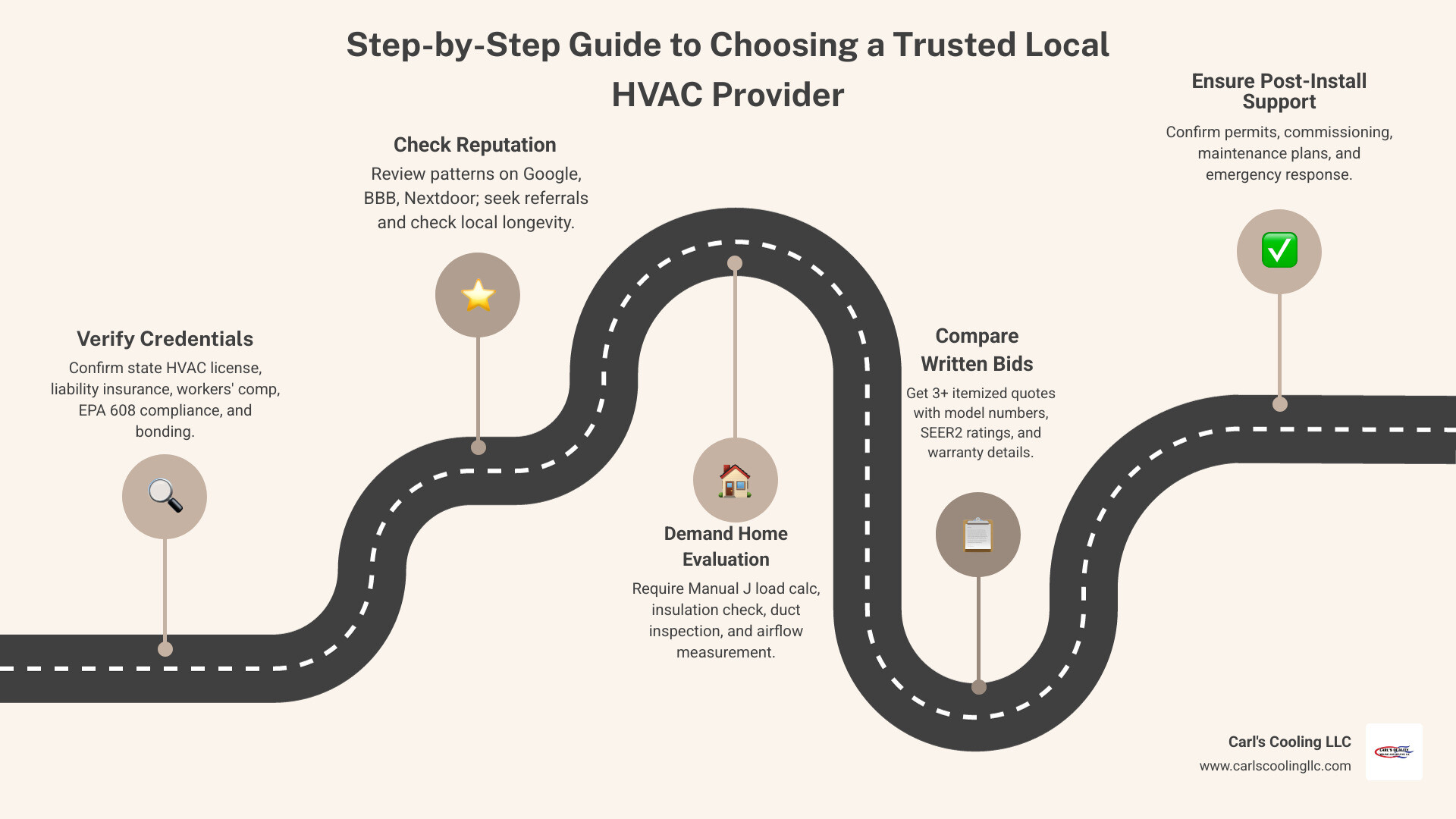
- Verify credentials - Confirm a valid state HVAC license, general liability insurance, and workers' compensation coverage
- Check reputation - Read review patterns on Google, BBB, and Nextdoor; ask neighbors for referrals
- Demand a home evaluation - A trustworthy contractor measures your home before recommending any system
- Compare written bids - Get at least three itemized estimates with equipment model numbers and warranty details
- Confirm permits and commissioning - Any contractor unwilling to pull permits or provide a commissioning report is a red flag
- Ask about maintenance support - Reliable providers offer ongoing maintenance plans and clear emergency response policies
The stakes are real. A third-party study found that nine out of ten new HVAC systems installed by licensed companies still had energy deficiencies, and three out of four newly installed air conditioners had the wrong refrigerant charge. That is not a fringe problem — it is the industry norm when homeowners skip the vetting process.
In Conroe, Montgomery, and the surrounding communities of Montgomery County, the summer heat makes a reliable HVAC system essential, not optional. This guide walks you through every step of finding a contractor you can actually trust.
Essential Credentials for Choosing a Trusted Local HVAC Provider

When we talk about April 2026 standards for home comfort, we aren't just talking about the latest smart thermostats. We are talking about the legal and professional safety nets that protect you if something goes wrong. In Texas, and specifically across our service areas like The Woodlands, Willis, and Magnolia, verifying credentials is the first line of defense.
A legitimate contractor should proactively offer proof of the following:
- State HVAC License: This isn't just a piece of paper. It confirms the contractor has at least five years of experience, has passed a rigorous 10-hour exam covering codes and safety, and completes annual continuing education.
- General Liability Insurance: This protects your property. If a technician accidentally causes damage to your home, this insurance covers the repairs.
- Workers' Compensation: This is vital for your protection. If a worker is injured on your property, workers' comp ensures you aren't held liable for their medical expenses.
- Municipal Permits: If a contractor suggests skipping a permit to "save time," walk away. Permits ensure a third-party inspector verifies the work meets local safety codes.
- EPA Section 608 Compliance: This is a federal requirement for any technician handling refrigerants. It ensures they know how to manage these chemicals without harming the environment.
By ensuring these boxes are checked, you are already ahead of the curve. For more information on how these standards apply to your home, you can explore our full range of HVAC services.
Verifying Reputation and Local Experience
Credentials tell you if a company can do the work; reputation tells you if they will do it well. When choosing a trusted local HVAC provider, look for patterns rather than isolated reviews. Does the company consistently show up on time? Do they clean up after themselves?
We recommend checking these sources:
- Google and Yelp: Look for detailed reviews that mention specific technicians or problem-solving.
- The Better Business Bureau (BBB): Check for a high rating and, more importantly, how the company responds to any complaints.
- Local Word-of-Mouth: In tight-knit communities like Bentwater or April Sound, your neighbors are your best resource.
- Community Longevity: A company that has served Montgomery County for years has a vested interest in maintaining its good name.
You can see what our neighbors are saying by reading our latest reviews or learn more about us and our commitment to the local area.
Red Flags When Choosing a Trusted Local HVAC Provider
Trust your gut, but also look for these specific warning signs:
- Lump-Sum Bids: If an estimate is just a single number on a napkin with no breakdown of equipment or labor, it’s a major red flag.
- No Physical Address: Be wary of "truck and a ladder" operations that lack a brick-and-mortar presence.
- High-Pressure Sales: If they tell you the "deal is only good for today," they are trying to stop you from doing your research.
- Skipping Load Calculations: If they glance at your old unit and say, "We'll just put back the same size," they aren't doing their job. Your home's needs may have changed due to new windows or insulation.
- Refusal to Pull Permits: This is often a sign that they aren't licensed or don't want their work inspected.
If you have more questions about what to avoid, our FAQ page offers deeper insights into the hiring process.
What to Expect During a Professional Home Evaluation
A professional consultation should take between one and two hours. It isn't just a sales pitch; it's a technical assessment. When we visit a home in Conroe or Spring, we look at the whole house as a system.
A proper evaluation includes:
- Manual J Load Calculation: This is the industry standard for sizing. It accounts for your home's square footage, orientation to the sun, insulation levels, and window efficiency.
- Ductwork Integrity: Even the best AC unit will fail if your ducts are leaking air into your attic. We check for leaks and proper sizing to ensure indoor air quality services can be effective.
- Airflow Measurement: We test how much air is actually reaching your rooms.
- Humidity Control: In our humid Texas climate, your air conditioning services must be able to remove moisture, not just lower the temperature.
The Long-Term Value of Choosing a Trusted Local HVAC Provider
The "cheapest" bid is often the most expensive in the long run. A system that is poorly installed might use 30% more energy than it should. By choosing a trusted local HVAC provider, you are investing in:
- System Lifespan: Proper commissioning—the process of testing the system after install—can help a unit last 20 years instead of 10.
- Safety: Correct wiring and gas line connections prevent fires and carbon monoxide leaks.
- Energy Efficiency: You'll see the difference in your monthly utility bills.
- Environmental Impact: Properly charged systems use less power and prevent refrigerant leaks.
We also offer commercial services for business owners who need this same level of reliability. To make these investments more manageable, check out our financing options and current promotions.
Comparing Written Bids and Ensuring Quality Workmanship
Once you have three bids, it's time to compare them "apples-to-apples." Don't just look at the bottom line.
| Feature | Trusted Contractor A | "Lowball" Contractor B |
|---|---|---|
| Equipment | Brand name with model # | Vague "16 SEER unit" |
| Sizing | Based on Manual J | "Same as old one" |
| Duct Work | Sealed and tested | Not mentioned |
| Permits | Included in bid | "Not necessary" |
| Warranty | 10-year parts / 2-year labor | Manufacturer parts only |
| Commissioning | Written report provided | Not provided |
An itemized scope of work should clearly list the SEER2 ratings (the current efficiency standard as of 2026) and any modifications needed for your heating services. Always demand a commissioning report. This document proves that the refrigerant charge, airflow, and static pressure meet the manufacturer's exact specifications. You can see our commitment to this level of detail on our service page.
Post-Installation Support and Maintenance
The relationship shouldn't end when the van pulls out of your driveway. A trusted provider will walk you through your new system, show you how to change the filters, and explain how to use your new thermostat.
Ongoing care is critical. We highly recommend a maintenance plan that includes seasonal tune-ups. This keeps your warranty valid—most manufacturers require professional maintenance to honor their 10-year parts guarantee. Furthermore, knowing who to call for a fast emergency response provides peace of mind when those July heatwaves hit. If you ever need to reach us, our contact us page is always available.
Frequently Asked Questions about HVAC Contractors
How do I verify a contractor's license in Montgomery County?
In Texas, you can verify an HVAC license through the Texas Department of Licensing and Regulation (TDLR) website. You can search by the company name or the license number, which should be clearly displayed on their trucks and marketing materials.
Why is a Manual J load calculation necessary for my home?
Every home is unique. Factors like the number of windows, the height of your ceilings, and the quality of your insulation determine how much "load" (heat) your system needs to remove. Without this calculation, you risk buying a system that is too large (which leads to humidity issues) or too small (which won't keep you cool).
What should be included in a final written contract?
A solid contract includes the total price, a payment schedule, the specific model numbers of all equipment, the start and completion dates, and a clear description of the warranty for both parts and labor.
Conclusion
At Carl's Cooling LLC, we believe that choosing a trusted local HVAC provider shouldn't feel like a gamble. As a family-owned business, we’ve built our reputation across Conroe, Montgomery, and the surrounding areas by prioritizing technical precision and honest communication. From the first load calculation to the final commissioning report, our goal is to ensure your home remains a sanctuary of comfort for years to come.
Whether you need a complex new installation or a simple seasonal tune-up, look for a partner who values your home as much as you do. Learn more about our values and our team on our about us page, and let's make sure your home stays perfectly comfortable, no matter what the Texas weather throws your way.


