


The Sudden Chill: Why Your Furnace Blows Cold Air on the First Brisk Morning
Your thermostat clicks, signaling the start of a heating cycle. You hear the familiar hum of the draft inducer motor and the engaging of the blower fan, but as you stand over the vent, the air rushing into the room is ice cold. At Carl's Quality Cooling and Heating LLC, we know firsthand that understanding The Anatomy of a Gas Furnace Ignitor and Why They Fail Over Time is the first step to resolving this frustrating, yet surprisingly common, early fall pre-heating season issue. Waking up to a freezing house during an unexpected cold snap often sends homeowners into a panic, assuming the entire heating system has suffered a catastrophic breakdown.
In our years of diagnosing heaters in Conroe, we've found that a furnace going through its startup sequence but failing to produce heat is often dealing with a localized, physical wear-and-tear issue. The most common culprit is a small but mighty component designed to withstand extreme conditions, which eventually reaches the end of its natural lifespan. Rather than a total system failure, our team is usually looking at a part that simply needs to be swapped out to restore warmth to your home. By learning how this specific component operates, you can make informed decisions about your heating services and recognize exactly why professional diagnosis and replacement are non-negotiable for safe operation.
What is a Hot Surface Ignitor?
When our technicians explain why a furnace is blowing cold air, we always start with the technology responsible for creating the flame. In decades past, furnaces relied on a standing pilot light—a small, continuously burning blue flame that waited for the gas valve to open. While functional, standing pilots wasted energy and were easily blown out by drafts. Modern high-efficiency furnaces have replaced this outdated technology with electronic ignition systems, the most common of which rely on silicon carbide hot surface ignitors.
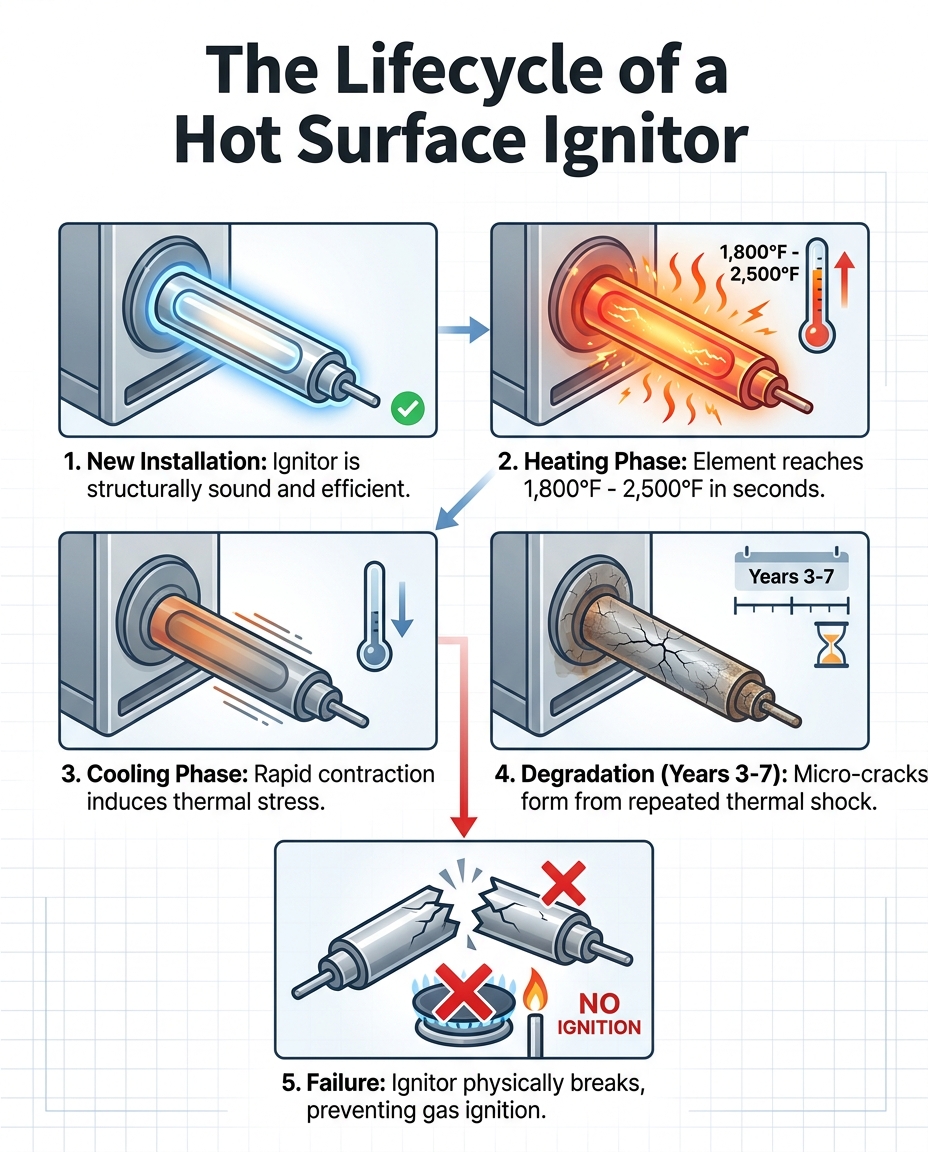
A hot surface ignitor acts much like the filament in a high-powered incandescent light bulb or the glowing element in a toaster, but on a far more extreme scale. When your thermostat calls for heat, the furnace's control board sends an electrical current directly to the ignitor. Because the material has high electrical resistance, it rapidly converts that electricity into intense heat. Within a matter of seconds, the small element glows white-hot, reaching temperatures between 1,800 and 2,500 degrees Fahrenheit. Once it reaches the required temperature, the gas valve opens, releasing fuel across the glowing element to ignite the main burners.
This extreme operational environment requires a component that can heat up instantly without melting. However, because the part is subjected to such violent temperature swings every single time the furnace turns on, it is inherently subjected to massive structural stress. When this component finally gives out, securing professional heating repair is the only safe way to restore the ignition sequence.
Comparing Ignition Technologies
• Standing Pilot Light — How It Works: Burns a small amount of gas 24/7 to ignite the main burner. — Efficiency: Low (wastes gas continuously). — Failure Mode: Blown out by drafts or clogged pilot tube.
• Direct Spark Ignition — How It Works: Creates a high-voltage electrical arc (spark) to light the gas. — Efficiency: High (only uses power during startup). — Failure Mode: Spark electrode wears out or control board fails.
• Hot Surface Ignitor — How It Works: Glows white-hot via electrical resistance to ignite gas. — Efficiency: High (reliable, instantaneous heat). — Failure Mode: Physical cracking from thermal shock over time.
The Material Science: Why Silicon Carbide Becomes Brittle
The secret to the hot surface ignitor's ability to reach 2,500 degrees in seconds lies in its material composition. The vast majority of these components are manufactured from silicon carbide or silicon nitride. Silicon carbide hot surface ignitors are highly conductive and capable of withstanding blistering heat, but they possess a significant physical drawback: they are incredibly fragile and brittle at a microscopic level.
The underlying problem: Every time your furnace cycles on, the ignitor undergoes a violent physical reaction known as thermal shock. As the electricity flows through the silicon carbide, the material rapidly expands. A few minutes later, once the main burners are lit and the ignitor's job is done, the electrical current stops, and the material rapidly contracts as it cools back down to room temperature. This constant, rapid expansion and contraction places immense strain on the crystalline structure of the component.
The localized cause: Our team sees the effects of this thermal stress constantly in climates like Conroe, Texas. Because our region experiences prolonged periods of mild weather, a furnace might sit completely dormant for weeks or months. When a sudden, sharp cold front pushes through, the furnace is called into action. The rapid heating of a cold, dormant ignitor causes acute thermal shock. Over hundreds and thousands of these cycles, microscopic structural weaknesses begin to form in the silicon carbide. These micro-cracks slowly propagate through the material, increasing the electrical resistance and causing the ignitor to burn even hotter at the site of the crack.
The inevitable solution: Eventually, the physical degradation becomes too much, and the material simply snaps or shatters. It is important to note that this is not an electronic glitch or a software error on the control board; it is a purely physical breakdown of a brittle material. Once the physical bridge is broken, electricity can no longer flow, the element cannot glow, and the furnace will not ignite.

Recognizing the Symptoms of Ignitor Failure
When the early fall pre-heating season arrives and your furnace fails to produce warmth, paying attention to the system's sequence of operations can help you identify if the ignitor is to blame. Modern furnaces follow a strict safety protocol, and listening to this sequence provides our technicians with critical clues before we even open the cabinet.
Normally, you will hear a click from the control board, followed by the hum of the inducer motor clearing the exhaust pipe. A few seconds later, you should hear a distinct "whoosh" sound as the gas ignites. If the ignitor has failed, you will hear the initial clicks and the inducer motor, but the "whoosh" of the gas will be entirely absent. Shortly after, the main blower fan may engage, circulating completely unheated air throughout your home.
• Audible clicks with no ignition: The control board is attempting to send power to the ignitor, but the broken circuit prevents it from glowing.
• Cold air from vents: The blower motor runs its timed cycle, assuming the burners are lit, distributing unheated air.
• Short cycling: The furnace attempts to start three or four times before going into a hard safety lockout.
Modern heating equipment is designed with strict safety mechanisms. If the hot surface ignitor fails to glow, the flame sensor will not detect a flame. Within roughly four seconds, the control board will slam the gas valve shut to prevent raw, unburned gas from flooding your home. This safety feature is highly effective, but it leaves you without heat. We recently helped a local homeowner who experienced this exact scenario, reaching out to our dispatch at 10 p.m. on a freezing winter night when their heater suddenly stopped running and the house temperature plummeted. Our technicians were deployed immediately, working late into the night to diagnose the sequence failure and get the heater safely running within the hour.
A Consumable Part, Not a Catastrophic Breakdown
When a furnace stops working, the immediate fear is that the entire system needs to be replaced. However, it is crucial to view silicon carbide hot surface ignitors not as permanent fixtures, but as consumable parts with a finite lifespan. Much like the brake pads on a vehicle, an ignitor is designed to withstand extreme stress, but the very nature of its job guarantees that it will eventually wear out.
In our daily service calls, we typically see the average lifespan of a standard hot surface ignitor range from 3 to 7 years under normal operating conditions. This lifespan is heavily dependent on several environmental and operational factors. A cracked ignitor simply means the part has fulfilled its duty cycle, absorbed thousands of thermal shock events, and needs to be swapped out by a professional.
Factors That Influence Ignitor Lifespan
• Short Cycling — Impact on Lifespan: Decreases Lifespan — Why It Matters: An oversized furnace or clogged filter forces the ignitor to turn on and off rapidly, doubling the thermal shock events.
• Airborne Dust — Impact on Lifespan: Decreases Lifespan — Why It Matters: Dust and debris settling on the element can insulate the heat, causing the ignitor to run hotter than designed.
• Voltage Spikes — Impact on Lifespan: Decreases Lifespan — Why It Matters: Power surges can send too much electricity through the fragile material, accelerating degradation.
• Routine Maintenance — Impact on Lifespan: Increases Lifespan — Why It Matters: Clean filters and proper airflow ensure the system cycles normally, reducing unnecessary wear and tear.
The Danger of DIY: Why Replacement Requires Professional Precision
Because the ignitor is a relatively small component, we occasionally see homeowners attempt a DIY replacement. We strongly advise against this, as it is highly dangerous and almost always leads to immediate failure. The process of replacing silicon carbide hot surface ignitors requires strict professional handling due to the extreme fragility of the materials involved.
The physics of contamination: The human hand naturally produces oils. If a person touches the dark grey element of a brand-new silicon carbide ignitor with their bare skin, those microscopic oils transfer to the porous surface. When the furnace is turned on and the element attempts to reach 2,500 degrees, the oil acts as an insulator. This creates a localized "hot spot" on the material. The uneven heating causes the brand-new part to shatter instantly upon its very first use.
Beyond the fragility of the part, our licensed professionals use specialized diagnostic tools to verify that the control board is sending the correct voltage to the ignitor. If the board is sending 120 volts to an ignitor rated for 80 volts, the new part will burn out immediately. Furthermore, because the repair involves the direct combustion sequence and the gas valve, our team ensures that all safety mechanisms, including the flame sensor and pressure switches, are calibrated and operating safely before we ever leave your home.
Military-Grade Precision: Catching Micro-Cracks Early
The most effective way to handle ignitor failure is to prevent it from happening on the coldest night of the year. Through disciplined, proactive visual inspections, our trained technicians can spot the early signs of material fatigue long before the component shatters. As silicon carbide ages and degrades, it often develops a white, powdery oxidation on its surface, indicating that the material is becoming dangerously brittle.
At Carl's Quality Cooling and Heating LLC, our veteran-owned background instills a military-grade precision approach to preventative care. We treat routine maintenance not as a casual glance, but as a meticulous inspection mission. Catching a micro-crack during the early fall pre-heating season allows us to replace the weakened part before it leaves your family freezing at midnight. This disciplined approach applies to all aspects of HVAC care. For instance, when our crew responded to a customer in an older house who noticed a severe 30-degree temperature differential between floors in January, a meticulous, highly detailed assessment was required to design and install a completely new, balanced HVAC system that resolved the massive airflow imbalance. Attention to detail prevents minor weaknesses from becoming major comfort crises.
Enrolling in our comprehensive preventative maintenance plan ensures that your heating system receives this level of rigorous inspection every single year. By identifying and replacing a brittle ignitor on your schedule, you maintain long-term system reliability and eliminate the stress of emergency breakdowns.
Preparing Your Heating System for the Fall Transition
As the long, hot summer fades, transitioning your home for cooler weather requires proactive steps. Waiting until the first frost to turn on your heater is a gamble, especially considering the thermal shock that dormant components will endure.
Our team strongly advises homeowners to schedule their annual heating tune-up well before the temperatures drop significantly. An early fall pre-heating season inspection gives our technicians the opportunity to test the entire ignition sequence, verify the health of the ignitor, clean the flame sensor, and ensure the gas valve opens smoothly. By testing your furnace before the first cold snap, you allow experts to identify wear-and-tear in a controlled environment.
Taking action early ensures that when the first real cold front arrives, your heating equipment will respond seamlessly, providing safe, reliable warmth without the sudden chill of a failed ignition cycle.
Frequently Asked Questions About Furnace Ignitors
What causes a furnace ignitor to go bad?
Our technicians find that a furnace ignitor goes bad primarily due to repeated thermal shock. Because the component rapidly heats to over 2,000 degrees and then cools back down during every heating cycle, the fragile silicon carbide material naturally expands and contracts. Over time, this constant physical stress creates micro-cracks that eventually cause the part to break and fail.
How do I know if my furnace ignitor is bad?
We typically diagnose a bad ignitor when a furnace clicks on and the blower runs, but only cold air comes out of the vents. Audibly, you will hear the system attempt to start, but you will not hear the distinct "whoosh" of gas igniting. Visually, our trained technicians will see that the element fails to glow white-hot or has physically snapped in half.
Can a furnace ignitor be repaired?
In our professional experience, no, a hot surface ignitor cannot be repaired under any circumstances. It is a physical, consumable part that shatters or cracks due to thermal fatigue. Once the material is broken, the electrical circuit is permanently severed, and the component must be completely replaced by a licensed professional.
How long do furnace ignitors last?
The average lifespan of a hot surface ignitor is between 3 to 7 years. This timeframe depends heavily on how often the furnace cycles on and off, the quality of the incoming electrical voltage, and whether the system receives regular maintenance to prevent short-cycling.
Why shouldn't I clean my hot surface ignitor?
You should never touch or clean a hot surface ignitor because the natural oils from your skin will transfer to the highly sensitive material. When the ignitor heats up, these oils create a localized hot spot that causes the brittle silicon carbide to shatter instantly. Furthermore, the material is so fragile that even gentle wiping can easily snap the component.
Secure Your Comfort Before the Cold Arrives
Understanding how your furnace initiates its heating cycle removes the mystery and stress of unexpected cold-air blowouts. When you recognize that an ignitor is simply a consumable part enduring intense thermal stress, you can take proactive steps to maintain your system. Rely on our local, disciplined experts to thoroughly inspect your equipment during the early fall pre-heating season. Schedule your professional maintenance today to ensure your home remains warm, safe, and perfectly comfortable all winter long.


