


The Hidden Threat of the Early Fall Allergy Spike in Montgomery County
Nearly 75% of indoor air quality issues in Southeast Texas become noticeably worse as summer transitions into autumn. Your air conditioner is still running hard to combat the lingering heat, but inside the house, you might find yourself sneezing, coughing, or waking up with a scratchy throat. Severe autumn ragweed and mold spores easily bypass standard HVAC filters, circulating freely through your living spaces right as the September ragweed and mold peak begins. As pollen counts surge, you face a critical decision: how to upgrade your home's filtration to capture these microscopic invaders without suffocating your system's airflow.
To tackle this seasonal shift effectively, a multi-layered approach combining routine cooling maintenance with specialized indoor air quality services provides the lasting relief your family needs.
Many homeowners assume that the worst of allergy season happens in the spring. However, the transition out of peak summer heat in Conroe triggers a massive release of ragweed pollen. A single ragweed plant can produce up to one billion pollen grains, which travel easily on the late summer breeze. When these grains enter your home through open doors, drafty windows, or fresh air intakes, your HVAC system becomes the primary distributor. If your filtration strategy hasn't been updated for the season, you are essentially paying your ductwork to blow allergens directly into every room of your house.
Why Standard Filters Fail Against East Texas Autumn Allergens
When you purchase a standard air filter at a big-box hardware store, you are likely buying a product designed to protect metal components, not human lungs. Understanding the mechanical limitations of these basic filters is the first step toward improving your home's air quality during the Montgomery County / Conroe TX autumn.
The Problem: Microscopic Invaders
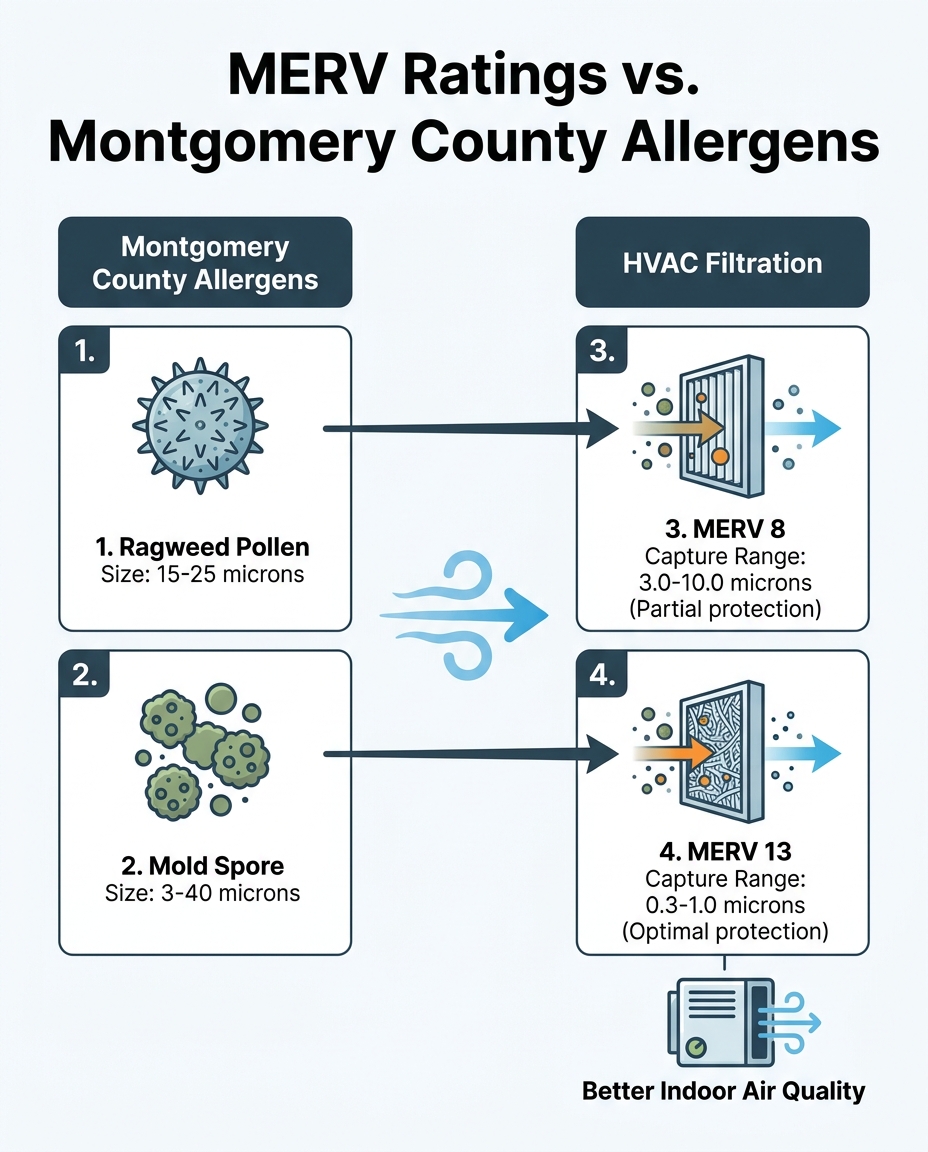
Allergens are measured in microns, a unit of length equal to one-millionth of a meter. To put this in perspective, a single strand of human hair is roughly 70 microns thick. Typical Montgomery County ragweed pollen ranges from 15 to 25 microns in size, while local mold spores can be anywhere from 3 to 40 microns. Because Conroe's lingering Gulf Coast humidity creates a dual-threat environment, mold spores actively grow inside dark, damp ductwork alongside the airborne ragweed pulling in from outside.
The Cause: Mechanical Limitations of MERV 8
The Minimum Efficiency Reporting Value (MERV) rates how effectively a filter traps airborne particles. Standard fiberglass or basic pleated filters usually sit around a MERV 8 rating. These filters are highly effective at catching large debris like pet hair, carpet fibers, and heavy dust. Their primary job is to prevent this large debris from caking onto your evaporator coil or burning out your blower motor. However, they are highly porous. When particles as small as 15 microns hit a MERV 8 filter, a significant percentage simply passes right through the fiberglass mesh and recirculates back into your living room.
The Solution: Regional Expertise and Targeted Filtration
Relying on standard filters during the fall peak leaves families vulnerable to poor indoor air quality. By accurately identifying the exact East Texas allergens plaguing homeowners—specifically the potent combination of high-humidity mold and aggressive September ragweed—we can implement a targeted filtration strategy. Upgrading your filter means shifting the focus from simply protecting the machinery to actively purifying the air you breathe.

The Mechanics of a MERV 13 Filtration Upgrade
When comparing a MERV 8 vs MERV 13 rating, the difference lies in the density of the filter media and the technology used to weave the fibers. A MERV 13 upgrade is often the sweet spot for residential allergy relief, providing hospital-grade particle capture without requiring commercial-grade ventilation equipment.
How MERV 13 Media Works: A MERV 13 filter utilizes a much denser, tightly woven synthetic mesh. More importantly, these filters often feature an electrostatic charge. Just as a balloon rubbed on your hair attracts static electricity, the fibers in a MERV 13 filter actively attract and hold onto microscopic particles as they pass through the return vent. This dual-action mechanical and electrostatic trapping allows the filter to capture particles as small as 0.3 to 1.0 microns.
Immediate Indoor Air Quality Improvements: Because ragweed pollen and mold spores fall well above the 1.0-micron threshold, a MERV 13 filter traps nearly all of these allergens on the first pass. When you transition to this level of filtration, the continuous circulation of your HVAC system acts as a whole-home air purifier. Within just a few hours of operation, the concentration of airborne allergens in the home drops significantly.
EPA Recommendations: The Environmental Protection Agency (EPA) explicitly notes that upgrading to higher-efficiency filters can significantly improve indoor air quality. They recommend using the highest MERV rating that your system's manufacturer allows, specifically noting that filters in the MERV 13 range are highly effective at capturing the biological pollutants that trigger severe respiratory responses during seasonal transitions.
Airflow Restrictions: Can Your System Handle the Upgrade?
While upgrading from a MERV 8 vs MERV 13 rating sounds like an easy fix, it comes with a critical warning: denser filters restrict the amount of air pulling through your system. If your HVAC equipment is older, improperly sized, or poorly maintained, a high-efficiency filter can actually cause catastrophic system failure.
This challenge comes down to a metric called static pressure. Your blower motor is designed to push and pull a specific volume of air. When you install a dense MERV 13 filter, it acts like a thick blanket over the return vent. The blower motor has to work twice as hard to pull the same amount of air through the dense media. If the motor cannot overcome this resistance, the airflow across your indoor evaporator coil drops dangerously low. Without enough warm household air passing over the coil, the refrigerant inside gets too cold, leading to frozen evaporator coils, overheated blower motors, and sudden system shutdowns.
One homeowner with an older beam and block house recently needed a new, efficient HVAC system installed to handle modern demands. Because older homes often feature unique ductwork limitations, we installed a system specifically calibrated for their layout. The system has worked very well, proving that with professional measurement and proper equipment sizing, even older architecture can support high-efficiency filtration without suffocating the blower.
Signs Your HVAC is Struggling to Breathe
If you recently upgraded your filter and notice any of the following symptoms, remove the dense filter immediately and consult a professional to measure your static pressure:
• Weak airflow from vents: You can barely feel the air coming out of the registers, even when the fan is set to "high."
• Unusual whistling noises: High pressure forcing air through tiny gaps around the filter frame often creates a high-pitched whistling sound near the return vent.
• Constant operation: The system runs continuously but struggles to reach the temperature set on the thermostat because it cannot move enough conditioned air into the living spaces.
• Ice on the refrigerant lines: Visible frost or ice building up on the copper lines outside or the indoor coil is a massive red flag for restricted airflow.
Complementary Solutions Beyond Traditional Filtration
Not every older beam and block house in Conroe has an HVAC system capable of pushing air through high-MERV filters. If a professional static pressure test reveals that a MERV 13 filter will suffocate your blower motor, you don't have to settle for poor indoor air quality. There are active air purification technologies that do not restrict airflow.
Unlike passive filters that wait for dust to hit them, active systems proactively seek out and neutralize pollutants. These solutions are installed directly into your ductwork and work alongside a standard, breathable filter. If you are comparing Aerus air scrubbers to standalone purifiers, you'll find that whole-home integrated solutions offer much broader coverage for Montgomery County / Conroe TX homes.
• MERV 13 Filter — How It Works: Passively traps particles in dense, electrostatically charged media. — Airflow Impact: High (Requires strong blower motor) — Best For: Modern systems with variable-speed blowers and properly sized ducts.
• UV Germicidal Lights — How It Works: Scrambles the DNA of biological contaminants passing under the light. — Airflow Impact: Zero (Does not block air) — Best For: Neutralizing mold spores growing near the indoor coil and drain pan.
• Whole-Home Air Scrubbers — How It Works: Releases specialized oxidizers into the air to clump and destroy allergens. — Airflow Impact: Zero (Installed inside the plenum) — Best For: Older homes that cannot handle dense filters; aggressive allergy relief.
By comparing these supplemental options, you can find the right fit for your specific home architecture. A combination of a standard MERV 8 filter to catch the big debris, paired with a UV light to neutralize mold spores, often provides exceptional relief without putting an ounce of extra strain on an aging blower motor.
Preparing Your System for the Fall Transition
The transition from heavy summer cooling to early fall operation is the absolute best time to evaluate your filtration strategy. During the peak summer months, your AC runs almost non-stop, pulling massive amounts of dust, pet dander, and humidity through the system. By the time the September ragweed and mold peak arrives, your system is likely already strained.
A dirty system will completely negate the benefits of a new, high-quality filter. If your indoor evaporator coil is already caked with summer dust, slapping a restrictive MERV 13 filter on the return vent will push the static pressure past the breaking point. Furthermore, if the blower motor is coated in grime, it cannot spin at its designed speed, further reducing the amount of air circulating through your home.
Before making any drastic changes to your filtration, we highly recommend scheduling a comprehensive inspection. A professional technician will clean the coils, check the blower motor's amp draw, clear the condensate drain line of any summer algae, and ensure the system is physically ready for the allergy peak. Staying on a consistent routine HVAC maintenance plan ensures that your equipment remains clean, efficient, and capable of supporting whatever indoor air quality upgrades you choose to implement.
Conroe Homeowner FAQs: HVAC Filtration and Fall Allergies
What MERV rating is best for fall allergies like ragweed and mold?
A MERV 13 filter is generally considered the optimal residential rating for tackling fall allergies. It effectively captures microscopic particles between 0.3 and 1.0 microns, which easily traps ragweed pollen and mold spores before they can recirculate through your home. Ratings higher than 13 are typically reserved for hospitals and can severely damage standard residential air conditioners.
Can my residential HVAC system handle a MERV 13 filter?
Not all residential systems are designed to push air through a MERV 13 filter safely. Older or undersized units, particularly those with single-stage blower motors, may struggle against the dense filter media, leading to restricted airflow and frozen coils. It is always best to have a professional measure your system's static pressure before making a significant jump in filter density.
Does running the AC help reduce indoor fall allergies?
Yes, running your air conditioner actively helps reduce indoor allergies by filtering the air and controlling humidity. As the system circulates air through the return vents, the filter traps airborne pollen, while the cooling process pulls excess moisture out of the air, making the environment less hospitable for mold growth.
How often should I change my air filter during Conroe's allergy season?
During the peak of allergy season, you should check your air filter every 30 days and replace it at least every 45 to 60 days. High pollen counts, combined with normal household dust and pet dander, can clog a high-efficiency filter much faster in September than during the milder winter months.
Why are mold spores a specific concern for Montgomery County HVAC systems in early fall?
The combination of warm temperatures and lingering Gulf Coast humidity creates the perfect breeding ground for mold spores. As summer transitions into fall, this moisture often condenses inside dark HVAC ductwork and around the evaporator coil, allowing mold to multiply and blow into your living spaces alongside seasonal ragweed.
Can a restricted air filter cause my AC to freeze up in September?
Yes, a highly restrictive or clogged air filter is a leading cause of frozen AC coils. When a dense filter blocks warm household air from passing over the indoor evaporator coil, the refrigerant inside the coil drops below freezing, turning normal condensation into a solid block of ice that eventually shuts down the system.
Breathe Easier This Fall in Conroe
Surviving the severe September allergy spike in Southeast Texas requires more than just keeping your windows closed and hoping for the best. When ragweed and mold spores bypass standard filters, they turn your home into an allergy trap. A strategic upgrade from a standard MERV 8 vs MERV 13 rating can drastically improve your indoor comfort, provided your equipment is prepared to handle the denser media.
Before you swap out your filters, it pays to know exactly what your system can support. By consulting a local professional to evaluate your ductwork, measure static pressure, and clean your coils, you ensure that your upgrades provide maximum allergy relief without risking a breakdown. If you are ready for a clear explanation of your options and actionable guidance on safely upgrading your home's air quality, our comprehensive air conditioning services are designed to help you breathe easier all season long.


