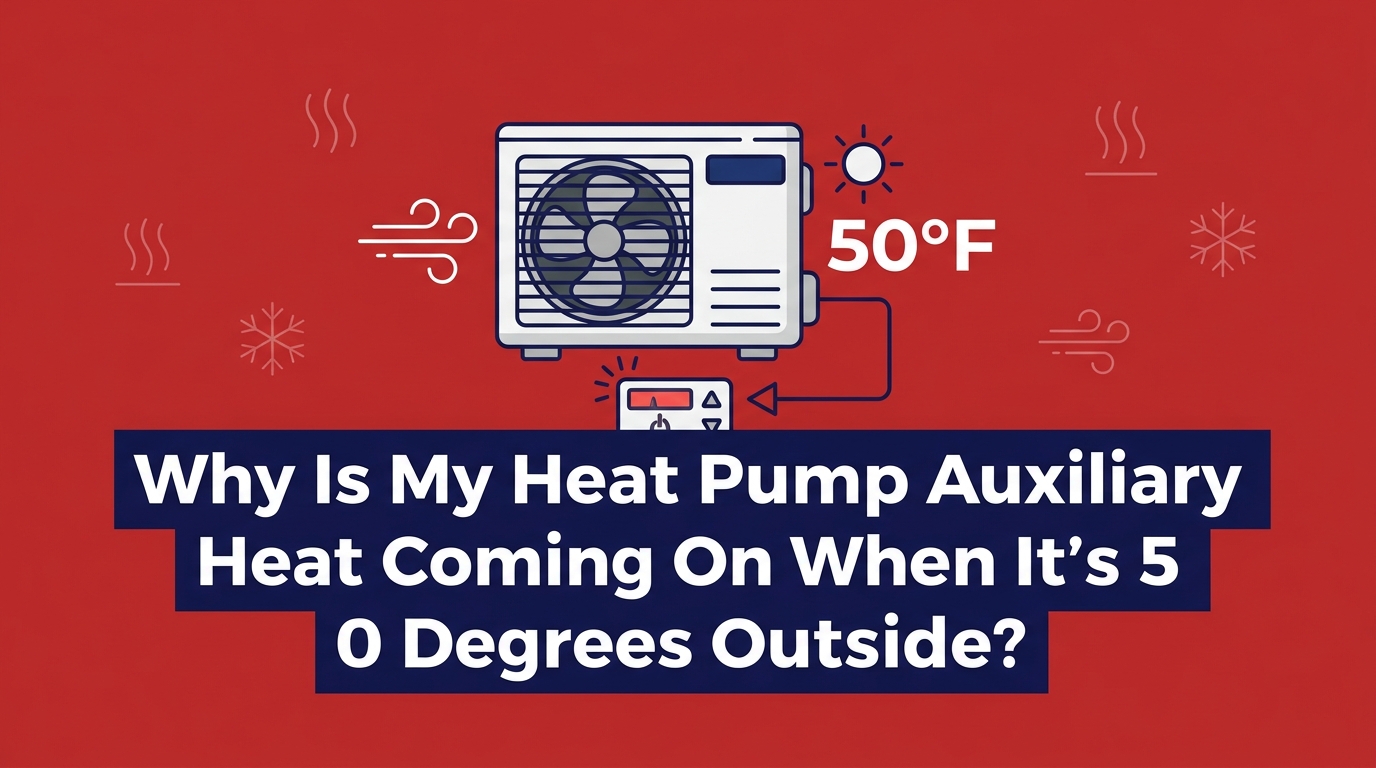

Is It Normal for Aux Heat to Run During a Mild 50-Degree Cold Snap?
At Carl's Quality Cooling and Heating LLC, one of the most common early fall questions our team hears from Conroe homeowners is, "Why is my heat pump auxiliary heat coming on when it's 50 degrees outside?" If you just woke up to a mild September morning and noticed that alert on your thermostat, you are right to be suspicious. At 50 degrees, your heat pump has more than enough ambient thermal energy available outdoors to warm your house without any backup assistance. Seeing the auxiliary (or "Aux") heat indicator means something is forcing those highly inefficient electric heat strips to turn on prematurely.
The good news is that this concrete problem usually comes down to a simple decision point: figuring out if someone in the house accidentally triggered a thermostat setting mistake, or if there is a genuine mechanical malfunction requiring professional diagnostics. Modern heat pump technology is incredibly resilient and designed to handle weather far colder than a 50-degree morning. Before you panic about a broken compressor or a failing system, it helps to understand exactly how these units are designed to operate. If you need assistance right away, our team provides comprehensive HVAC services to get your system back on track.
Understanding Heat Pump Balance Points and the 50-Degree Benchmark
To understand why your backup heat is activating too early, we first need to look at the mechanical baseline of heat pump efficiency. Heat pumps do not generate heat the way a gas furnace does; instead, they extract ambient heat from the outdoor air and move it inside. During early fall (September) here in Southeast Texas, morning lows occasionally dip to 50 degrees. This marks the first time heating systems are used for the season, which frequently exposes dormant system issues and incorrect settings.
What is an Economic Balance Point?
The economic balance point is the exact outdoor temperature where your heat pump can no longer efficiently heat the home on its own, making it cheaper to run a backup heating source. For most modern systems, this balance point is typically set dynamically by the thermostat between 30 and 35 degrees Fahrenheit. Above this temperature, the heat pump compressor operates as the sole source of warm air.
Why 50 Degrees is Well Above the Threshold
A reading of 50 degrees provides abundant thermal energy for your system's refrigerant to absorb. In fact, high-efficiency heat pumps function perfectly well down to 5 to 15 degrees. When the outdoor temperature is 50 degrees, your system should operate entirely in its primary heating stage. To illustrate why this matters, look at the stark contrast between your primary heat pump and the backup electric strips.
• Primary Heat Pump Compressor — How It Works: Transfers existing ambient heat from outside to inside. — Efficiency Level: High (Produces roughly 3 units of heat per 1 unit of electricity) — Ideal Operating Temp: Above 30-35 degrees
• Electric Resistance Strips (Aux Heat) — How It Works: Generates heat directly by running electrical current through metal coils. — Efficiency Level: Low (Produces exactly 1 unit of heat per 1 unit of electricity) — Ideal Operating Temp: Below freezing or during defrost
Thermostat Configuration Errors: The Most Common Culprit
In our years of servicing Conroe and Montgomery County, a pattern we see often is that if your system is mechanically sound, the most likely reason your auxiliary heat is running at 50 degrees is a user-induced configuration error. Smart thermostats and programmable controllers use specific algorithms to decide when the house needs emergency help to reach your desired temperature. If you are troubleshooting a blank thermostat screen or dealing with strange heating behaviors, check these common settings first.
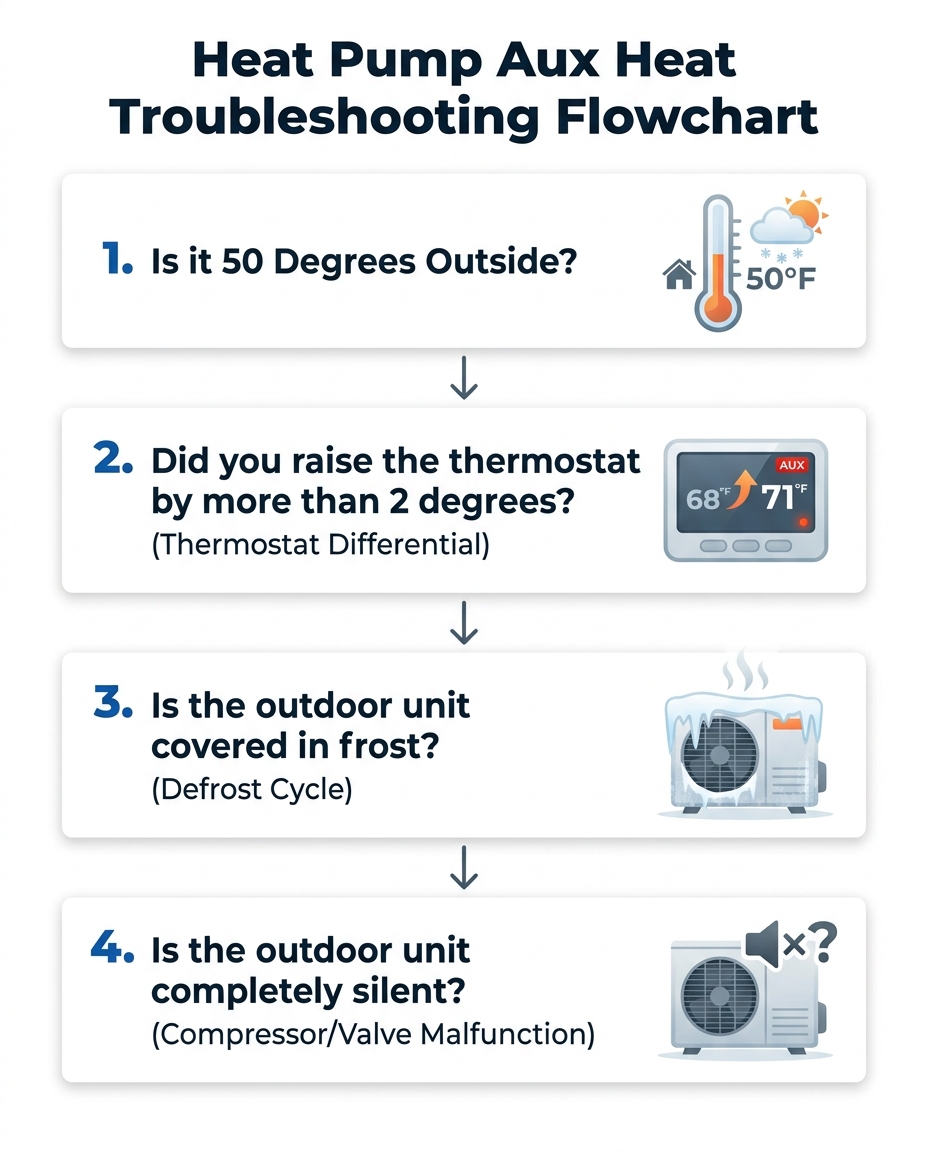
1. Check the thermostat differential: The differential is the number of degrees you can change the temperature before the system calls for backup. If you walk up to the thermostat and bump the heat up by more than 2 to 3 degrees all at once, the system assumes the heat pump cannot handle the load alone and immediately turns on the aux heat to bridge the gap.
2. Inspect the droop settings: "Droop" refers to how far the indoor temperature is allowed to fall below your set point before backup heat kicks in. If the droop is set too tight (e.g., 1 degree), even a slight draft could trigger the electric heat strips.
3. Test with gradual increases: To see if a differential setting is your problem, try gently increasing the indoor temperature just 1 degree at a time. Wait a few minutes between adjustments. If the aux heat stays off, your system is fine—you just need to avoid large temperature jumps.
4. Verify the emergency heat switch: Many thermostats have a dedicated "Emergency Heat" (Em Heat) setting. If this was accidentally toggled on while cleaning or adjusting the interface, it locks out the outdoor compressor completely and forces the electric strips to run, regardless of the outdoor temperature.

The Defrost Cycle: When Temporary Aux Heat is Normal
There is one specific operational exception where auxiliary heat might briefly activate, even in milder weather conditions. Heat pumps occasionally enter a defrost cycle to melt frost that accumulates on the outdoor coils.
During a defrost cycle, the system temporarily reverses its operation, switching into cooling mode. This pulls warm air from inside your home and sends it outside to thaw the frozen coils. To prevent blowing freezing cold air through your indoor vents while this happens, the system automatically turns on the electric aux heat strips to temper the air.
It is important to note that this cycle should be brief. A normal defrost cycle typically lasts only 10 to 15 minutes. While frost is less common at 50 degrees here in Conroe, high humidity combined with rapid temperature drops can occasionally trigger the sensors. However, if the aux heat stays on continuously for hours, it is no longer a normal defrost cycle. You are likely dealing with a faulty defrost control board or a malfunctioning temperature sensor.
The Energy Impact of Unnecessary Electric Heat Strips
Allowing your auxiliary heat to run unchecked during mild weather carries significant financial and energy-efficiency consequences. Electric heat strips operate using electrical resistance—similar to the coils inside a toaster. Because they have to generate heat from scratch rather than moving existing heat, they can consume up to three times more electricity than your heat pump compressor.
Relying on aux heat at 50 degrees completely defeats the purpose of investing in a high-efficiency heat pump. If you ignore the "Aux Heat" light during the early fall (September) transition, you will likely be shocked by surprisingly high early-season utility bills. Your system is working much harder than it needs to, burning excess electricity to accomplish a job the compressor could handle easily.
The upgrade advantage: If your current thermostat lacks precise control over balance points and differentials, upgrading to a smart thermostat can save considerable energy. When looking into upgrades, remember to check for generally applicable energy rebates or utility incentive programs in your area. Federal tax credits or local utility incentives often apply to qualifying high-efficiency heat pump and smart thermostat installations, helping offset the initial cost of gaining better control over your auxiliary heat.
When to Call a Professional for Heat Pump Troubleshooting
If you have verified that your thermostat is set correctly, you haven't bumped the temperature up too fast, and the unit isn't in a brief defrost cycle, it's time to transition away from user error. Persistent auxiliary heat points to mechanical failures that require an expert eye. As a veteran-owned business serving Conroe, our team at Carl's Quality Cooling and Heating LLC believes in a commitment to honest, transparent diagnostics—helping homeowners fix simple configuration errors when possible, rather than pushing unnecessary equipment replacements. However, some issues strictly require professional heating services.
Signs of a Failing Reversing Valve
The reversing valve is the component that allows your heat pump to switch between cooling and heating modes. If this valve gets stuck, the outdoor unit will run, but only cold air will blow from the vents. Sensing that the indoor temperature is dropping, the thermostat will panic and trigger the auxiliary heat strips to keep the house warm. Replacing a reversing valve requires recovering refrigerant and brazing new copper lines, which must be done by a licensed technician.
Outdoor Compressor Lockouts
If you walk outside and notice that the outdoor unit is completely silent while the indoor fan continues to run, the compressor has likely entered a safety lockout. This can happen due to low refrigerant flow, a bad capacitor, or electrical shorts. When the primary heat source is unresponsive, the system defaults entirely to electric strips. Never attempt dangerous DIY electrical work when dealing with high-voltage heat pump wiring or internal capacitors. Our technicians handle these professional diagnostics daily, which entails checking internal sensors, testing high-voltage components safely, and verifying exact refrigerant pressures without putting you at risk.
Proactive Heating Maintenance for Early Fall
The best way to avoid unexpected auxiliary heat activation is to take preventive action before the weather gets truly cold. Routine check-ups catch thermostat misconfigurations, sensor issues, and minor wear before they turn into mid-winter breakdowns. For example, our team recently helped a local Conroe homeowner who experienced a significant temperature differential between floors in January after purchasing a post-Harvey house; by having our experts design and install a properly calibrated HVAC system, they were able to correct the airflow issues and enjoy an efficient, quiet setup.
We highly recommend testing your heating system on the first mild day of early fall (September) rather than waiting for a freeze. Signing up for a routine HVAC maintenance plan ensures these checks happen automatically. A comprehensive pre-season tune-up for a heat pump system includes:
• Calibrating the thermostat: Ensuring the differential, droop, and balance point settings match the specific capabilities of your equipment.
• Testing the defrost sensors: Verifying that the defrost board activates and terminates the cycle at the correct temperatures.
• Checking refrigerant levels: Low refrigerant forces the compressor to work harder and often triggers early auxiliary heat.
• Inspecting the reversing valve: Cycling the system between heating and cooling to ensure the valve shifts smoothly without sticking.
• Testing electrical components: Measuring the amp draw on the compressor and the electric heat strips to ensure they are operating within safe manufacturer limits.
Frequently Asked Questions About Heat Pump Auxiliary Heat
Why is my auxiliary heat on when it's 50 degrees?
The most common reason your auxiliary heat is on at 50 degrees is a thermostat configuration error, such as raising the set temperature by more than two degrees at once. When you demand a rapid temperature increase, the system uses the electric heat strips to warm the house faster. It can also be caused by incorrect balance point settings, a system stuck in a defrost cycle, or an outdoor compressor failure that forces the system to rely entirely on backup heat.
How do I stop my heat pump from using auxiliary heat?
To stop your heat pump from using auxiliary heat, try raising your indoor temperature gradually, just one degree at a time, rather than making large jumps. You should also check your thermostat settings to ensure it is not switched to "Emergency Heat" mode. If you have a smart thermostat, you can often adjust the compressor lockout temperature or the auxiliary heat differential settings to prevent the strips from activating during mild weather.
What is the balance point of a heat pump?
The balance point of a heat pump is the specific outdoor temperature at which the heat pump can no longer extract enough ambient heat to keep the home warm on its own. For most modern systems, the economic balance point sits between 30 and 35 degrees Fahrenheit. Below this temperature, the system requires the help of auxiliary electric heat strips or a secondary gas furnace to maintain indoor comfort.
Is it bad if aux heat is on?
It is not inherently bad if your aux heat turns on, as it is a designed safety feature meant to keep your home warm during extreme cold or during a brief defrost cycle. However, it is highly inefficient. If the aux heat is running frequently during mild weather, it indicates a setting error or a mechanical problem that will cause your electricity bills to skyrocket unnecessarily.
At what temperature should auxiliary heat actually come on?
Auxiliary heat should typically only come on when the outdoor temperature drops below your system's balance point, which is usually around 30 to 35 degrees Fahrenheit. It may also activate briefly at higher temperatures if the outdoor coil accumulates frost and the system needs to run a 10-to-15-minute defrost cycle.
Does emergency heat use more electricity than auxiliary heat?
Emergency heat and auxiliary heat actually use the exact same electric resistance heat strips inside your air handler, meaning they consume the same high amount of electricity when active. The difference is operational: auxiliary heat runs automatically alongside the heat pump to help it catch up, while emergency heat is a manual setting that shuts off the outdoor heat pump entirely and relies 100% on those expensive electric strips.
Get Transparent Heat Pump Diagnostics Today
While a simple thermostat bump is an easy fix you can handle yourself, persistent auxiliary heat running at 50 degrees requires an expert eye. Ignoring the issue will only lead to excessive wear on your system and unnecessarily high utility bills as those electric strips consume massive amounts of power. We remain committed to honest, transparent service—we will help you identify whether you just need a thermostat recalibration or a deeper mechanical repair. Protect your system's health and your energy budget by scheduling a professional inspection for Conroe and surrounding service areas today.