

Is That Musty Smell Just Dust Burn-Off or Mold In HVAC Ducts?
Why does your home suddenly smell like a damp basement the moment you turn on the heat? You finally switch your thermostat from cooling to heating for that November first-furnace-use, and instead of cozy warmth, you are greeted by a harsh, earthy odor. You are likely wondering if this is just normal seasonal dust burning off the heating elements, or if you are dealing with actual mold in hvac ducts. After running your air conditioning constantly through a long, humid season, that sudden smell is a clear signal to investigate what is happening inside your ventilation system.
When you need to get to the bottom of lingering vent odors, our indoor air quality services provide the clear answers you need.
The sudden shift in seasons exposes hidden issues.
For months, your air conditioner has been pushing cold air through your home. This constant airflow often masks subtle odors. However, when the weather cools down and your system sits idle for a few weeks, any moisture left behind in the dark corners of your ductwork has time to stagnate. The moment you fire up the furnace, a wave of hot air rushes through those same ducts, baking whatever has settled inside and blowing the resulting odors directly into your living spaces.
This creates a stressful decision point for homeowners. Ignoring a genuine biological issue allows it to spread, but panicking over harmless seasonal dust causes unnecessary worry. Understanding exactly what happens inside your system during the transition from summer cooling to fall heating is the first step toward restoring fresh, clean air to your home.
How Extreme Summer Humidity Creates Hidden Moisture Pools
To understand why your ducts smell musty in the fall, you have to look at what your system endured over the summer. Cooling a home is only half of an air conditioner's job; the other half is dehumidification. As warm indoor air passes over your system's freezing-cold evaporator coil, moisture condenses into water droplets, much like a cold glass of iced tea sweating on a summer afternoon.
The burden of the Gulf Coast climate.
In the Conroe, TX / Gulf Coast climate, where summer humidity regularly exceeds 70%, this dehumidification process works in overdrive. A typical residential cooling system can pull gallons of water out of the air every single day. This constant flow of heavy condensation heavily taxes your equipment, and when mechanical drainage slows down, hidden moisture pools begin to form.
When you want to ensure your system handles this heavy moisture load efficiently next season, our air conditioning services focus on keeping these critical drainage pathways clear.
The Mechanics of Moisture Buildup
Moisture escapes into your ductwork through a few common mechanical failures:
• Sluggish condensate drains: If the primary drain line backs up even slightly, water pools in the drain pan. The system's blower motor can then pick up this standing water and mist it directly into the supply ducts.
• Sweating duct insulation: In a hot, humid attic, cold air rushing through poorly insulated metal or flex ductwork causes condensation to form on the outside and sometimes inside of the vapor barrier.
• Air leaks in unconditioned spaces: If your return ducts have a tear or a loose seal, they pull hot, humid attic or crawlspace air directly into the system, overwhelming the unit's ability to remove moisture.
Because the interior of your ductwork is completely dark, these small, hidden moisture pools remain undetected. While the AC runs constantly, the cold temperatures keep biological growth relatively slow. But the moisture is there, waiting for the right conditions to thrive.
Dust Burn-Off vs. Actual Mold: Key Differences to Look For
When you experience that jarring odor during your November first-furnace-use, you need to know what you are smelling. Dust burn-off is a completely normal, harmless event. Real biological growth requires professional attention. Here is how you can tell the difference.
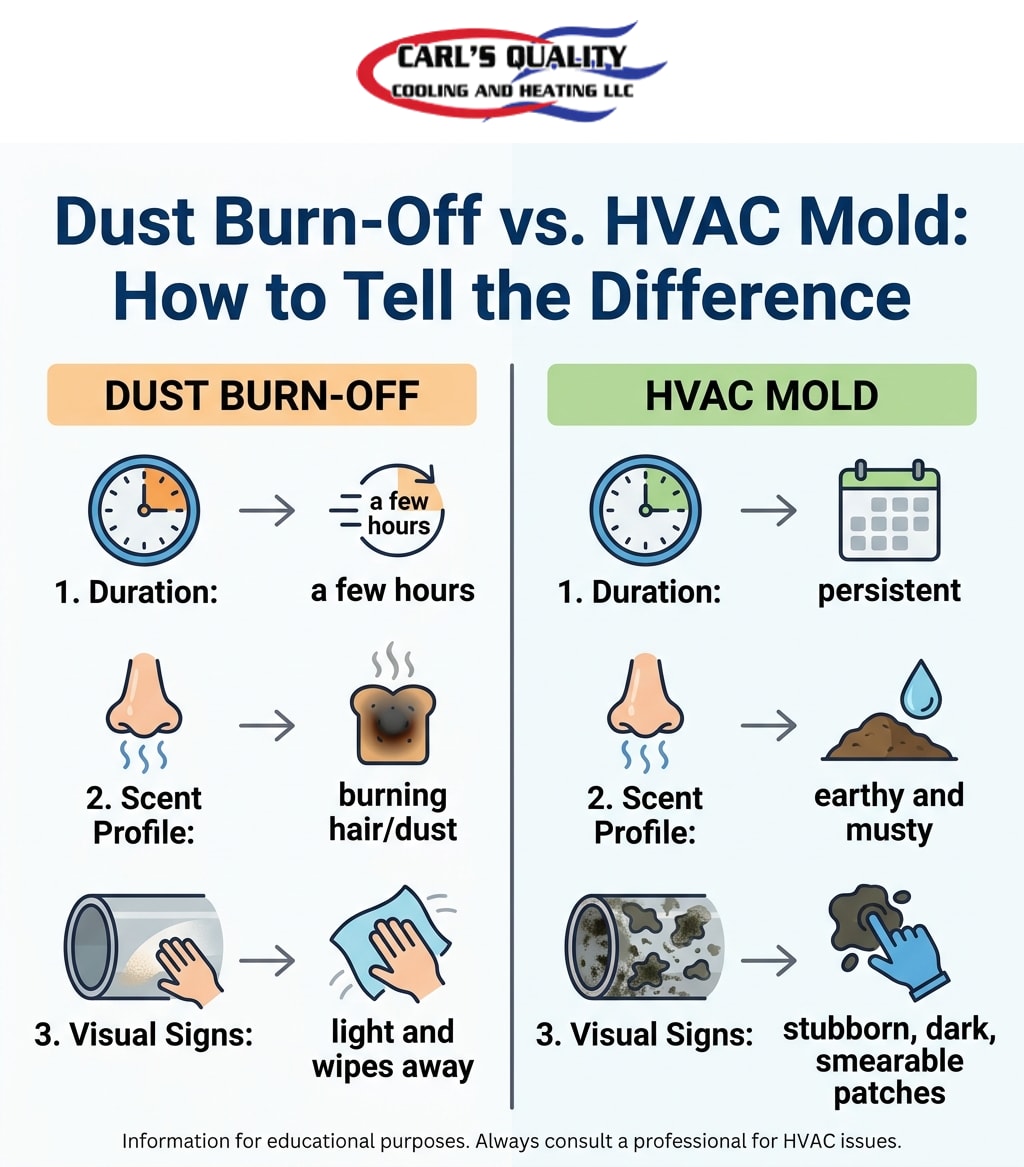
• Scent Profile — Normal Dust Burn-Off: Smells like a hot iron, burning hair, or singed dust. — Biological Growth (Mold/Mildew): Smells earthy, musty, or like a "dirty sock."
• Duration — Normal Dust Burn-Off: Fades away completely within 1 to 3 hours of heating. — Biological Growth (Mold/Mildew): Persists every time the system runs, regardless of time.
• Visual Signs — Normal Dust Burn-Off: Light, dry, gray dust that easily wipes off vent covers. — Biological Growth (Mold/Mildew): Stubborn, dark, or sticky patches that smear when wiped.
• Physical Location — Normal Dust Burn-Off: Usually originates at the furnace heat exchanger. — Biological Growth (Mold/Mildew): Often visible around the edges of supply vents or inside ducts.
The temporary nature of dust burn-off.
During the summer, dust, pet dander, and normal household particulates settle onto the heating elements of your furnace. Because the furnace sits completely unused for months, this layer builds up. When the burners finally ignite in the fall, those settled particles literally toast. This produces a sharp, slightly smoky smell. The key takeaway is that this odor is temporary. Once the settled dust burns away, the smell disappears.
The persistent nature of biological growth.
If the smell does not go away after a few hours, or if it has a distinctly wet, earthy characteristic, you are likely dealing with biological growth. This odor is caused by volatile organic compounds (VOCs) released by active spores. Furthermore, if you take a flashlight and look inside your supply vents, you might notice dark spots accumulating on the metal or drywall just behind the register. If these spots look like black dust but smear like grease when you touch them, you have found a moisture problem.
The Three Ingredients for Biological Growth in Your Vents
Mold and mildew do not magically appear in your HVAC system; they require a very specific environment to survive. Understanding the science behind this growth helps you prevent it without resorting to unnecessary panic. Biological growth in ductwork relies on three primary ingredients.
1. Ingredient 1: Consistent Moisture. As we discussed, heavy condensation from the Conroe, TX / Gulf Coast climate provides the water. Without moisture, spores remain completely dormant. This is why addressing the mechanical cause of the water—like a clogged drain or a torn duct—is always the most important step.
2. Ingredient 2: Ideal Temperatures. Spores thrive in moderate, warm temperatures. During the peak of summer, the freezing air inside the ducts slows down growth. But during the mild shoulder season in early fall, the attic temperatures moderate, and the dark, enclosed spaces within your walls and ceilings become the perfect incubator.
3. Ingredient 3: A Reliable Food Source. Biological growth needs organic material to consume. Your ductwork naturally accumulates a thin layer of settled dust, dead skin cells, pet dander, and cooking oils over time. When moisture meets this organic buffet, growth accelerates rapidly.
By removing just one of these three ingredients, you stop the growth cycle in its tracks. Because you cannot easily remove all dust from a home, and you cannot change the temperature of your hidden ducts, controlling moisture is your best defense. If you suspect your system is providing these three ingredients, our comprehensive HVAC services can help you identify and eliminate the root causes.
Why the Fall Transition Suddenly Exposes Summer Duct Issues
Homeowners often wonder why a problem created in July suddenly becomes obvious in November. The answer lies in how your HVAC system operates as the seasons change. The transition from summer to fall creates a specific timeline of events that exposes hidden issues.
Phase 1: The Peak Cooling Months (Masking the Problem)
During the hottest months, your system runs almost continuously. This constant rush of cold, conditioned air keeps odors diluted and prevents them from settling heavily in the living space. The extreme cold of the evaporator coil also suppresses rapid biological growth. The moisture pools are forming, but the symptoms remain hidden by the sheer volume of airflow.
Phase 2: The Idle Shoulder Season (The Incubation Period)
As the intense heat breaks in early fall, you naturally turn your AC off or run it much less frequently. The constant airflow stops. This is the critical period. The hidden moisture pools inside your ductwork now sit stagnant in the dark. Without cold air suppressing them, dormant spores begin to feed on the settled dust and multiply, generating strong musty odors that are trapped inside the closed vents.
Phase 3: The November First-Furnace-Use (The Exposure)
When the first real chill arrives, you switch the thermostat to heat. The furnace kicks on, sending a blast of warm air through the previously dormant ducts. This warm air acts as an amplifier. It rapidly evaporates remaining moisture, picks up the concentrated musty odors, and forcefully distributes them into every room of your house simultaneously.
This predictable seasonal cycle is exactly why proactive care is so valuable. Staying ahead of this transition with an HVAC maintenance plan ensures that moisture issues are caught and resolved long before you ever turn on the heat.
Honest Professional Inspections: Assessing Your Indoor Air Quality
If you suspect biological growth in your ductwork, the next step is a professional evaluation. However, the indoor air quality industry is unfortunately filled with companies that use scare tactics to sell expensive, unnecessary cleaning services. As a veteran-owned company, we believe in a completely different approach: discipline, accountability, and absolute transparency.
Following EPA guidelines.
The Environmental Protection Agency (EPA) is very clear on this topic: duct cleaning is only necessary if there is visible, substantial mold growth, a severe pest infestation, or if the ducts are clogged with an excessive amount of dust and debris. A thin layer of dust is normal. A temporary burn-off smell is normal. We do not recommend invasive cleaning unless the evidence proves it is required.
Finding the root mechanical cause.
Treating the symptom (the mold) without fixing the cause (the moisture) is a waste of your time and money. If someone simply sprays a chemical in your vents but leaves a leaking condensate drain untouched, the growth will return the moment the Conroe, TX / Gulf Coast climate heats up again. A thorough, honest professional inspection involves:
• Visual confirmation: Inspecting the evaporator coil, drain pan, and the interior of the supply plenums with specialized cameras.
• Moisture tracking: Checking the insulation and duct seams for signs of sweating or air leaks.
• System performance evaluation: Ensuring the blower motor is moving enough air to properly dehumidify the home.
Working with a veteran-owned company means you get an honest "What We Found" report. We show you the actual condition of your system, explain the mechanical realities, and offer practical solutions without the high-pressure sales pitch.
Frequently Asked Questions About Musty Odors and Ductwork
When dealing with unexpected smells from your vents, it is normal to have a lot of questions about safety and next steps. We hear these concerns frequently during the fall transition. If you are looking to upgrade your home's defenses after addressing a moisture issue, exploring air purification options is a great next step. Here are the answers to the most common questions homeowners ask.
What does mold in air vents smell like?
Mold in air vents emits a distinct earthy, musty, or "dirty sock" odor. It smells very similar to a damp basement or wet cardboard that has been left in a closed room. This is vastly different from the sharp, smoky scent of burning dust that occurs when a furnace first kicks on.
How to tell the difference between dust and mold in air vents?
Dust is typically dry, light-colored, and easily wiped away with a dry cloth. Biological growth, on the other hand, often appears as stubborn, dark, or greenish patches that smear like grease when touched. If the substance looks wet or is growing in a circular pattern around the vent cover, it is likely not just dust.
Why does my heater smell musty when I turn it on?
Your heater smells musty because moisture accumulated in your ductwork during the summer cooling season. When the system sat idle in early fall, that moisture allowed biological growth to form. The sudden introduction of warm air from your heater amplifies those trapped odors and pushes them into your living space.
Can you clean mold out of HVAC ducts yourself?
We strongly advise against DIY cleaning deep within your ductwork. Using household cleaners or bleach inside your vents can damage flexible duct insulation and introduce harsh chemical fumes into your breathing air. Furthermore, scrubbing without proper negative pressure containment simply knocks spores loose, spreading them further throughout your home.
Is it safe to run AC with mold in ducts?
Running your system with severe biological growth in the ducts circulates spores and particulates throughout your living space. While a minor musty smell might just be a dirty filter, strong, persistent odors indicate a larger issue. We recommend keeping the system off and scheduling a professional assessment to ensure your indoor air remains clean.
How can I prevent moisture buildup in my ductwork?
Preventing moisture buildup starts with regular filter changes to ensure proper airflow, which helps the system dehumidify effectively. You should also manage indoor humidity levels, ensure your attic ductwork is properly insulated to prevent sweating, and schedule seasonal maintenance checks to catch sluggish drain lines early.
Restoring Your Home's Comfort Before Winter Arrives
You now have the actionable criteria needed to identify whether that November first-furnace-use smell is just harmless dust or a sign of deeper moisture issues. In a humid Conroe, TX / Gulf Coast climate, hidden condensation is a mechanical reality, but it is entirely fixable. If you are dealing with persistent musty odors, there are proven, safe solutions to improve your indoor air quality. Reach out for a transparent, professional assessment, and ensure your home stays comfortable and fresh all winter long.