

Why Whole Home Air Purification Options Compared Side by Side Can Change How You Breathe Indoors
When you start looking at whole home air purification options compared side by side, the choices can feel overwhelming fast. But here is the short answer most homeowners need:
Quick Comparison: Whole Home Air Purification Options
| System Type | Best For | Coverage | Key Limitation |
|---|---|---|---|
| HVAC-integrated (media/MERV filter) | Whole-house baseline filtration | All ducted areas | Only works when HVAC fan runs |
| In-duct purifier (UV, PCO, carbon) | Odors, VOCs, and germs | All ducted areas | Needs professional installation |
| High-capacity standalone purifier | Open-concept or single-floor homes | 1 large area | Limited by walls and distance |
| Hybrid (central + room units) | Multi-room homes, allergy sufferers | Whole home + targeted rooms | Higher upfront investment |
The air inside your home may not be as clean as it looks. According to the EPA, indoor air is often two to five times more polluted than the air outside — and most of us spend roughly 90% of our time indoors. Dust, pet dander, pollen, mold spores, cooking fumes, and VOCs from cleaning products all build up quietly in the spaces where you sleep, eat, and relax.
For homeowners in Conroe, Montgomery, and Montgomery County, where high humidity and seasonal pollen are constant challenges, getting whole-home air quality right is not just about comfort — it is about health.
This guide breaks down every major whole-home air purification approach clearly and honestly, so you can make the right call for your home and your family.
What Whole-Home Air Purification Is and How It Differs From Room Units
Whole-home air purification is any system designed to improve air quality across most or all of a house rather than in just one room. Usually, that means the purifier works with your HVAC system, your ductwork, or a planned combination of central filtration plus room-by-room support.
Portable room purifiers do something different. They clean the air in the immediate space around them. That can work very well in a bedroom, nursery, or home office, but it does not automatically mean the kitchen, hallway, or upstairs rooms are getting the same treatment.
The biggest differences come down to:
- Coverage
- Airflow path
- Fan runtime
- Filtration type
- How many air changes each area actually gets
A portable purifier can often deliver stronger cleaning in one closed room. A whole-home system aims for broader, more consistent coverage across the house.
Whole home air purification options compared: central systems vs portable room purifiers
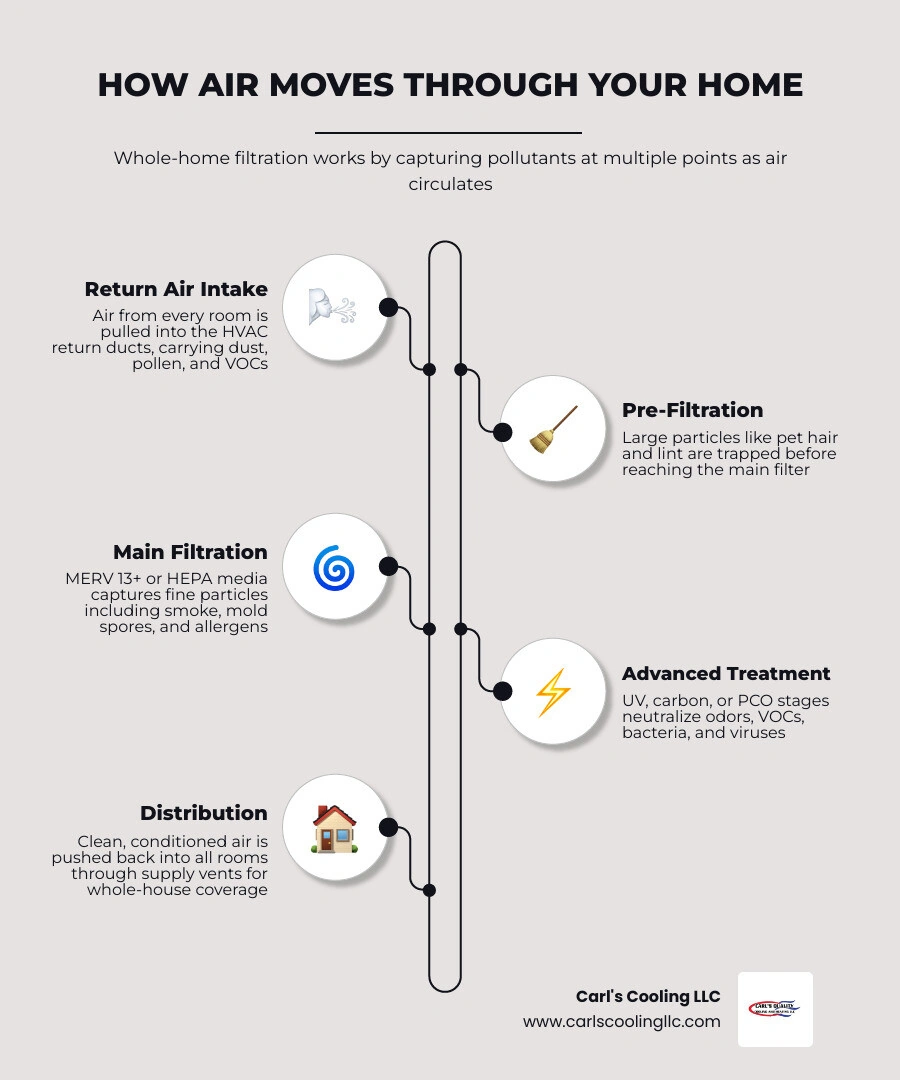
Central systems use your return ducts and blower fan to pull air through filters or purification devices. That means they can serve all ducted rooms, but only when air is moving through the system.
Portable units are independent. They run continuously if you want them to, which is helpful for bedrooms or spaces with doors closed. They are also easier to add where symptoms are worst.
In plain English:
- Central systems are better for baseline whole-house coverage
- Portable units are better for targeted, high-need areas
- Hybrid setups often give the best real-world results
This is especially true in larger homes, multi-story layouts, and houses with several bedrooms. Walls, doors, and hallways do not care about marketing claims. Airflow still has to travel.
When a whole-home system makes more sense than a portable purifier
A whole-home solution usually makes more sense when:
- You want cleaner air in multiple rooms
- Someone in the home has allergies or asthma
- Pets shed throughout the house
- Seasonal pollen affects the whole family
- Outdoor smoke events affect indoor air
- You want quieter air cleaning without a purifier in every room
For many homeowners, the goal is not just cleaner air in one spot. It is consistency. That is where central options often shine. For more local guidance, see this Ultimate Conroe Air Purification Guide.
When portable units still play an important supporting role
Portable purifiers still matter, even in homes with central filtration. We often think of them as the "special ops team" of air cleaning.
They work best in:
- Bedrooms
- Nurseries
- Home offices
- Rooms with pets
- Spaces that stay closed off
If one family member is especially sensitive to pollen, dander, or dust, a portable HEPA purifier in that room can provide an extra layer of protection.

The Main Types of Whole-Home Air Purification Systems
There are three main categories we compare most often:
- HVAC-integrated purification systems
- Standalone high-capacity systems
- Hybrid systems
Each one can be effective, but they solve different problems.
HVAC-integrated purification systems and how they work
HVAC-integrated systems clean air as it moves through your central heating and cooling equipment. They may include:
- High-efficiency media filters
- MERV-rated filtration cabinets
- HEPA bypass systems
- In-duct UV devices
- Carbon-enhanced filtration
- Electronic purification components
Air is pulled through return ducts, passes through the purification stage, and is redistributed through the supply ducts. If the thermostat is set to circulate or fan-on mode, the system can clean air even when cooling or heating is not actively running.
These systems are ideal for homeowners who want a cleaner-air baseline throughout the house. Learn more about a Whole Home Air Purification System.
Standalone high-capacity systems for broad home coverage
Some homeowners use a large standalone purifier to treat a major living area or open-concept floor plan. These units rely on CADR, or Clean Air Delivery Rate, to show how quickly they remove airborne particles.
They can be very effective in:
- Large living rooms
- Open kitchen-family room layouts
- Smaller single-story homes
- Apartments or homes without duct modifications
But they have limits. One unit in a living room will not clean a closed bedroom down the hall equally well. Multi-story homes almost always need more than one zone of coverage.
Hybrid setups that combine central filtration with room-by-room support
For many homes in our area, a hybrid setup is the sweet spot.
That means:
- Central filtration handles the whole-home baseline
- Bedroom or office purifiers add focused support
- Special events like smoke or allergy season are easier to manage
This layered approach is especially useful during spring pollen spikes, pet-heavy households, and periods of poor outdoor air quality. You can explore more Indoor Air Quality Products if you want to combine solutions.
Whole home air purification options compared by filtration technology
Not all purification technologies do the same job. Some are excellent for particles. Others are better for odors or gases. Some sound impressive in ads but do not deliver enough real-world benefit to justify the hype.
Whole home air purification options compared: HEPA, media filtration, and carbon
HEPA is the gold standard for fine particle removal. Certified HEPA filters capture 99.97% of particles at 0.3 microns, which is the most penetrating particle size used for testing. That makes HEPA very effective for:
- Dust
- Pollen
- Pet dander
- Smoke particles
- Many mold spores
MERV 13 to MERV 16 media filters are common in HVAC-integrated systems. They can do a strong job on airborne particles, especially when properly matched to the HVAC system and installed in a deep media cabinet. MERV 13 is often considered a strong baseline because it can reduce a meaningful share of fine particulate pollution, including PM2.5.
Activated carbon is different. It targets:
- Odors
- VOCs
- Some gases
- Cooking fumes
- Cleaning chemical smells
For gas removal, more carbon generally works better. Thick beds of carbon or pelletized carbon usually outperform thin carbon-coated fabric.
If your main concern is particles, HEPA or strong media filtration should lead the conversation. If odors and chemicals are also part of the problem, carbon matters too. For more on filtration options, visit the HEPA Filtration System page.
What each technology removes best
Here is the simple version:
- HEPA: dust, pollen, dander, smoke, fine particles
- MERV 13-16 media filtration: strong whole-home particle control
- Activated carbon: odors, VOCs, smoke smell, cooking smells
- UV: helps reduce microbial growth on coils and in some air streams
- Pre-filters: catch larger debris and protect main filters
A helpful reality check: UV does not replace particle filtration, and carbon does not replace HEPA. They do different jobs. If someone promises one magic device solves everything, that is usually your sign to reach for the salt shaker.
Safety concerns homeowners should know about
Safety matters. We recommend focusing on ozone-free systems and verified technologies.
Be cautious with:
- Ozone generators
- Some ionizers
- Some electrostatic devices
- Some PCO or PECO products without strong independent validation
Research and consumer guidance consistently warn that ozone-producing devices can create indoor air quality problems of their own. If a product intentionally produces ozone, we would cross it off the list.
Look for:
- Ozone-free labeling
- UL-listed components where applicable
- CARB compliance when relevant
- Clear maintenance instructions
- Real filtration performance data, not just vague claims
Performance in Real Homes: Smoke, Allergens, Pets, and VOCs
Performance always depends on the pollutant, the airflow, and how the home is used. A purifier is not magic. It is part of a system.
How whole-home systems perform during wildfire smoke events
Wildfire smoke is one of the toughest indoor air quality challenges because it includes very fine PM2.5 particles that can enter through gaps, doors, attic leaks, and ventilation pathways.
Whole-home systems help most when you:
- Keep windows and doors closed
- Reduce outside air intake when appropriate
- Run the HVAC fan to increase filtration time
- Use high-efficiency particle filtration
- Replace loaded filters promptly
In severe smoke events, a hybrid setup is often best: central filtration for the house plus portable HEPA support in bedrooms and main living spaces. For broader indoor pollution strategies, see Tackle Indoor Air Pollution in Homes.
What works best for pet dander, pollen, and allergy season
For allergens, particle capture is the priority. The best-performing setups usually include:
- Strong central return-side filtration
- Good filter sealing
- Bedroom-focused HEPA support if symptoms are worse at night
- Humidity control to discourage mold and dust mite issues
- Regular HVAC maintenance
This matters a lot in Conroe, Montgomery, The Woodlands, Spring, Tomball, and nearby communities where seasonal pollen can be relentless. If allergies are flaring indoors, this guide on Allergy Season Indoor Air Quality is a useful next read.
Handling odors and VOCs from cooking, cleaning, and remodeling
HEPA does not remove gases well. For odors and VOCs, activated carbon is the better tool. So are old-fashioned basics like source control and ventilation.
The most effective strategy usually includes:
- Activated carbon filtration
- Using kitchen exhaust fans while cooking
- Choosing lower-VOC products when possible
- Storing chemicals tightly sealed
- Ventilating during painting or remodeling
- Managing indoor humidity
Carbon does not last forever. Once saturated, its performance drops, so replacement timing matters. Humidity also affects comfort and indoor air quality, which is why The Benefits of Using a Dehumidifier Creating Comfortable and Healthy Environments ties into this conversation.
Why duct condition and airflow matter to results
Even the best purifier cannot fix bad airflow. If ducts are dirty, leaking, undersized, or poorly balanced, whole-home purification will not perform as intended.
Important factors include:
- Duct cleanliness
- Adequate return airflow
- Proper static pressure
- Sealed return leaks
- Balanced supply air delivery
- Blower performance
Think of it this way: purification is only as good as the air path it depends on. That is why duct health matters so much. Read more in Air Duct Cleaning Houston and Healthy Duct System Healthy Indoor Air Quality.
How to Choose the Right Whole-Home System for Your House
The right choice depends on your home, not just the product label.
Match the system to your home size, layout, and HVAC setup
We recommend looking at:
- Square footage
- Ceiling height
- Total cubic footage
- Number of floors
- Open vs closed floor plan
- Number of return ducts
- Existing blower capacity
- Rooms with the highest sensitivity needs
A large open-plan home may do well with central filtration plus one strategically placed purifier. A two-story home with closed bedrooms may need a layered design.
Coverage claims can also be optimistic. In real homes, walls, doors, and limited fan runtime reduce effective reach. That is why air changes per hour matter more than flashy square-foot numbers.
Check installation and maintenance requirements before you buy
Before choosing a system, ask:
- Will my blower handle the added resistance?
- Is the filter easy to access?
- How often does it need service?
- Does the unit have sensors that need cleaning?
- Does it require professional installation?
- Is the technology ozone-free?
- Will it work with my thermostat fan settings?
Maintenance is not optional. Filters load with dust, carbon saturates, and neglected systems lose effectiveness. For practical upkeep advice, read Professional Air Purifier Maintenance Tips.
Use this checklist to compare whole-home solutions
| Option | Best For | Main Pollutants | Noise | Maintenance | Safety Notes | Flexibility |
|---|---|---|---|---|---|---|
| HVAC media filter | Whole-home baseline | Dust, pollen, dander, some PM2.5 | Very low | Regular filter changes | Choose properly rated, ozone-free systems | Low once installed |
| In-duct purifier with carbon/UV support | Homes needing broader treatment | Particles, odors, some VOC support, microbial support | Very low | Filter and lamp service as applicable | Avoid ozone-producing designs | Medium |
| High-capacity room purifier | Open areas or targeted zones | Particles, some odors if carbon included | Varies by fan speed | Frequent pre-filter and filter care | Choose verified ozone-free models | High |
| Hybrid setup | Multi-room homes and sensitive households | Best all-around mix | Low to moderate | Multiple maintenance points | Usually safest when using mechanical filtration plus carbon | Highest |
Complementary solutions that improve indoor air quality even more
Air purification works best with a full indoor air quality strategy:
- Control moisture
- Use kitchen and bath exhaust fans
- Vacuum with good filtration
- Change HVAC filters on schedule
- Keep return vents unobstructed
- Seal obvious air leaks
- Reduce indoor pollutant sources
- Clean pre-filters regularly
Because air purifiers need to run consistently to be effective, energy efficiency also matters. Research shows Energy Star certified purifiers can be significantly more efficient than standard models. For more practical tips, see Maximizing Your Air Purifier Efficiency and Declining Air Purifier Performance Reasons.
Frequently Asked Questions About Whole-Home Air Purification
Can one whole-home air purifier clean every room equally well?
Usually, no. Even central systems do not clean every room equally at every moment. Airflow depends on duct layout, door position, zoning, blower runtime, and how well air returns to the system.
A good whole-home system improves air quality across the house, but some rooms may still benefit from extra support.
Do whole-home systems help with viruses and germs?
They can help, especially when paired with strong filtration, ventilation, and good airflow. HEPA and high-efficiency filtration can capture many airborne particles that carry contaminants, and UV can play a supporting role in specific applications.
But no purifier should be treated as a standalone guarantee against illness. Cleaner air is one layer of protection, not the whole sandwich. For more on this topic, read Air Purifiers Against Winter Viruses.
How often should whole-home air purification systems be maintained?
That depends on the system type, filter type, occupancy, pets, and outdoor conditions. In general:
- Pre-filters may need regular cleaning
- Media filters often need scheduled replacement
- Carbon filters need replacement when saturated
- UV lamps need periodic service
- Ducted systems should be inspected seasonally
Homes with pets, construction dust, heavy pollen, or smoke exposure may need more frequent attention.
Conclusion: Choosing Cleaner Air for Your Entire Home
When we look at whole home air purification options compared, the best answer is rarely one-size-fits-all. Some homes need strong central filtration. Others need targeted bedroom support. Many benefit most from a hybrid strategy that combines both.
What matters most is matching the system to your home layout, HVAC design, air quality concerns, and maintenance habits. Cleaner indoor air is not about chasing gimmicks. It is about building a smart, safe, reliable plan.
If you want to keep learning, these resources can help:
- Enhance Well-Being with Home Air Quality
- Indoor Air Quality Ensuring Health
- More info about indoor air quality products
For homeowners in Conroe, Montgomery, The Woodlands, Spring, Tomball, Willis, Magnolia, and surrounding communities, the goal is simple: healthier air in the rooms where life actually happens. And that is a goal worth breathing easier about.