
The Myth of Set-It-And-Forget-It Cooling in Late Summer
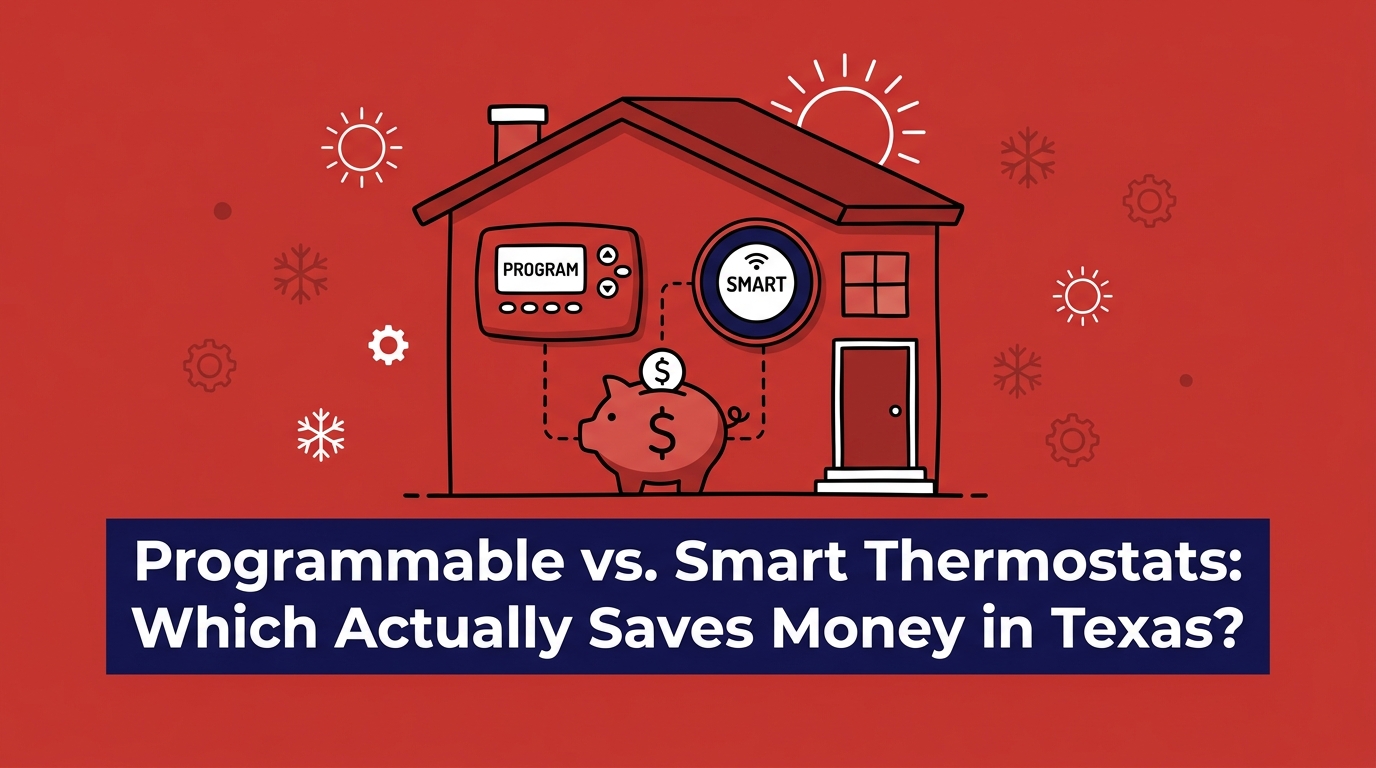
If you are searching for answers about Programmable vs. Smart Thermostats: Which Actually Saves Money in Texas?, you might believe the old rule that setting a single temperature and walking away is the most efficient choice. At Carl's Quality Cooling and Heating LLC, our team frequently hears this from homeowners, but the truth is, setting a rigid schedule doesn't guarantee energy efficiency—it usually just guarantees you are paying to cool an empty house. Many homeowners assume that a predictable cooling cycle is the ultimate solution for HVAC efficiency. However, the reality of daily life rarely sticks to a perfect timetable, especially as the late-summer seasons begin to shift.
Upgrading your controls is a core part of comprehensive Air Conditioning Services, ensuring your equipment runs smoothly without wasting power.
The concrete problem becomes glaringly obvious during the August back-to-school transition. One week, the house is full of kids running in and out all afternoon. The next week, the house sits entirely empty from 8:00 AM until 4:00 PM. If your thermostat is still running its mid-July schedule, your air conditioner is working relentlessly for nobody. This creates a critical decision point: do you stick with a basic, schedule-based unit, or do you upgrade to an adaptive smart model that reacts to your actual life?
The Hidden Cost of Rigid Schedules:
• Wasted energy: Pumping cold air into vacant rooms drives up utility usage unnecessarily.
• Unnecessary wear and tear: Forcing your compressor to cycle on and off when no one is home shortens the overall lifespan of the equipment.
• Comfort delays: Coming home early means walking into a stifling house and waiting for the system to catch up.
Optimizing how your system operates directly impacts both your daily comfort and the long-term health of your equipment. A thermostat is the brain of your HVAC setup. If that brain is operating on outdated information, the entire body suffers the consequences.
Why the Texas Climate Challenges Basic Programmable Models
The Problem: Texas heat requires sustained, heavy air conditioning usage, making efficiency a daily necessity rather than an afterthought. The relentless late-summer heat makes inefficient cooling especially punishing on the system. When temperatures soar, your home absorbs thermal energy rapidly. A basic programmable unit relies on rigid timeframes that simply do not account for the realities of modern life—early dismissals from school, unexpected sick days, or varied after-school activities.
The Cause: When routines become erratic, programmable units often end up cooling an empty house or, conversely, falling entirely behind the afternoon heat curve. If a static schedule tells the AC to turn off at 8:00 AM and turn back on at 5:00 PM, the house bakes during the hottest part of the day. By the time the system kicks on at 5:00 PM, the indoor temperature might be sweltering. Pushing an AC unit to catch up during peak heat strains the system immensely, forcing it to run continuously at maximum capacity just to remove the accumulated thermal load.
The Solution: Keeping a system from overworking requires regular care and responsive controls, which is why an HVAC Maintenance Plan is so valuable. Our technicians at Carl's Quality Cooling and Heating LLC see the effects of this strain frequently in Conroe, TX. Just last August, a local homeowner called us for help before a late-summer thunderstorm rolled in; their AC unit was struggling to keep up with the afternoon heat and erratic schedule changes. We came out as soon as it was safe, diagnosed the overworked system, and had it fixed within an hour. The underlying issue we discovered was exactly this: a rigid schedule forcing the equipment to do too much heavy lifting all at once.
The Mechanics of Thermal Catch-Up
Air conditioners do not cool a house faster simply because you set the temperature lower. They run at a constant speed until the target temperature is reached. When a basic programmable thermostat allows a house to heat up drastically during the day, the air conditioner must run for hours without stopping to remove both the sensible heat (temperature) and latent heat (humidity) from the air, furniture, and walls. This prolonged runtime often negates any energy saved while the unit was turned off.
Programmable Thermostats: When Basic is Actually Enough
Despite the hype surrounding new technology, there are plenty of situations where a traditional programmable thermostat is perfectly sufficient. As a veteran-owned business, we believe in an honest, straightforward approach. We will explicitly tell you when a basic model is the right choice, rather than blindly upselling you on gadgets you do not need.
A standard programmable thermostat is ideal for homes with strictly fixed, unchanging daily schedules. If you work from home with a set routine, or if you are retired and your daily occupancy rarely fluctuates, a static schedule works beautifully. You can set your preferred temperatures for morning, daytime, evening, and sleep, and trust the system to maintain that rhythm.
Benefits of Keeping It Simple:
• Lower upfront investment: Basic models require significantly less initial expenditure.
• Zero tech complexity: There are no apps to download, no firmware updates to manage, and no accounts to create.
• No Wi-Fi dependency: If your internet goes down, your thermostat continues to function exactly as programmed.
• Privacy: Basic units do not track your location or collect behavioral data.
Our team recently visited a Conroe homeowner whose AC went out right as the back-to-school rush began. We arrived the next day with parts, repaired the AC unit, and made the house ice cold again. During the visit, we evaluated their controls to determine the actual utility bill impact basic vs smart thermostat upgrades might have for them. Because they lived alone and worked strictly from home with an unwavering routine, we advised them that their basic programmable model was already doing everything they needed. Upgrading would have added complexity without delivering measurable efficiency gains.
Smart Thermostats: Adaptive Learning for Unpredictable Routines
For families juggling work, school, and extracurricular activities, smart thermostats offer a level of adaptability that basic models simply cannot match. Instead of relying on a clock, these devices use advanced technology to adapt to changing household occupancy in real time.
The Power of Geofencing
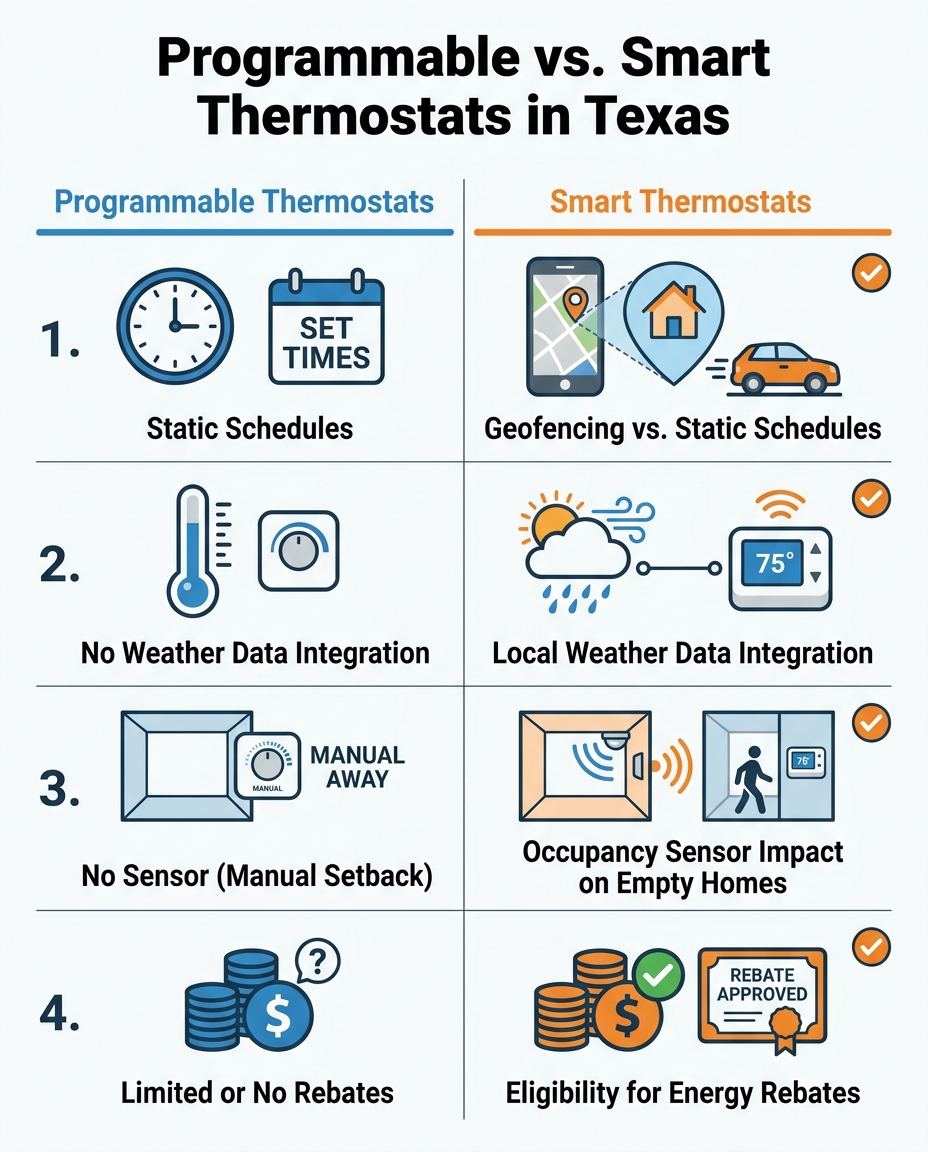
One of the most effective features of a smart thermostat is geofencing. This technology creates a virtual perimeter around your home using your smartphone's location services. When the last family member leaves the perimeter, the thermostat automatically adjusts to an energy-saving mode. When the first person crosses back into the boundary, the system begins cooling the house so it is comfortable by the time they walk through the door. This entirely eliminates the problem of cooling an empty house during the August back-to-school transition when schedules are chaotic.
Occupancy Sensors in Action
Many high-end smart thermostats also utilize remote indoor occupancy sensors. You can place these small sensors in high-traffic areas like the living room or master bedroom. If the thermostat's schedule says you should be at work, but the sensor detects movement because you took a sick day, it overrides the static schedule and restores the temperature to a comfortable level automatically. You never have to walk over to the wall and manually adjust the settings.
Learning Algorithms
Over the first few weeks of use, learning algorithms analyze your manual adjustments. If you consistently turn the temperature down at 9:00 PM before bed, the thermostat learns this preference and begins doing it for you. It adjusts to your family's actual behavior rather than forcing you to conform to a strict clock. This responsive technology prevents the AC from running at full blast in an empty house, ensuring that energy is only used when it actually benefits the occupants.
Side-by-Side Comparison: Static Scheduling vs. Adaptive Cooling
To truly understand the actual utility bill impact basic vs smart thermostat technologies deliver, it helps to look at them side by side. The right choice depends heavily on how much your daily life fluctuates.
• Energy Usage Adaptation — Basic Programmable Thermostat: Relies on rigid, pre-set time clocks. — Smart Learning Thermostat: Adjusts in real-time based on actual home occupancy.
• Ease of Use — Basic Programmable Thermostat: Requires manual reprogramming for schedule changes. — Smart Learning Thermostat: Uses automated learning algorithms to adapt naturally.
• Remote Access — Basic Programmable Thermostat: Controlled only via the physical wall unit. — Smart Learning Thermostat: Adjustable from anywhere via a smartphone app.
• Reaction to Routine Changes — Basic Programmable Thermostat: Will cool an empty home if not manually paused. — Smart Learning Thermostat: Automatically pauses cooling when the house is empty.
• Installation Requirements — Basic Programmable Thermostat: Generally works with existing basic wiring. — Smart Learning Thermostat: Often requires a C-wire for continuous power.

Weather Integration and Humidity Management
One of the most overlooked advantages of a smart thermostat is its ability to communicate with the outside world. Smart models pull real-time local weather data via Wi-Fi to anticipate afternoon temperature spikes. This specific climate advantage is incredibly beneficial for residents in Conroe, TX. In our years of installing and servicing these systems, we've found this feature invaluable when the late-summer weather shifts rapidly from sweltering heat to severe thunderstorms.
Anticipating the Afternoon Heat
Because a smart thermostat knows the weather forecast, it can proactively manage your home's temperature. If the data indicates that an extreme heatwave will hit around 3:00 PM, the thermostat will gently pre-cool the home starting at 1:00 PM. By dropping the indoor temperature slightly before the peak outdoor heat arrives, the system avoids having to fight against the most intense thermal load of the day. This proactive approach reduces overall strain on the HVAC equipment and maintains a much more consistent indoor climate.
Tackling Subtropical Humidity
Local weather data integration also mitigates the extreme strain of the hot-humid subtropical climate. High humidity makes a home feel significantly warmer than the actual temperature reading. Advanced smart thermostats monitor both indoor and outdoor moisture levels. If the humidity inside rises to uncomfortable levels, the thermostat can instruct the air conditioner to run longer cycles at a lower fan speed. This process, known as overcooling, wrings excess moisture out of the air without necessarily dropping the temperature drastically. Managing humidity levels effectively is a game-changer for indoor comfort, making 74 degrees feel crisp and cool rather than clammy and heavy.
Maximizing Efficiency Year-Round and Accessing Rebates
The benefits of advanced climate control do not end when summer fades. Optimized cooling technology also translates to better efficiency when the seasons finally change. A smart thermostat handles the transition from cooling to heating seamlessly, managing heat pump auxiliary strips and furnace staging with precision. If you are curious about how these controls integrate with winter equipment, exploring our Heating Services can provide a clearer picture of whole-home comfort.
Exploring Local Incentives
Many modern smart thermostats qualify for generic energy efficiency programs. Utility companies recognize that adaptive technology reduces strain on the local power grid during peak hours. As a result, homeowners should check with their local utility providers for current rebate opportunities. You can learn more about navigating these generic incentives by reading our guide on Texas energy rebates for HVAC upgrades.
The Importance of Professional Installation
While many thermostats are marketed as simple DIY projects, our experts at Carl's Quality Cooling and Heating LLC strongly recommend professional installation. We've replaced countless DIY setups gone wrong. Smart thermostats often require a common wire (C-wire) to provide continuous power to the Wi-Fi radio and digital display. If your older HVAC system lacks this wire, improper installation can lead to blown fuses, damaged control boards, or a thermostat that constantly drops its internet connection. A professional technician ensures the new thermostat communicates properly with the existing system. A minor upgrade, when installed correctly, supports the health of the entire HVAC setup and helps you realize the actual utility bill impact basic vs smart thermostat options promise.
Let Us Help You Weigh Your Thermostat Options
Ultimately, the right choice depends entirely on your family's schedule and daily habits. If your routine is set in stone, a basic programmable model will serve you perfectly well. If your life is constantly in motion, a smart thermostat will adapt to your needs and prevent you from cooling an empty house.
We offer a professional, honest assessment of your home's HVAC setup right here in Conroe, TX. Our goal is to provide you with the facts so you can make an informed decision that improves your comfort and protects your equipment. Reach out to our team today for guidance on upgrades or to schedule a comprehensive system check-up to ensure your home is ready for whatever the weather brings next.
Frequently Asked Questions
Are smart thermostats worth it in Texas?
Yes, they are highly beneficial for most Texas homes. The extreme heat requires long cooling cycles, and smart thermostats optimize these cycles based on your actual presence and local weather data. By preventing the system from running needlessly when the house is empty, they reduce unnecessary wear on the equipment.
What is the difference between a programmable and a smart thermostat?
A programmable thermostat operates on a rigid, manual schedule that you set based on time and day. A smart thermostat connects to Wi-Fi, learns your behavior, tracks your location via your smartphone, and adjusts temperatures automatically without requiring manual input.
Do smart thermostats actually reduce energy consumption?
They do reduce energy consumption for households with fluctuating schedules. By using geofencing and occupancy sensors, they ensure the HVAC system only runs when people are actually home to enjoy the comfort, eliminating the waste of cooling empty rooms.
Do smart thermostats work better in hot climates?
They offer distinct advantages in hot climates by integrating local weather data. They can pre-cool the home before afternoon heat spikes and manage indoor humidity levels more effectively by adjusting run times based on outdoor conditions.
Why is my programmable thermostat cooling an empty house?
Your programmable thermostat is cooling an empty house because it is following a static schedule that doesn't account for changes in your routine. If you leave for work early or take a weekend trip without manually overriding the schedule, the thermostat will continue to run exactly as programmed.
Will a smart thermostat work with my older HVAC system?
Most smart thermostats are compatible with older systems, but they usually require a C-wire (common wire) for continuous power. If your older system lacks this wire, a professional HVAC technician can often install an adapter or run new wiring to make it compatible.