
Why the Shift from AC to Heat Demands a Mechanical Reset
At Carl's Quality Cooling and Heating LLC, our technicians see firsthand how late August in Texas brings a specific kind of weariness to your home's climate control equipment. After running relentlessly for months, preparing your HVAC system for the transition from cooling to heating season is not just a matter of adjusting the thermostat—it requires a comprehensive mechanical reset. During the peak of late-summer August cooling, your air conditioner operates under maximum load, keeping internal components locked into a single, continuous operational pattern. When the time finally comes to switch over to heating, those components are suddenly asked to reverse their function, change pressure dynamics, and route refrigerant in the opposite direction.
Many homeowners assume that if the air conditioning worked fine through the end of the summer, the heating will automatically kick on without a hitch. However, our team frequently observes that the physical reality of transitioning a complex mechanical system after months of static operation tells a different story. Parts that have been heated, vibrated, and held in one position for half the year can easily stick or fail when commanded to shift. When it is time to evaluate your equipment for the changing weather, scheduling professional heating services ensures the transition happens smoothly and safely.
A true mechanical reset goes far beyond swapping out an air filter. It involves verifying that the electrical signals from the thermostat successfully trigger the physical valves, motors, and sensors required for heating. Skipping this step leaves your system highly vulnerable to sudden failures right when the first cold snap arrives.
The Heavy Toll of Prolonged Texas Summers on Your System
Prolonged, intense Conroe heat heavily taxes every component within your climate control system. By the time the back-to-school season approaches, the outdoor condensing unit has endured thousands of hours of direct sunlight, high ambient temperatures, and continuous electrical loads. This sustained thermal and mechanical stress bakes moving parts into rigid positions, making the internal mechanisms far more prone to sticking when they are finally asked to change states.
In our experience servicing Conroe neighborhoods, understanding the specific wear and tear your system endures helps highlight why a transition check is so important. Professional air conditioning services often reveal hidden vulnerabilities that developed during the hottest months, even if the system seemed to be performing adequately in August.
• Thermal fatigue: The constant expansion and contraction of copper lines and metal housings under extreme summer heat can weaken connections and degrade protective seals.
• Lubricant settling: When a system runs in a single mode for months, the oil that circulates with the refrigerant tends to settle in specific patterns, potentially leaving transition components under-lubricated.
• Electrical degradation: Contactors and relays that have engaged thousands of times to manage heavy cooling loads often develop pitting or carbon buildup, which can interrupt the signals needed to activate heating mode.
• Component rigidity: Rubber seals, Teflon sliders, and internal valves that sit in one position for a prolonged period can become stubborn or completely stuck due to the constant heat and pressure.
The end of summer should not be viewed as a time to ignore your equipment until winter. Instead, this is the critical window for evaluation. Identifying the toll the summer has taken allows our professionals to address minor wear before it translates into a major operational failure during a temperature drop.
Understanding Your Heat Pump Reversing Valve
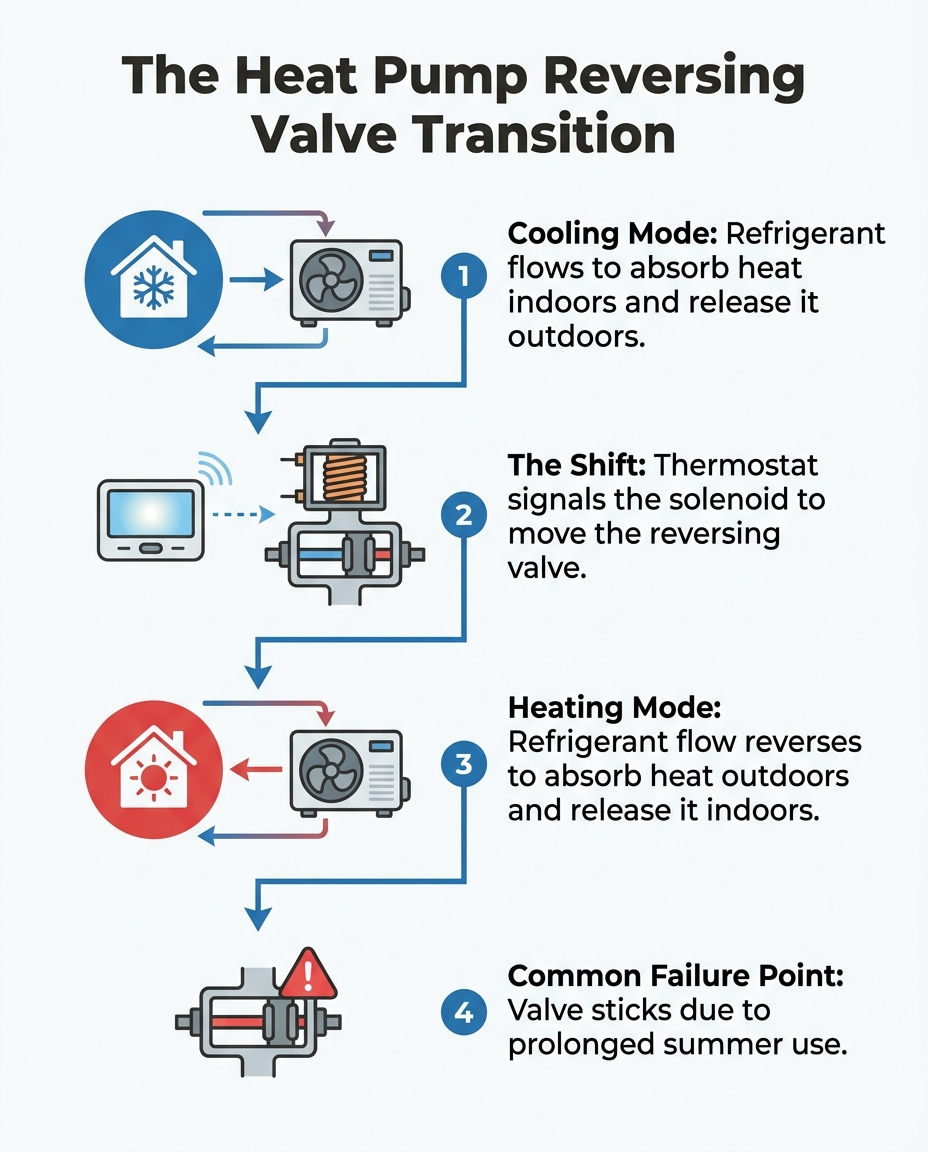
For homes equipped with a heat pump, the transition between seasons relies entirely on a single, critical component: the heat pump reversing valve. This brass body valve is responsible for physically reversing the flow of refrigerant through the system, allowing the outdoor unit to absorb heat from the outside air and transfer it indoors, rather than the other way around.
The Problem: Our service team consistently finds that a stuck reversing valve is one of the most common reasons a heat pump fails to cool or heat properly. Because this valve sits in the cooling position for six to eight months straight during a Texas summer, the internal slide mechanism can easily become locked in place.
The Cause: The valve operates using a pressure differential. A small electrical solenoid opens a pilot valve, which then uses the system's own high-pressure refrigerant gas to push a heavy internal slide block from one side to the other. If the system is low on refrigerant, if the solenoid coil is weak, or if the internal Teflon seals have dried out from summer heat, the slide block will not move.
The Solution: Diagnosing a reversing valve issue requires specialized tools, high-voltage electrical testing, and pressurized refrigerant gauges. Because of the extreme pressures and voltages involved, testing and repairing this mechanism always requires a licensed professional. If you find yourself caught in the reversing valve trap, one of our certified technicians can determine whether the electrical coil has failed or if the mechanical valve itself needs replacement.
How Refrigerant Flow Changes
To appreciate the mechanical shift, you have to understand how the indoor and outdoor coils swap functions. In cooling mode, the indoor coil acts as the evaporator (absorbing heat from your home) while the outdoor coil acts as the condenser (releasing that heat outside). When the thermostat calls for heat, the reversing valve shifts.
Instantly, the high-pressure, high-temperature discharge gas from the compressor is routed directly to the indoor coil, turning it into the condenser. The indoor coil now releases heat into your ductwork. Meanwhile, the outdoor coil becomes the evaporator, absorbing ambient heat from the outside air. This massive shift in pressure dynamics and temperature routing happens in seconds, placing an immense, sudden load on the system's mechanical integrity.

Why Reversing Valves Fail During the First Fall Cold Snap
The climate in Conroe is known for its sudden, dramatic shifts. Fall cold fronts, often referred to as Blue Northers, can drop temperatures rapidly in a matter of hours. These sudden weather events require an immediate and flawless mechanical response from your climate control system. If the reversing valve has been parked in the cooling position since March, this sudden demand is a prime opportunity for failure.
Weather shifts happen fast, and system vulnerabilities are often exposed right when the weather turns hostile. We've seen this play out when a local homeowner discovered an urgent mechanical issue right before a severe spring thunderstorm rolled in—requiring our technicians to arrive as soon as it was safe to diagnose and fix the problem within an hour. Similarly, the sudden arrival of a fall cold front demands immediate, reliable system response. The shock to the system is significant. The cold ambient temperatures lower the overall refrigerant pressure, which means the reversing valve has less physical force available to push the internal slide block exactly when it needs it most.
When a transition fails during one of these cold snaps, the symptoms are immediate and frustrating. You may hear the system turn on, but notice that cold air is blowing out of the vents even though the thermostat is set to heat. You might also hear a loud hissing sound from the outdoor unit as the valve struggles to seat properly, allowing high-pressure and low-pressure gases to mix. Addressing these mechanical risks before the temperature drops is the only way to prevent a late-night emergency when your family desperately needs warmth.
The Risks of Skipping a Pre-Season Mechanical Inspection
Contrasting proactive, preventive care with the stress of reactive emergency repairs highlights exactly why a late-summer mechanical reset is so valuable. As a veteran-owned company, our team at Carl's Quality Cooling and Heating LLC brings a disciplined, honest approach to preventative maintenance, designed to protect homeowners from reactive winter emergency repairs rather than waiting for things to break.
The value of this proactive approach is clear: one of our customers who prioritized preventative maintenance through twice-yearly spring and fall inspections saw potential problems solved long before they could escalate into expensive, disruptive issues. Skipping these checks allows minor transition issues to evolve into major system failures. A stuck reversing valve, for example, doesn't just prevent heating; it can cause liquid refrigerant to flood back into the compressor, potentially destroying the most expensive component in the entire system.
• Reversing Valve — Skipping Inspection (Reactive Risk): Sticks in cooling mode, blowing cold air during a freeze. — Pre-Season Check (Proactive Benefit): Slide mechanism and pressures verified for flawless shifting.
• Solenoid Coil — Skipping Inspection (Reactive Risk): Fails silently, preventing the valve from receiving the shift signal. — Pre-Season Check (Proactive Benefit): Electrical continuity and voltage tested to ensure reliable operation.
• Compressor — Skipping Inspection (Reactive Risk): Subject to liquid slugging if the transition valve gets stuck halfway. — Pre-Season Check (Proactive Benefit): Pressures mapped to ensure safe, balanced refrigerant flow.
• Defrost Board — Skipping Inspection (Reactive Risk): Fails to activate, allowing the outdoor coil to encase itself in solid ice. — Pre-Season Check (Proactive Benefit): Sensors and timing cycles tested to prevent winter freeze-ups.
The peace of mind that comes from knowing the system has been professionally vetted cannot be overstated. A late-summer maintenance visit is a true mechanical reset that addresses the cascading effects of component wear, ensuring that your equipment is structurally sound and ready for the shifting seasons.
What a Professional Transition Check Actually Involves
Demystifying the maintenance process helps illustrate why a mechanical reset requires certified expertise. During a recent end-of-summer service call, one of our technicians performed a thorough inspection, clearly explained the findings, and made honest recommendations, resulting in highly efficient service that left the homeowner fully prepared for the season. This level of detail is standard for our professional transition checks.
A certified technician follows a strict protocol to safely test the shift mechanisms, handling high-voltage electricity and pressurized refrigerants that are dangerous for untrained individuals to manipulate.
1. Thermostat Calibration and Signal Verification: The technician begins by verifying that the thermostat is accurately reading the ambient temperature and successfully sending the 24-volt signal to the outdoor unit's reversing valve terminal.
2. Refrigerant Pressure Mapping: Gauges are applied to the system to measure the suction and discharge pressures. The technician monitors how these pressures react during the exact moment the valve shifts, ensuring the slide block seats fully without internal bypassing.
3. Defrost Cycle Testing: Because heat pumps naturally build up frost on the outdoor coil during winter, the technician forces the system into a defrost cycle to ensure the sensors and timers will successfully melt ice buildup before it damages the fan blades.
4. Mechanical Shift Verification: The technician listens for the distinct "whoosh" sound that indicates the reversing valve has successfully redirected the high-pressure gas, verifying that the indoor air temperature rises accordingly.
Testing the Solenoid and Electrical Connections
The electrical signal is the trigger for the mechanical shift. Our technicians use a multimeter to test the solenoid coil that sits on top of the reversing valve. They check for proper resistance and ensure the magnetic field generated is strong enough to pull the pilot valve open. Identifying worn wiring, degraded contactors, or a failing solenoid coil before they break is a primary goal of this inspection. By securing these electrical connections, the technician guarantees that when you ask for heat, the system has the electrical authority to deliver it.
Secure Your Comfort Before the Temperatures Drop
The reversing valve is the mechanical heart of your seasonal transition. Ensuring this component, along with the rest of your system's electrical and pressurized infrastructure, is ready to shift seamlessly is the best way to protect your home from sudden cold snaps. Taking action while the weather is still manageable gives you the upper hand against the changing seasons.
Do not wait until the first freezing night to discover that your system is stuck in summer mode. Secure your comfort and protect your equipment by scheduling a comprehensive seasonal check through a professional HVAC maintenance plan with Carl's Quality Cooling and Heating LLC today.
Frequently Asked Questions
Why is my heat pump not cooling or heating properly?
A heat pump failing to heat or cool properly is often due to a stuck reversing valve or low refrigerant levels. The reversing valve is responsible for switching the flow of refrigerant; if it fails, the system cannot change modes. A licensed technician must diagnose whether the issue is a failed electrical solenoid or a jammed mechanical valve.
What happens when a heat pump switches to heat mode?
When a heat pump switches to heat mode, a solenoid activates the reversing valve to redirect the flow of high-pressure refrigerant. The outdoor coil becomes the evaporator to absorb ambient heat, and the indoor coil becomes the condenser to release that heat inside. This mechanical shift completely reverses the system's pressure dynamics.
How do I switch my HVAC from cooling to heating?
Switching your HVAC from cooling to heating is done directly at the thermostat by selecting the "Heat" mode and setting your desired temperature. However, for the system to execute this command successfully, the internal reversing valve and electrical relays must be in good working order. If the system blows cold air in heat mode, professional service is required.
What happens when a reversing valve gets stuck?
When a reversing valve gets stuck, the system becomes locked in its current mode, regardless of what the thermostat requests. If it sticks in cooling mode during the winter, the vents will blow cold air into the house. A partially stuck valve can also cause high-pressure and low-pressure refrigerant to mix, severely stressing the compressor.
When should I schedule my fall HVAC maintenance in Texas?
You should schedule your fall HVAC maintenance in late summer or early fall, before the first major cold front arrives. Texas weather can drop rapidly, and testing the transition components while temperatures are still mild prevents emergency failures. Proactive scheduling ensures your system is mechanically reset and ready for immediate heating demands.
Can I manually unstick a heat pump reversing valve?
No, you cannot manually unstick a heat pump reversing valve safely. The valve operates under extreme refrigerant pressure and relies on high-voltage electrical solenoids to function. Attempting to force the valve or bypass the electrical controls can cause catastrophic compressor failure or severe physical injury, making professional intervention mandatory.