
Why Knowing How Often to Change Your HVAC Air Filter Can Save You Money and Headaches
How often should you change your hvac air filter is one of the most common questions homeowners ask — and for good reason. The answer directly affects your comfort, your energy bill, and how long your system lasts.
Here's a quick-reference guide based on filter type:
| Filter Type | Recommended Change Frequency |
|---|---|
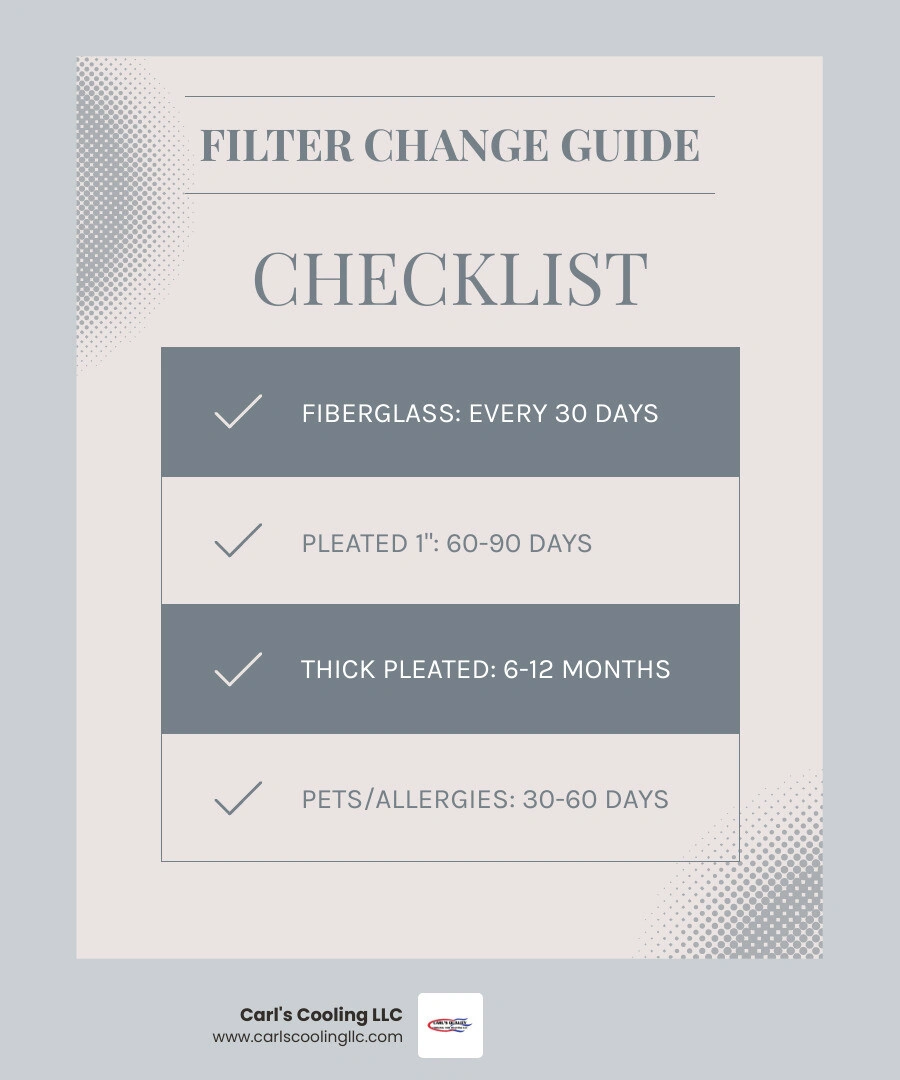
| Fiberglass (1-inch) | Every 30 days or less |
| Pleated (1-inch) | Every 60–90 days |
| Pleated (4–5 inch) | Every 6–12 months |
| HEPA | Every 6–12 months |
| Homes with pets | Every 30–60 days |
| Allergy/asthma households | Every 20–45 days |
| Vacation or rarely used homes | Every 6 months |
These are general baselines. Your actual schedule depends on factors like pets, household size, local air quality, and how hard your system runs — especially here in Montgomery County, where Texas heat means your AC works overtime for months at a stretch.
Think of your air filter as the lungs of your home. When it gets clogged, your whole HVAC system has to work harder to push air through. According to the U.S. Department of Energy, swapping out a dirty filter can improve your system's efficiency by 5 to 15%. That's not a small number.
Most homeowners don't change their filters nearly often enough — not because they don't care, but because it's one of those easy-to-forget tasks that only becomes obvious when something goes wrong.
How Often Should You Change Your HVAC Air Filter?
When we talk to neighbors in Conroe or The Woodlands, we often find that the "3-month rule" is the most common piece of advice people have heard. While it’s a decent starting point, it’s far from a universal law. As we move through 2026, filtration technology has advanced, but so has our understanding of how indoor environments affect our health.
The frequency with which you should swap that filter depends heavily on the material it's made of and its physical size.
- Fiberglass Filters: These are the thin, blue or white "see-through" filters you often find in bulk at hardware stores. They are designed to protect your HVAC equipment from large debris, but they don't do much for your Indoor Air Quality. Because they have very little surface area, they clog quickly. We recommend changing these every 30 days—no exceptions.
- Pleated Filters: These are the most common filters in modern Texas homes. The "folds" in the material (pleats) create more surface area to trap dust and allergens. A standard 1-inch pleated filter usually lasts about 90 days in a clean, pet-free home, but in our humid climate, 60 days is often safer.
- High-Efficiency (HEPA) and Media Filters: If your system uses a 4-inch or 5-inch thick "media" filter, you're in luck. These have massive amounts of surface area. They are often rated to last 6 to 12 months. However, because they trap so much, they can become a breeding ground for odors if left too long in high humidity.
Understanding the thickness is key. A 1-inch filter is like a small net; a 5-inch filter is like a deep maze. The maze can hold a lot more "junk" before it actually starts to block the airflow to your furnace or air handler.
How Often Should You Change Your HVAC Air Filter with Pets?
We love our furry friends, but they are undeniably hard on HVAC systems. Whether you have a Golden Retriever in Montgomery or a couple of cats in Spring, pet hair and dander are constant contributors to filter clogs.
Pet dander isn't just the fur you see on the rug; it includes microscopic skin cells and "sticky" proteins that cling to filter fibers much faster than standard household dust. If you have one pet, we recommend checking your filter every 60 days. If you have multiple shedding pets, you should move that window to every 30 to 45 days. Ignoring this can lead to a buildup of allergens that circulate through your home, making it harder to breathe. For those looking to mitigate these effects, exploring Indoor Air Quality Products can help supplement your filtration.
How Often Should You Change Your HVAC Air Filter for Allergies?
For our customers dealing with asthma or severe seasonal allergies—which can be quite intense in the piney woods of East Texas—the filter is your first line of defense. During peak pollen seasons in April 2026, a standard filter can become saturated with irritants in just a few weeks.
If someone in your home suffers from respiratory issues, we suggest a 30-day replacement cycle regardless of the filter type. You may also want to consider a Hepa Filtration System, which captures 99.97% of particles as small as 0.3 microns. Keeping a fresh filter ensures that your HVAC system is actually removing those triggers from the air rather than just blowing them back into your living room.
Key Factors Influencing Your Replacement Schedule

It would be easy if we could all just set a calendar alert for the same day every year, but life in Southeast Texas is rarely that simple. Several environmental and lifestyle factors will speed up or slow down your replacement needs.
- Home Size: In a larger home, the HVAC system moves a much higher volume of air. More air means more dust passing through the filter. If you have a large property in Bentwater or Carlton Woods with multiple units, those filters may need more frequent attention than a small apartment in Houston.
- Occupancy Levels: More people means more skin cells, more lint from clothing, and more movement stirring up dust. A family of six will clog a filter significantly faster than a single person living alone.
- Local Environment: Are you near a new construction site in Magnolia or Woodforest? Construction dust is incredibly fine and can coat a filter in a matter of days. Similarly, if you live near unpaved roads or areas with heavy pollen, your filter is doing double duty.
- System Usage: During a Texas summer, your AC might run 12 to 18 hours a day. During a mild fall, it might only run for three. The more the fan blows, the more the filter works. If you keep your thermostat's fan setting to "On" rather than "Auto," you are constantly filtering the air, which is great for health but means you'll need to change the filter much more often. A Healthy Duct System Healthy Indoor Air Quality starts with a filter that isn't overloaded by these local factors.
Understanding MERV Ratings and Filter Thickness
You’ve likely seen the term "MERV" on the side of filter packaging. It stands for Minimum Efficiency Reporting Value. The scale runs from 1 to 20.
- MERV 1–4: These are basic fiberglass filters. They stop "boulders" (large dust) but let the "sand" (pollen and bacteria) through.
- MERV 8–11: This is the sweet spot for most residential homes. They trap a high percentage of household dust, mold spores, and pet dander without putting too much strain on your blower motor.
- MERV 13–16: These are high-efficiency filters often used in hospitals or by people with severe health needs.
A word of caution: higher isn't always better. A high MERV filter is very "tight," which can cause airflow restriction if your system wasn't designed for it. This is where Common Questions About Media Air Filters come into play—thicker 5-inch filters allow for a high MERV rating without the same airflow drop because they have more surface area for the air to pass through.
Signs and Consequences of a Clogged Filter
How do you know if it’s time? We always recommend the "Light Test." Take your filter out and hold it up to a bright light source or the sun. If you can’t see light passing through the fibers, it’s officially a Clogged Furnace Filter and needs to be replaced immediately.
Other warning signs include:
- Visible Dust: If you notice a fine layer of dust appearing on your furniture just a day after cleaning, your filter might be full and bypassing air around the edges.
- Musty Odors: A dirty filter can trap moisture and organic material, leading to a "dirty sock" smell when the unit kicks on.
- Longer Cycles: If your AC seems to be running forever without reaching the target temperature, it might be struggling to pull enough air through a restricted filter.
The consequences of neglect are more than just a little dust. A severely clogged filter can cause your evaporator coils to freeze over—yes, even when it's 100 degrees in Conroe. When airflow is restricted, the cold coils don't get enough warm air to keep them from dropping below freezing. This can lead to water damage and expensive repairs. Furthermore, you can Reduce Heating Costs With Duct Cleaning and regular filter changes by ensuring the system doesn't have to work twice as hard to do its job.
Benefits of Regular Air Filter Maintenance
We like to think of filter changes as the cheapest insurance policy you can buy for your home. When you stay on top of this simple task, the benefits ripple through your entire household.
First, there is the Equipment Lifespan. HVAC systems are a major investment. By keeping the airflow clear, you prevent the blower motor from overheating and reduce the wear and tear on every internal component. We see fewer "emergency" calls from customers who are diligent about their filters.
Second is Consistent Comfort. A clean filter ensures that air is distributed evenly throughout your home. Have you ever noticed one room feeling warmer than the others? While there could be many causes, a restricted filter is often a contributing factor.
Third is the Health Factor. Using Indoor Air Quality Services and keeping fresh filters helps to Enhance Well Being With Home Air Quality. Removing mold spores, bacteria, and fine dust from your breathing zone is essential, especially as we spend more time indoors. Indoor Air Quality Ensuring Health isn't just a catchphrase; it's a measurable improvement in how you feel every day.
Frequently Asked Questions
Are washable filters better than disposable ones?
Washable filters are often marketed as an eco-friendly, one-time purchase. While they do save on waste, they require a lot of work. You have to rinse them monthly and—crucially—let them dry completely before putting them back in. If you put a damp filter back into your dark HVAC cabinet, you are essentially inviting mold to grow. In our experience, high-quality disposable pleated filters provide better filtration and are much more convenient for most homeowners.
Can I run my HVAC system without a filter?
Technically, yes, the system will turn on. However, you should never do this for more than a few minutes (perhaps while you run to the store for a replacement). Without a filter, dust, hair, and debris go directly onto your sensitive evaporator coils and into the blower motor. This can cause permanent damage and significantly reduce the efficiency of your system in a very short amount of time.
Which direction should the filter arrow point?
This is the most common installation mistake! Almost every air filter has a small arrow printed on the frame. This arrow should point in the direction of the airflow. Usually, this means the arrow points toward the HVAC unit (the furnace or air handler) and away from the return duct where the air comes from. Installing it backward can cause the filter to collapse or whistle, as the wire reinforcement is only on one side.
Conclusion
As we navigate through 2026, the air we breathe inside our homes has never been more important. While the general guideline for how often should you change your hvac air filter is every 90 days, your specific home in Conroe, Montgomery, or Willis might need a change every 30 days due to pets, allergies, or the relentless Texas heat.
By taking five minutes every month to inspect your filter, you are protecting your wallet, your HVAC system, and your family's health. It is the single most effective DIY maintenance task any homeowner can perform.
If you find that your home is still dusty or your allergies are flaring up even with regular filter changes, it might be time for a deeper look at your system. We’re here to help our neighbors throughout Montgomery County keep their air clean and their systems running smoothly.
Ready to take the guesswork out of your home maintenance? Sign up for a professional Maintenance Plan with Carl's Cooling LLC today, and we'll ensure your system is always in peak condition, from the filters to the coils and beyond.