
Is Your HVAC System Too Old? Here's What Most Homeowners Don't Know
Knowing how old is too old for an hvac system is one of the most important questions you can ask as a homeowner — especially before your unit quits on the hottest day of a Montgomery County summer. Most systems don't fail overnight. They slow down, cost more to run, and break down more often long before they stop working completely. And nearly one in three homeowners faces a major HVAC breakdown before their system even reaches the end of its expected lifespan.
Quick Answer: When Is an HVAC System Too Old?
| System Type | Typical Lifespan | Consider Replacing After |
|---|---|---|
| Central AC | 15-20 years | 12-15 years with signs of trouble |
| Gas Furnace | 15-25 years | 15-20 years |
| Heat Pump | 10-15 years | 10-12 years |
| Ductless Mini-Split | 15-20 years | 15 years |
| Boiler | 20-25 years | 20 years |
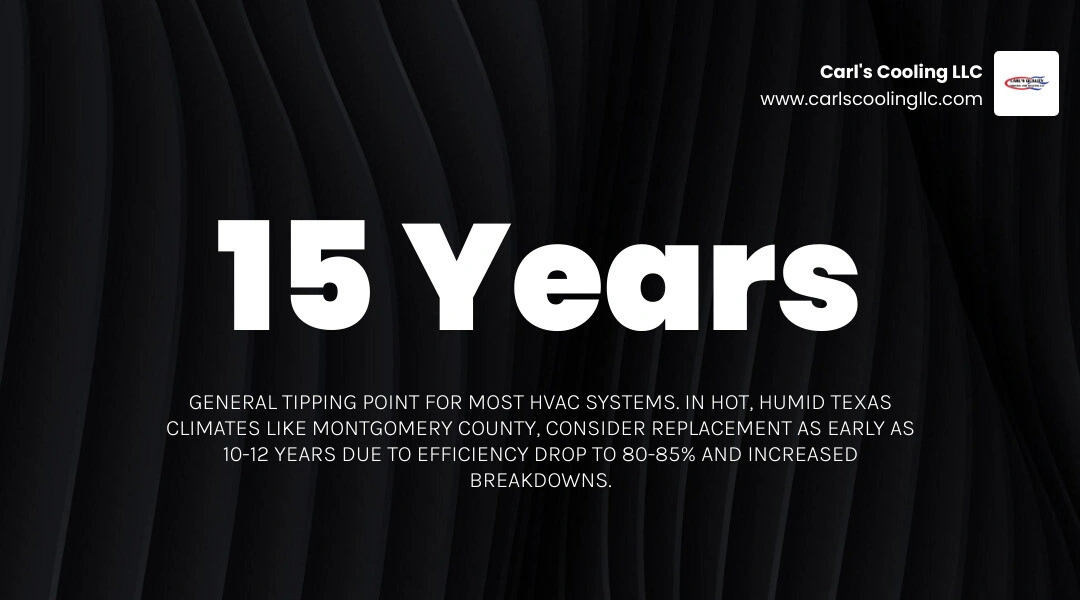
In short: 15 years is the general tipping point for most systems. But in hot, humid climates like Conroe and the greater Montgomery County area, that window can shrink to 10-12 years due to the strain of near-constant cooling cycles and high humidity.
The good news? Age alone doesn't seal your system's fate. How well it's been maintained, how it was installed, and how it's been used all play a major role. This guide walks you through everything you need to know — from finding out exactly how old your unit is, to the real math behind repair-versus-replace decisions.
Average Lifespan: How Old Is Too Old for an HVAC System?
When we talk about the average lifespan of heating and cooling equipment, we are usually looking at a window of 15 to 20 years. However, "design life" and "actual service life" are two very different things. While a manufacturer might design a unit to last 20 years in a laboratory setting, the real-world conditions in Texas can be much harsher.
Most HVAC systems are considered "middle-aged" by year 10. By year 12, many central air systems are operating at only 80–85% of their original efficiency. If your system was installed during the Obama administration, it is officially a "senior citizen" in the HVAC world. At this stage, components like the blower motor and compressor have undergone thousands of cycles, leading to microscopic wear and tear that eventually results in a catastrophic failure.
Determining When to Replace Your Heater or air conditioner often comes down to reliability. If you find yourself calling us for a "quick fix" every single season, your system is likely telling you it’s ready for retirement.
Lifespan Variations by System Type
Not all HVAC components age at the same rate. Here is a deeper dive into how different systems hold up over time:
- Gas Furnaces (15-25 years): These are the "marathon runners" of the HVAC world. Because they typically only run during our shorter Texas winters, they experience less mechanical fatigue than air conditioners. However, safety becomes a major concern as they age. A Time for a Furnace Replacement is often triggered by a cracked heat exchanger, which can pose a carbon monoxide risk.
- Electric Heat Pumps (10-15 years): Heat pumps work double-time. They provide cooling in the summer and heating in the winter, meaning the compressor never really gets a season off. This year-round usage strain typically results in a shorter lifespan compared to a dedicated furnace.
- Boilers (20+ years): While less common in newer Conroe developments, cast-iron boilers in older homes can be incredibly durable, sometimes lasting 30 years with meticulous care. However, their efficiency is often so low (60-70% AFUE) that they waste 30-40% of the fuel they consume.
- Ductless Mini-Splits (15-20 years): These systems are highly efficient but rely on sensitive inverter technology. In our humid climate, keeping the indoor coils clean is the secret to reaching that 20-year mark.
How Texas Climate Impacts Longevity
If you live in Conroe, The Woodlands, or Spring, your HVAC system is working harder than a system in a milder climate like Ohio or Oregon. The Montgomery County humidity is a silent killer for AC units. High humidity levels mean your system isn't just cooling the air; it’s working overtime to remove moisture.
This constant moisture leads to "formicary corrosion"—tiny, pin-sized holes in your copper coils. Furthermore, the extreme heat cycles we experience can cause the metal components to expand and contract rapidly, leading to refrigerant leaks. In high-demand environments like Houston and Cypress, we often see a "12-year wall." This is the point where the cost of electricity and the frequency of repairs make keeping the old unit a "false economy."
Before the heat spikes, it is wise to Replace Heating System Before Spring Signs to ensure you aren't caught in a summer backlog when every technician in the county is booked solid.
Determining the Age and Health of Your Unit

Many homeowners move into a house without knowing exactly when the HVAC system was installed. Don't worry—you don't need the original receipt to find out. Your unit carries its birth certificate right on its back.
How to find the exact age of your HVAC system
To find the age of your unit, look for the manufacturer's nameplate. On the outdoor condenser (the big box outside), this is usually a metal plate or a heavy-duty sticker located near the refrigerant line connections. On the indoor air handler or furnace, it’s typically inside the cabinet door.
Look for a line that says "MFR DATE" or "Manufacture Date." If it isn't clearly labeled, you can use the serial number. Most brands use a code where the first four digits represent the week and year. For example, a serial number starting with "1214" often means the unit was manufactured in the 12th week of 2014.
If you can't decode it yourself, you can enter the brand and serial number into an online database or give us a call. Knowing the age is the first step in spotting Signs You Need AC Replacement before a total breakdown occurs.
Signs your HVAC system is too old for comfort
Age is just a number, but performance is a reality. Even if your unit is only 12 years old, it might be "too old" if it exhibits these symptoms:
- Rising Utility Bills: Older systems consume 20-40% more energy than modern alternatives. If your bills are creeping up every summer despite similar usage, your system is losing the battle against friction and motor degradation.
- The "Ghost in the Attic": Unusual grinding, squealing, or banging noises are often signs of failing bearings or a struggling compressor.
- Inconsistent Temperatures: Does the master bedroom feel like a sauna while the kitchen is a walk-in freezer? Older units struggle to maintain even airflow and static pressure.
- Excessive Dust and Humidity: An aging system loses its ability to filter air and dehumidify effectively, leaving your home feeling "clammy" and dusty.
- Frequent Breakdowns: If you've had more than two major repairs in the last three years, you are in the "slow bleed" phase where repair costs will soon exceed the value of the unit.
Identifying these Replace Your Old AC Unit Signs early can save you from an emergency situation in the middle of a July heatwave.
The Math of Retirement: Repair vs. Replace Rules
Deciding whether to sink more money into an old unit or invest in a new one is a financial crossroads. We recommend using two industry-standard "rules of thumb" to help make the decision easier.
The 50% RuleThis rule is simple: If the cost of a single repair is 50% or more of the price of a brand-new system, you should replace it. Why? Because a major repair on a 15-year-old unit doesn't reset the clock on the other aging parts. You might fix the compressor today only to have the blower motor fail three months from now.
When you Repair or Replace Your Furnace, always look at the cumulative history. A $500 repair might seem manageable, but if it's the third one this year, the math quickly shifts toward replacement.
The $5,000 Rule for Aging Systems
This is a favorite among HVAC experts because it factors in the age of the equipment.
The Formula: Age of System × Cost of Repair = Total Score
- If the score is less than $5,000, repair the system.
- If the score is more than $5,000, replace the system.
Example A: Your AC is 12 years old and needs an $800 repair. 12 × 800 = 9,600. Since 9,600 is way over 5,000, the math suggests replacement is the smarter long-term move.
Example B: Your AC is 5 years old and needs a $400 repair. 5 × 400 = 2,000. Since 2,000 is well under 5,000, you should definitely go through with the repair.
This rule helps you avoid the "sunk cost fallacy," where you keep pouring money into a system that is fundamentally at the end of its life.
Refrigerant Phase-outs and Modern Efficiency
It is currently May 2026, and the landscape of HVAC technology has changed dramatically in recent years. If your system was built before 2010, it likely uses R-22 refrigerant (Freon). The EPA banned the production and import of R-22 in 2020, making it incredibly scarce and expensive to find. A simple leak in an R-22 system can now cost a fortune just for the refrigerant alone.
Furthermore, we are currently in the midst of the R-410A phasedown. Systems built today use newer, more environmentally friendly refrigerants with lower global warming potential. Upgrading now allows you to take advantage of SEER2 efficiency standards. Modern units are significantly more efficient than the 13 SEER units common a decade ago.
Upgrading to a system with variable-speed technology doesn't just lower your bills; it provides superior comfort by running at lower speeds for longer periods, which is much better for dehumidification in our Texas climate.
Risks of Keeping an Aging System in Montgomery County
Pushing an old system to its absolute limit isn't just a matter of comfort; it can be a matter of safety. As furnaces age, the heat exchanger—the component that keeps combustion gases separate from your breathing air—can develop stress cracks. According to NFPA 54 standards, a cracked heat exchanger is a non-repairable safety hazard that requires an immediate shutdown to prevent carbon monoxide leaks.
There are other risks to consider:
- Fire Hazards: Aging electrical components, such as capacitors and contactors, can overheat and cause electrical surges or small fires.
- Property Damage: Old AC units often have rusted condensate pans or clogged drain lines. A leak in an attic-mounted unit can cause thousands of dollars in damage to your ceilings, floors, and furniture.
- Catastrophic Summer Failure: In places like Willis, Porter, and New Caney, a total AC failure in August isn't just an inconvenience—it's a health risk for the elderly and pets. Repair wait times can be four times longer during peak season.
Frequently Asked Questions
Can a well-maintained furnace really last 30 years?
While it is technically possible for high-quality gas furnaces or electric units to reach 30 years, it is extremely rare. Even if it does "run," it is likely operating at a fraction of its original efficiency. Furthermore, parts for 30-year-old units are nearly impossible to source. From a safety perspective, we always recommend a rigorous annual inspection for any furnace over 20 years old. In many cases, the energy savings from a new 95%+ AFUE furnace will pay for the upgrade over time.
Does a 10-year-old AC need replacing?
Not necessarily. If a 10-year-old unit has been professionally maintained every year, it might have another 5 to 7 years of good life left. However, you should start a "replacement fund" at the 10-year mark. In the Conroe and Woodlands area, the 12-year mark is where we see the most significant drop in reliability. If you’re noticing rising bills and frequent "minor" issues, it’s time to start shopping so you can choose a new system on your own terms, rather than in an emergency.
Why are my energy bills rising if the system still runs?
As systems age, they experience "efficiency slippage." Dirt builds up on the internal coils, the refrigerant charge may be slightly off, and the motors have to work harder to overcome mechanical friction. A 12-year-old AC unit has typically lost about 20% to 30% of its original efficiency. If your system was a 13 SEER unit when it was installed, it might be performing like a 9 SEER unit today. You’re paying for 100% of the electricity but only getting 70% of the cooling.
Conclusion
At Carl's Cooling LLC, we know that your home’s comfort is your top priority. Whether you are in Conroe, Montgomery, The Woodlands, or anywhere across Montgomery County, we are here to help you navigate the tricky decision of how old is too old for an hvac system.
We don't believe in high-pressure sales. Our goal is to provide you with a professional system assessment so you can make an informed choice. From preventive maintenance that extends your unit's life to high-efficiency installations that slash your utility bills, our family-owned team is dedicated to keeping your home cool and your air clean.
Don't wait for your "senior citizen" AC to retire on its own terms. Schedule your professional HVAC evaluation today and let us help you find the perfect balance of comfort, safety, and energy efficiency.