
The Hidden Toll of Gulf Coast Aquifer Groundwater on Your Cooling System
Nearly 100% of the groundwater supplying this region comes from the Gulf Coast Aquifer, meaning that the impact of Montgomery County hard water on evaporative coolers is a constant, unavoidable reality for local homeowners. Here at Carl's Quality Cooling and Heating LLC, our team sees the effects of this naturally mineral-loaded water on a daily basis. While these high concentrations of calcium and magnesium are perfectly safe for drinking, they create a highly destructive environment for water-based cooling equipment. Every time your system cycles on, it pulls this mineral-heavy water across its internal components, setting the stage for rapid, cumulative wear.
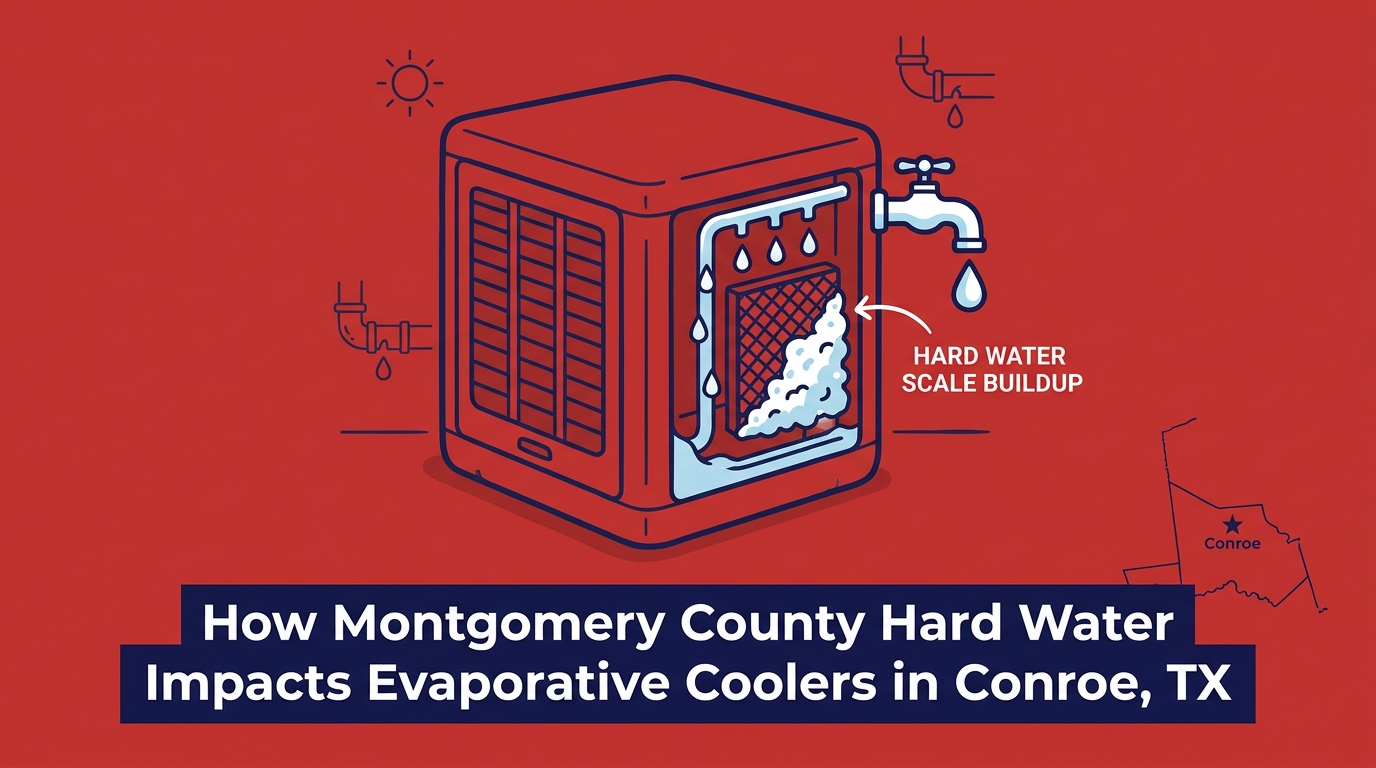
The concrete problem facing Conroe residents is the aggressive formation of heavy calcium deposits and scale buildup on the system's cooling pads. As the season progresses, these once-porous pads transform into calcified, restrictive barriers. By the time late summer arrives and families are navigating the back-to-school transition, homeowners face a critical decision point: struggle through the rest of the season with a system that runs constantly but barely cools the house, or take immediate action to clear the buildup and restore efficiency. Managing this local environmental wear requires more than just hoping for the best; it requires professional air conditioning services to properly diagnose and mitigate the extreme mineral accumulation.
The Chemistry of Evaporation: How Minerals Concentrate on Cooling Pads
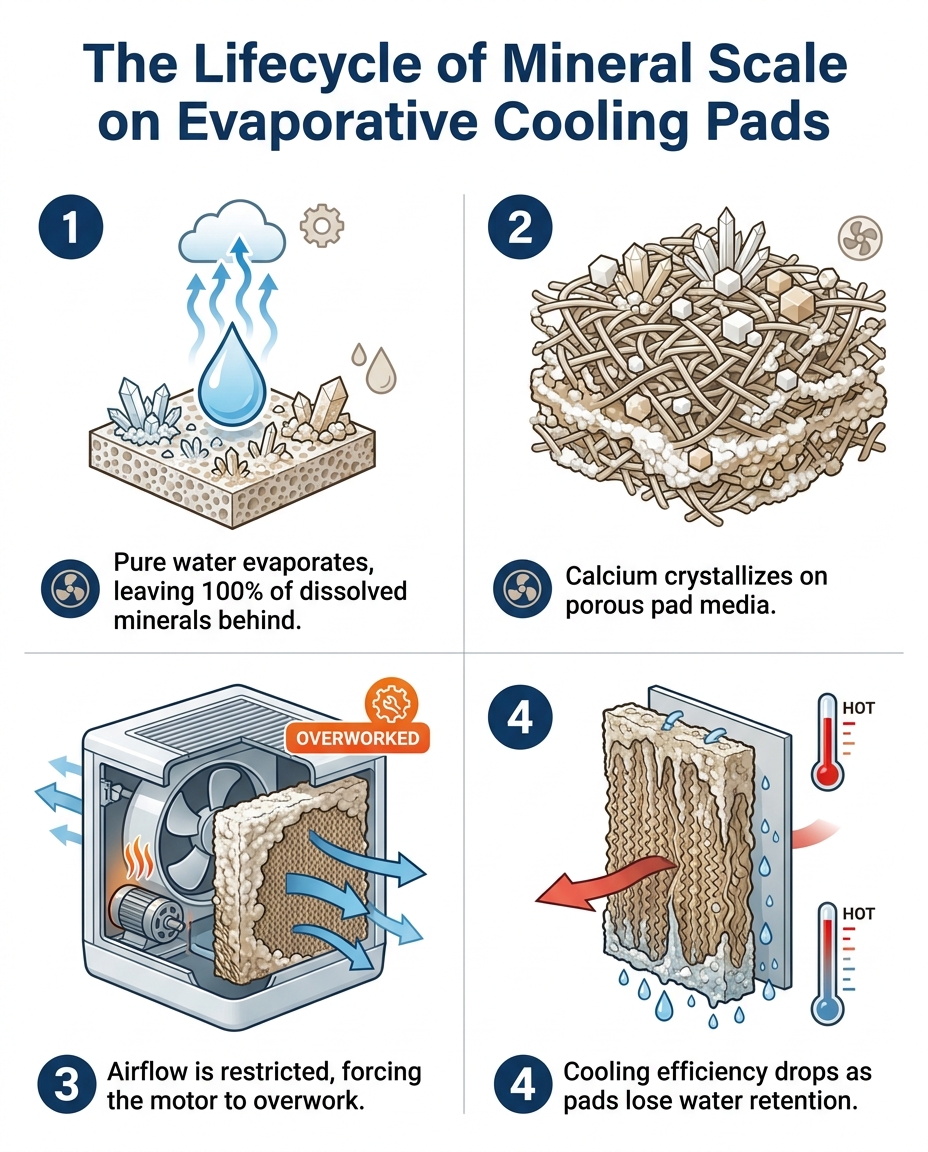
Our technicians often explain to customers that to understand why local groundwater is so destructive to your equipment, you have to look at the exact chemistry of the evaporation process. Evaporative coolers work by drawing hot outside air through water-saturated media. As the water evaporates, it absorbs heat, dropping the temperature of the air before it enters your home. However, evaporation is a process of separation. Only pure H2O transitions into vapor. Every single dissolved solid present in the water is left behind.
Because the local water supply is exceptionally hard, the concentration of these leftover solids is massive. Calcium and magnesium do not simply wash away; they crystallize directly onto the porous material of the cooling pads. Over weeks of operation, these microscopic crystals bond together, creating a thick, chalky crust. This physical transformation alters the pads from highly absorbent, sponge-like media into hardened, calcified walls. The cellulose or synthetic fibers become completely encased in heavy calcium deposits and scale buildup.
Many systems are equipped with standard bleed-off valves designed to drain a portion of the mineral-heavy water before it can crystallize. The limitation of standard components: In areas with extreme hard water, we find that factory-set bleed-off rates are rarely sufficient. The rate of mineral accumulation simply outpaces the system's ability to flush itself. Without specialized water treatment or recalibrated drainage, the mineral concentration in the reservoir becomes a hyper-saturated brine, rapidly accelerating the calcification of the pads and internal housing.

Why the Late-Summer Heat Pushes Calcified Systems to the Breaking Point
The severity of mineral scale is directly tied to how often your system runs. In our years of servicing Conroe homes, we've observed that the intense August heat maximizes evaporation rates, demanding constant, uninterrupted operation from your cooling equipment. More heat means more water must be evaporated to achieve the same cooling effect. This massive increase in water volume moving through the system leads to a hyper-concentration of calcium deposits on the pads in a very short amount of time.
Scale formation is entirely cumulative. By the time late summer arrives, your cooling pads have already collected months of continuous mineral deposits from June and July. The system is no longer operating with fresh, porous media; it is fighting against a thick wall of accumulated rock. Understanding how the Montgomery County climate affects cooling systems is critical because the hottest part of the year coincides exactly with the point when your system's components are at their most degraded state.
The mechanical strain: This hyper-concentrated buildup forces the fan and blower motor to work significantly harder. Because the calcified pads restrict the intake of air, the motor must draw higher amperage to overcome the static pressure. This constant overworking generates excess heat within the motor itself. When the system is already under maximum seasonal stress due to triple-digit outdoor temperatures, this added mechanical strain drastically increases the risk of premature failure, often resulting in a complete system breakdown right when you need cooling the most.
Secondary Impacts: Airflow Restriction and Indoor Comfort
The hidden costs of ignoring heavy calcium deposits and scale buildup extend far beyond the unit on your roof or beside your house. As the pads calcify, they fundamentally lose their ability to retain water. Instead of passing through a deeply saturated cooling medium, the intake air passes over dry, hardened channels. The result is hot, unconditioned outdoor air being blown directly into your living spaces, causing your indoor temperatures to climb even while the system runs continuously.
This degradation also places immense strain on the internal water pump. The pump is designed to circulate a specific volume of water over the pads. When the media becomes crusted with scale, the water channels become blocked, forcing the pump to push against severe resistance. Over time, this resistance can burn out the pump entirely, leaving you with a system that only acts as a large, expensive fan.
Furthermore, compromised cooling pads create significant indoor comfort and air quality concerns. Stagnant water trapped behind dams of mineral scale becomes a breeding ground for biological growth. As the dry, calcified portions of the pad begin to flake and crumble under the force of the blower, microscopic mineral dust and debris can be pulled into the airstream and distributed throughout your home. Addressing these issues proactively is a critical part of comprehensive indoor air quality services, ensuring that the air circulating through your home remains clean, cool, and healthy.
The End-of-Season Dilemma: Push Through or Replace?
As August drags on, homeowners often face a frustrating dilemma. You notice the system is struggling, but the temptation to simply wait out the remaining hot weeks is strong. Ignoring poor performance might seem like a cost-saving measure, but our team consistently sees that pushing a compromised system to its breaking point usually results in much higher expenses.
Running an evaporative cooler with heavily calcified pads guarantees higher utility bills. Because the system cannot properly cool the air, the thermostat never reaches its set point, causing the unit to run 24/7. This constant electrical draw, combined with an overworked motor pulling excess amperage, drives up your energy costs significantly. (Note that while local utility incentive programs may apply to qualifying high-efficiency cooling upgrades, it is always best to verify current programs with your provider). More importantly, pushing through risks a sudden, mid-day mechanical failure that could require expensive emergency repairs or a complete motor replacement.
• Pushing Through — Immediate Impact: Poor cooling, constant operation, high energy bills. — Long-Term Consequence: Burned out blower motors, failed water pumps, emergency repair needs.
• Replacing & Treating Now — Immediate Impact: Restored airflow, immediate drop in indoor temperatures. — Long-Term Consequence: Extended equipment lifespan, lower utility costs, reliable late-summer cooling.
Signs Your Pads Have Reached Critical Mass
You do not have to guess whether your system is suffering from local water hardness. Our service professionals recommend looking for these highly visible symptoms of severe scale accumulation:
• Visible chalky crust: A thick, white, or gray mineral buildup on the exterior louvers or directly on the visible portions of the cooling pads.
• Reduced cooling capacity: The system runs continuously, but the air coming from the vents feels barely cooler than room temperature.
• Dry spots on the media: Uneven water distribution where certain sections of the pad remain completely dry while the pump is running.
• Unusual mechanical noise: A louder-than-normal hum or grinding sound indicating strain on the blower motor or water pump.
Professional Scale Management for Conroe Residents
Managing the extreme mineral content in Montgomery County requires more than just occasionally swapping out the pads. It requires a professional, structured approach to scale mitigation. Professional technicians utilize advanced scale inhibitors and precise bleed-off valve calibration to manage the dissolved solids before they can crystallize. Because water chemistry and system usage vary from home to home, a one-size-fits-all DIY fix is rarely effective. A licensed technician must thoroughly evaluate the system's current condition, the specific mineral load, and the airflow requirements to provide tailored treatment options.
We saw this exact pattern during a recent routine maintenance visit in the area. A homeowner scheduled a standard late-summer check-up, and our technician found severe scale buildup threatening the blower motor. Operating as a veteran-owned, family-run business means we apply military precision and discipline to every inspection. We did not just push a quick fix; we performed a thorough evaluation, clearly explained the mechanical strain caused by the local water, and provided several treatment options. The customer was able to decide what made the most sense for their family, allowing them to restore their system's efficiency without pressure.
This level of disciplined, reliable service is exactly why a structured preventative maintenance plan is so vital. Routine professional oversight ensures that the local water chemistry does not quietly destroy your equipment from the inside out. By treating the water and monitoring the mechanical components, you can prevent the severe late-summer degradation that plagues so many local systems.
Restore Your Cooling Power Before the Season Ends
The harsh reality of the groundwater in Conroe TX does not have to dictate the lifespan or efficiency of your cooling system. While the minerals are unavoidable, the damage they cause is entirely preventable with the right professional strategy. At Carl's Quality Cooling and Heating LLC, we believe you shouldn't have to suffer through the rest of the hot season with a system that runs constantly but fails to keep your home comfortable.
Seeking professional guidance to manage mineral buildup is the most effective way to protect your investment. Whether you need an immediate pad replacement, a recalibration of your bleed-off system, or the introduction of advanced scale inhibitors, taking action now ensures reliable performance. Schedule a comprehensive inspection today to clear the scale, relieve the strain on your motor, and restore your cooling power before the heat takes a final toll on your equipment.
Frequently Asked Questions
How does hard water affect an evaporative cooler?
Hard water leaves behind dissolved minerals, primarily calcium and magnesium, as pure water evaporates. These minerals quickly crystallize on the cooling pads, forming a hard scale that restricts airflow and reduces the pad's ability to absorb water. In our experience, this buildup forces the blower motor and water pump to overwork, drastically lowering the system's cooling efficiency and increasing the risk of mechanical failure.
How do you prevent calcium buildup on cooling pads?
Preventing calcium buildup requires a combination of proper water drainage and chemical treatment. A correctly calibrated bleed-off valve is essential to constantly drain a portion of the mineral-heavy water from the reservoir. Additionally, our technicians recommend professional-grade scale inhibitors that can be added to the water supply to keep minerals suspended in liquid form, preventing them from bonding to the porous pad material.
How often should you change pads with hard water?
In areas with extremely hard water, cooling pads typically need to be replaced at least once per cooling season, and sometimes twice if the system runs continuously during peak heat. Monitoring the pads for visible white crust, dry spots, or a noticeable drop in cooling performance will dictate the exact timing. Waiting too long to replace calcified pads places severe, unnecessary strain on the system's internal motors.
Can local Montgomery County water destroy my cooling system?
Yes, if left unmanaged, the heavy mineral content in the local groundwater can cause irreversible mechanical damage. The rapid accumulation of scale not only ruins the cooling media but can also burn out the water pump and cause the main blower motor to overheat due to restricted airflow. Proactive maintenance and professional water treatment are required to protect the equipment from premature failure.
What is the most effective scale inhibitor for evaporative coolers?
The most effective scale inhibitors are professional-grade treatments specifically formulated to target high levels of calcium and magnesium. These treatments work by altering the chemical structure of the minerals, preventing them from adhering to surfaces. Because the exact mineral profile of the water can vary, a licensed HVAC technician should evaluate your system to recommend and apply the correct treatment for your specific equipment.