



Preparing Your Home for the October Pre-Winter Transition
October is the critical pre-winter transition month in Southeast Texas, making it the perfect time to explore heating options comparisons for homeowners who need a reliable system before the cold arrives. The intense summer heat often pushes aging cooling equipment to its absolute limits. If your system struggled to keep up during August and September, you are likely facing a major decision point right now. You need to decide whether to replace that aging HVAC system with a modern heat pump or stick with a traditional gas furnace before evening temperatures consistently drop into the 40s.
Making this choice requires looking far beyond generic, nationally syndicated heating advice. What works best in the snowy Northeast is rarely the optimal solution for the Gulf Coast region. If your cooling system barely survived the summer heat, securing professional Air Conditioning Services alongside a comprehensive heating upgrade is the smartest way to prepare your home. Assessing your current equipment health during the October pre-winter transition gives you the time to make an educated, data-driven decision rather than an emergency purchase on the first freezing night of the year.
How Conroe's Mild Winters Change the Heating Equation
When you research heating systems online, much of the information you find assumes you live in a climate with extended sub-freezing temperatures. That traditional advice heavily favors gas furnaces. However, the Conroe TX area experiences a fundamentally different weather pattern. Our average winter lows rarely stay below freezing for extended periods, which completely shifts the standard heat-pump-vs-furnace debate.
In our region, the heating equation is less about battling blizzards and more about managing rapid temperature swings and lingering high humidity. Modern heat pumps operate at peak efficiency within this exact temperature range. Because they do not rely on burning fuel to create heat, they offer a smooth, consistent output that perfectly matches our moderate winter climate.
Conversely, installing a massive traditional furnace designed for northern winters can actually cause comfort problems in Southeast Texas. Oversized gas furnaces often suffer from short-cycling. This happens when the system blasts a massive amount of heat into the home, satisfies the thermostat almost instantly, and shuts off before it has a chance to circulate the air properly. Short-cycling leads to uneven room temperatures, excessive wear and tear on the mechanical components, and poor moisture management. High humidity and mild winters make heat pumps superior for year-round climate control without the short-cycling risks of oversized gas furnaces.
The Heat Pump Advantage: Efficiency and Humidity Control
To understand why heat pumps are so effective during the October pre-winter transition, it helps to look at how they operate. A heat pump does not burn fuel to generate heat. Instead, it uses electricity and a specialized refrigerant cycle to absorb ambient heat from the outside air and transfer it inside your home. Even when it feels chilly outdoors, there is still plenty of thermal energy in the air for the system to harvest.
Maximizing Energy Delivery
Because they move heat rather than creating it from scratch, modern heat pumps are incredibly efficient. Under the right conditions, a high-efficiency heat pump can deliver up to three times more heat energy to your home than the electrical energy it consumes to run the compressor. This remarkable efficiency translates into consistent comfort without the heavy energy consumption associated with electric resistance heaters.
Managing Fall Moisture
Beyond temperature control, heat pumps excel at managing moisture. The warm but wet shoulder seasons in Southeast Texas require a system that can run long enough to pull excess humidity out of the indoor air. A heat pump's variable-speed technology allows it to run at lower capacities for longer periods, gently warming the home while effectively dehumidifying the space. This continuous air circulation is a critical component of comprehensive Indoor Air Quality Services, helping to prevent the stagnant, damp air that can foster mold and mildew growth in the fall.
Additionally, upgrading to this technology often comes with financial incentives. Federal tax credits may apply to qualifying high-efficiency heat pump installations, making the long-term investment even more appealing for homeowners looking to modernize their climate control.
Traditional Gas Furnaces: Reliability and Performance Considerations
While heat pumps offer distinct advantages for the Conroe TX area, traditional gas furnaces remain a viable option under certain circumstances. A gas furnace generates heat through combustion. It ignites natural gas or propane in a sealed burner, heating a metal heat exchanger. The blower motor then forces air over this hot metal, distributing the warmed air throughout your ductwork.
When Does Gas Heating Make Sense?
Gas furnaces are renowned for their reliability and their ability to produce incredibly hot air very quickly. If your home already has established gas lines and extensive ductwork optimized for a furnace, a direct replacement might be the most straightforward path. Furthermore, gas furnaces typically boast a long lifespan because they are only used for a few months out of the year in our region, whereas a heat pump runs year-round for both heating and cooling.
Safety and System Variations
It is important to consider the safety differences between gas combustion and electric heating. Gas furnaces require proper exhaust flues to vent combustion byproducts safely outside the home. They also require routine safety inspections to ensure the heat exchanger remains intact and free of cracks.
Some homeowners explore dual-fuel systems, which pair an electric heat pump with a backup gas furnace. The heat pump handles the mild weather, and the gas furnace takes over only during extreme cold snaps. While this offers the best of both worlds, a dual-fuel setup is often unnecessary in our specific region, as modern heat pumps are more than capable of handling the coldest nights Southeast Texas typically experiences.
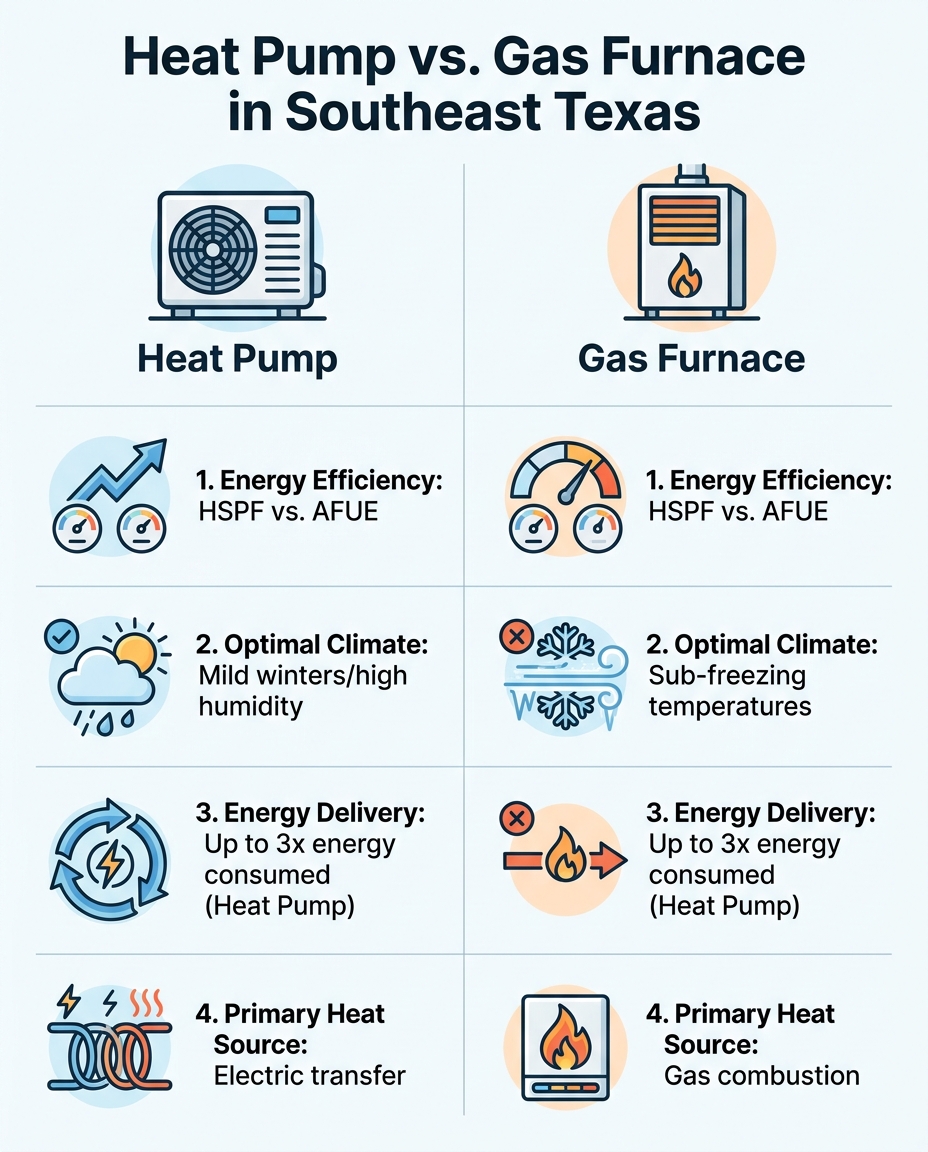
Side-by-Side Comparison: Heat Pump vs. Gas Furnace
To help you actively weigh your options, it is helpful to look at a direct comparison of these two distinct technologies. Both systems require regular upkeep, and enrolling in an HVAC Maintenance Plan is essential for protecting your investment regardless of which path you choose. However, they differ significantly in how their efficiency is measured and how they impact your home environment.
• Primary Energy Source — Electric Heat Pump: Electricity (transfers ambient heat) — Traditional Gas Furnace: Natural Gas or Propane (combustion)
• Efficiency Rating Metric — Electric Heat Pump: HSPF (Heating Seasonal Performance Factor) — Traditional Gas Furnace: AFUE (Annual Fuel Utilization Efficiency)
• Climate Suitability — Electric Heat Pump: Ideal for the Conroe TX area's mild winters and high humidity. — Traditional Gas Furnace: Designed for rapid heating in sub-freezing, harsh winter climates.
• Operational Cycle — Electric Heat Pump: Runs year-round (handles both heating and cooling). — Traditional Gas Furnace: Runs only during the winter heating season.
• Environmental Impact — Electric Heat Pump: Lower direct emissions; highly efficient heat transfer. — Traditional Gas Furnace: Produces combustion byproducts requiring safe outdoor venting.
When evaluating long-term value, remember that a heat pump replaces both your air conditioner and your heater in a single unit. A gas furnace only handles the heating side of the equation, meaning you will still need a separate air conditioning unit to survive the Texas summers.

Pairing Your New System with Smart Thermostat Controls
No matter which system you choose during the October pre-winter transition, modern controls are essential for maximizing its efficiency. Upgrading your physical equipment without upgrading your thermostat is like putting a high-performance engine in a car with a broken steering wheel. Smart thermostats optimize the running cycles for both heat pumps and gas furnaces, ensuring you get the most out of your new investment.
Here is how advanced controls improve your home heating experience:
1. Optimized Cycle Times: Smart thermostats learn how long it takes your specific home to heat up and cool down. They adjust the system's cycles to prevent overworking the equipment during drastic temperature swings, which is especially important during our unpredictable fall weather.
2. Precise Humidity Monitoring: Advanced controls do more than read the temperature. They actively monitor indoor humidity levels, allowing a variable-speed heat pump to adjust its airflow specifically for dehumidification.
3. Proactive Troubleshooting: Modern thermostats can alert you to system issues before you even feel a difference in the room temperature. However, if you ever wonder What to Do When Your Thermostat Screen is Blank while the system is running, it usually points to a tripped safety switch or a blown low-voltage fuse that requires a professional diagnostic.
4. Staging Control: For multi-stage heat pumps and furnaces, a smart thermostat precisely dictates when to use the low-energy first stage and when to engage the high-power second stage, drastically reducing overall energy waste.
Why Precision Sizing Matters More Than the System Type
Whether you lean toward a heat pump or a gas furnace, the most critical factor in your home's comfort is not the brand name on the box—it is the precision of the installation. Choosing a system out of a catalog based on square footage alone is a recipe for disaster. Rule-of-thumb sizing leads to oversized systems that short-cycle, or undersized systems that run continuously without ever reaching the set temperature.
Working with a veteran-owned company means you are getting the same level of discipline and accountability that military service demands. We believe in honest, data-driven system matching. Before recommending any equipment for your Conroe TX area home, a professional must perform a methodical diagnostic approach known as a Manual J load calculation.
This calculation takes into account your home's unique thermal load. It evaluates the quality of your insulation, the orientation of your windows, the height of your ceilings, and the local climate data. Proper installation and precise sizing impact the lifespan and efficiency of the chosen equipment far more than the specific technology itself. Because this process involves complex mathematics, high-voltage electrical work, and specialized refrigerant handling, professional assessment and installation are absolutely required.
Make the Right Heating Choice for Your Conroe Home
As the fall weather sets in, finalizing your heating options comparisons for homeowners is the best way to ensure a comfortable winter. Heat pumps offer distinct advantages for the Conroe TX area, providing superior humidity control, incredible energy efficiency, and a perfect match for our mild climate. Meanwhile, gas furnaces remain a traditional, reliable option for homes already equipped to support them.
The key to long-term comfort is finalizing your research and scheduling a professional assessment before the first winter freeze arrives. Professional guidance takes the guesswork out of the equation, ensuring your new system is perfectly sized and expertly installed. If you are ready to explore the best options for your home, reach out for comprehensive HVAC Service and Repair. Let data-driven diagnostics and local expertise guide you to the perfect heating solution for your family.
Frequently Asked Questions
Is a heat pump better than a gas furnace in Texas?
For most homes in Southeast Texas, a heat pump is the superior choice due to our mild winters and high humidity. Heat pumps provide highly efficient, year-round climate control without the risk of short-cycling that often plagues oversized gas furnaces in warmer climates.
At what temperature does a heat pump stop working efficiently?
Modern high-efficiency heat pumps can extract heat from the air even when temperatures drop below freezing. While older models struggled in extreme cold, today's advanced systems maintain excellent efficiency well below the coldest temperatures we typically experience in the Conroe area.
Do I need a gas furnace if I have a heat pump?
In Southeast Texas, a standalone heat pump is generally more than sufficient to handle our winter heating demands. While dual-fuel systems (a heat pump paired with a gas furnace) exist for extreme northern climates, they are rarely necessary for homes in our region.
Should I switch from gas to electric heat this fall?
Switching to an electric heat pump is a smart long-term investment for many homeowners looking to improve efficiency and humidity control. A professional load calculation can help you determine if your home's current ductwork and electrical panel are ready for the upgrade.
How does a smart thermostat improve heat pump efficiency?
A smart thermostat optimizes a heat pump's variable-speed technology by precisely managing its running cycles. It learns your home's thermal patterns, prevents the system from overworking during rapid temperature swings, and actively monitors indoor humidity levels.
Why is my thermostat screen blank while the system is running?
A blank thermostat screen while the equipment is running usually indicates a loss of low-voltage power from the indoor unit. This is often caused by a tripped safety switch, a clogged condensate drain line, or a blown fuse, requiring a professional technician to diagnose and resolve the underlying issue safely.

