


Why Your Heat Pump Seems to Struggle When the Mercury Hits Triple Digits
Are you staring at your thermostat during a brutal heat wave, wondering: is your heat pump not cooling enough or just undersized for 100-degree days? In our years of dispatching technicians across Conroe, TX, this is one of the most common questions our team at Carl's Quality Cooling and Heating LLC receives. When the temperature outside climbs past the century mark and your indoor temperature stubbornly hovers around 78 degrees, panic usually sets in. You might assume your system is broken, leaking refrigerant, or simply failing to do its job. We know it is incredibly frustrating to hear the unit running continuously on a hot afternoon while the house still feels warmer than you would like.
However, before you assume the worst, we always remind our customers that all air conditioning and heat pump systems have physical design limits. A unit that runs continuously during an extreme heat wave might actually be doing exactly what it was engineered to do. Understanding these hard physical limits can save you from unnecessary stress and prevent you from paying for an emergency repair call when your system is actually functioning perfectly.
To ensure your system is operating at its true potential, learn more about our Air Conditioning Services.
Understanding HVAC Design Temperatures and the 20-Degree Rule
To understand why your system behaves the way it does during extreme weather, you have to look at how HVAC systems are engineered before they ever reach your home. Systems are not built to handle infinite temperatures; they are precisely calculated to handle the typical climate of your specific region.
What is ACCA Manual J?
The national standard for calculating residential heating and cooling loads is known as ACCA Manual J. When our team installs a new heat pump, we rely on this calculation to determine exactly how much capacity your home needs based on square footage, insulation, window placement, and local historical climate data. The critical factor here is that Manual J uses historical averages, not absolute peak extremes.
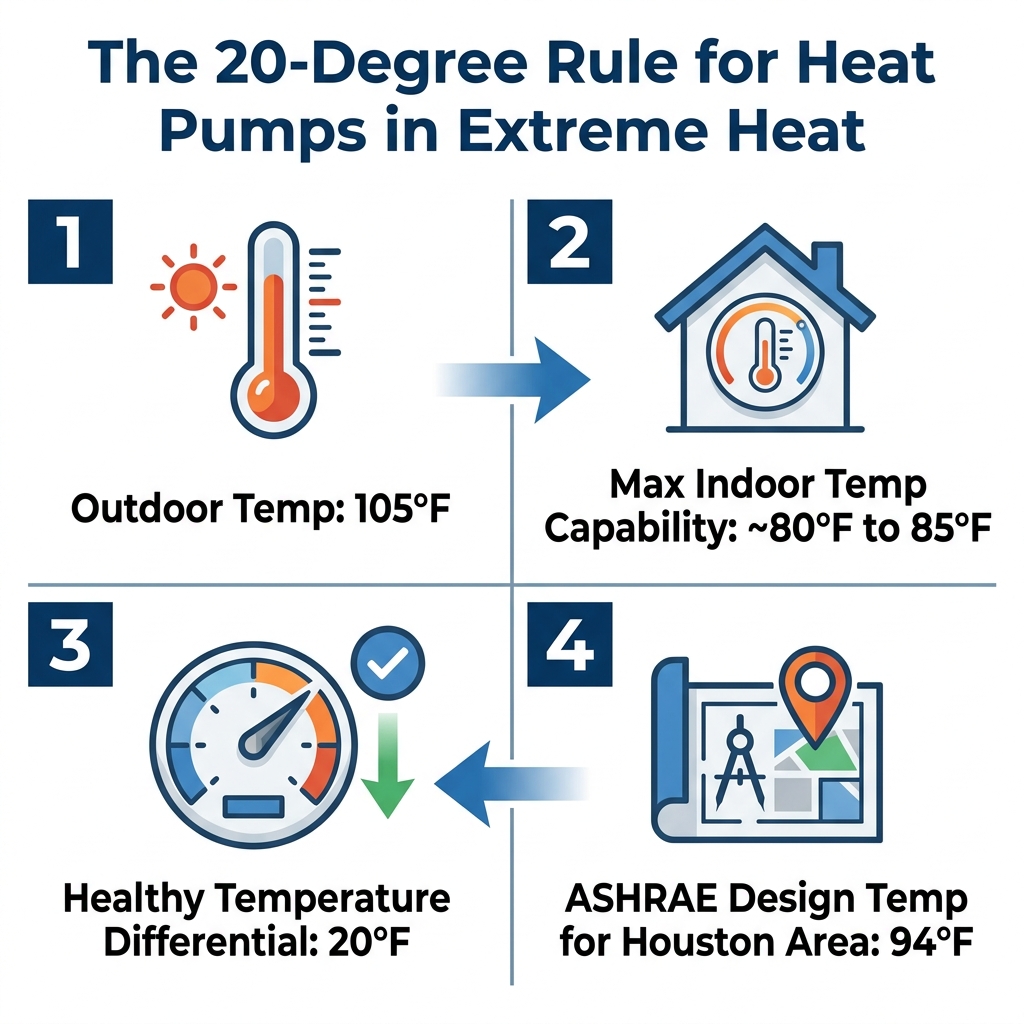
For the greater Houston and Conroe area, the ASHRAE cooling design temperature is approximately 94 degrees Fahrenheit. This is known as a "1% design temperature." It means that historically, the outdoor temperature only exceeds 94 degrees for about 1% of the hours in a year. Your heat pump is perfectly sized to keep your home at a comfortable 70 to 72 degrees when it is 94 degrees outside. It is deliberately not sized for the absolute hottest hour of the hottest day of the decade.
How the 20-Degree Differential Works
Because of how refrigerant absorbs and releases heat, residential cooling systems are generally designed to achieve a 20-degree temperature differential (often called Delta T) between the outdoor air and the indoor air. As we often explain during our summer service calls, this is a limitation of physics and heat transfer, not a mechanical failure of your specific unit.
If it is a Peak Southeast Texas Summer (100-105°F days) outside, a perfectly functioning system will max out around 80 to 85 degrees inside. The system is physically incapable of creating a 30- or 35-degree difference between the indoor and outdoor environments.
• 90°F — Maximum Expected Indoor Temperature (20°F Differential): 70°F — System Status: Normal Operation (Cycling on and off)
• 95°F — Maximum Expected Indoor Temperature (20°F Differential): 75°F — System Status: Heavy Load (Running frequently)
• 100°F — Maximum Expected Indoor Temperature (20°F Differential): 80°F — System Status: Maximum Capacity (Running continuously)
• 105°F — Maximum Expected Indoor Temperature (20°F Differential): 85°F — System Status: Extreme Load (Running continuously)

Why a 78-Degree House During a Heat Wave Means Your System is Healthy
It can be difficult to accept that a warm house means a healthy heat pump, but the math tells a very reassuring story. If you are panicking over a 78°F indoor temperature while the afternoon sun pushes the outdoor thermometer to 105 degrees, you can actually take a deep breath. In fact, our technicians would tell you that your system is overperforming.
1. Calculate the true differential: Subtract your indoor temperature (78 degrees) from the outdoor temperature (105 degrees). That is a 27-degree drop.
2. Recognize the achievement: Because the standard design limit is a 20-degree drop, achieving a 27-degree differential means your heat pump is operating at or slightly above its absolute maximum design capacity. It is working incredibly hard and doing a fantastic job.
3. Accept the continuous operation: Under these extreme conditions, the heat pump will run non-stop. It has to. If it shuts off even for five minutes, the intense outdoor heat will immediately begin to penetrate your home's thermal envelope. Continuous operation in this scenario is necessary and normal, not a sign of a refrigerant leak or a failing compressor.
4. Mitigate indoor heat gain: To help your system maintain that impressive 27-degree drop, you have to reduce the heat generated inside the house. Keep your blinds tightly closed on south and west-facing windows. Avoid using the oven, running the dryer, or taking long hot showers during peak afternoon hours. We always advise our customers that every bit of heat you add indoors is heat the system has to fight to remove.
The Hidden Workload: How High Humidity Impacts Heat Pump Cooling
In Southeast Texas, the heat is only half the battle. The other half is the thick, oppressive moisture in the air. To understand why your heat pump struggles during a Peak Southeast Texas Summer (100-105°F days), our experts emphasize the difference between two critical types of cooling: sensible cooling and latent cooling.
Sensible cooling is the energy your heat pump spends actually lowering the air temperature. This is the change you can feel and the number you see dropping on your thermostat.
Latent cooling is the energy your heat pump spends extracting moisture from the humid air. Water vapor holds a massive amount of heat energy. Before your heat pump can drop the raw temperature of the room by even one degree, it first has to condense gallons of water out of the indoor air and drain it outside.
When the humidity is exceptionally high, your heat pump is doing a staggering amount of latent cooling. It is working at maximum capacity, drawing immense amounts of electricity, and moving massive amounts of heat energy out of your house—but because all that effort is going toward removing water, the sensible temperature on your thermostat doesn't budge. We see this daily during peak summer: high humidity makes the heat pump work significantly harder, dramatically reducing its ability to drop the raw temperature quickly.
Is Your Heat Pump Undersized? The Risks of Buying a Bigger Unit
When a homeowner experiences a hot house during a heat wave, the immediate temptation is to demand a larger unit. The logic seems sound: if a 3-ton unit can't keep the house at 70 degrees on a 100-degree day in Conroe, TX, then surely a 4-ton or 5-ton unit will solve the problem.
The Problem: Sizing a heat pump exclusively for the five hottest days of the year creates severe operational problems for the other 360 days.
The Cause: If you install an oversized unit, it will cool your house incredibly fast on a normal 85-degree day. While that sounds great, it leads to a phenomenon called "short-cycling." The unit turns on, blasts the house with cold air, hits the target temperature in 10 minutes, and shuts off. Because it only ran for 10 minutes, it never had time to perform latent cooling (removing humidity).
The Solution: The result of an oversized unit is a cold, clammy, deeply humid house that is highly susceptible to mold growth and poor indoor air quality. A properly sized unit is designed to run continuously on extreme days because that long, steady run cycle is exactly what keeps your humidity perfectly balanced during the rest of the summer.
As a veteran-owned business, we believe in straightforward, honest advice. Our team at Carl's Quality Cooling and Heating LLC will tell you the truth about HVAC sizing and the dangers of oversizing, rather than just using a heat wave as an excuse to sell you a bigger, more expensive system that will ultimately damage your home's comfort. If you want to ensure your home is properly evaluated, we serve numerous Montgomery County Service Areas with integrity-first diagnostics.
Signs Your Heat Pump Actually Needs Professional Repair
While a 78°F indoor temperature on a 105-degree day is normal, there are distinct symptoms that indicate your system has actually crossed the line from "working hard" to "mechanically failing." If the 20-degree rule no longer applies—meaning it is 95 degrees outside and your house is climbing into the upper 80s—you need to take action.
• Blowing completely warm air: If the air coming out of your vents feels like the air outside, the system is no longer transferring heat. This often points to a refrigerant leak or a failed compressor.
• Ice forming on the coils or refrigerant lines: Ice is never normal in the summer. It usually means severe airflow restriction or low refrigerant levels causing the evaporator coil to drop below freezing.
• Strange, aggressive noises: A continuous loud grinding, screeching, or metal-on-metal clanking from the outdoor unit indicates a failing fan motor or compressor issue that needs immediate professional attention.
• Severe temperature imbalances: For example, a homeowner dealing with significant temperature differentials between floors (a common pattern we see in Conroe homes purchased after Hurricane Harvey) often requires a completely redesigned and newly installed HVAC system to finally achieve efficient, quiet cooling.
• A completely clogged air filter: Always check your filter first. A filter blocked by months of dust and pet hair chokes the system's airflow, perfectly mimicking a catastrophic mechanical failure. We urge homeowners to change the filter before calling our technicians.
If you are experiencing these genuine symptoms of failure, you can learn more about Why Is Your Heat Pump Running But Not Cooling? to help diagnose the issue.
Frequently Asked Questions About Heat Pumps in Extreme Heat
Why is my heat pump running but not cooling?
If it is over 95 degrees outside and your house is in the upper 70s, your heat pump is actually cooling—it has simply hit its maximum physical design limit. However, if the air blowing from your vents is completely warm, the system may have a refrigerant leak, a stuck reversing valve, or severely dirty condenser coils. A system that runs constantly without lowering the temperature at all requires a professional diagnostic from our team.
At what temperature does a heat pump stop cooling?
Heat pumps do not "stop" cooling at a specific outdoor temperature, but their overall efficiency and capacity drop as the heat increases. They will continue to provide approximately a 20-degree drop from the outdoor temperature regardless of how hot it gets. If it reaches 110 degrees outside, a healthy heat pump will still produce cooling, but the indoor temperature will likely hover around 90 degrees.
How many degrees can a heat pump cool a house?
A properly sized residential heat pump is designed to maintain a 20-degree difference between the outdoor air and the indoor air. During a Peak Southeast Texas Summer (100-105°F days), achieving a 20 to 25-degree drop is the maximum expected performance based on standard HVAC engineering calculations.
Is a 20 degree drop across the AC coil normal?
Yes, a 15 to 20-degree drop (known as Delta T) across the indoor evaporator coil indicates a healthy, properly charged cooling system. Our technicians take this measurement by comparing the temperature of the warm return air entering the system to the cold supply air blowing out of the vents. If the drop is significantly less than 15 degrees, the system is underperforming.
Should I set my thermostat lower if the heat pump is struggling?
No. Setting the thermostat lower will not make the air coming out of the vents any colder; it only tells the system to run longer. If the heat pump is already running continuously and failing to reach 78 degrees, dropping the setting to 68 degrees will only waste electricity and put unnecessary strain on the compressor without changing the indoor temperature.
Get Straight-Shooting Advice on Your Heat Pump's Performance
Surviving a 105-degree day in Conroe, TX, with a 78-degree house is a victory for your heat pump, not a failure. Understanding the 20-degree design limit helps you avoid panic and prevents you from making rash decisions about replacing a perfectly healthy system. An honest, veteran-owned HVAC professional like Carl's Quality Cooling and Heating LLC will always tell you the truth about these design limits rather than pushing unnecessary fixes or oversized units.
If you are experiencing genuine symptoms of mechanical failure, or if you want to ensure your system is clean, charged, and operating at peak efficiency before the next heat wave hits, our team is here to help. Secure your HVAC Maintenance Plan today to get straight-shooting advice, priority service, and the peace of mind that your heat pump is ready for whatever the Texas summer brings.


