


The Hidden Danger of the First Freezing Night in Texas
The long Texas summer is finally breaking, making right now the perfect time to discuss the crucial first furnace test: why you shouldn't wait for the first Conroe cold snap. In our years serving the Conroe area, our team at Carl's Quality Cooling and Heating LLC often sees homeowners ignore their heating systems until the exact moment the temperature drops, leading to unpleasant surprises. When you have spent the last seven months running your air conditioner to battle the humidity, it is easy to assume your furnace is sitting in the attic or closet, perfectly ready to take over the job. Unfortunately, heating equipment does not thrive on neglect.
Discovering a failed furnace ignitor or a stuck blower motor on a freezing night creates immediate, unavoidable stress. You wake up shivering, you check the thermostat, and you hear the system clicking in the hallway—but no warm air ever comes out of the vents. In that moment, the temperature inside your home begins to plummet, and your family's comfort is entirely compromised. We see this scenario play out in hundreds of homes simultaneously across the region the moment the first true cold front pushes through.
As a result, local HVAC schedules become completely booked during the first freeze, turning minor repairs into agonizingly long waits. When hundreds of people call for emergency service on the same morning, even the most robust service fleets reach their maximum capacity. A simple part replacement that would take an hour on a mild Tuesday suddenly becomes a multi-day ordeal. We always advise that proactively initiating a test run in early fall is the smartest way to ensure reliable warmth when it matters most, allowing you to bypass the emergency rush entirely.
If you need professional help right away, explore our heating services or secure your HVAC maintenance plan today.
The Conroe Climate Whiplash: Why September is the Critical Window
Our technicians know firsthand that Texas weather does not transition smoothly; it jumps abruptly from extreme summer heat to sudden, unpredictable cold snaps. Unlike northern states where autumn slowly cools down over a period of months, giving homeowners ample time to test and tune their equipment, the climate here operates on whiplash. You might be running your air conditioning on full blast during a 95-degree afternoon, only to wake up a few days later to frost on the grass. This drastic swing puts immense thermal and mechanical stress on your home's HVAC infrastructure.
The September early fall transition serves as the perfect transition month to evaluate heating equipment before emergency weather hits. During this window, the daytime temperatures are mild enough that running the heater for a brief test will not make your home unbearably hot, yet the evenings are just starting to cool down. More importantly, this is the brief lull in the HVAC industry calendar. The summer cooling emergencies have tapered off, and the winter heating panics have not yet begun.
Waiting until late fall guarantees that any discovered issues will compete with hundreds of other service calls. The moment the local meteorologist announces the first freeze warning, our phone lines light up. If your system has a hidden dormant-season failure, you will be added to a very long list of frustrated homeowners.
A controlled test now shifts repair timelines from days to mere hours. If your September test reveals a problem, one of our technicians can typically arrive the same day, diagnose the issue in a calm environment, source the necessary parts without supply chain panics, and restore your system well before the actual cold weather arrives. You are essentially buying yourself time, peace of mind, and priority access to professional care.
What Happens to Your Furnace During the Texas Summer?
The Problem: Heating systems sit completely dormant for over six months during the long Texas cooling season. While your air conditioner's compressor and evaporator coil are working overtime, the heating components—specifically the gas burners, heat exchangers, and ignition systems—are doing absolutely nothing. Mechanical and electrical systems are designed to operate, and prolonged periods of total inactivity often lead to unexpected degradation.
The Cause: During this long dormancy in the Conroe area, our maintenance crews routinely see dust accumulation settle heavily on sensitive components. The attic or mechanical closet is a dusty environment, and fine particulates coat the furnace ignitor, the flame sensor, and the burner assembly. Furthermore, the extreme heat of a Texas attic in July and August bakes these dormant components. Micro-cracks can develop in the delicate silicon carbide of the ignitor due to the intense ambient heat fluctuations. Simultaneously, blower motors that are not utilized for heating can suffer from lubricant settling, causing bearings to dry out and mechanical parts to seize up from lack of use.
The Solution: When the system is finally called to run on a freezing November night, these dormant-season vulnerabilities instantly cause ignition failure. The dusty flame sensor fails to read the fire, shutting the gas valve off as a safety precaution. The micro-cracked ignitor snaps under the sudden surge of electricity. The dry blower motor strains and trips a circuit breaker. By understanding what happens during the summer, you can appreciate why a proactive test is the only way to uncover these hidden vulnerabilities before they leave you freezing in the dark.
How to Safely Perform a 15-Minute Thermostat Test
Running a controlled test during the September early fall transition is the best way to verify your system's readiness. However, we always stress to our customers that it is vital to perform this test safely, without attempting to open the furnace cabinet or manipulate internal components. Here is the safe, step-by-step process we recommend for homeowners.
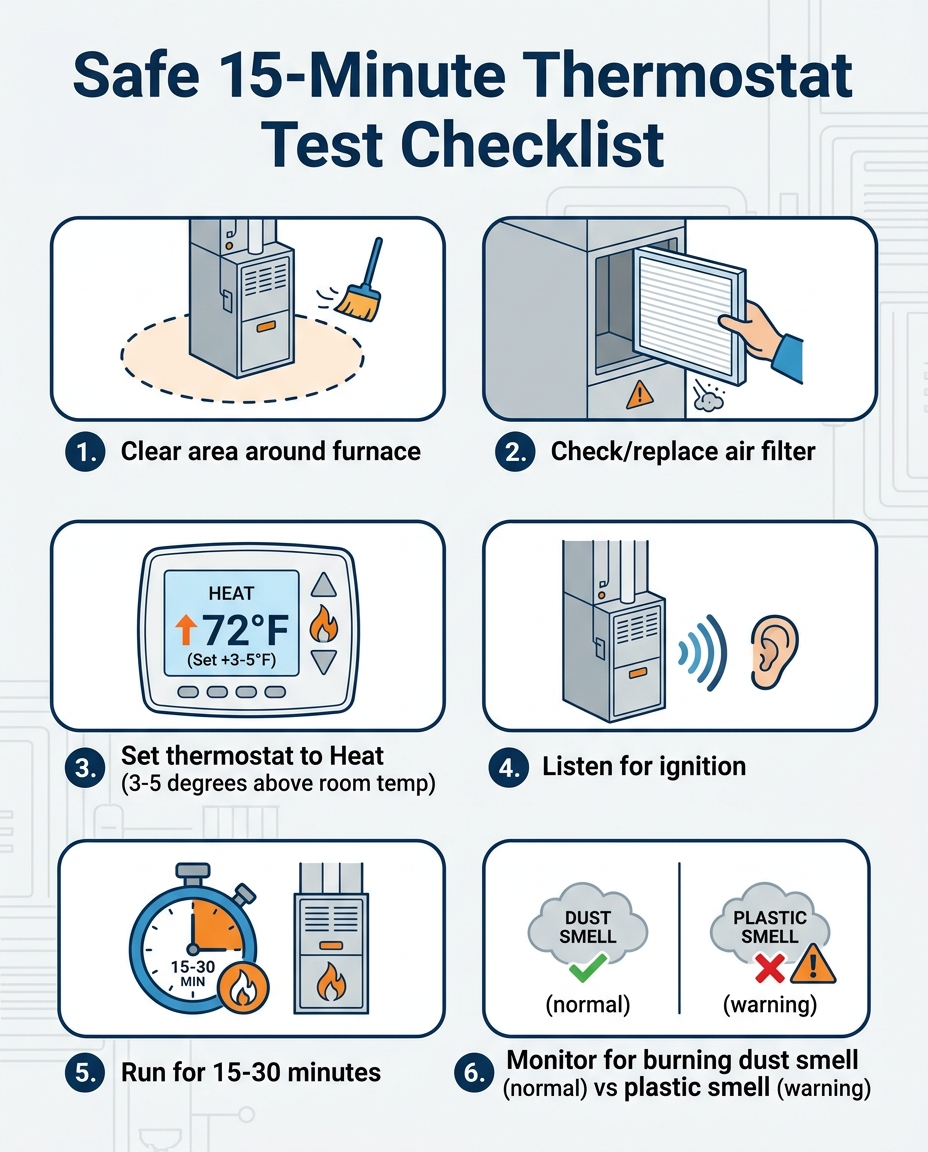
1. Clear the surrounding area: Start by ensuring the area around the furnace is clear of summer storage items. Over the summer, it is common for boxes, holiday decorations, or cleaning supplies to migrate toward the mechanical closet. Move all combustible materials at least three feet away from the unit.
2. Inspect the airflow: Check and replace the air filter to ensure proper airflow before initiating the test. A clogged furnace filter will suffocate the system, causing it to overheat and shut down prematurely, which ruins the diagnostic value of your test.
3. Initiate the heating cycle: Switch the thermostat from 'Cool' to 'Heat'.
4. Monitor the operation: Let the system run for 15 to 30 minutes to ensure it cycles completely and produces steady warm air from all vents in the home.
Setting the Thermostat Correctly
When you switch the system over, avoid cranking the heat excessively high. You do not need to set the thermostat to 85 degrees to test the furnace. Just 3 to 5 degrees above the current ambient room temperature is enough to trigger the heating cycle. Once you adjust the temperature, stand near the thermostat and listen for the click of the device communicating with the furnace. Within a minute or two, you should hear the inducer motor start up, followed by the ignition sequence, and finally the rush of warm air through your ductwork.

Normal vs. Warning Signs During Your First Run
When you fire up the heater for the first time in the Conroe area, the system will exhibit some quirks. Knowing the difference between a harmless start-up characteristic and a genuine mechanical failure can save you from unnecessary panic—or alert you to a real emergency.
• Smell of burning dust — Classification: Normal — What It Means: Settled dust is burning off the heat exchanger. — Action to Take: Open a window; wait 15-30 minutes for it to clear.
• Smell of burning plastic or ozone — Classification: Warning — What It Means: Electrical wires are melting or arcing. — Action to Take: Shut the system off immediately at the thermostat.
• Brief clicking before ignition — Classification: Normal — What It Means: The system is stepping through its safety sequence. — Action to Take: Allow the cycle to continue naturally.
• Loud banging or squealing belts — Classification: Warning — What It Means: Delayed gas ignition or a seized blower motor. — Action to Take: Turn off the heater and call for professional repair.
• System blows cold air endlessly — Classification: Warning — What It Means: The burners have failed to ignite entirely. — Action to Take: Turn off the system to prevent circulating cold drafts.
A brief smell of burning dust is completely normal as settled particles burn off the heat exchanger. Because the system has sat idle all summer, a thin layer of particulate matter has coated the metal. When those metal tubes rapidly heat up to hundreds of degrees, that dust incinerates. The dust smell should dissipate within 15 to 30 minutes of continuous operation.
However, warning signs include smells of burning plastic or electrical ozone, which require immediate shutdown. If you smell melting wire casing, do not wait to see if it goes away. Similarly, our team often responds to loud banging (often caused by gas building up and igniting all at once), squealing belts, or a system that blows cold air continuously—all of which indicate a mechanical fault that requires immediate intervention.
Why You Shouldn't Ignore a Failed Ignitor (And When to Call a Pro)
If the system fails to produce heat during the test, a faulty ignitor is often the culprit. The ignitor is a small, delicate component made of silicon carbide that glows white-hot to light the gas burners. After a long summer of extreme attic heat and settling dust, these components frequently develop microscopic fractures. When the thermostat sends 120 volts of electricity into a fractured ignitor, it snaps, leaving your furnace unable to light the gas.
Replacing an ignitor requires navigating delicate electrical components and gas lines, making it strictly professional work. We cannot emphasize enough that this is not a weekend DIY project. Handling the new ignitor with your bare hands can leave behind skin oils that cause the new part to shatter the moment it heats up. Furthermore, diagnosing why the ignitor failed—whether it was age, a voltage spike, or a failing control board—requires specialized multimeters and training.
Ignoring a failing system guarantees a breakdown during the worst possible weather. Last fall, our emergency dispatch received a late-night call from a Conroe homeowner whose heater was suddenly not running during a sharp temperature drop. Our technicians worked around the clock to get the system operational within the hour, and the heater was successfully up and running at 10 PM. While emergency situations often require us to work late into the night to restore heat when temperatures plummet, finding these issues during a controlled daytime test is far less stressful for everyone involved. If your test reveals a failure, it is time to schedule heating repair in Conroe immediately.
Proactive Readiness: Protecting Your Home Before the Rush
Treating the September early fall transition test as a proactive readiness drill ensures your home is secure before emergencies strike. A simple 15-minute run at the thermostat is an excellent first step, but it is only the beginning of total seasonal preparation.
As a veteran-owned company, our team at Carl's Quality Cooling and Heating LLC treats maintenance with the same discipline and accountability as a military readiness drill. We believe in proactive family protection, delivering military-grade reliability so you never have to wonder if your equipment will perform when called upon. Professional maintenance goes beyond a simple test, providing thorough inspections of heat exchangers for deadly carbon monoxide leaks, testing safety sensors, and calibrating the gas pressure.
Routine seasonal check-ups consistently solve minor wear-and-tear before it evolves into an expensive breakdown. Another of our long-term customers found that scheduling recommended twice-yearly check-ups—including comprehensive spring and fall inspections—caught small electrical anomalies and friction issues early. The result was that potential problems were solved long before they became costly, catastrophic issues in the dead of winter. Partnering with a reliable team guarantees honest assessments, priority service, and the peace of mind that comes from a thorough annual furnace service.
Secure Your Home's Comfort Before the Winter Rush
Do not wait for the first freezing night to discover your heating system needs help. The September early fall transition is your best window of opportunity to take control of your home's comfort. If your thermostat test revealed cold air, strange noises, or persistent smells that didn't fade, professional attention is required immediately.
By taking action now, you avoid the massive scheduling backlogs that plague the HVAC industry during the first freeze. Secure your spot on our schedule today to ensure peace of mind all winter long by enrolling in a comprehensive HVAC maintenance plan.
Frequently Asked Questions
When should I turn on my furnace for the first time in Conroe?
We recommend turning on your furnace for the first time during the early fall transition, typically in September or early October. Running a brief 15-minute test on a mild day allows you to verify the system works before the actual cold weather arrives. If you discover a problem during this proactive test, you can schedule repairs without fighting the massive emergency service backlogs that occur during the first freeze.
Why does my heater smell like burning dust?
A burning dust smell is completely normal during the first heating cycle of the season. Over the long summer, fine particulates and dust settle on the dormant heat exchanger tubes inside the furnace. When the system fires up and those tubes get incredibly hot, the settled dust safely incinerates, creating a distinct temporary odor. This smell should naturally dissipate within 15 to 30 minutes of continuous operation.
How do I safely test my heater at the thermostat?
To safely test your heater, first ensure the area around the furnace is clear of boxes and debris, and check that your air filter is clean. Switch your thermostat to the 'Heat' setting and raise the temperature just 3 to 5 degrees above the current room temperature. Let the system run continuously for about 15 to 30 minutes to verify that it cycles on correctly and delivers steady, warm air through the vents.
How do I know if my furnace ignitor is bad?
The most common sign our technicians see of a bad furnace ignitor is a system that clicks on, runs the inducer fan, but never actually produces warm air. You might hear the system attempt to start multiple times before eventually shutting down completely as a safety precaution. Because the ignitor fails to glow and light the gas, the safety sensors prevent the furnace from running, leaving your home blowing cold air.
How long should I run my furnace for a test?
You should run your furnace for 15 to 30 minutes during a seasonal test. This duration is long enough to ensure the system completes a full heating cycle, reaches the set temperature, and successfully turns itself off. It also provides enough time for the normal burning dust smell to clear out of the ductwork and the living spaces.
Is it safe to replace a furnace ignitor myself?
No, replacing a furnace ignitor is not a safe DIY project and requires a licensed professional. The process involves navigating delicate 120-volt electrical connections and working in close proximity to the gas valve assembly. Furthermore, the silicon carbide material of the ignitor is extremely fragile; simply touching the new part with your bare hands can transfer skin oils that cause it to shatter upon heating.


