

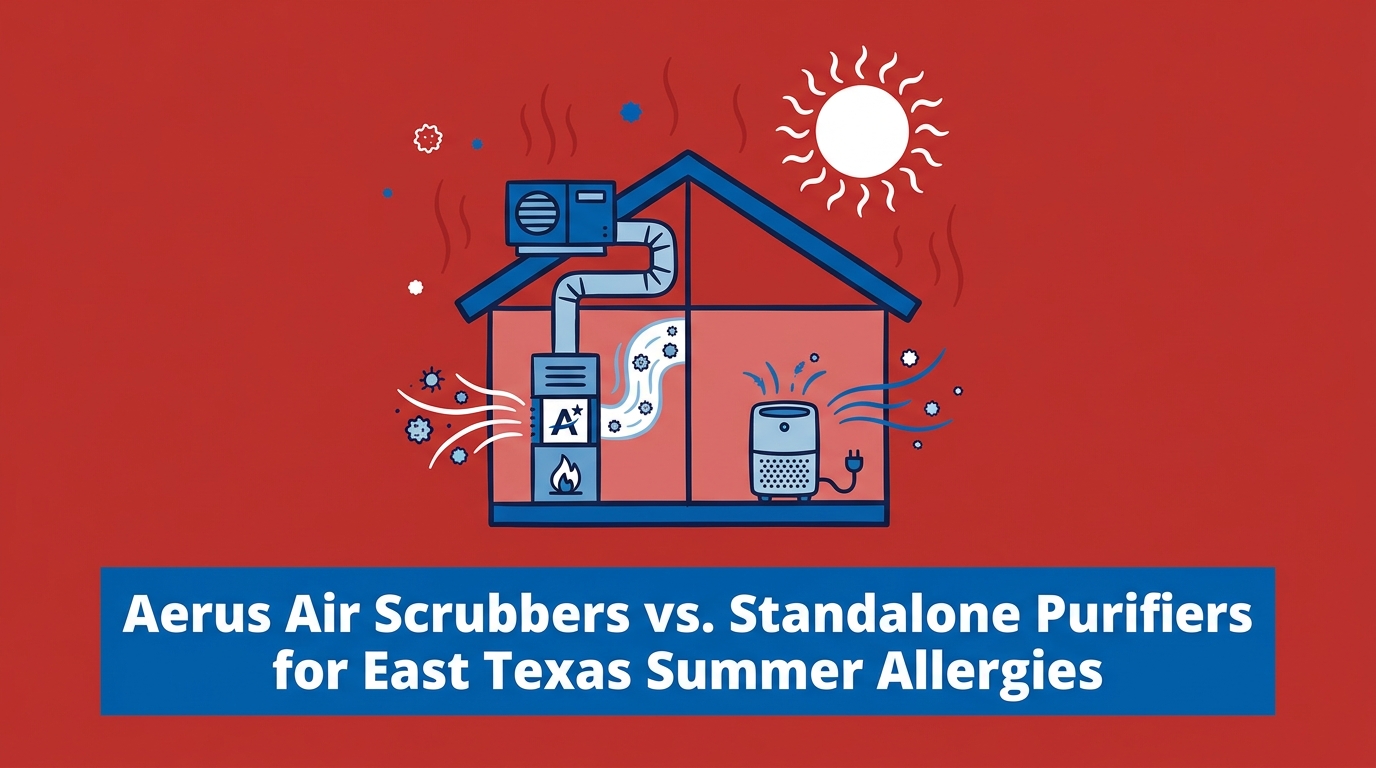

Are Your Current Air Purifiers Surviving the July Pollen Surge?
Are you constantly adjusting your room fans and filters to fight off dust and pollen, wondering if it is time to compare Aerus Air Scrubbers vs. Standalone Purifiers for East Texas Summer Allergies? You are not alone. At Carl's Quality Cooling and Heating LLC, our team frequently hears from homeowners who find that during the July peak summer cooling season, managing indoor air quality becomes a daily battle. Your air conditioning is running nonstop to keep the house comfortable, but the air inside still feels heavy, stale, or loaded with invisible irritants. In our years of servicing Conroe TX, a pattern we see often is homeowners trying to solve this concrete problem by placing multiple portable HEPA units in different rooms, hoping to capture enough dust and dander to finally find some relief.
The core decision point you face is whether to continue relying on these localized, single-room units or to upgrade to an inline system that cleans the air as it circulates through your central ductwork. Both approaches have their place, but they function very differently under heavy summer cooling loads. To help you make an informed choice, we will break down the objective differences between these two strategies. For more comprehensive solutions regarding your home's climate control, explore our HVAC and Air Quality Services.
The Unique Challenge of East Texas Summer Air Quality
Maintaining a healthy indoor environment is remarkably difficult in Conroe TX and greater East Texas due to our specific regional climate. Our technicians know firsthand that the environmental baseline here creates a perfect storm for indoor allergens, making standard filtration methods struggle to keep up. Here is why the local climate puts such a heavy burden on your indoor air quality:
1. Extreme humidity levels: High moisture in the air creates an ideal breeding ground for mold spores and dust mites, which thrive in damp conditions and quickly multiply during the summer months.
2. Severe outdoor allergens: The region experiences high pollen counts that easily find their way indoors through open doors, poorly sealed windows, and normal foot traffic.
3. The closed-loop effect: Because the extreme heat forces you to keep windows tightly closed from May through September, your central HVAC system is forced to handle 100% of the home's air circulation without any fresh air ventilation.
4. Filtration limitations: A standard media filter HVAC setup is excellent at trapping large particles like pet hair and heavy dust, but it often fails to neutralize microscopic pathogens, volatile organic compounds (VOCs), or severe allergens that slip right through the fiberglass mesh.
Because basic central filtration often falls short of providing true allergy relief, homeowners typically attempt to address the gap by purchasing standalone units for their most heavily used rooms. If you are looking for professional integration to solve these issues at the source, reviewing dedicated Indoor Air Quality Services is a highly effective next step.
How Standalone Purifiers Handle Localized Allergens
Portable HEPA air purifiers are the most common initial response to indoor allergy symptoms. These units operate on a principle known as passive trapping. They sit in a room, use a built-in fan to pull the immediate surrounding air through a dense, pleated filter, and push the filtered air back into that specific space. During the July peak summer cooling season, these units work hard to clear the air in their immediate vicinity.
The Benefits of Portable Units:
• Zero installation required: You simply unbox the unit, plug it into a standard wall outlet, and turn it on.
• Easy to deploy and move: They can be carried from the home office during the day to the bedroom at night.
• Effective single-room isolation: In a closed space, such as a master bedroom with the door shut, a properly sized portable unit can significantly reduce airborne particles.
The Drawbacks of Portable Units:
• Limited coverage area: A unit designed for a 200-square-foot room will have almost zero impact on the air quality in the adjacent hallway or living room.
• Intrusive noise levels: To effectively cycle the air in a room, the fan must run at high speeds, generating a noticeable humming or rushing sound that can disrupt sleep or conversation.
• Multi-unit requirements: Achieving whole-home relief requires purchasing, placing, and maintaining multiple units, which means tracking several different filter replacement schedules.
There are certainly scenarios where a standalone unit is sufficient. If you only experience mild, isolated sniffles during a specific two-week pollen bloom, or if you only need targeted relief in a single home office, a portable unit is a practical tool. For a deeper look at expanding your strategy, you can read our guide on Whole Home Air Purification Options.
The Mechanics of an Inline Aerus Air Scrubber
To understand why an inline system performs differently, we have to look at the shift from passive trapping to active purification. The fundamental problem with passive filters is that they must wait for airborne contaminants to travel to them. If a mold spore or pollen grain settles on your living room sofa or kitchen counter, a standard filter cannot reach it. The cause of ongoing allergy symptoms is often these settled particles being kicked back into the air whenever someone walks through the room or sits on the furniture.
The solution is active purification technology. An Inline Aerus Air Scrubber does not just wait for air to pass through a dense mesh. Instead, it is installed directly into your existing central ductwork. As your air conditioner pushes air through the system, the scrubber uses specialized technology to generate safe, oxidizing molecules. These scrubbing molecules are then distributed through your vents into every conditioned room of the house.
Once these molecules enter the living space, they actively seek out and neutralize airborne allergens, mold spores, and microscopic pathogens. Furthermore, because these active molecules fill the room, they also help reduce surface contaminants on countertops, doorknobs, and furniture. It is a proactive approach rather than a reactive one.
It is important to note that upgrading to an Inline Aerus Air Scrubber is not a plug-and-play weekend project. Because it integrates directly with your central air handler and requires specific electrical and spatial configurations within the plenum, it requires professional integration by a licensed technician—like our experienced crew—to ensure it operates safely and effectively without disrupting your system's static pressure.
Why Heavy Summer AC Runtime Maximizes Scrubber Efficiency
The true advantage of an inline system becomes apparent when you analyze how it interacts with your central cooling system during the hottest months of the year. Central HVAC systems generally cycle the entire volume of a home's air 3 to 5 times per hour when running continuously. This high rate of air turnover is the engine that drives whole-home purification.
During a typical July heatwave, your air conditioner might run for 12 or more hours a day to maintain a comfortable temperature. This continuous operation means the scrubber is constantly active, relentlessly distributing purifying molecules into every corner of the house. The heavy summer AC runtime naturally maximizes the scrubber's efficiency because the delivery system (your blower motor) is already working at peak capacity.
Contrast this with the limited air turnover rate of a portable unit sitting in the corner of a large, open-concept living room. The portable unit simply cannot generate enough airflow to pull particles from the far side of the room, let alone the rest of the house.
Our team at Carl's Quality Cooling and Heating LLC often sees how critical reliable central cooling is during these extreme weather events. Just recently, our crew responded to a local homeowner who experienced a complete system failure on July 4th during a period of extreme heat. A technician arrived quickly, replaced the old unit, and ensured the new one was working perfectly to provide immediate relief from the sweltering temperatures. When a dependable system is running continuously to battle the July peak summer cooling season, it creates the perfect delivery mechanism for an inline scrubber. Keeping that core cooling system well-maintained through professional Air Conditioning Services ensures your purification system operates at peak capacity all season long.
Side-by-Side Comparison: Aerus Air Scrubbers vs. Standalone Purifiers for East Texas Summer Allergies
When weighing your options for managing indoor air quality, it helps to see the differences laid out clearly. The choice between an Inline Aerus Air Scrubber and portable HEPA units comes down to how you prefer to manage upfront setup, ongoing maintenance, and daily operation.
• Coverage Area — Inline Aerus Air Scrubber: Whole-home (every room with a vent) — Standalone Portable Units: Single-room (localized to the unit)
• Purification Method — Inline Aerus Air Scrubber: Active pathogen reduction (scrubbing molecules) — Standalone Portable Units: Passive particle trapping (pulling air through a filter)
• Installation — Inline Aerus Air Scrubber: Professional integration into ductwork — Standalone Portable Units: Plug-and-play directly into a wall outlet
• Noise Level — Inline Aerus Air Scrubber: Silent operation within the ductwork — Standalone Portable Units: Audible fan noise, especially on high speeds
• Maintenance — Inline Aerus Air Scrubber: Annual professional check and cell replacement — Standalone Portable Units: Frequent manual filter changes per unit
While an inline system requires a professional setup, it consolidates your air quality management into a single, silent location. Portable units offer immediate, localized deployment but demand ongoing attention to individual filters and fan settings. To keep any central system running smoothly, pairing it with a comprehensive HVAC Maintenance Plan is always highly recommended.


Making the Objective Choice for Your Home's Air Quality
Ultimately, synthesizing this comparison comes down to identifying the specific needs of your household. Standalone units work incredibly well for isolated, minor seasonal sniffles in small spaces like a dedicated home office or a single bedroom. If your allergy symptoms are mild and localized, a portable HEPA filter is a highly practical and immediate tool.
However, if you are looking for whole-home continuous relief during peak heat, an inline system offers a distinct advantage. By leveraging the continuous operation of your air conditioning system, it actively reduces allergens across every square foot of your living space without adding noisy fans to your rooms. Before committing to an inline upgrade, we always recommend evaluating your existing ductwork and overall AC health to ensure the system can support the integration.
As a veteran-owned company, our team at Carl's Quality Cooling and Heating LLC brings the same level of discipline and accountability that military service demands. Our focus is always on providing honest, mission-driven recommendations tailored to your specific needs, rather than just pushing the most complex system available. The primary goal is finding the right tool for your specific allergy problem in Conroe TX and greater East Texas, ensuring your indoor environment remains healthy and comfortable.
Frequently Asked Questions About Summer Air Purification
Are whole house air purifiers better than portable units for severe allergies?
Whole house systems treat every room simultaneously by utilizing your central ductwork. This eliminates the need to carry units from room to room or manage multiple noisy fans. For severe allergies, the continuous, broad coverage of an inline system typically provides more consistent relief throughout the entire living space.
Does an Aerus air scrubber really work for pollen and mold?
Yes, an Inline Aerus Air Scrubber utilizes active technology to neutralize contaminants directly in the air and on surfaces. It is highly effective against microscopic particles, including mold spores and pollen grains, that often slip through standard fiberglass AC filters.
Can you use a standalone air purifier with central air?
Yes, standalone units can absolutely supplement central air in highly sensitive rooms, such as a nursery or a master bedroom. They are best used alongside a high-MERV media filter integrated into your central HVAC system to provide an extra layer of localized passive trapping.
What is the difference between a media filter HVAC setup and an air scrubber?
Media filters passively trap particles as air passes through a dense, pleated mesh inside your return vent. Air scrubbers, on the other hand, actively send purifying, oxidizing molecules into the home's air and onto surfaces to neutralize pathogens before they even reach the return vent.
Will an inline scrubber slow down my AC airflow?
Properly installed units do not restrict airflow or harm your system's efficiency. However, this requires professional sizing and installation by a licensed technician to ensure the unit is integrated into the ductwork correctly without altering the static pressure of your HVAC system.
Take Control of Your Indoor Comfort This Season
You do not have to suffer through stuffy, allergen-filled air all season long. Whether you decide to utilize targeted portable units or upgrade to a whole-home solution, understanding the differences between Aerus Air Scrubbers vs. Standalone Purifiers for East Texas Summer Allergies is the first step toward breathing easier. If you are tired of battling indoor pollen and dust in Conroe TX and greater East Texas, reach out to our team for an honest, objective assessment of your home's indoor air quality needs. We are here to help you find the exact right solution to keep your home comfortable, clean, and healthy all summer.


