


Why Adding Cooling Without Ductwork Options Compared Matters for Older Texas Homes
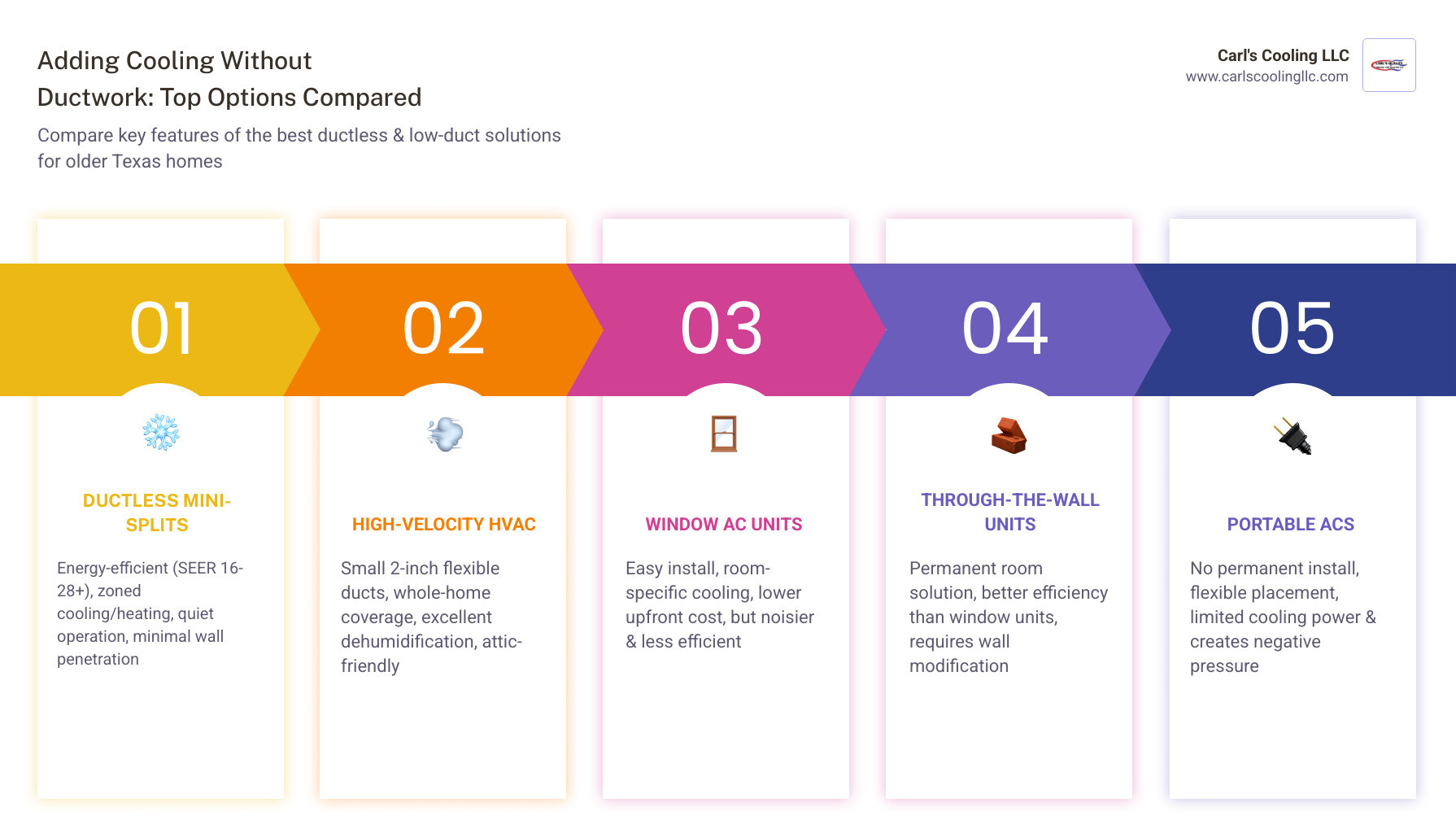
Adding cooling without ductwork options compared side by side is exactly what most homeowners in older Texas homes need before making a decision. Here's a quick look at the top three choices:
- Ductless Mini-Split Systems - Most energy-efficient, SEER ratings of 16-28+, quiet, zoned cooling, heats and cools, minimal installation disruption
- High-Velocity HVAC Systems - Uses small 2-inch flexible ducts, good for whole-home coverage, strong dehumidification, less invasive than standard ductwork
- Room Units (Window, Through-the-Wall, Portable AC) - Lower upfront commitment, easier to install, but less efficient and more limited in comfort and coverage
Many homes in the Conroe and Montgomery County area were built long before central air conditioning was standard. That means no ductwork - and no easy path to whole-home cooling. Installing traditional ductwork after the fact is expensive, invasive, and can damage the original structure of an older or historic home. On top of that, even when ductwork exists, it can leak 20-30% of conditioned air before it ever reaches a room.
The good news? There are solid ductless and low-duct solutions available in 2026 that work well in Texas heat and humidity - without tearing your home apart to install them.
Understanding Your Options for Adding Cooling Without Ductwork Options Compared
When we look at the unique challenges of Texas architecture—from the historic bungalows in Montgomery to the mid-century gems in Panorama Village—the primary goal is often comfort without compromise. Traditional central air requires bulky ductwork that usually necessitates dropping ceilings or building "soffits" that eat into your living space and ruin the aesthetic of a classic home.
Furthermore, traditional duct systems are notorious for energy waste. Research shows that duct systems often lose 20-30% of conditioned air through leaks, gaps, and poor insulation. In a climate like ours, where summer temperatures routinely soar, that’s money literally disappearing into your attic. When adding cooling without ductwork options compared, we have to look at how each system preserves the structural integrity of your home while maximizing every dollar spent on electricity.

| Feature | Ductless Mini-Splits | High-Velocity Systems | Room Units (Window/Portable) |
|---|---|---|---|
| Energy Efficiency | Ultra-High (16-28+ SEER) | Moderate (14-18 SEER) | Low (8-15 SEER) |
| Installation | Minimal (3" hole) | Moderate (2" tubes) | Easy (DIY) |
| Noise Level | Whisper Quiet (19-32 dB) | Moderate (Aspiration sound) | Loud (50-60+ dB) |
| Zoning | Excellent (Per room) | Whole Home | Single Room |
| Aesthetics | Visible indoor units | Small, discreet vents | Blocks windows/clunky |
For homeowners focused on Mini Splits Older Home Cooling Solutions, the choice often boils down to how much of the home's original character they want to keep intact. While a high-velocity system provides a "central" feel, the ductless mini-split has become the go-to for many in 2026 because it eliminates duct loss entirely.
Ductless Mini-Split Systems: The Modern Gold Standard
In our experience serving neighbors from April Sound to The Woodlands, the ductless mini-split has revolutionized how we think about home comfort. A mini-split system consists of two main parts: an outdoor compressor/condenser and one or more indoor air-handling units. These are linked by a "conduit" which houses the power cable, refrigerant tubing, and a condensate drain.
The beauty of this setup is the lack of invasive construction. A professional Ductless AC Installation typically only requires a small three-inch hole in the exterior wall. This makes it an ideal solution for homes with masonry walls, plaster and lath, or limited attic space where ducts simply won't fit.
Why Mini-Splits Lead the Adding Cooling Without Ductwork Options Compared
Efficiency is where mini-splits truly shine. Most modern units utilize inverter technology, which allows the compressor to adjust its speed dynamically. Instead of the "all-on or all-off" cycle of a traditional AC, an inverter system slows down or speeds up to maintain a perfectly consistent temperature. This can cut cooling costs by 25-40% compared to traditional central air systems.
When adding cooling without ductwork options compared, consider these specific benefits:
- Zero Duct Loss: By delivering air directly into the room, you avoid the 30% efficiency drop caused by leaky ducts in unconditioned attics.
- Zoned Comfort: You can cool the kitchen while it's in use and keep the guest room at a higher temperature, saving significantly on monthly bills.
- Quiet Operation: Indoor units often run at 19-32 decibels—literally quieter than a whisper.
For a deeper dive into these advantages, check out our Ductless AC Benefits Ultimate Guide. We’ve seen how a well-placed unit can transform a hot second-story bedroom in Ductless AC Spring TX into the most comfortable spot in the house.
Versatile Mounting and Aesthetic Integration
A common concern we hear is about the "look" of the units. In 2026, the options are more stylish than ever. While wall-mounted units are the most common, we also install:
- Ceiling Cassettes: These sit flush with the ceiling, showing only a discreet grille.
- Floor-Mounted Units: Perfect for rooms with low windows or slanted ceilings.
- Slim-Duct Units: These can be hidden in a closet or crawlspace, providing the look of central air with the efficiency of a mini-split.
Whether you are looking for a Ductless AC Cypress TX solution or a custom Ductless AC System in Waters Edge TX, we can help you find a mounting style that complements your home’s decor rather than distracting from it.
High-Velocity HVAC: Central Air for Historic Homes
If you prefer a system that looks and feels like traditional central air but your home has no room for standard 6-to-10-inch ducts, a high-velocity system might be the answer. These systems use the "aspiration" principle, where air is delivered through small, two-inch flexible tubes at a high rate of speed.
The tubes are small enough to be snaked through existing wall cavities, over ceilings, and under floors with minimal disruption to the home's structure. One of the biggest advantages for Texas residents is that high-velocity coils run much colder than standard coils. This allows them to remove up to 30% more moisture from the air, which is a game-changer during a humid July in Ductless AC Tomball TX.
While the installation is more involved than a single-zone mini-split, it offers a "hidden" look that some homeowners prefer for their historic properties. However, keep in mind that these systems still involve some ductwork, meaning they don't quite reach the ultra-high SEER2 ratings of the best ductless units.
Room-Specific Units: Window, Through-the-Wall, and Portable AC
For some situations, such as a temporary rental or a very small workspace, room-specific units are the first thing people think of when adding cooling without ductwork options compared. However, it is important to understand the trade-offs.
- Window Units: These are the most common but come with security risks, noise (often 50-60 decibels), and they block your natural light and view.
- Through-the-Wall Units: These are essentially window units installed into a permanent hole in the wall. They offer better security than window units but require a significant structural cut.
- Portable ACs: These are often a "last resort." Single-hose models are particularly inefficient because they create negative pressure, actually pulling hot outdoor air into the room through cracks in doors and windows. Research indicates that single-hose portables can reduce effective cooling power by up to 40%.
While these units have a lower upfront price, they cost much more to run. A high-efficiency mini-split can save $1,000 to $2,000 annually in running costs compared to a collection of portable or window units. If you do go this route, regular maintenance is vital; see our Ductless Mini Split Maintenance Guide for tips that apply to all types of smaller cooling equipment.
Evaluating Room Units When Adding Cooling Without Ductwork Options Compared
If you are considering a room unit, look closely at the SACC (Seasonally Adjusted Cooling Capacity) rating rather than just the BTU. The SACC rating provides a more accurate picture of how the unit will perform in real-world conditions.
In areas like Ductless AC Klein TX and Ductless AC Willis TX, where humidity is a constant factor, a unit that struggles to dehumidify will leave your room feeling "clammy" even if the temperature is lower. This is another area where the mini-split's dedicated dehumidification mode typically outperforms basic room units.
Critical Considerations for Texas Homeowners
Choosing the right system isn't just about picking a model off a shelf. To ensure your home stays comfortable during a 105-degree Texas afternoon, we always recommend a professional Manual J load calculation. This calculation takes into account your home’s square footage, insulation levels, window orientation, and even local climate data for areas like Ductless AC Conroe TX.
When adding cooling without ductwork options compared, don't forget these three factors:
- Electrical Panel Capacity: Modern mini-splits are efficient, but multi-zone systems may require a dedicated 220V circuit. We can help determine if your current panel in Ductless AC The Woodlands TX can handle the load.
- Humidity Management: In our region, an AC is as much a dehumidifier as it is a cooler. Systems with variable-speed compressors (like mini-splits) are superior at moisture removal because they run longer, lower-intensity cycles.
- Financial Incentives: As of April 2026, federal tax credits (Section 25C) can cover 30% of the cost of a high-efficiency heat pump mini-split, up to $2,000. Many local utility companies also offer rebates ranging from $500 to $2,000 for upgrading to energy-efficient systems.
Frequently Asked Questions about Ductless Cooling
Can ductless mini-splits provide heating during Texas cold snaps?
Absolutely. Most of the systems we install today are actually "heat pumps." They work by reversing the refrigeration cycle to pull heat from the outdoor air and move it inside. Modern cold-climate mini-splits can maintain 100% of their heating capacity even when temperatures drop well below freezing. This provides year-round comfort for our neighbors needing Mini Split Heat Pumps Montgomery TX.
How do these systems address indoor air quality and humidity?
Because mini-splits don't use ducts, they don't collect the dust, dander, and mold that often hide in traditional HVAC channels. Most units feature multi-stage filtration that traps allergens. Additionally, because they can run at very low speeds, they are excellent at pulling humidity out of the air without over-cooling the room. You can learn more about these health perks in our guide on Ductless Mini Split AC Benefits.
What maintenance is required for systems without ductwork?
Maintenance is relatively simple but essential. You should clean the indoor filters every 4 to 6 weeks—most are washable and easy to pop out. Once a year, it’s a good idea to have a professional inspect the outdoor coils for debris (like those Texas cottonwood seeds!) and ensure the condensate drain is clear to prevent leaks. For a full checklist, see our Ductless Mini Split Maintenance Guide.
Conclusion
When it comes to adding cooling without ductwork options compared, the best choice for your home depends on your specific needs, the layout of your house, and your long-term goals for energy savings. Whether you're retrofitting a historic home in Montgomery or adding a sunroom in Conroe, Carl's Cooling LLC is here to help you navigate these choices.
We believe in providing long-term comfort through professional installation and energy-efficient upgrades that respect the integrity of your home. If you're ready to ditch the window units and experience the quiet, efficient power of a modern system, explore our Ductless Mini-Split AC Systems today. We serve a wide range of communities, from Woodforest and Willis to Magnolia and The Woodlands, ensuring every neighbor can stay cool, no matter how high the Texas sun climbs.