
Why HVAC Replacement Is a Smart Investment for Homeowners in Montgomery County
Why HVAC replacement is a smart investment comes down to one simple idea: at some point, keeping an aging system running costs you more than starting fresh with a new one. When you factor in rising energy bills, repeated repair costs, lost home value, and real safety risks, replacement stops looking like an expense and starts looking like a financial decision that pays you back.
Here is a quick summary of the core reasons HVAC replacement makes financial sense:
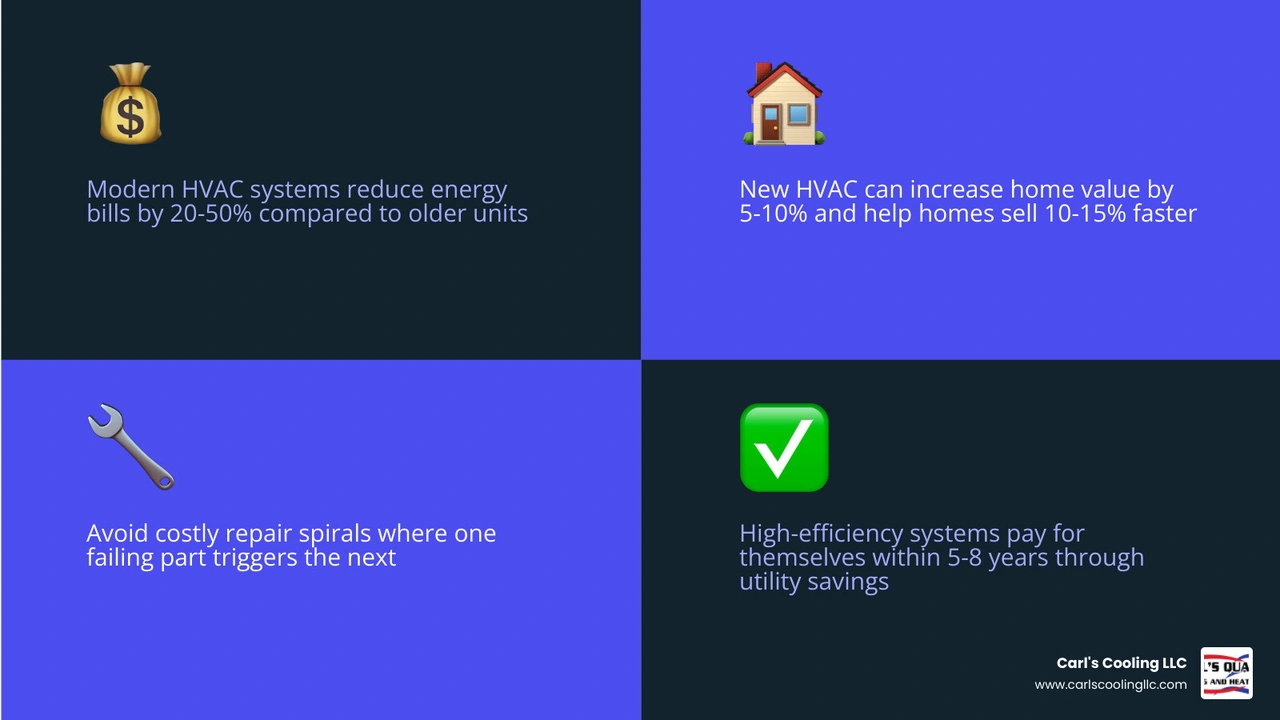
- Lower energy bills - Modern high-efficiency systems cut heating and cooling costs by 20-50% compared to older units
- Faster home sales - Homes with new HVAC systems sell 10-15% faster than comparable homes with aging equipment
- Higher home value - A new system can add 5-10% to your home's appraised value
- Avoided repair costs - Replacing stops the "repair spiral" where one failing part triggers the next
- Safety - Eliminates risks like carbon monoxide leaks from cracked heat exchangers
- Payback period - High-efficiency systems typically pay for themselves within 5-8 years through utility savings alone
- Incentives - Federal tax credits and state rebates can significantly offset your upfront investment
Most homeowners think of HVAC replacement purely as an expense. But when you add up energy savings, avoided emergency repairs, appraisal adjustments, and buyer confidence during a home sale, the math often tells a different story. Your heating and cooling system is one of the single largest energy expenses in your home — and when it starts failing, that cost only grows.
At Carl's Cooling LLC, we help homeowners and business owners across Conroe, Montgomery, and Montgomery County make confident, informed decisions about their HVAC systems — so you never pay more than you have to.
Key why hvac replacement is a smart investment vocabulary:
- does a new hvac help sell your home faster
- how a new hvac system increases home value
- how hvac condition affects home appraisals
I'm looking to upgrade my home's heating and cooling. Who in Montgomery County specializes in energy-efficient systems?

If you are living in Conroe, Magnolia, Spring, or The Woodlands, you know how brutal our Southeast Texas summers can be. When temperatures soar past 100 degrees, your air conditioner isn't just a luxury—it is a critical piece of home infrastructure. If you are asking yourself who specializes in designing and installing high-efficiency systems tailored to our unique climate, our team at Carl's Cooling LLC is here to help.
Modern HVAC systems have made massive technological leaps over the last decade. If your current unit was installed in the 2010s, it is likely running on older, single-stage technology. Older units operate like a light switch: they are either 100% on or 100% off. This constant cycling on and off consumes enormous amounts of electricity and subjects your system to heavy wear and tear.
When you upgrade to a modern system, you gain access to incredible efficiency benchmarks:
- SEER2 Ratings: The Seasonal Energy Efficiency Ratio 2 (SEER2) is the updated industry standard for measuring cooling efficiency. Older systems in our area often operate at SEER ratings as low as 8 to 10. Modern high-efficiency systems boast SEER2 ratings ranging from 16 to 22+, which translates directly into lower power bills.
- AFUE Ratings: For winter heating, the Annual Fuel Utilization Efficiency (AFUE) rating measures how efficiently a gas furnace converts fuel into heat. Older furnaces struggle to reach 80% AFUE, meaning 20% of the fuel you pay for escapes up the flue. Modern high-efficiency furnaces reach AFUE ratings of 95% to 98%, ensuring almost no heat is wasted.
- Variable-Speed Technology: Rather than blasting at full power and then shutting down, variable-speed compressors and blowers operate like cruise control. They adjust their output in tiny increments to match the exact cooling or heating load of your home. This keeps your indoor temperatures incredibly consistent while using only a fraction of the energy.
By upgrading, you can easily secure Air Conditioning Replacement Montgomery County that handles the damp, heavy heat of summer, or invest in a reliable Heating Replacement Jersey Village to keep you cozy during our unexpected winter cold snaps.
The Financial Framework: Why HVAC Replacement Is a Smart Investment
Deciding whether to continue pouring money into an aging system or to invest in a brand-new setup can feel overwhelming. To make an objective, business-minded decision for your household, it helps to look at the hard data.
Below is a helpful comparison framework to guide your decision:
| Decision Indicator | Consider Repairing | Choose Replacement |
|---|---|---|
| System Age | Under 10 years old | Over 10–15 years old |
| Repair Frequency | Rare, minor wear-and-tear items | Multiple breakdowns within 24 months |
| Refrigerant Type | Modern, eco-friendly R-410A or R-454B | Phased-out, expensive R-22 |
| Utility Bills | Stable and predictable | Rising steadily year-over-year |
| Repair Cost vs. Value | Minor costs (capacitor, contactor) | Failed compressor or cracked heat exchanger |
Continuing to repair an old system can lead to what we call the "repair spiral." This is a pattern where one failing component puts extra stress on the surrounding parts, causing a chain reaction of breakdowns. For example, a weak blower motor can cause your evaporator coil to freeze, which eventually damages your compressor. Spending money on a series of repairs for a 12-year-old system is like putting brand-new, expensive tires on a shopping cart with a broken wheel—it does not solve the underlying issue.
Furthermore, if your system was built before 2010, it likely uses R-22 refrigerant. The EPA has completely phased out R-22, making it incredibly scarce and expensive to source. If your older system develops a refrigerant leak, a simple recharge can cost hundreds of dollars just for the gas itself, without even fixing the source of the leak.
Evaluating the How to Decide Between Repair and Replacement framework shows that shifting your budget from temporary fixes to a permanent upgrade is a far safer financial move. When you compare the compounding Cost of Repairing Old HVAC vs Buying New System, the long-term savings of a new installation quickly outweigh the endless cycle of repair bills.
How the 50% Rule and $5,000 Rule Prove Why HVAC Replacement Is a Smart Investment
To take the emotion and guesswork out of the equation, the HVAC industry relies on two simple mathematical formulas: the 50% Rule and the $5,000 Rule.
The 50% Rule states that if the cost of a single repair quote exceeds 50% of the price of a brand-new system, replacement is almost always the smarter, more practical choice. Spending a large percentage of a new system's value on a unit that still carries old, out-of-warranty components is a high-risk gamble.
The $5,000 Rule is another excellent quick-filtering tool. To apply it, simply multiply the age of your system by the repair quote you received:
$$\text{Age of System (Years)} \times \text{Repair Quote} = \text{Decision Score}$$
If your Decision Score is over $5,000, you should replace the system. If it is under $5,000, a repair is generally a reasonable option.
Let's look at two real-world examples:
- Scenario A: You have a 6-year-old air conditioner that needs a new capacitor. The repair quote is $300. $$6 \times 300 = 1,800$$Since $1,800 is well below the $5,000 threshold, repairing the unit is a smart, cost-effective decision.
- Scenario B: You have a 13-year-old air conditioner with a failed compressor. The repair quote is $1,200.$$13 \times 1,200 = 15,600$$At $15,600, the score is far past the threshold. Investing that money into a brand-new, warrantied system is the only logical move.
Recognizing the Signs You Need AC Replacement early—such as frequent minor breakdowns, uneven cooling, or strange noises—helps you plan ahead. The same applies to your heating system; knowing When to Replace Your Heater allows you to avoid emergency replacement fees during a winter freeze.
Leveraging 2026 Tax Credits and Rebates to Maximize Your Return
One of the reasons why hvac replacement is a smart investment in 2026 is the historic level of financial incentives available to homeowners. Through federal programs like the Inflation Reduction Act, you can significantly lower the net cost of upgrading your system.
- Federal Tax Credits: Homeowners can claim a federal tax credit of up to 30% for qualifying high-efficiency HVAC upgrades. High-efficiency heat pump installations can qualify for a tax credit capped at $2,000, while high-efficiency air conditioners and gas furnaces can receive up to $600.
- State HEAR Rebates: Depending on your household income and state participation, the Home Electrification and Appliance Rebates (HEAR) program offers substantial point-of-sale rebates for heat pump upgrades.
- Utility Company Incentives: Local utility providers serving Conroe, Cypress, and Houston frequently offer cash-back rebates for installing ENERGY STAR certified systems. These rebates can often be combined with federal tax credits, saving you even more.
These incentives act as an immediate discount on your investment, shortening your payback period and accelerating your return on investment (ROI).
Maximizing Property Value and Resale Appeal
An HVAC system is not just an appliance hidden in a closet or sitting in your backyard; it is the beating heart of your home's infrastructure. Consequently, real estate appraisers and home buyers pay close attention to its age and condition.
When an appraiser evaluates your property, they look closely at the remaining economic life of your major mechanical systems. An old, rusted air conditioner or a furnace that looks like a relic from the 1990s signals that the home has deferred maintenance. Conversely, a brand-new, professionally installed HVAC system can boost your home's appraised value by 5% to 10%, adding direct valuation to your property.
Furthermore, a new system completely changes the psychology of prospective buyers. According to industry statistics, 72% of home buyers prioritize energy-efficient features when searching for a new home. When buyers see a modern outdoor unit paired with a smart, programmable thermostat on the wall, it sends a powerful message:
- They won't have to worry about an expensive, unexpected breakdown for the next 10 to 15 years.
- Their monthly moving-in costs will be lower due to reduced utility bills.
- The previous owners took excellent care of the property.
This peace of mind translates directly into stronger offers. Understanding How a New HVAC System Increases Home Value is incredibly valuable for any homeowner looking to build equity. If you plan to list your property soon, you will find that a new system is a major selling point that makes your home stand out in competitive local markets like The Woodlands or Spring. In fact, real estate data shows that homes with new HVAC systems sell 10-15% faster than those with aging, unreliable units. If you are wondering, Does a New HVAC Help Sell Your Home Faster, the answer is a resounding yes.
Why HVAC Replacement Is a Smart Investment Before Listing Your Home
If you are preparing to list your home on the market, you might be tempted to leave the old HVAC system for the next owner to handle. However, this strategy often backfires during the home inspection phase.
Buyers in 2026 are highly risk-averse. If a professional home inspector flags your AC or heater as near the end of its lifespan, or notes a major performance issue, it can quickly stall your home sale. Buyers will often demand massive financial concessions, ask you to lower your asking price, or insist that you replace the system under emergency, high-stress conditions before closing.
By taking a proactive approach and scheduling professional AC Home Inspections before listing, you can identify issues early. Replacing an ancient system beforehand allows you to control the narrative, market the home as fully "move-in ready," and avoid stressful, last-minute negotiations that could put your sale at risk.
Critical Safety Indicators and Modern Technology Upgrades
While the financial and resale benefits of a new HVAC system are compelling, your family's safety and health are what truly matter. Aging heating and cooling systems present real physical hazards that should never be ignored.
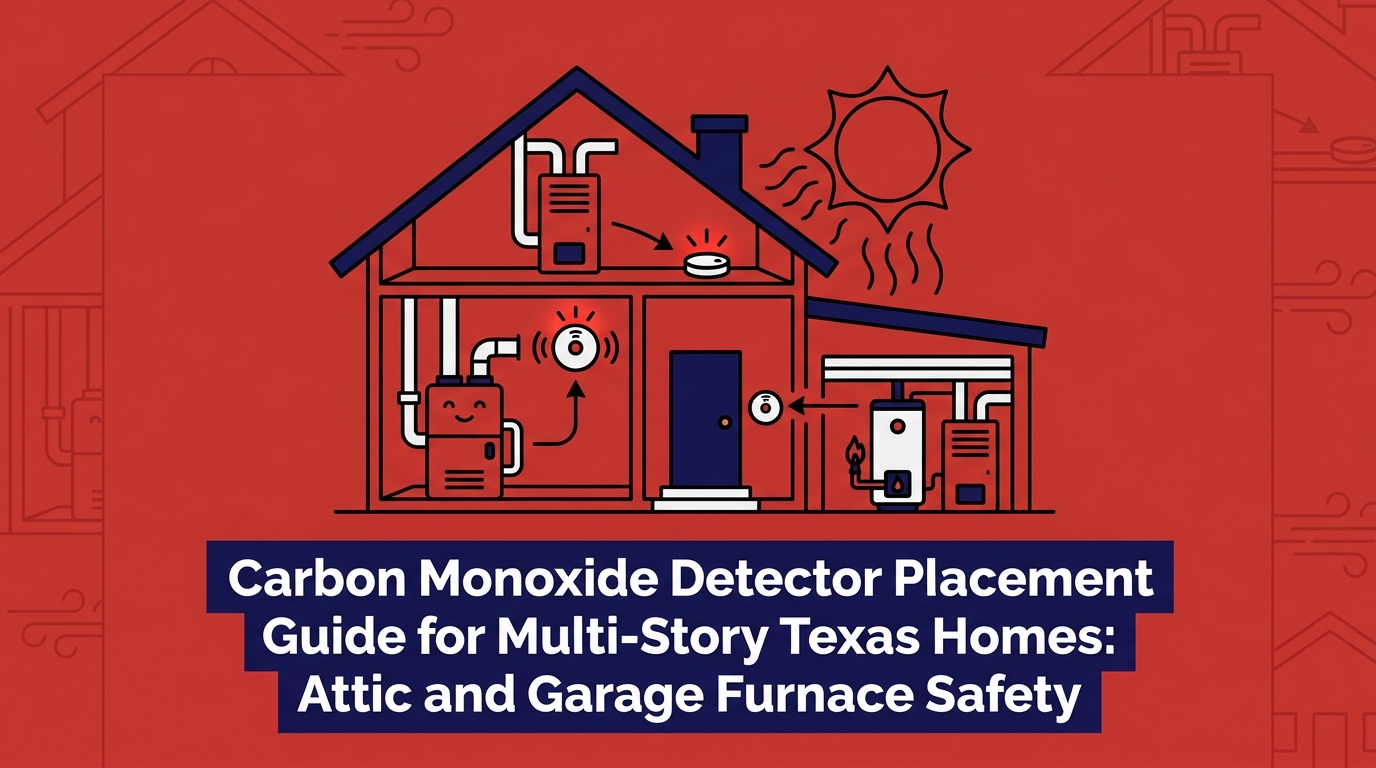
The most critical safety risk associated with an aging gas furnace is a cracked heat exchanger. The heat exchanger is the metal chamber that prevents toxic combustion gases—such as carbon monoxide (CO)—from mixing with the clean air blowing into your living spaces. Over years of heating and cooling cycles, this metal expands and contracts. Eventually, the metal can fatigue and crack.
A cracked heat exchanger is an immediate, life-threatening emergency because it allows odorless, tasteless carbon monoxide to enter your home. If a technician discovers a cracked heat exchanger during a routine inspection, they are legally required to shut down your gas service to protect your household. In this scenario, immediate replacement is the only safe option.
Beyond safety, modern HVAC systems offer incredible quality-of-life benefits through advanced indoor air quality (IAQ) technology:
- Enhanced Humidity Control: Here in Southeast Texas, humidity is our constant companion. Modern variable-speed systems run longer, gentler cycles that pull incredible amounts of moisture out of the air. Keeping your indoor humidity between 30% and 50% prevents mold growth, protects your wood flooring, and makes your home feel much cooler at higher thermostat settings.
- Advanced Filtration: Modern systems are designed to accommodate high-MERV filters, carbon purifiers, and UV light systems that neutralize airborne bacteria, viruses, pet dander, and wild-fire smoke.
- Quieter Operation: Older systems can sound like a jet engine starting up in your hallway. Modern units operate so quietly that you will barely notice when they turn on.
To keep your current system running safely and efficiently as long as possible, regular AC Unit Cleaning and preventative maintenance are absolutely essential.
Frequently Asked Questions about HVAC Upgrades
How long does a typical HVAC system last?
The lifespan of your heating and cooling equipment depends heavily on your local climate, system type, and maintenance history:
- Central Air Conditioners: Typically last 12 to 15 years. In hot, humid regions like Montgomery County, where systems run almost year-round, lifespans can lean closer to the 10-to-12-year mark due to heavy use.
- Heat Pumps: Typically last 10 to 15 years. Because they handle both heating and cooling, they run during all seasons, which subjects them to consistent wear.
- Gas Furnaces: Typically last 15 to 20 years. Since they are only used for a few months out of the year in Texas, they tend to last longer than cooling units, provided they receive regular safety checks.
Can a new high-efficiency HVAC system pay for itself?
Yes, a new high-efficiency system can absolutely pay for itself over time. By upgrading from an older 10 SEER system to a modern 16 to 20 SEER2 system, you can reduce your cooling energy consumption by 20% to 50%.
When you combine these monthly utility savings with the money you save by avoiding emergency repairs, the system typically reaches a financial break-even point within 5 to 8 years. For the remaining lifespan of the system, those utility savings are pure profit back in your pocket.
What safety risks make immediate HVAC replacement necessary?
You should consider immediate replacement if your system exhibits any of the following safety hazards:
- A Cracked Heat Exchanger: This allows carbon monoxide to leak directly into your home's air supply.
- Frequent Electrical Shorts: Aging wiring, failing contactors, and overheating motors can pose serious fire hazards.
- Phased-Out R-22 Refrigerant Leaks: Because R-22 is banned and incredibly expensive, trying to patch a leak on an old system is a poor financial decision that often leads to repeated failures and environmental harm.
Conclusion
At the end of the day, investing in a new heating and cooling system is one of the smartest decisions you can make for your home. It protects your family's safety, slashes your monthly utility bills, eliminates the stress of constant breakdowns, and builds real equity in your property.
At Carl's Cooling LLC, we pride ourselves on delivering honest, dependable, and professional HVAC services to our neighbors in Conroe, Montgomery, Willis, and throughout Montgomery County. We are a family-owned business dedicated to helping you find the perfect system for your budget and home comfort needs.
Don't wait for your old system to leave you stranded in the Texas heat. Schedule your professional HVAC installation with Carl's Cooling LLC today and start enjoying a safer, more comfortable, and energy-efficient home.