
Facing the Late-Summer Heat: When Your Heat Pump Runs But Doesn't Cool
Late August in the Conroe TX area brings a relentless kind of heat. As families gear up for the back-to-school transition, finding solid home maintenance tips and troubleshooting advice becomes urgent when your system starts struggling. You walk inside expecting relief, but your heat pump is running continuously and the house still feels uncomfortably warm. That constant hum without the cooling payoff is a frustrating, concrete problem our technicians see many homeowners face as the season drags on. The main decision point is figuring out whether your system is simply maxed out by the extreme Texas heat, or if August late-summer cooling wear has caused a failing component that requires professional intervention.
While there are a few safe checks you can perform yourself, professional diagnostics are necessary to prevent a minor issue from turning into a complete system breakdown. For immediate help, explore our air conditioning services or schedule professional heat pump and heating repair.
Is It Just the Texas Heat or a Real Problem?
When the Gulf Coast heatwave pushes temperatures past the century mark, your heat pump is working at its absolute design limits. In our years of servicing local homes, we've learned it is entirely normal for a system to run for hours on end during the hottest part of the day. However, running constantly is only acceptable if the air coming out of your vents is still cold. Understanding the difference between normal extreme-heat operation and a system in distress is the first step in effective troubleshooting.
Understanding Normal Extreme-Heat Operation
Heat pumps and air conditioners are typically designed to maintain a 20-degree temperature differential between the outdoor air and the indoor air. When it is 100 degrees outside in the Conroe TX area, your system is working incredibly hard just to keep your indoor temperature at 80 degrees. If your thermostat is set to 72 degrees on a 105-degree afternoon, the unit will likely never reach that set point. It will run constantly, pulling maximum power, simply trying to keep up. As long as the air blowing from your vents is noticeably cooler than the room temperature, the continuous operation is a result of the extreme weather, not necessarily a mechanical failure.
Warning Signs of System Distress
The situation changes completely if the air coming from your vents feels warm, room-temperature, or weak. This indicates that the system is no longer removing heat from your home. You might also notice unusual sounds, such as buzzing, grinding, or rapid clicking. Another major red flag our team frequently encounters is short-cycling, which happens when the unit turns on for just a few minutes, shuts off abruptly, and then restarts repeatedly. These are clear indicators of mechanical distress. For example, our crew recently helped a homeowner who purchased their house after a hurricane and noticed a significant temperature differential between floors that simply would not resolve. The issue ultimately required a custom-designed, newly installed HVAC system to correct the airflow and cooling imbalances. If your system is showing signs of distress rather than just working hard, it is time to investigate further.
• Running constantly, blowing cold air — Likely Cause: Normal extreme-heat operation (100+ degrees outside) — Action Required: Monitor system, keep filters clean, close blinds
• Running constantly, blowing warm air — Likely Cause: Refrigerant leak, failed compressor, or stuck valve — Action Required: Turn off system immediately, call a professional
• Short-cycling (turning on/off rapidly) — Likely Cause: Overheating compressor, electrical fault, or severe airflow restriction — Action Required: Turn off system, check filter, call a professional
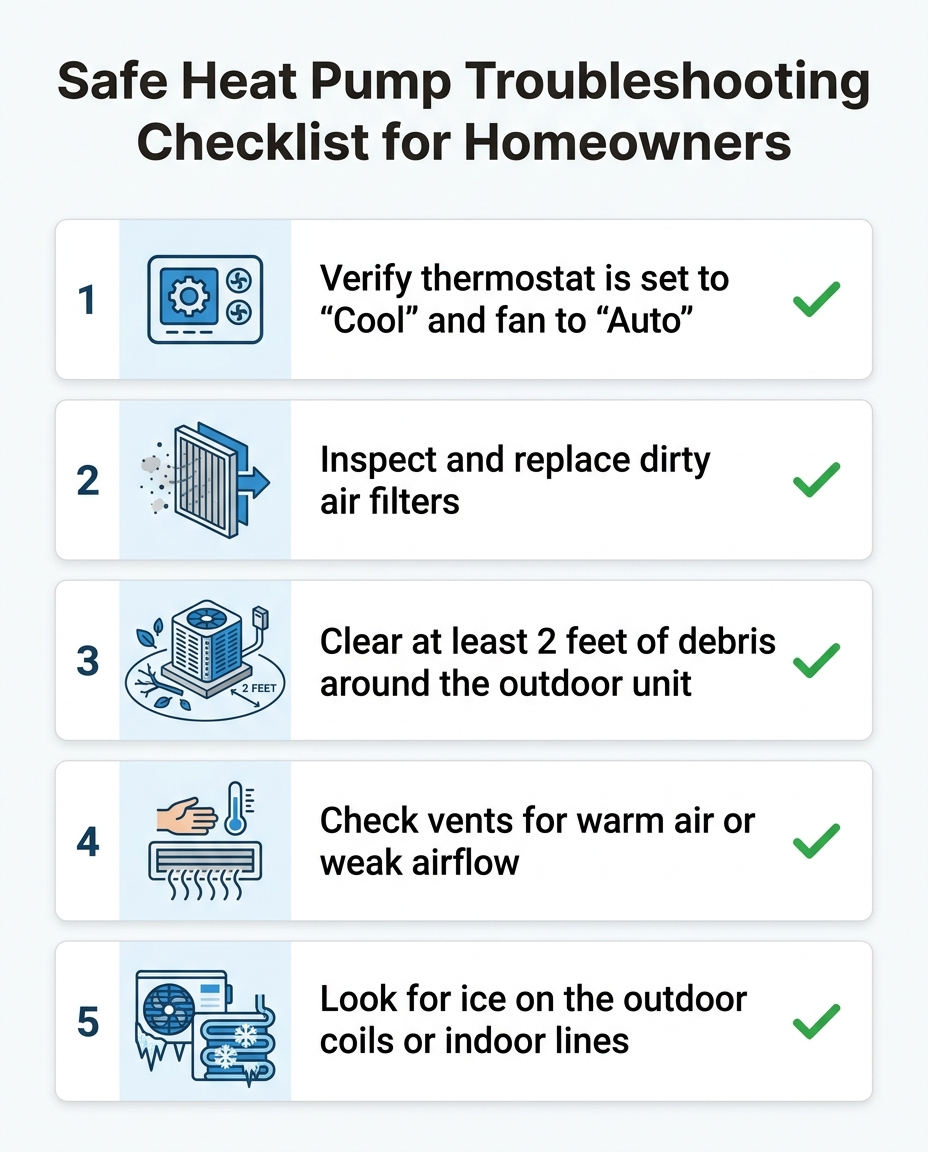
• Weak airflow from vents — Likely Cause: Frozen evaporator coil or clogged air filter — Action Required: Check filter, turn off cooling to thaw, call a professional
Safe Troubleshooting Steps for Homeowners
Before you call a technician, there are several safe, basic checks you can perform. These steps strictly avoid any dangerous electrical or refrigerant work, focusing instead on airflow and thermostat settings. Addressing these common issues can often resolve minor problems caused by August late-summer cooling wear.
Thermostat and Airflow Checks
Verify your thermostat settings: The most common oversight is an incorrect thermostat setting. Ensure the system is set to "Cool" and the temperature is set lower than the current room temperature. Check the fan setting as well; it should be set to "Auto" rather than "On." When the fan is set to "On," it blows continuously, even when the compressor isn't running, which can make the air coming out of the vents feel warm and humid.
Inspect and replace the air filter: In our experience, a dirty air filter is the number one cause of end-of-season cooling issues. After running non-stop since May, your filter has likely accumulated a massive amount of dust, pet dander, and debris. A clogged filter severely restricts airflow, choking the system and forcing the blower motor to work harder. This restriction can even cause the indoor coils to freeze. Pull the filter out and hold it up to a light source. If you cannot see light passing through it, replace it immediately.
Outdoor Condenser Clearance
Clear the outdoor unit: Your heat pump relies on the outdoor condenser unit to dissipate the heat it removes from your home. If the outdoor unit is choked by overgrown vegetation, tall grass, or layers of dirt, it cannot release that heat effectively. Walk outside and inspect the unit. Ensure there is a minimum of two feet of clear space on all sides. Remove any leaves, twigs, or debris that have gathered against the metal fins. If the fins are caked with mud or grass clippings, you can gently rinse them with a standard garden hose on a low-pressure setting—never use a pressure washer, as it will bend the delicate fins and ruin the unit.
If you have completed these basic checks and your heat pump is still not cooling your home, the problem is likely internal. At this point, the issue requires a licensed technician with the proper tools and training to diagnose the electrical or refrigerant systems.

The Hidden Impact of Gulf Coast Humidity on Your Heat Pump
Heat alone is tough on a mechanical system, but the specific Gulf Coast humidity experienced in the Conroe TX area adds an entirely different layer of stress. Understanding how moisture interacts with your heat pump explains why certain failures happen so frequently in the late summer.
The Dehumidification Burden
Your heat pump performs double-duty every time it turns on: it cools the air (sensible cooling) and it removes moisture from the air (latent cooling). When the humidity levels soar, the system has to work significantly harder just to wring the moisture out of the indoor air before it can effectively lower the temperature. This dehumidification burden means the compressor runs longer and hotter. If your system is slightly undersized, or if it is suffering from August late-summer cooling wear, it may struggle to keep up with the sheer volume of moisture in the air, leaving your home feeling clammy even if the temperature drops slightly.
Why Evaporator Coils Freeze in the Summer
It seems impossible that a block of ice could form inside your HVAC system when it is over 100 degrees outside, but our technicians see it constantly when high humidity combines with restricted airflow. The indoor evaporator coil gets extremely cold during operation. As warm, humid air passes over it, condensation forms on the metal fins. If airflow is restricted—usually by a dirty filter or a failing blower motor—that condensation doesn't drain away fast enough. Instead, it freezes directly onto the cold coils.
Once a thin layer of ice forms, it acts as an insulator, preventing the system from absorbing any more heat from your home. The ice continues to build, eventually encasing the entire coil and the outdoor refrigerant lines. If you notice reduced airflow, warm air from the vents, or water pooling around your indoor unit, you likely have a frozen coil. Turn the thermostat to "Off" and switch the fan to "On" to help thaw the ice before a technician arrives. A professional cannot accurately diagnose a system while it is encased in ice.
Signs of Component Failure: When to Call a Professional
When the basic troubleshooting steps do not resolve the issue, you are likely dealing with a mechanical or electrical failure. After months of running continuously, specific components are prone to breaking down. These technical failures require professional repair.
Capacitor Degradation
When our team is dispatched for a cooling emergency in late summer, a degraded capacitor is one of the most common components we find at fault. Think of the capacitor as a heavy-duty battery that provides the massive jolt of electricity needed to start the compressor and the fan motors. Constant running, combined with high ambient outdoor temperatures, degrades the internal components of the capacitor over time. When a capacitor fails, you might hear a clicking or humming sound from the outdoor unit, but the fan or compressor will not engage. Because capacitors handle high voltage, replacing them is strictly a job for a professional.
Reversing Valve and Refrigerant Issues
Unlike standard air conditioners, heat pumps have a component called a reversing valve, which allows the system to switch between heating and cooling modes. Sometimes, electrical failures or mechanical sticking can cause this valve to fail, trapping the system in heating mode even when the thermostat is set to cool.
Refrigerant leaks are another critical issue. Heat pumps do not "consume" or burn up refrigerant. If your system is low on Freon or Puron, it means there is a physical leak somewhere in the closed loop that must be located and sealed. For instance, our team recently helped a local customer dealing with an unidentified leak in their Freon line. Once our technician thoroughly diagnosed the exact source of the leak, the necessary repairs were completed in a timely manner, restoring the system's cooling power without resorting to endless, ineffective "top-offs." If you suspect a leak, it is time to reach out for professional help across our Montgomery County service areas.
Why Late-Summer Wear Demands Honest Diagnostics
By the time late August rolls around, your heat pump has likely logged thousands of hours of operation since the spring. This cumulative wear and tear makes end-of-season component degradation highly likely. However, a struggling system does not automatically mean you need a brand-new unit.
Honest Diagnostics vs. Premature Replacements
When a heat pump stops cooling during a heatwave, it is easy to panic. Some companies use this urgency to push for premature, high-pressure replacements. Working with a veteran-owned company like Carl's Quality Cooling and Heating LLC means you get the same level of discipline and accountability that military service demands. We believe in a "mission-accomplished" approach to service: our technicians focus on finding the actual root cause of the problem and fixing it with integrity. Often, a system that runs constantly but fails to cool simply needs a minor repair, such as a capacitor swap, a thorough coil cleaning, or a contactor replacement. Honest diagnostics focus on restoring your comfort safely and effectively, rather than upselling you on equipment you don't need. If a replacement is ultimately necessary, we always advise homeowners to check with their utility provider or a tax professional, as generic federal tax credits or local utility incentives may apply to qualifying high-efficiency heat pump installations.
The Value of End-of-Season Maintenance
The best way to handle August late-summer cooling wear is to prevent it from causing a breakdown in the first place. Catching cumulative wear and tear early keeps your system running efficiently, even when the Conroe TX area weather is at its worst. Enrolling in a routine HVAC maintenance plan ensures that a professional inspects your electrical connections, cleans your coils, and tests your refrigerant levels before small issues turn into late-night emergencies.
Frequently Asked Questions About Heat Pumps in Extreme Heat
When the temperature spikes, we hear many of the same concerns from homeowners. If you are dealing with a heat pump not cooling enough on 100-degree days, reviewing these common questions can help you understand exactly what your system is experiencing.
Why is my heat pump running constantly but not cooling the house?
Your heat pump is likely struggling against extreme outdoor temperatures, restricted airflow, or a mechanical failure. If the air coming from the vents is still cold, the system is simply maxed out by the heat and trying to keep up. If the air is warm, you may have a clogged filter, a frozen evaporator coil, or a degraded capacitor preventing the compressor from running.
Is it normal for a heat pump to run all day in extreme heat?
Yes, it is entirely normal for a heat pump to run continuously when outdoor temperatures exceed 95 degrees. HVAC systems are designed to maintain a specific temperature differential (usually around 20 degrees). When the weather pushes past that limit, the system will run non-stop to remove as much heat as possible, as long as the output air remains cold.
How do you fix a heat pump that is not cooling?
Start by checking your thermostat settings to ensure it is set to "Cool" and the fan is on "Auto." Next, inspect your indoor air filter and replace it if it is dirty, as restricted airflow is a primary cause of cooling failures. Finally, clear any debris away from the outdoor condenser unit. If these steps do not work, you must call a licensed professional to diagnose internal electrical or refrigerant issues.
Why is my heat pump blowing warm air in cool mode?
Blowing warm air in cool mode usually points to a compressor issue, a refrigerant leak, or a stuck reversing valve. The reversing valve controls the flow of refrigerant, and if it fails, the system may physically be stuck in heating mode. Alternatively, if the outdoor compressor fails to start due to a bad capacitor, only the indoor fan will run, circulating warm room air.
Can high humidity cause my heat pump to freeze up in the summer?
Yes, excessive humidity combined with poor airflow can absolutely cause a heat pump to freeze in the summer. When the system pulls high volumes of moisture out of the air, condensation forms on the indoor coils. If a dirty filter restricts the warm air blowing over those coils, the condensation freezes, eventually encasing the system in solid ice.
How does late-summer wear affect heat pump efficiency?
Months of continuous operation cause significant wear on moving parts and electrical components. By late summer, filters are often clogged, outdoor coils are caked with dust, and capacitors are degraded from the heat. This cumulative wear forces the system to consume more electricity to produce less cooling, sharply reducing its overall efficiency.
Ready to Restore Your Home's Cooling and Comfort?
As a local team dedicated to keeping Conroe comfortable, we know that understanding the difference between normal extreme-heat operation and a system in true distress gives you the clarity you need to protect your home. By keeping an eye out for warning signs like warm air, short-cycling, and frozen coils, you can catch August late-summer cooling wear before it leads to a total system failure. Knowing exactly when to rely on safe, basic troubleshooting and when to call a professional ensures your heat pump operates safely through the toughest Conroe TX area heatwaves.
If your system is struggling to keep up, do not wait for it to break down completely. Incorporating these home maintenance tips and troubleshooting strategies is a great start, but true peace of mind comes from expert diagnostics. Contact us today to schedule your professional heat pump and heating repair and restore your home's comfort.