
That Dreaded Humming Sound: Is Your AC Dead or Just Stalled?
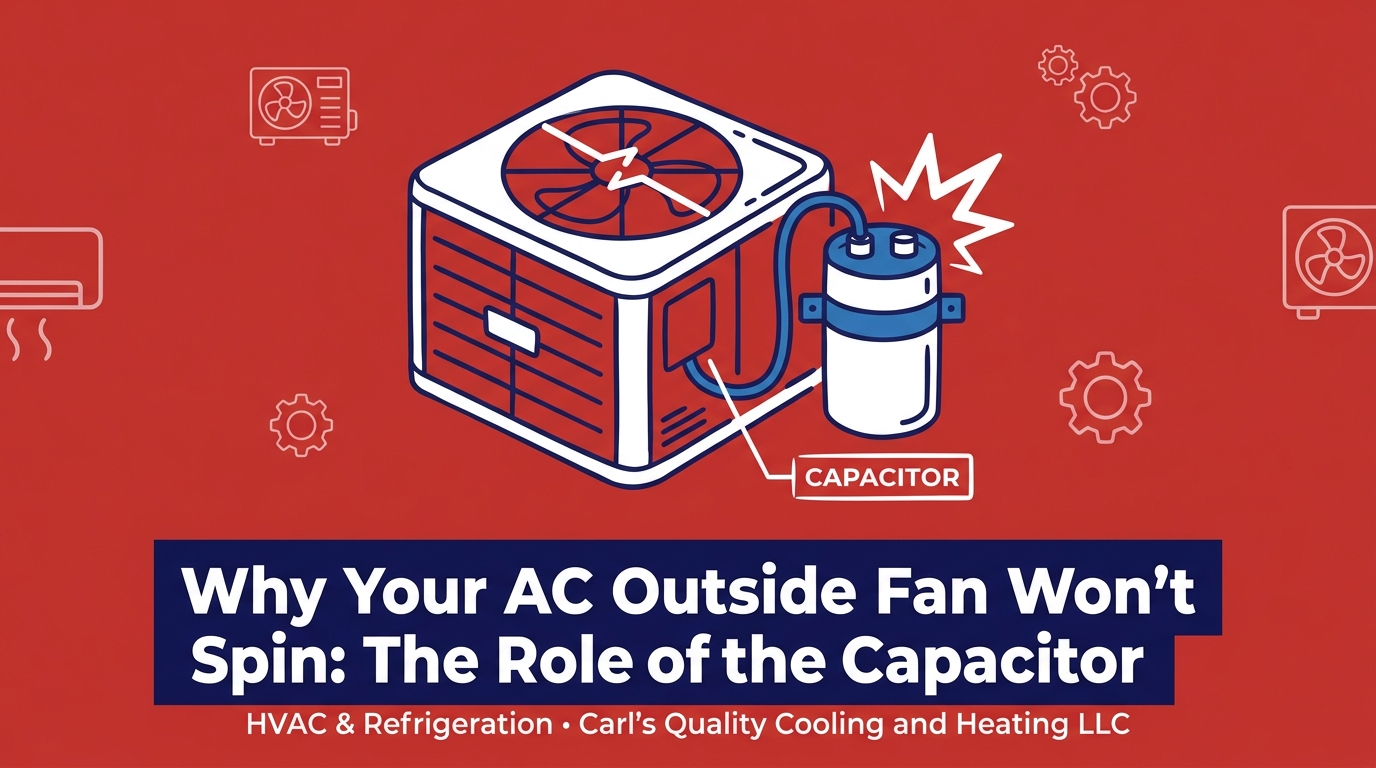
Understanding the role of the capacitor when your AC outside fan won't spin is the first step toward getting your home comfortable again when the heat becomes unbearable. You walk outside in the sweltering heat, expecting to feel a warm breeze blowing from your condenser unit, but instead, you are met with a loud, persistent humming sound from the outdoor unit. You look down through the top grille, and the fan blades are completely still. For most homeowners, this triggers immediate panic. At Carl's Quality Cooling and Heating LLC, our technicians see this exact scenario play out daily as Conroe families try to stay comfortable during the busy back-to-school transition. Your mind races straight to a catastrophic system failure, a burned-out compressor, and a massive replacement bill.
The good news is that this alarming symptom does not always mean your entire air conditioner is dead. More often than not, a stalled fan and a loud buzzing noise point to a much smaller, replaceable component that has simply given up under the pressure of the late-summer heat. That component is the capacitor.
When you encounter this issue, you need professional HVAC services to accurately diagnose the system. Our team can determine whether the motor has failed or if the capacitor has simply lost its ability to deliver the necessary electrical charge. Because the symptoms of a dead capacitor and a dead fan motor look nearly identical to the untrained eye, a professional assessment is the only safe way to get your cooling system back online.
Why the Panic is Usually Premature
It is entirely normal to fear the worst when your cooling system suddenly stops working during an August heatwave. However, HVAC systems are built with specific electrical checkpoints. The capacitor acts as one of these crucial checkpoints. When it fails, it stops the fan motor from running, which in turn prevents the compressor from overheating and destroying itself. In many ways, a failed capacitor is the system's way of protecting its most expensive parts from catastrophic damage.
What Does an AC Capacitor Actually Do?
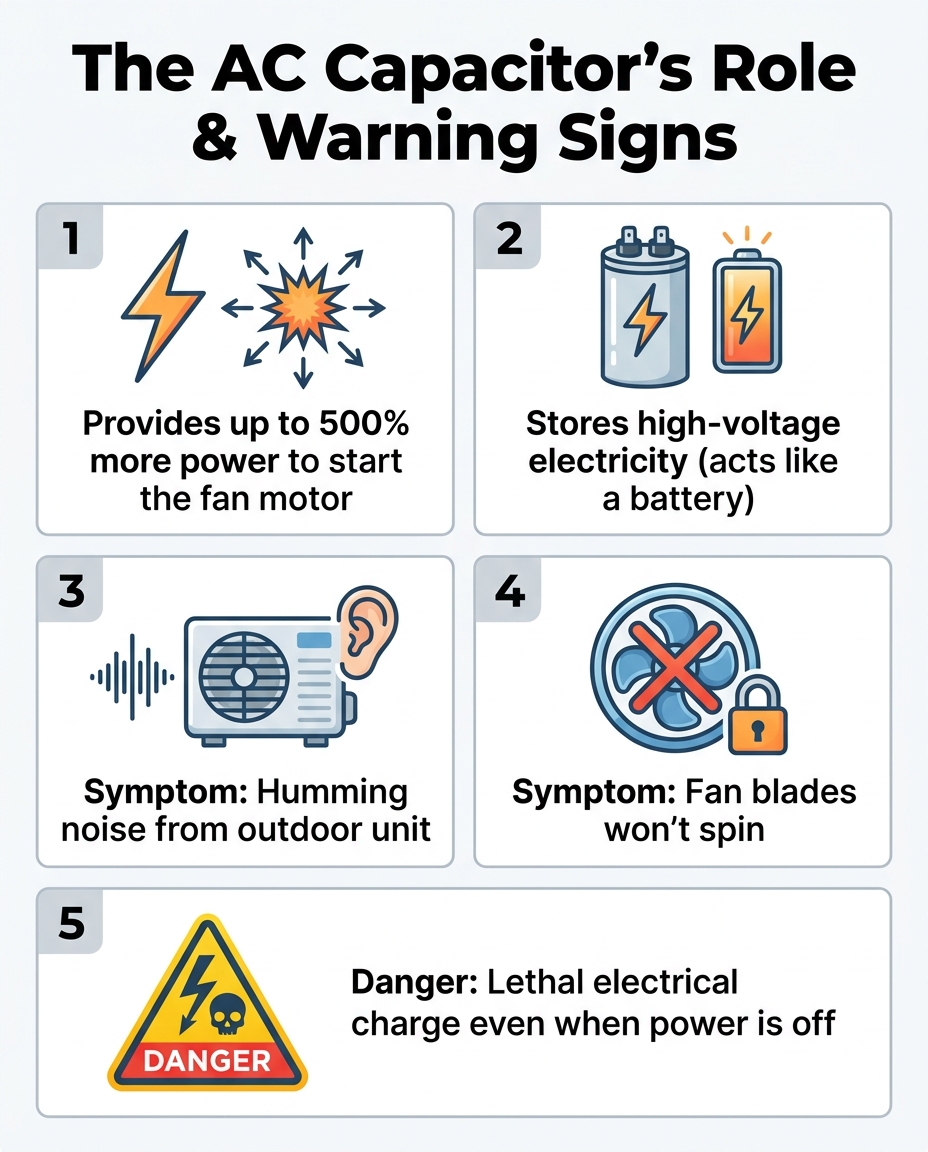
To understand why your fan is stalled, you have to understand the mechanical function of the capacitor. In the simplest terms, an AC capacitor acts like a high-capacity battery or a "jump-starter" for your air conditioning system. When your thermostat detects that the house is too warm, it sends a signal to the outdoor unit to turn on. However, the motors inside that outdoor unit are heavy, powerful pieces of machinery that require a massive jolt of electricity to get moving.
Starting a heavy fan motor or compressor requires up to 500% more power than simply keeping it running once it is already spinning. Your home's standard electrical grid cannot deliver that sudden, massive spike in voltage all at once without tripping your circuit breakers. This is where the capacitor steps in. It stores up a large volume of electrical energy while the system is off, and when the thermostat calls for cooling, it releases that massive jolt of energy in a fraction of a second.
This is why air conditioning repair services like ours frequently involve testing these components; they do the heaviest lifting in the entire system.

Start Capacitors vs. Run Capacitors
Most standard residential HVAC setups rely on two distinct types of capacitor functions, often combined into a single silver cylinder known as a dual run capacitor.
• The Start Capacitor: This provides the initial, massive torque required to break the inertia of the heavy fan blades and the compressor pump. It is the jump-starter.
• The Run Capacitor: Once the motor is spinning, the run capacitor provides a steady, continuous series of smaller electrical boosts to keep the motor running efficiently and smoothly.
If either of these functions degrades, the motor will struggle, overheat, or fail to start entirely, leading directly to the humming noise you hear outside.
Decoding the Symptoms: Why Your AC Fan Is Not Turning On
When homeowners search for reasons why their "ac fan is not working" or "ac fan not turning on," they are usually standing right next to a vibrating, humming condenser. Understanding the physics behind that noise can save your system from permanent damage.
The humming sound from the outdoor unit is the sound of electrical current trying to force a motor to turn without enough torque. The motor is receiving its standard running voltage from your home's electrical panel, but it is missing the 500% jump-start that the capacitor is supposed to provide. Because it lacks the power to overcome its own weight, the motor stalls. It sits there, locked in place, vibrating intensely as electricity flows through its copper windings.
The immediate solution: We always tell our customers that if you hear this humming sound and the fan is not spinning, you must turn your air conditioner off at the thermostat immediately. Leaving the system on while the motor is stalled will cause the motor windings to overheat, melt their protective insulation, and short out completely. What could have been a simple capacitor replacement quickly turns into a highly expensive fan motor replacement if the system is left running.
To learn more about the specific mechanical failures that cause this, read our guide on what it means when your AC fan stops working but you still hear humming.
Why the Compressor Might Still Sound Like It's Running
You might notice a strange contradiction: the fan is dead, but the unit still sounds like it is trying to cool. This happens because most systems use a dual capacitor. One side of the capacitor powers the fan motor, and the other side powers the compressor. It is incredibly common for the fan side of the capacitor to fail while the compressor side continues to work.
• Humming noise + fan won't spin — What It Usually Means: Failed fan capacitor or seized fan motor bearings.
• Clicking noise from the cabinet — What It Usually Means: Faulty contactor failing to send voltage to the unit.
• Compressor runs + fan is dead — What It Usually Means: The fan side of a dual run capacitor has failed.
• Total silence outside — What It Usually Means: Tripped breaker, blown disconnect fuse, or thermostat issue.
The Toll of Conroe's Late-Summer Heat on AC Components
Capacitors do not just fail randomly; they are heavily influenced by the environment. By the time August late-summer extreme heat arrives in Conroe, TX, your air conditioning system has likely been running almost continuously for months. As we transition into the back-to-school season, our team typically sees a massive spike in these failures due to a phenomenon known as cumulative thermal stress.
Sustained, extreme summer temperatures prevent the outdoor condenser from adequately cooling down between cycles. The ambient air is simply too hot to draw heat away from the mechanical components effectively. Inside the capacitor is a specialized dielectric fluid designed to insulate the electrical charges. When the capacitor is forced to operate continuously in 100-degree weather without a break, this internal fluid overheats and begins to boil.
Just recently, our team at Carl's Quality Cooling and Heating LLC responded to a local family whose unit stopped cooling right in the middle of back-to-school prep. Because rapid response is critical during severe weather, one of our technicians arrived the same day, diagnosed a heat-swollen capacitor, and completed the correct work at a fair price, restoring the home's comfort before the evening.
The Physical Signs of Heat Failure
When the dielectric fluid boils, it expands. This expansion causes the top or sides of the metal capacitor casing to bulge outward. A healthy capacitor has a completely flat top. A heat-damaged capacitor will look like a swollen soda can that has been left in a freezing car. If the pressure becomes too great, the casing can even split open, leaking oily fluid into the electrical cabinet. This severe thermal degradation is exactly why capacitors are the number one point of failure during late-summer heatwaves in Conroe.
The Hidden Dangers of AC Capacitors: Why You Need a Pro
When you discover that a humming sound from the outdoor unit often points to a relatively small part, it can be tempting to order a replacement online and attempt the fix yourself. We cannot stress this enough: this is an incredibly dangerous mistake. Air conditioning capacitors are not like standard AA batteries; they are high-voltage industrial components that pose a severe risk of electrocution.
Even when you shut off the power to the air conditioner at the main electrical breaker, the capacitor retains its stored electrical charge. Remember, its entire job is to store up a massive jolt of electricity. It acts like a battery that does not know it has been disconnected from the wall. Touching the terminals of a charged capacitor, or accidentally bridging them with an uninsulated tool, will release hundreds of volts directly into your body.
Standard safety protocols require:
• Specialized discharge tools: Technicians use specific, highly insulated resistors to safely drain the stored voltage before ever touching the component.
• Multimeter verification: Professional meters are used to verify that zero voltage remains in the circuit.
• Proper sizing knowledge: Installing a capacitor with the wrong microfarad rating will permanently damage the fan motor and compressor.
ASHRAE (the American Society of Heating, Refrigerating and Air-Conditioning Engineers) and all major HVAC manufacturers explicitly warn against untrained individuals handling high-voltage components. Replacing a capacitor is a fast, routine job for a licensed technician like ours who has the right insulated equipment and training. It is never worth risking your life to save a service call fee.
Honest Diagnostics: A Simple Fix vs. System Replacement
One of the biggest fears homeowners have when their AC stops spinning is that a technician will walk up to the unit, hear the humming sound, and immediately declare that the whole system needs to be replaced. A dead capacitor is one of the most common and straightforward fixes in the HVAC industry, and it should never be used as an excuse for an aggressive upsell.
Working with a veteran-owned company like Carl's Quality Cooling and Heating LLC means you are getting the same level of discipline, accountability, and integrity that military service demands. We believe in honest diagnostics. Our trustworthy technicians will never recommend a costly whole-system replacement without first testing the capacitor's microfarad readings and inspecting the motor windings.
For instance, during an end-of-season service call in the Conroe area, our team inspected a customer's AC after they noticed a drop in cooling performance. Following a quick appointment and a thorough inspection, our technician explained the exact microfarad readings of the aging components and provided honest recommendations. The customer knew exactly what was failing and why, allowing them to make an informed decision without any pressure.
What a Professional Diagnostic Looks Like
When a professional arrives to inspect a fan that will not spin, they follow a strict diagnostic process:
1. Visual Inspection: Checking the capacitor casing for bulging, swelling, or leaking fluid.
2. Electrical Draw Testing: Using a multimeter to measure the exact microfarad capacity remaining in the component.
3. Motor Winding Check: Testing the fan motor to ensure the humming hasn't caused the internal wiring to short out.
4. System Load Test: Once a new part is installed, verifying that the system draws the correct amperage upon startup.
Protecting Your System from Future Heat Waves
While you cannot control the August late-summer extreme heat in Conroe, TX, you can control how well your air conditioning system is prepared to handle it. Capacitors rarely fail without warning. Long before they swell up and stop the fan from spinning, they begin to lose their ability to hold a full charge. A capacitor rated for 45 microfarads might drop to 35, then 25, forcing the fan motor to work harder and harder to start.
We recommend taking proactive steps to protect your system as the summer winds down:
1. Test Electrical Components Annually: Have a licensed technician measure the microfarad readings of your capacitors every spring or late summer. If the reading drops below the manufacturer's tolerance, replace it before the heatwave hits.
2. Keep the Condenser Clean: Your outdoor unit needs airflow to cool down. Keep bushes, weeds, and debris at least two feet away from the cabinet. Gently wash dirt and pollen off the exterior coils so heat can escape properly.
3. Provide Shade if Possible: While not always feasible, keeping the condenser out of direct afternoon sunlight can reduce the ambient temperature around the unit, easing the thermal stress on internal electrical parts.
4. Don't Ignore Unusual Sounds: If you notice your fan hesitating before starting, or if the outdoor unit sounds louder than usual, call for an inspection immediately.
Also, keep in mind that if your system is constantly struggling and nearing the end of its lifespan, generic local utility incentive programs or federal tax credits may apply to qualifying high-efficiency AC or heat pump upgrades, so it is always worth checking with your utility provider or a tax professional.
Enrolling in a routine AC maintenance plan is the easiest way to ensure these critical electrical checks happen automatically. A technician will catch a weak capacitor during a routine tune-up, replacing it for a fraction of what an emergency weekend breakdown would cost.
Get Honest Answers for Your AC Troubles
Understanding the role of the capacitor when your AC outside fan won't spin takes the mystery and panic out of a sudden cooling failure. While that loud humming sound is certainly alarming, it is often just your system's way of asking for a new jump-starter. By relying on professional diagnostics rather than dangerous DIY guesswork, you protect both your safety and your investment. We proudly serve Montgomery County service areas with transparent, veteran-led service. If your fan is stalled, turn off the thermostat and let our team provide the honest, accurate fix you deserve.
Frequently Asked Questions
Why is my AC fan not turning on but making a humming noise?
The humming noise is the sound of the fan motor trying to start without the necessary electrical jump-start. When the capacitor fails, the motor receives standard running voltage but lacks the massive torque required to spin the heavy blades. The motor stalls in place, vibrating and humming as electricity flows through it.
What does an AC capacitor do?
An AC capacitor acts like a heavy-duty battery that stores up a massive amount of high-voltage electricity. When your thermostat calls for cooling, the capacitor releases this energy in a fraction of a second to jump-start the heavy fan motor and compressor. Once the motors are running, it provides a steady stream of smaller electrical boosts to keep them spinning efficiently.
Is it safe to run the AC if the fan isn't spinning?
No, it is extremely dangerous for the equipment to run the AC if the fan is stalled. Without the fan pulling air across the condenser coils, the compressor will rapidly overheat. Furthermore, leaving power flowing to a stalled fan motor will cause its internal wiring to melt, turning a simple repair into a highly expensive motor replacement.
What happens when an AC capacitor goes bad?
When an AC capacitor goes bad, it loses its ability to store and deliver an electrical charge. Physically, the internal dielectric fluid often boils and expands, causing the metal casing to bulge or leak. Mechanically, the outdoor fan or compressor will fail to start, resulting in a loud humming noise and a total loss of cold air inside the house.
Can an AC fan run with a bad capacitor?
An AC fan cannot start on its own with a completely dead start capacitor, as it lacks the initial torque to break inertia. If only the run capacitor is failing, the fan might start but will run sluggishly, overheat, and eventually shut down on thermal overload. In either case, operating the system with a bad capacitor will cause severe damage to the motor.
How does extreme Texas heat affect my AC capacitor?
Extreme Texas heat subjects the capacitor to severe cumulative thermal stress, preventing the outdoor unit from cooling down between cycles. This continuous high-temperature operation causes the internal insulating fluid to overheat, expand, and eventually rupture the casing. This is why capacitor failures spike dramatically during late-summer heatwaves.