
The Myth of the Quick Fix: Why High-Pressure Hoses Destroy AC Efficiency
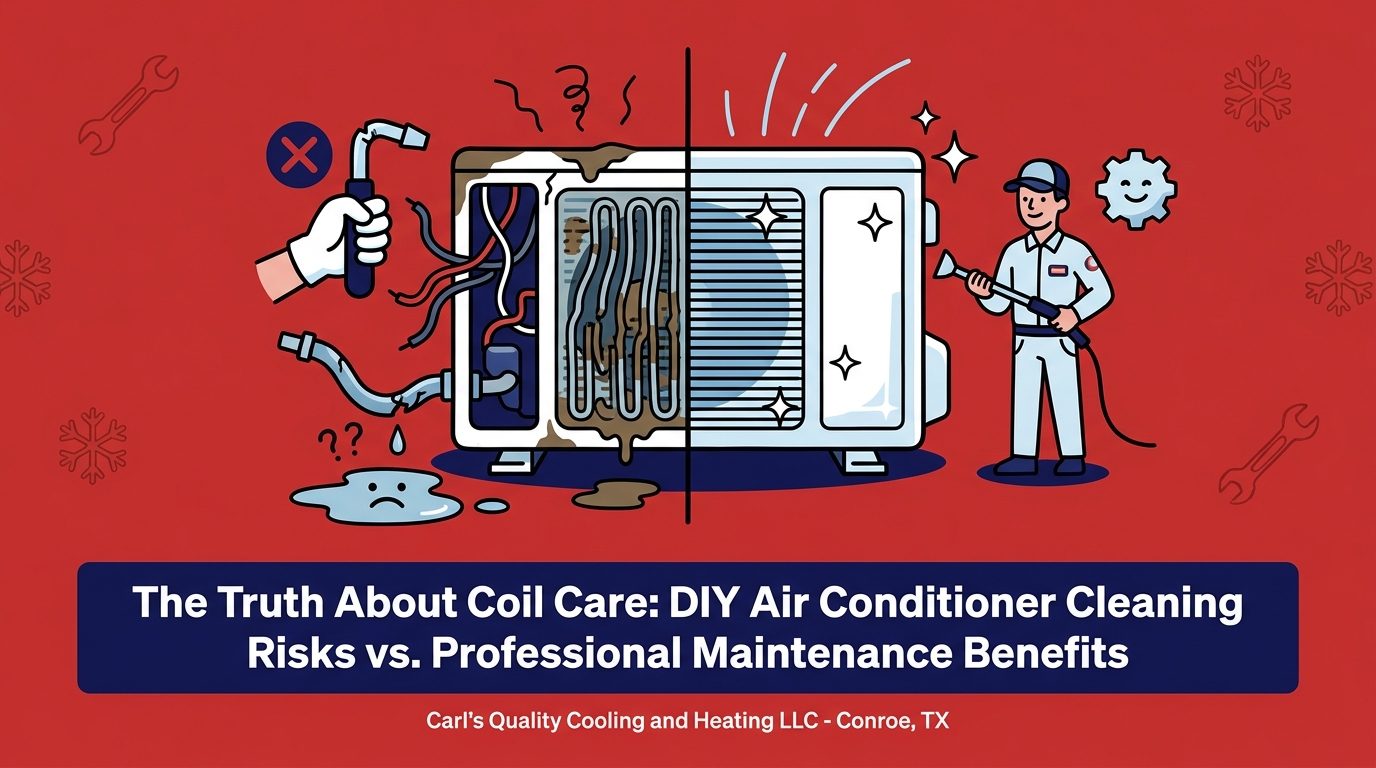
Blasting your outdoor AC unit with a garden hose or pressure washer to boost its cooling power is one of the most common—and destructive—misconceptions in home maintenance. Here at Carl's Quality Cooling and Heating LLC, our team frequently sees the costly aftermath of these well-intentioned chores. When you are weighing DIY Air Conditioner Cleaning Risks vs. Professional Maintenance Benefits, the most critical factor is understanding what mechanical force actually does to your delicate equipment. Water pressure might wash away the top layer of dirt, but it frequently leaves behind permanent, irreversible damage that ruins your system's efficiency.
If you are looking for a safe, proven way to restore your system's performance, learn more about our air conditioning services before attempting a DIY fix.
The underlying issue usually starts when the dreaded August late-summer cooling lag hits. Right around the back-to-school transition, your thermostat might be set to a comfortable temperature, but the house still feels warm, and the outdoor unit is running non-stop. You walk outside, notice a layer of grass clippings and grime on the exterior, and assume a quick wash will solve the problem. Unfortunately, homeowners who take this route often end up inadvertently suffocating their system's airflow by flattening the delicate coil fins that encase the unit.
This creates an immediate decision point: do you risk causing catastrophic mechanical damage with a DIY deep clean, or do you invest in a safe, calibrated chemical coil wash performed by an expert? Resolving efficiency issues before the heaviest heat of the season takes its toll is critical, but using the wrong method will instantly turn a minor maintenance task into a major equipment failure.
The False Promise of Pressure Washing
Many hardware stores sell attachments designed to increase your garden hose's pressure, marketing them as heavy-duty cleaning tools. During our service calls, we constantly remind homeowners that while these are great for concrete driveways or tough siding stains, they are entirely the wrong tool for an air conditioner. The exterior cabinet of your AC unit looks rugged and durable, leading many people to believe the internal components are just as tough. This false sense of security is exactly why so many systems fail prematurely during the hottest months of the year.
The Anatomy of an AC Coil: Thinner Than Paper, Highly Vulnerable
To understand why high-pressure water is so dangerous to your cooling system, you have to look at the physics of how a condenser coil is built. The heavy metal louvers or wire guards on the outside of your AC unit are just a protective shell. Hidden just underneath that shell are thousands of tightly packed aluminum fins surrounding the copper refrigerant tubes.
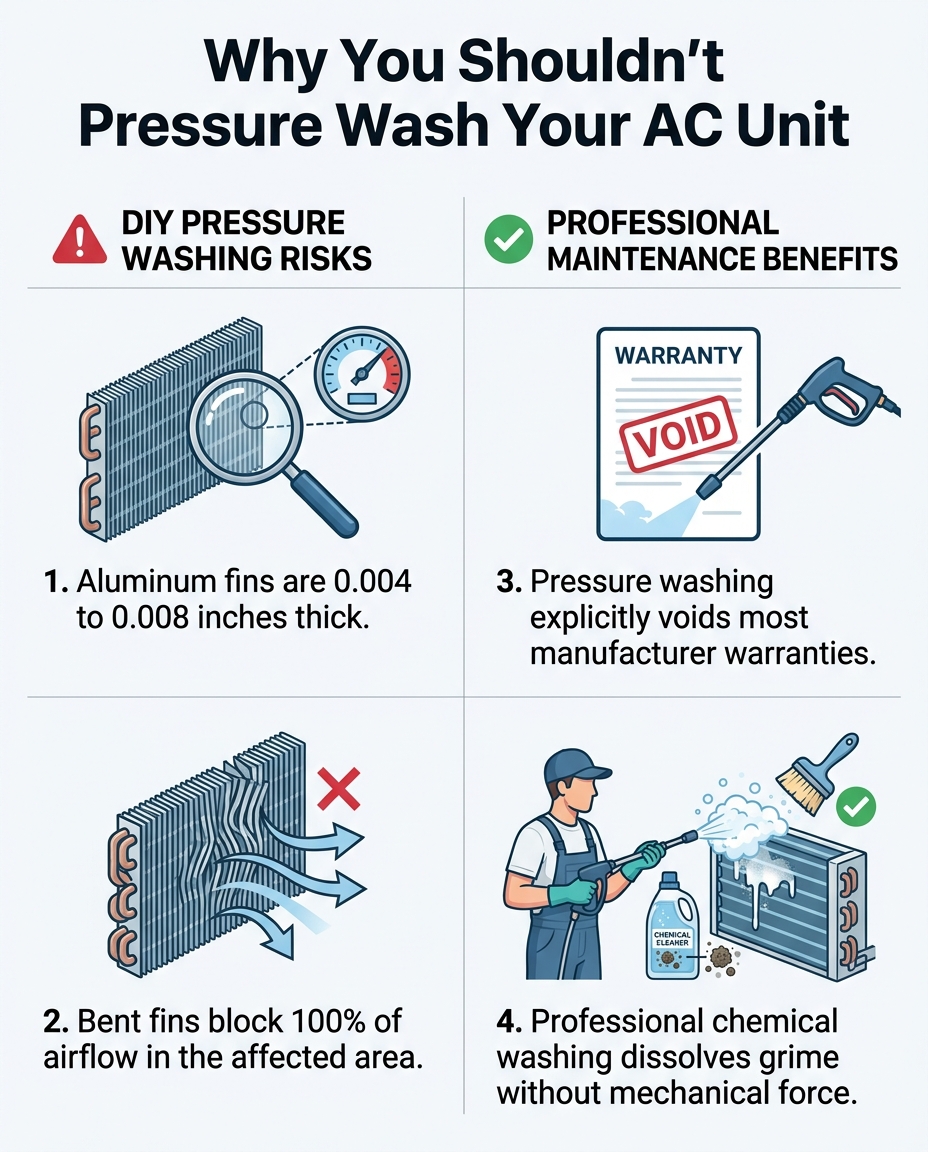
These aluminum condenser coil fins are incredibly fragile. In most modern residential units our technicians service, these fins measure anywhere from 0.004 to 0.008 inches thick. To put that into perspective, a standard sheet of printer paper is about 0.004 inches thick. These fins are designed to be as thin as mathematically possible to maximize heat transfer, not to withstand blunt mechanical force.
The Role of Precise Spacing
The function of these fins is entirely dependent on their precise, factory-set spacing. As hot refrigerant pumps out of your house and into the outdoor unit, the fan pulls massive amounts of outside air through the narrow gaps between the fins. This airflow absorbs the heat from the aluminum and disperses it into the outdoor air. If the air cannot flow freely through those gaps, the heat stays trapped inside the refrigerant.
Here in Conroe, TX, where the late-summer heat demands maximum performance from your cooling equipment, optimal heat transfer is non-negotiable. When you point a standard garden hose nozzle—let alone a mechanical pressure washer—at these paper-thin fins, the water pressure easily bends and folds the aluminum over on itself. A single misdirected blast of water can crush hundreds of fins in seconds, sealing off the air gaps completely.
The Catastrophic Impact of Flattened Fins on System Airflow
When the aluminum fins fold over and block the gaps, your system experiences what HVAC technicians call airflow suffocation. The large fan at the top of your outdoor unit continues to spin, but it can no longer pull sufficient air through the sides of the coil. The heat absorbed from inside your home has nowhere to go.
The problem compounds rapidly:
• Trapped heat: Because the heat cannot escape, the refrigerant returning to your home is still warm, drastically reducing your indoor cooling capacity.
• Compressor strain: Your compressor—the heart of the AC system—has to work twice as hard and run twice as long to try and reject the heat.
• Overheating and failure: This continuous, strained operation leads directly to rapid overheating, frequent tripped breakers, and eventually, premature compressor failure.
We see the results of this airflow suffocation regularly in our Conroe service area. One homeowner reached out to us recently during the back-to-school rush, sweating in the Texas heat with a faulty AC unit. When our Carl's Quality Cooling and Heating LLC technician arrived, serviced the AC unit, and fixed the problem, it was clear that restricted airflow from crushed, unmaintained coils had forced the system to its breaking point. We got the AC work done right, but the situation highlighted how quickly a system can fail when it cannot breathe.
The Danger of Improper DIY Correction
Once a homeowner realizes they have bent the fins, the next mistake is often trying to pry them back open with a knife, a screwdriver, or an improper fin comb. Because the aluminum is so thin and has already been stressed by bending, prying it often tears the metal entirely. Worse, slipping with a tool can easily puncture the pressurized copper tubing beneath the fins, causing a massive refrigerant leak that shuts down the system completely. Proper AC unit cleaning requires specialized knowledge to avoid these exact cascading failures.
The Gulf Coast Climate Factor: Why Water Alone Fails
In our years of maintaining HVAC systems across the region, we've found a fundamental reason why DIY hose-washing fails to actually clean the unit: it does not address the specific type of grime that forms in our Gulf Coast climate. The local weather plays a massive role in how your outdoor unit degrades over the cooling season.
Our extreme local humidity in Conroe, TX, mixes with airborne dust, pollen, and yard debris to create a unique challenge. When dry dust hits the constantly damp, sweating coils of an air conditioner in a high-humidity environment, it does not just sit on the surface. It forms a thick, sticky, cement-like paste that bakes onto the aluminum fins under the harsh summer sun.
The Biological Growth Factor
In addition to the dust paste, the Gulf Coast climate is the perfect breeding ground for biological growth. Algae and mildew thrive on warm, damp outdoor coils. This biological matter weaves itself into the sticky dust, creating a stubborn barrier that insulates the coils and prevents heat transfer.
The Frustration Loop:
• Observation: You notice the unit is covered in a dark, sticky grime.
• Attempt: You try spraying it with a gentle mist from the hose, but the water just beads up and rolls off the greasy paste.
• Escalation: Frustrated that the dirt isn't moving, you twist the hose nozzle to the strongest jet setting or hook up the pressure washer.
• Destruction: The high pressure still fails to dissolve the sticky paste, but it successfully crushes the delicate aluminum fins underneath it.
This specific, regional grime cannot be removed with mechanical force. It requires a chemical breakdown to dissolve the biological growth and release the sticky paste safely.
Electrical Hazards and Voided Warranties: The Hidden DIY Threats
Even if you manage to avoid flattening the fins, DIY deep cleaning introduces a host of secondary risks that can instantly erase any perceived savings from skipping a professional service call. Modern air conditioners are high-voltage electrical appliances, and mixing them with uncontrolled water pressure is inherently dangerous.
The hidden threats of DIY cleaning include:
1. Electrical Compartment Penetration: High-pressure water easily forces its way past the weather-stripping on the system's electrical access panel. Water spraying onto sensitive capacitors, contactors, and circuit boards can cause immediate short circuits, permanent component damage, or severe shock hazards when the system powers back on.
2. Corrosive Over-the-Counter Chemicals: Some homeowners realize water isn't enough and purchase generic coil cleaners from hardware stores. Using the wrong pH-balance of chemicals, or failing to rinse them away completely, will rapidly corrode both the aluminum fins and the copper tubing, leading to microscopic leaks over time.
3. Voided Manufacturer Warranties: HVAC manufacturers are very clear in their documentation. Damage resulting from improper maintenance—explicitly including the use of pressure washers or unapproved chemicals—will instantly void your warranty. If your compressor burns out because of airflow suffocation from bent fins, you will be paying out of pocket for the replacement.
When that August late-summer cooling lag hits, the last thing you want is to accidentally void your warranty right before the system needs a major repair.
Safe, Calibrated Care: The Mechanics of Professional Maintenance
The alternative to these destructive DIY methods is professional, calibrated care. Technicians do not rely on mechanical force to clean your system; they rely on chemistry and precision. Carl's Quality Cooling and Heating LLC's use of a safe, calibrated professional maintenance approach ensures that your delicate components are protected while their efficiency is fully restored.
The professional cleaning process uses a specialized, foaming chemical wash. This alkaline or acidic foam (depending on the specific coil material and grime type) is applied gently. As it expands, it pushes deep into the microscopic gaps between the fins, actively dissolving the sticky dust paste, algae, and mildew. Once the chemical has broken down the grime, the technician uses a calibrated, low-pressure rinse to safely wash away the debris without putting any physical stress on the aluminum.
Comprehensive System Optimization
Professional care goes far beyond just spraying the coils. During a routine late-summer visit, a customer asked us to look at their struggling system. While performing our comprehensive checks, we thoroughly diagnosed and fixed a Freon leak that was hiding behind the coils. Because the job was completed in a timely manner, the homeowner avoided a total system breakdown during the end-of-season peak.
A proper visit includes measuring and restoring precise airflow to ensure maximum heat transfer, checking refrigerant levels, and tightening all electrical connections. This comprehensive approach provides peace of mind, knowing your system is optimized for peak efficiency. If you want to protect your investment, consider enrolling in a professional maintenance plan to keep your system running safely year-round.
Side-by-Side Comparison: DIY vs. Professional Coil Cleaning
To make the best decision for your home's comfort, it helps to see the differences laid out clearly. Here is how DIY attempts stack up against professional care.
• Methodology — DIY Hose / Pressure Washing: High-pressure mechanical force that physically pushes against the unit. — Professional Coil Cleaning: Calibrated chemical breakdown that dissolves grime without force.
• Risk to Equipment — DIY Hose / Pressure Washing: High probability of flattened fins, electrical shorts, and voided warranties. — Professional Coil Cleaning: Protected components, safe electrical panels, and validated warranties.
• Effectiveness on Humidity Grime — DIY Hose / Pressure Washing: Leaves sticky residue and biological growth behind in the deep crevices. — Professional Coil Cleaning: Fully dissolves mildew, algae, and baked-on dirt paste from the inside out.
• Long-term Impact — DIY Hose / Pressure Washing: Reduced efficiency, higher energy bills, and premature compressor failure. — Professional Coil Cleaning: Restored heat transfer, lower energy consumption, and extended lifespan.
Before you drag the hose across the yard to tackle that August late-summer cooling lag, check out our current service promotions to see the value of professional, safe maintenance.

Frequently Asked Questions About AC Coil Safety
Is it safe to pressure wash an air conditioner?
No, high-pressure water will flatten the delicate aluminum fins that surround the outdoor unit. This restricts airflow and can cause the system to overheat rapidly. Using a pressure washer also risks forcing water into sealed electrical compartments, creating severe shock hazards and potentially destroying the system's circuit boards.
What happens if you bend AC fins?
Bent fins block air from flowing through the condenser coil, which is critical for the cooling process. The system loses its ability to transfer heat out of your home, leading to poor cooling performance and significantly higher energy consumption. Over time, the strain of trying to push air through blocked fins will cause the compressor to burn out prematurely.
Can I clean my AC unit myself?
While you can clear loose leaves, twigs, and debris from the exterior of the unit, deep cleaning the coils requires professional chemical treatments. DIY deep cleaning risks electrical damage, bent fins, and voided warranties. Our team always recommends leaving the internal washing and maintenance to a trained professional with the right tools.
Why does my AC unit have bent fins?
Fins are often bent by improper cleaning methods, such as high-pressure hoses or aggressive brushing. They can also be damaged by severe weather like hail, or accidental impacts from lawnmowers and weed trimmers. Even leaning a heavy object, like a ladder or a bicycle, against the unit can cause localized fin damage.
How do professionals safely clean condenser coils?
Professionals use specialized, foaming chemical cleaners that expand into the coil to dissolve dirt, sticky paste, and biological growth from the inside out. They then rinse the coils with calibrated, low-pressure water to wash away the foam while fully protecting the fragile aluminum fins from bending.
Protect Your Investment with Professional AC Maintenance
When you look closely at the facts, the risks of DIY pressure washing far outweigh any perceived benefits. Resolving efficiency issues safely requires specialized tools, chemical knowledge, and an understanding of heat transfer physics. Don't let the frustration of a struggling system push you into making a mistake that could cost you an entire compressor.
Here in Conroe, TX, your air conditioner works incredibly hard to keep your family comfortable. Encourage immediate action to restore your cooling performance the right way. Rely on the team at Carl's Quality Cooling and Heating LLC to safely dissolve the grime, protect your delicate aluminum fins, and ensure your system runs efficiently for years to come.