
Beating the Late-Summer Stickiness: Why Your Home Still Feels Clammy
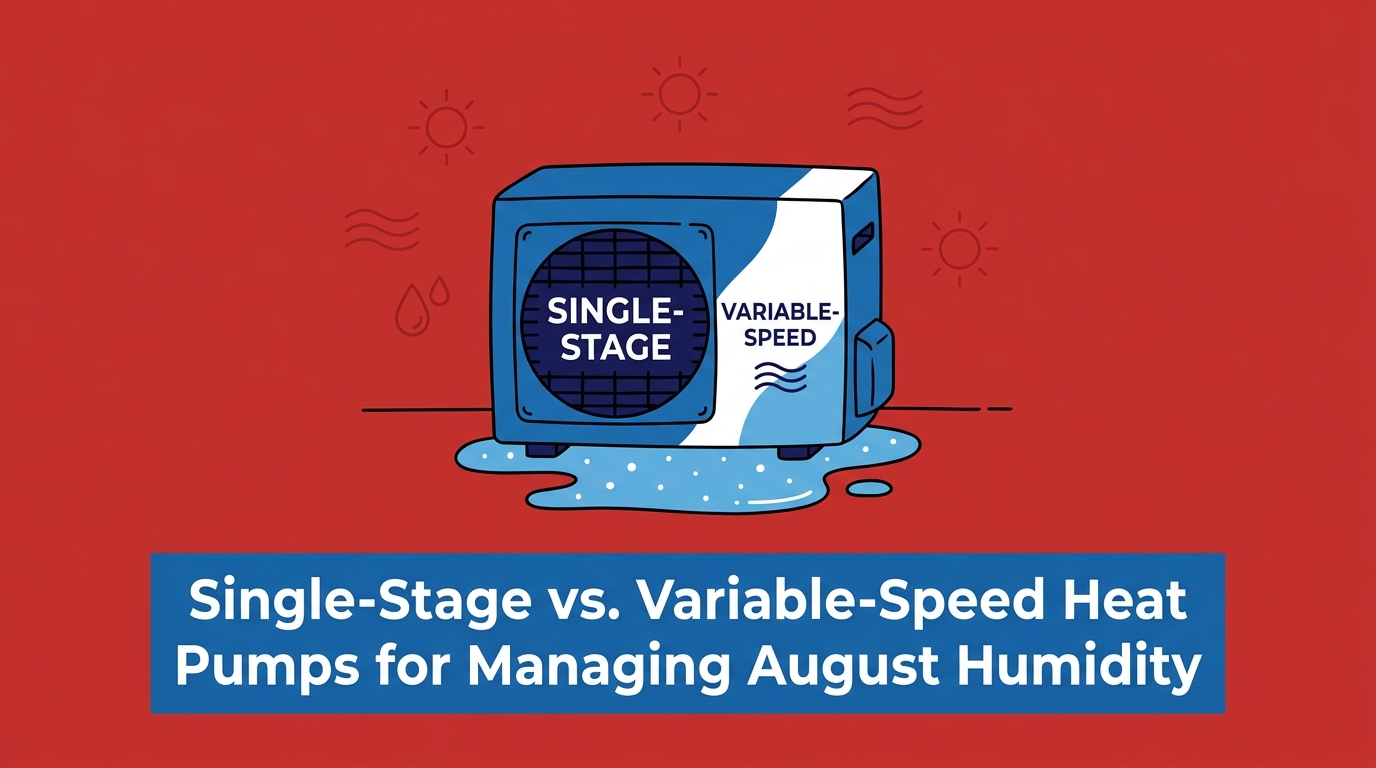
August in Southeast Texas brings a heavy, inescapable moisture that settles over everything. You walk inside, hear your cooling system running at full blast, and check the thermostat—it reads a perfectly cool 72 degrees. Yet, your skin still feels clammy, the air feels thick, and the house simply does not feel comfortable. If you are preparing to replace an aging unit during this back-to-school transition, understanding the difference between Single-Stage vs. Variable-Speed Heat Pumps for Managing August Humidity is the key to finally achieving true indoor comfort.
Lowering the thermostat further will not solve the core issue. When the air inside your home is saturated with water vapor, raw cooling power is only half the battle. Your system must actively pull that moisture out of the air. Evaluating your current air conditioning services and indoor air quality services is the first step toward transforming your home from a damp icebox into a genuinely comfortable environment.
The Science of Gulf Coast Comfort: Temperature vs. Humidity
To understand why your home feels damp even when the air conditioner is running, you have to look at the two different types of cooling your system performs: sensible cooling and latent cooling. Sensible cooling is the temperature drop you can measure with a thermometer. Latent cooling is the removal of moisture from the air, which determines how the air actually feels on your skin.
The Subtropical Climate Challenge: Living in Conroe, TX, means dealing with a subtropical climate where the air is frequently saturated with moisture. In this region, cooling loads require significant latent cooling. If a system only focuses on sensible cooling, it leaves the heavy water vapor behind.
Your HVAC system's evaporator coil acts a lot like a glass of ice water sitting on a patio table in mid-August. As warm, moist indoor air blows across the freezing cold metal coil, condensation forms on the surface. That moisture drips into a drain pan and is carried out of your home. However, this process takes time. The air must flow over the coil long enough for the moisture to condense. If the system turns off too quickly, the coil warms up, the condensation stops, and the humidity remains trapped inside your living space.
The Single-Stage Struggle: Why Faster Cooling Isn't Always Better
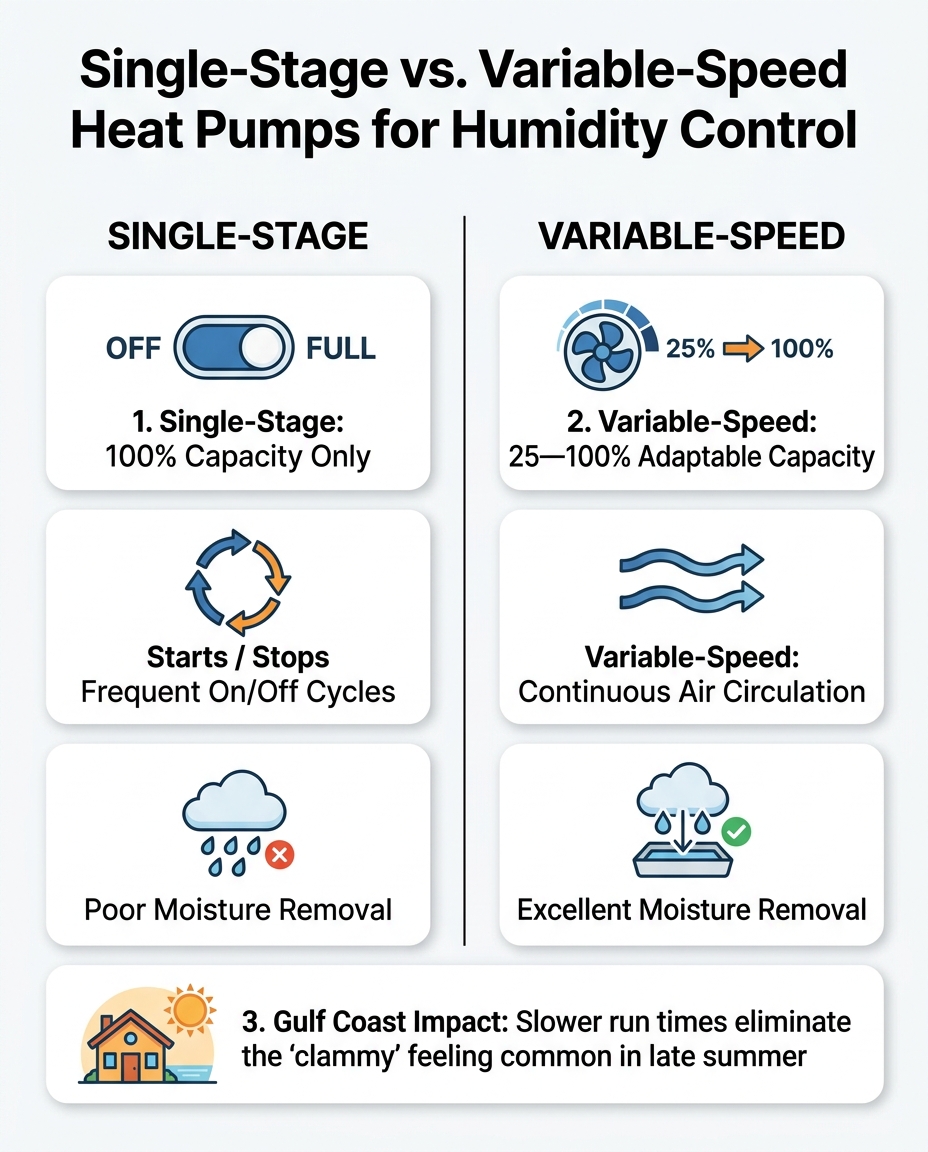
Most older heat pumps and air conditioners rely on single-stage compressors. A single-stage compressor is incredibly simple: it operates at 100% capacity whenever it is turned on, and 0% capacity when it is turned off. There is no middle ground, which creates a significant problem during the late-summer humidity peak.
Because a single-stage system blasts maximum cold air into your home, it often reaches the target temperature on the thermostat very quickly. Once the thermostat senses the house has hit 72 degrees, it shuts the entire system down. This rapid on-and-off process is known as short-cycling. While the sensible temperature drops rapidly, the system simply does not run long enough to perform the necessary latent cooling. The evaporator coil never gets the extended dwell time required to wring the humidity out of the air, leaving your home feeling cold but uncomfortably damp.
This constant starting and stopping also takes a severe toll on the mechanical components. Every time a single-stage compressor kicks on at full power, it draws a massive surge of electricity and puts immense stress on the motors and capacitors. If you want to learn more about reducing this strain, you can read our guide on keeping your AC running efficiently during heat waves.
The Hidden Costs of Short-Cycling
Relying on a single-stage system in a high-humidity environment leads to several secondary issues beyond just physical discomfort:
• Increased energy consumption: The constant system reboots draw massive amounts of starting amperage, driving up your monthly utility bills.
• Inconsistent temperatures: Rapid cycles often fail to push conditioned air to the furthest rooms in the house, creating distinct hot and cold spots.
• Elevated indoor humidity: Lingering moisture can encourage poor indoor air quality, making the air feel stale and heavy.
• Premature wear and tear: The mechanical stress of hard-starting dozens of times a day shortens the overall lifespan of the compressor and electrical components.
The Variable-Speed Solution: Continuous Moisture Removal
Variable-speed technology completely changes the mechanics of how a heat pump cools and dehumidifies a home. Instead of operating strictly at 100% or 0%, a variable-speed compressor uses inverter technology to ramp its capacity up and down in tiny increments. Depending on the model, these systems can operate at capacities as low as 25% to 30%.
One local homeowner recently reached out needing a new HVAC system and wanted to explore various configurations to solve their comfort issues. Our team patiently explained the pros and cons of different Daikin variable speed units and options. By understanding how the technology matched their specific home layout, they were able to choose a configuration that finally solved their humidity problems.
Here is exactly how variable-speed technology defeats late-summer humidity:
1. Extended Run Times: Because the system can run at a very low capacity, it stays on for much longer periods without overcooling the house.
2. Maximum Condensation: These long, slow cycles keep the indoor air constantly circulating over the cold evaporator coil, maximizing latent heat removal.
3. Even Air Distribution: Continuous, gentle airflow eliminates hot and cold spots, keeping every room at a consistent temperature.
4. Whisper-Quiet Operation: Since the compressor rarely needs to ramp up to 100% capacity, the system operates at a much lower decibel level, eliminating the loud "clunk" associated with older units turning on.
Side-by-Side Comparison: Which System Wins the Late-Summer Battle?
When you are weighing your options for a late-summer replacement, seeing the differences laid out clearly can help make the decision much easier. The chart below breaks down how these two technologies handle the specific demands of a Gulf Coast climate.
• Dehumidification — Single-Stage Heat Pump: Poor. Short cycles leave moisture behind, causing a clammy feeling. — Variable-Speed Heat Pump: Excellent. Long, slow cycles continuously wring moisture from the air.
• Energy Efficiency — Single-Stage Heat Pump: Standard. High energy draw due to constant hard starts and stops. — Variable-Speed Heat Pump: Ultra-High (SEER2 Optimized). Low, steady power draw saves electricity.
• Temperature Consistency — Single-Stage Heat Pump: Fluctuating. Noticeable temperature swings between cycles. — Variable-Speed Heat Pump: Even. Precise temperature control within half a degree of the thermostat setting.
• Noise Level — Single-Stage Heat Pump: Loud. Operates at maximum capacity every time it turns on. — Variable-Speed Heat Pump: Quiet. Runs at low speeds for the majority of the day.
Keep in mind that regardless of which technology you choose, maintaining that performance requires clean equipment. A dirty evaporator coil cannot transfer heat or remove moisture effectively. Keeping either system running optimally requires a preventative maintenance plan to ensure filters and coils remain spotless throughout the heavy cooling season.

Making the Upgrade Accessible: Balancing Investment with Comfort
It is important to acknowledge that variable-speed units require a higher initial investment compared to a traditional single-stage replacement. The advanced inverter technology and sophisticated control boards that make these systems so effective do carry a premium upfront cost. However, for homes struggling with severe humidity, that investment directly translates into a drastic improvement in daily comfort and long-term utility savings.
Working with a veteran-owned company means you get an honest, mission-driven assessment of your home's actual needs. The goal is never to push an unnecessary upgrade, but rather to evaluate whether your specific humidity and comfort issues truly require variable-speed technology to solve. If a standard system will meet your needs, that is exactly what will be recommended.
If a variable-speed upgrade is the right choice for your home, there are multiple ways to make the investment manageable. Federal tax credits may apply to qualifying high-efficiency heat pump installations, helping to offset the initial costs (always verify current programs with a tax professional). Additionally, you can utilize flexible HVAC financing options that allow you to bring premium comfort into your home immediately without breaking your household budget.
Frequently Asked Questions About Heat Pumps and Humidity
Why does my house feel humid even when the AC is running?
A house feels humid when the AC runs if the system is short-cycling. This happens when the unit is too large for the space or uses a single-stage compressor that blasts cold air at 100% capacity. The system cools the room to the target temperature too quickly and shuts off before the evaporator coil has enough time to extract the moisture from the air. The result is a cold, damp, and clammy environment.
Is a variable speed heat pump better for humidity?
Yes, variable-speed heat pumps are vastly superior for managing high humidity. Because they can ramp their cooling capacity down to 25% or 30%, they run for much longer periods at lower speeds. This continuous air circulation over the cold evaporator coil pulls significantly more moisture out of the air than a system that constantly turns on and off.
How do variable speed heat pumps work?
Variable-speed heat pumps utilize advanced inverter technology to adjust the compressor's speed in real time. Instead of just having "on" and "off" settings, the compressor acts like a car's gas pedal, providing exactly the amount of cooling needed to maintain the temperature. This allows the system to run continuously at very low power, providing steady, quiet, and highly efficient comfort.
Does upgrading to a variable-speed heat pump require new ductwork?
Upgrading to a variable-speed system does not always require new ductwork, but it does require an assessment of your current layout. Because these systems rely on precise, continuous airflow, your existing ducts must be properly sized, sealed, and free of major leaks. If your current ductwork is undersized or severely deteriorated, modifications may be necessary to get the full efficiency and comfort benefits of the new unit.
How much can a variable-speed system save on monthly energy bills?
Variable-speed systems typically offer substantial energy savings over older single-stage units. By running at lower capacities and avoiding the massive power spikes required to constantly start a single-stage compressor, these units use electricity much more efficiently. While exact savings depend on your home's insulation, local utility rates, and thermostat habits, the reduction in energy consumption is a major long-term benefit.
Secure Your Comfort Before the Next Heat Wave
You do not have to settle for a sticky, clammy home during the final, most brutal weeks of summer. If your current system is leaving you uncomfortable despite running all day, the issue is likely a lack of active moisture removal. True comfort in Conroe requires a system designed to handle the heavy humidity of the Gulf Coast.
Get a professional, honest evaluation of your current equipment to see if an upgrade makes sense for your specific situation. Schedule an assessment today to explore your options for indoor air quality services and discover how modern heat pump technology can transform the way your home feels.