
How to Decide Between Repair and Replacement for Your HVAC System
How to decide between repair and replacement comes down to five core factors most homeowners in Conroe and Montgomery County face every time their system acts up:
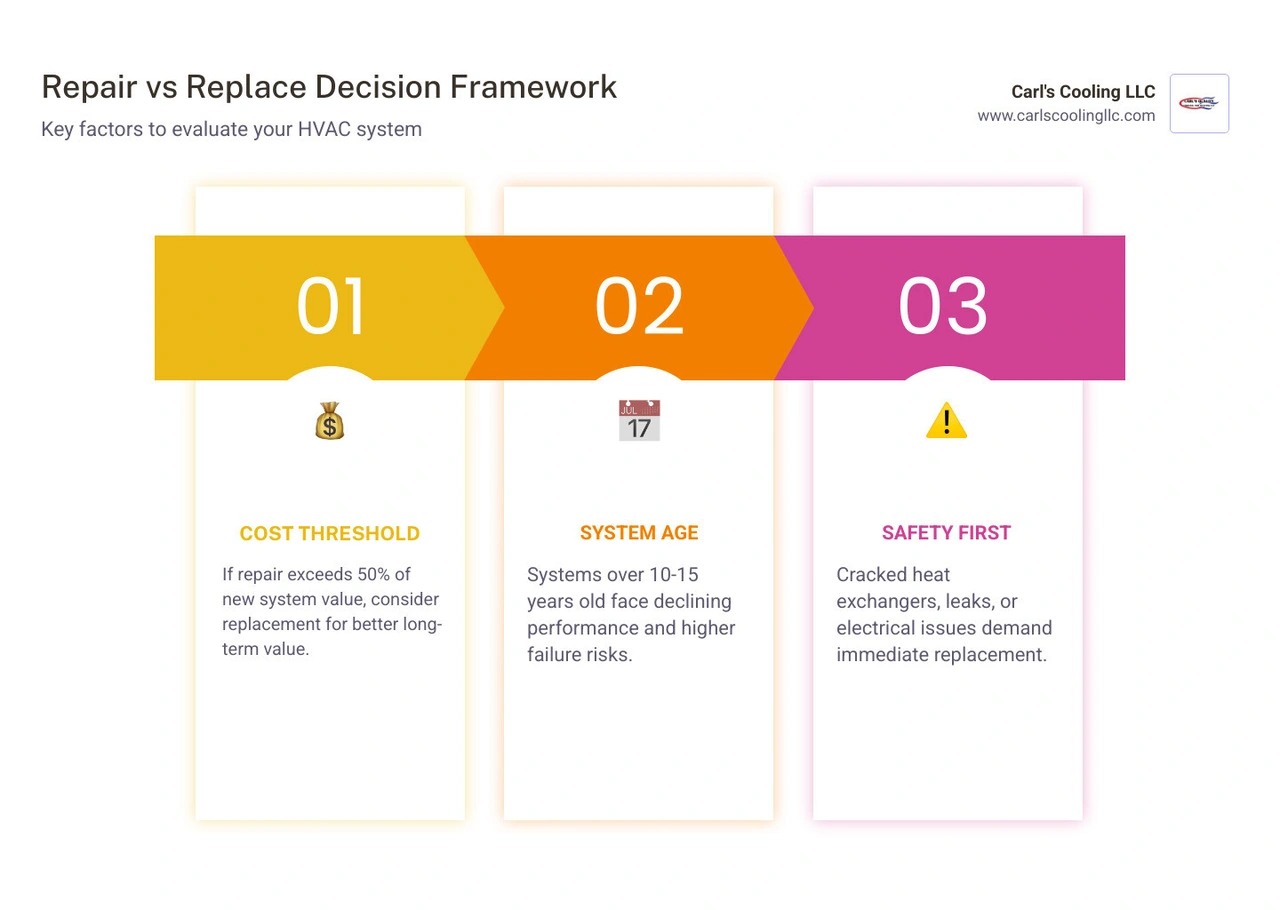
- Repair cost vs. system value — If the repair costs more than 50% of what a comparable new unit would cost, replacement is usually the smarter move.
- System age — Most HVAC systems last 10–15 years. The closer yours is to that window, the harder it is to justify a major repair.
- Frequency of breakdowns — One repair is normal. Repeated failures signal a system in decline.
- Energy efficiency — Older units can use 20–30% more energy than modern high-efficiency models, meaning your monthly bills tell part of the story too.
- Safety concerns — A cracked heat exchanger, refrigerant leak, or persistent electrical fault is never just a repair question — it's a safety question first.
Here's the honest truth: there's no single rule that works for every situation. The old "50% rule" is a useful starting point, but it doesn't account for your system's age, Texas's punishing heat cycles, or the long-term cost of keeping an inefficient unit running month after month.
Whether you're a homeowner in Conroe dealing with a unit that stopped cooling on a 95-degree afternoon, or a business owner in Montgomery County staring at a repair bill that doesn't quite make sense, this guide will walk you through a clear, practical framework for making the right call — without guessing.
The 50% Rule and Beyond: How to Decide Between Repair and Replacement
When we sit down with a homeowner in The Woodlands or Spring to look at a malfunctioning air conditioner, the conversation almost always starts with the "50% Rule." It’s the classic benchmark in our industry: if the cost of a single repair exceeds 50% of the value of a brand-new system, you should replace the unit.

However, as we move through May 2026, we’ve found that this rule can sometimes be a bit too blunt. For instance, if you have a 14-year-old furnace, even a repair that costs only 30% of a new unit might be a "bad" investment because you are likely to face another major repair within the next year.
To get a more accurate picture, we often look at the Value-Added Repair Model. Instead of just looking at the price tag of the fix, we ask: "Does this repair add significant life to the asset?"
The Economic Logic of Asset Valuation
Think of your HVAC system like a vehicle. In asset management (specifically following frameworks like ISO 55000), we calculate the remaining value of the equipment. If you bought a system ten years ago and it has a 15-year life expectancy, it has five years of "value" left. If a major component like a compressor or a blower motor fails, you have to weigh the cost of that part against the five years of comfort you might get out of it.
If you are struggling with a heater that won't stay on, it might be time to Repair or Replace Your Furnace. We often tell our neighbors in Magnolia and Tomball that a "repair" on a terminal system is really just a "band-aid" that delays the inevitable while increasing your total cost of ownership.
Evaluating System Age and Performance in Montgomery County
In our neck of the woods—from the shores of Lake Conroe down to the busy streets of Houston—the age of your system matters more than almost anywhere else in the country. Why? Because a Texas "year" is like seven years for an HVAC unit. Our systems run nearly around the clock for six months of the year.
The 10-15 Year Lifespan
While manufacturers often cite a 15-to-20-year lifespan, the reality for homes in Willis or Montgomery is usually closer to 10–12 years for an AC unit and slightly longer for a furnace. Between 90,000 and 120,000 "miles" (if we were talking about cars), major parts begin to fail. In HVAC terms, this is when we see compressors, evaporator coils, and heat exchangers start to give up the ghost.
If your unit was installed before 2015, you are likely missing out on massive technological advancements. Modern systems use SEER2 ratings (Seasonal Energy Efficiency Ratio 2), which are much more stringent and result in significantly lower monthly utility bills. When you see Signs You Need AC Replacement, it’s often because the mechanical components are physically worn down to the point where they can no longer meet the cooling demands of a Texas summer.
How to decide between repair and replacement based on system age
- 0–5 Years: Almost always repair. Most components are likely still under manufacturer warranty, which covers the cost of the parts.
- 6–10 Years: This is the "grey area." We look at the maintenance history. Has the system been serviced regularly in April Sound or Bentwater? If so, a repair is likely worth it.
- 11+ Years: Start planning for replacement. Even if you choose to repair it today, you should know When to Replace Your Heater or AC so you aren't caught off guard during a heatwave.
When Safety and Reliability Dictate Your Choice
Sometimes, the financial math doesn't matter because the safety math takes over. We take safety very seriously at Carl's Cooling LLC. There are certain "hard boundaries" where we will almost always recommend a replacement over a repair to protect your family.
The Danger of Cracked Heat Exchangers
In the winter months in places like Huntsville or New Waverly, your furnace is your lifeline. However, a cracked heat exchanger is a non-negotiable safety hazard. It can leak carbon monoxide—an odorless, colorless, and potentially lethal gas—into your home. When a system reaches this point, it is usually Time for a Furnace Replacement because the cost of replacing the exchanger on an old unit is nearly as much as a new, safer furnace.
Reliability and the "Hassle Factor"
Reliability is the other side of the safety coin. If your AC is "short-cycling" (turning on and off every few minutes), it’s putting immense strain on the electrical components. Frequent breakdowns don't just cost money; they cost time. If you’re a business owner in Conroe or a homeowner in Woodforest with a busy schedule, you can’t afford to wait for a technician three times a summer.
How to decide between repair and replacement for safety concerns
We look for these definitive Replace Your Old AC Unit Signs:
- Electrical Hazards: Frayed wiring or frequent tripped breakers that suggest a fire risk.
- Refrigerant Leaks: If your system uses R-22 (an older, phased-out refrigerant), a leak is often a death sentence for the unit because the cost of the gas itself has skyrocketed.
- Humidity Control: A failing system can't pull moisture out of the air. In our high-humidity Texas climate, this leads to mold and biological growth in your ductwork, which severely impacts indoor air quality.
Long-Term Ownership: Efficiency and Environmental Impact
Deciding to replace your system isn't just about stopping the bleeding of repair bills; it’s about investing in your property’s future. A new, high-efficiency system can drastically change your home's energy profile.
| Feature | Old System (10+ Years) | New High-Efficiency System |
|---|---|---|
| Efficiency Rating | 10–13 SEER | 16–22+ SEER2 |
| Refrigerant | R-22 (Phased out/Expensive) | R-410A or R-454B (Eco-friendly) |
| Monthly Bill | Baseline | 20–40% Reduction Potential |
| Humidity Control | Single-stage (Poor) | Variable-speed (Excellent) |
| Warranty | Expired | 10-Year Parts Warranty |
The Environmental and Financial Payback
Newer units use significantly less electricity. For our customers in Cypress or Humble, this means the "payback period"—the time it takes for the energy savings to cover the cost of the new unit—is shorter than you might think. Furthermore, if you are planning to sell your home in The Woodlands or Carlton Woods anytime soon, a brand-new HVAC system is a major selling point that increases property value.
Beyond the money, there is the environmental impact. Older units using R-22 are harmful to the ozone layer if they leak. Modern systems are designed with the environment in mind, using refrigerants with much lower global warming potential. When you consult a Professional AC Replacement Guide, you’ll see that today's units are quieter, cleaner, and much more consistent at maintaining a comfortable temperature.
Frequently Asked Questions about HVAC Decisions
Is it worth repairing a unit that is over 12 years old?
In most cases, no—especially if the repair involves a major component like the compressor or the evaporator coil. By age 12, the "cumulative repair cost" often starts to climb. You might fix the fan motor today, only to have the capacitor fail next month. When you factor in the 20–30% efficiency gains of a new unit, the math usually favors replacement.
What are the most common signs that a system is beyond repair?
We consider a system "beyond repair" when it suffers from a systemic decline. This includes:
- A failed compressor on a unit out of warranty.
- Multiple refrigerant leaks in the evaporator coil.
- A cracked heat exchanger in a furnace.
- Obsolete parts that are no longer manufactured or are on a permanent backorder.
How does the Texas climate affect the replacement timeline?
The heat in areas like Cleveland, Porter, and New Caney is relentless. High humidity levels mean your AC has to work twice as hard to remove moisture from the air. Additionally, if you live near Lake Conroe or in coastal-adjacent areas, salt-air corrosion can eat away at the outdoor condenser fins much faster than in drier climates. This "usage intensity" often means a Texas HVAC system needs replacement 3–5 years sooner than a system in a milder climate like the Midwest.
Conclusion
At Carl's Cooling LLC, we aren't just technicians; we are your neighbors. We’ve been serving families from Conroe and Montgomery to Magnolia and The Woodlands for years. We understand that how to decide between repair and replacement is a stressful choice, which is why we focus on transparency and education.
Whether you need a fast AC repair on a Saturday night in Spring or a full commercial refrigeration overhaul in Houston, our family-owned expertise is here to guide you. We specialize in everything from residential HVAC and indoor air quality to specialty wine cellar cooling and new construction.
Don't let a failing system keep you from enjoying the comfort of your home. If you're tired of throwing money at an old unit, or if you just want an honest assessment of your system's health, reach out to us. For More info about our services, give us a call or visit our website today. We’ll help you make the decision that’s right for your budget, your family, and your long-term peace of mind.