
Navigating the First Chill: What Happens During Your Fall Heating Startup?
As the intense summer heat finally breaks and the evenings cool down, homeowners actively seek reliable home maintenance tips and troubleshooting advice to prepare for the season ahead. Turning on your heating system for the first time after months of continuous cooling is a major mechanical transition. During this initial October heating startup, it is incredibly common to experience unexpected smells, strange sounds, or even a slight delay in ignition before the warm air begins to flow.
For many homeowners, these sudden sensory changes trigger immediate concern. You might wonder if a dusty odor means a fire hazard, or if a sudden whooshing noise indicates a blown compressor. The core challenge is determining the difference between normal, expected seasonal behaviors—like harmless dust burn-off—and a genuine mechanical failure that requires professional intervention.
Understanding exactly how your system transitions from cooling to heating empowers you to observe your equipment responsibly. By learning the normal sequence of operations, you can avoid unnecessary panic while ensuring your home remains safe. Before the colder winter months arrive, establishing a baseline for how your system sounds and smells is a critical step in proactive home care. If you are ever in doubt about your system's performance, exploring professional heating services provides the safest path forward.
The Reversing Valve: Managing Texas Temperature Swings
Unlike traditional standalone air conditioners and separate gas furnaces, modern heat pumps handle both heating and cooling duties using a single, continuous refrigeration cycle. The component that makes this dual functionality possible is called the reversing valve. This heavy-duty brass valve physically shifts internal components to reverse the flow of pressurized refrigerant gas, allowing the system to extract heat from the outside air and pump it indoors.
In the Conroe TX area, October brings highly specific temperature swings. It is completely normal to see afternoon highs pushing into the 80s, followed by nighttime lows dropping sharply into the 50s. This volatile weather pattern places unique stress on a heat pump. Instead of settling into a dedicated heating mode for the winter, the system is forced to bounce rapidly between cooling your home during the day and heating it at night.
During these transitional weeks, the reversing valve works overtime. When the thermostat calls for a mode change, a solenoid energizes, sliding an internal mechanism to redirect the refrigerant. This action produces a distinct, audible "whoosh" or a brief hissing sound. This noise is simply the pressure equalizing inside the copper lines—it is a sign that the valve is functioning exactly as designed.
However, if the internal sliding mechanism becomes stuck due to wear or electrical failure, the system will fail to switch modes. You might find your unit blowing warm air during a hot afternoon, or failing to produce heat on a chilly evening. If the reversing valve is compromised, the system cannot regulate temperature accurately, which may eventually require comprehensive air conditioning services or heating repairs to replace the faulty component.
Burning Dust and Strange Odors: What is Normal?
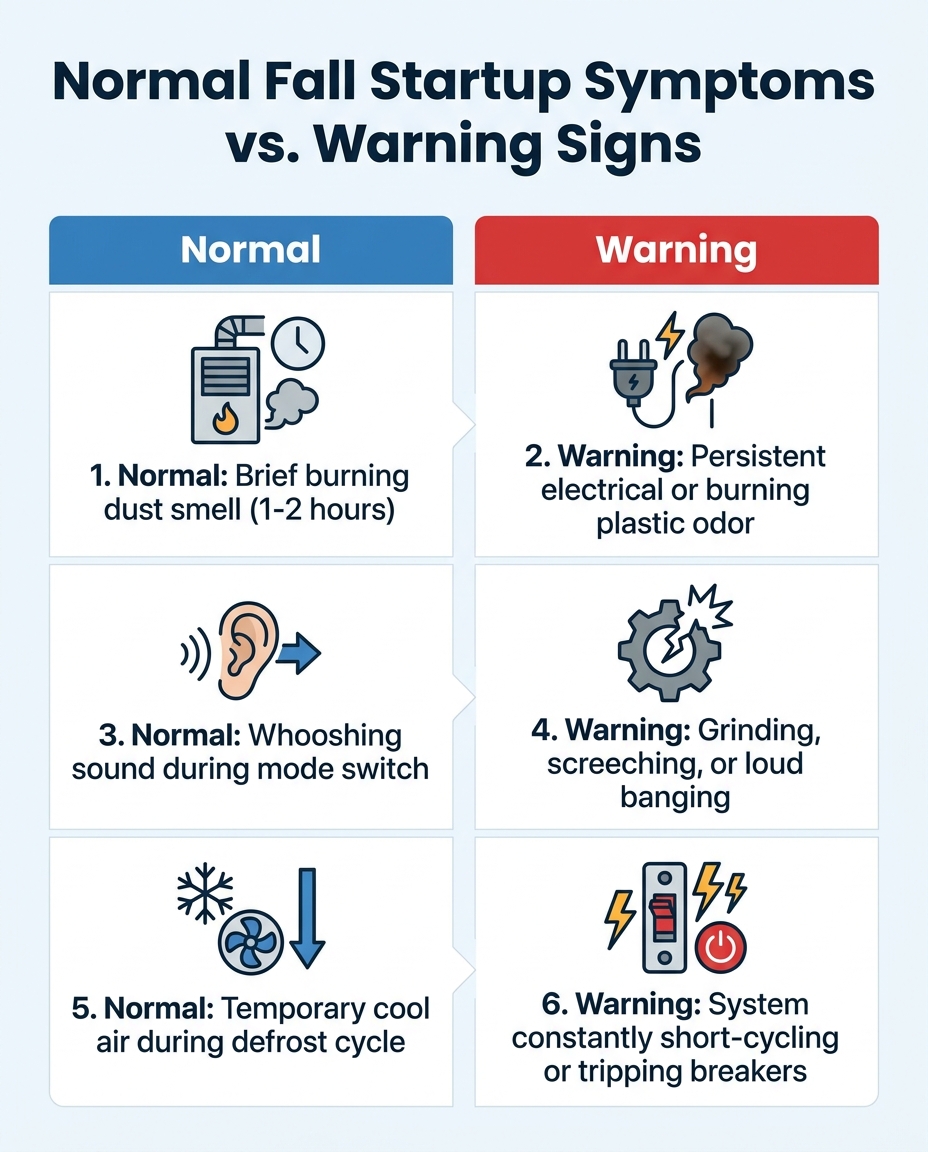
One of the most alarming experiences during an October heating startup is the sudden, distinct smell of burning emanating from the air vents. Fortunately, in the vast majority of cases, this odor is entirely harmless and expected.
Throughout the long, demanding cooling season, airborne dust, pet dander, and microscopic debris naturally settle onto the internal components of your HVAC system. This accumulation heavily coats the heat exchangers and the electric auxiliary heat strips located inside the indoor air handler. Because these components remain cold or dormant all summer, the dust sits undisturbed.
When you finally switch the thermostat to heat, those metal surfaces and internal heating elements rapidly reach very high temperatures. The accumulated dust instantly vaporizes or "burns off." This process creates a noticeable, somewhat smoky odor that quickly circulates through your ductwork and into your living spaces. In coastal and humid regions, the high indoor humidity mixing with the first-time use of heat strips can actually exacerbate these initial odors, making them smell heavier or more pungent.
To help you distinguish between a harmless seasonal transition and a dangerous electrical issue, review this comparison of common startup odors:
• Burning Dust / Musty — Common Cause: Accumulated debris burning off heat strips or exchangers. — Expected Duration: 1 to 2 hours during the first few heating cycles. — Required Action: Monitor the system. Open windows if necessary.
• Dirty Sock / Damp Mildew — Common Cause: Bacterial growth on the indoor evaporator coil. — Expected Duration: Persists whenever the system runs. — Required Action: Schedule a professional coil cleaning.
• Burning Plastic / Electrical — Common Cause: Melting wire insulation or a failing blower motor. — Expected Duration: Continuous; often worsens as the system runs. — Required Action: Shut the system down immediately at the thermostat.
Normal dust burn-off odors typically dissipate completely within the first few hours of operation. If you are already wondering is your heat pump not cooling enough for 100-degree days during the summer, a heavily soiled indoor coil might be to blame—and that same soil will produce stronger smells in the fall. If a burning smell persists beyond 24 hours, or if it smells sharply of melting plastic, it indicates a serious mechanical problem that requires immediate attention.
Clicking, Humming, and Defrost Cycles: Decoding System Noises
A heat pump is a complex machine with dozens of moving parts, and its sequence of operations involves several distinct sounds. Knowing what to listen for during your October heating startup prevents unnecessary panic and helps you identify true mechanical anomalies.
When your thermostat signals the need for heat, you will typically hear a sharp "click" from the indoor unit or the wall thermostat itself. This is the sound of electrical relays and contactors engaging to close the circuit. Shortly after, a low, steady humming noise begins as the outdoor compressor ramps up and the blower motor starts pushing air. These clicks and hums are the normal heartbeat of your HVAC system.
Conversely, loud banging, continuous metal-on-metal grinding, or high-pitched screeching are never normal. A screeching sound often points to a failing blower motor bearing or a damaged fan belt, while a loud banging noise could indicate a loose internal component or a compressor struggling against high pressure. If you hear these aggressive sounds, the safest course of action is an immediate system shutdown.
Understanding the Defrost Cycle
Even in mild fall weather, specific atmospheric conditions can trigger a heat pump's built-in protective mode: the defrost cycle. When outdoor temperatures drop into the 40s or 50s while humidity remains high, moisture in the air can freeze onto the outdoor unit's copper coils. If left unchecked, this frost turns into a solid block of ice, choking off airflow and potentially destroying the compressor.
To prevent this, the heat pump control board periodically initiates a defrost cycle. You will notice the outdoor fan motor suddenly stop spinning, while the compressor continues to run loudly. Inside the home, you might temporarily feel cool air blowing from your vents. This happens because the system has essentially switched back into air conditioning mode to send hot refrigerant outdoors and melt the ice. Once the frost is cleared, the system seamlessly switches back to heating your home. This temporary burst of cool air is entirely by design and is not a sign of a broken heater.

Safe Homeowner Checks: Filters, Airflow, and Thermostats
When troubleshooting a heating system, it is vital to establish strict, safety-first boundaries. There are several safe, highly effective checks a homeowner can perform to restore comfort without crossing the line into unlicensed, dangerous DIY repair.
Before assuming your system has suffered a major breakdown, run through this baseline operational checklist:
• Verify thermostat settings: Ensure the thermostat is explicitly set to "Heat" rather than "Auto" or "Cool." Confirm that the target temperature is set at least three to five degrees higher than the current ambient room temperature to trigger the ignition sequence.
• Inspect and replace air filters: A clogged, dirty air filter is the leading cause of poor heating performance in Conroe TX. Restricted airflow causes the internal components to overheat, which triggers safety limit switches that shut the entire system down. This rapid on-and-off behavior is known as short-cycling. Replace your filter with a clean one to restore proper static pressure.
• Check indoor air vents: Walk through every room in your home and verify that the supply and return registers are fully open and unobstructed. Blocking vents with heavy furniture, rugs, or drapes chokes the system's airflow and forces the blower motor to work significantly harder.
• Clear the outdoor unit: Fall brings falling leaves, twigs, and windblown debris. Inspect your outdoor heat pump cabinet and carefully clear away any organic material resting against the metal fins. The unit requires at least two feet of clear clearance on all sides to pull in enough air for the heating cycle to function efficiently.
If you have completed these fundamental checks and the system still refuses to operate correctly, you have exhausted the safe troubleshooting steps. Opening the equipment cabinet, testing capacitors, or handling refrigerant lines is extremely dangerous and strictly prohibited without proper licensing.
When to Call a Professional: Hard Boundaries for Troubleshooting
While proactive maintenance is always encouraged, knowing exactly when to stop and call for help is the most important part of responsible homeownership. Electrical work, refrigerant handling, and internal mechanical repairs require a licensed professional with specialized diagnostic tools.
Certain symptoms represent hard boundaries where professional intervention is non-negotiable. If you experience a persistent burning smell that lasts longer than 24 hours, if your system repeatedly trips the circuit breaker at the main electrical panel, or if the unit completely fails to ignite despite a clear thermostat call, you must schedule a diagnostic visit. Continuing to force a malfunctioning system to run will only cause cascading damage to the compressor or blower motor.
Working with a veteran-owned HVAC company provides a distinct advantage in these situations. The military instills a culture of discipline, accountability, and unwavering honesty. When you call for a diagnostic, you receive a no-nonsense, technically accurate assessment of your equipment rather than a high-pressure sales pitch. You get the facts about what is broken, what can be repaired, and what safety limits have been compromised.
Real-world experience proves the value of immediate professional action. For example, one local homeowner experienced a complete heating failure late at night during a severe winter cold snap. Because they recognized the warning signs and called a professional immediately rather than attempting a dangerous DIY fix, technicians were able to respond, diagnose the failure, and work around the clock to get the heater running safely within the hour.
In cases where an older system has suffered a catastrophic failure—such as a grounded compressor or a cracked heat exchanger—repair may no longer be viable. If a full replacement is necessary, keep in mind that generic federal tax credits or local utility rebates may apply to qualifying high-efficiency heat pump upgrades. These programs can help offset the initial investment, though you should always verify current eligibility requirements with a qualified tax professional or your utility provider.
Frequently Asked Questions About Fall Heat Pump Operation
Why does my heater smell like burning dust when I turn it on?
The smell is caused by the sudden vaporization of dust and debris that settled on your internal heating components over the summer. When the heat exchangers and electric auxiliary heat strips heat up for the first time in months, this accumulated dust literally burns off. The resulting odor is circulated through your ductwork. While it can be startling, it is a completely normal part of the fall transition and poses no fire risk to your home.
How long should a furnace smell when first turned on?
A normal burning dust odor should dissipate entirely within the first one to two hours of active heating operation. Once the initial layer of debris has burned away, the air should return to smelling clean and neutral. If the smell persists for more than 24 hours, or if it changes from a dusty smell to a sharp, acrid electrical odor, shut the system off immediately and call a professional.
What noises are normal for a heat pump in fall?
Normal operating noises include a sharp click when the thermostat engages, a steady hum from the outdoor compressor, and the rushing sound of air moving through your ductwork. You may also hear a distinct "whoosh" when the reversing valve changes the system from cooling to heating mode. Banging, grinding, or high-pitched squealing noises are abnormal and indicate mechanical distress.
Why is my heat pump making a whooshing sound?
The whooshing sound is the equalization of refrigerant pressure as the reversing valve shifts positions. Because heat pumps in mild climates often switch between cooling during the day and heating at night, this valve activates frequently in the fall. The brief hissing or whooshing noise confirms that the internal solenoid has successfully redirected the flow of refrigerant gas.
How do I know if my heat pump is broken or just starting up?
A healthy system starting up may produce a brief dusty smell, a few clicks, and a steady hum before delivering warm air within ten to fifteen minutes. A broken system will exhibit red flags: blowing continuously cold air for hours, tripping electrical breakers, making violent metal-on-metal noises, or failing to turn on the outdoor fan. If basic checks like replacing the air filter do not resolve the issue, the system requires a professional diagnostic.
When should I call a professional for heating issues?
You should call a professional whenever your system exhibits symptoms that go beyond basic airflow restrictions. Immediate triggers include persistent electrical odors, a completely unresponsive thermostat, a frozen outdoor coil that fails to defrost, or repeated breaker trips. Never attempt to open the equipment cabinet, handle internal wiring, or check refrigerant pressures yourself, as these tasks require specialized licensing and safety training.
Securing Reliable Comfort for the Heating Season
Understanding the normal sequence of operations for your HVAC system brings invaluable peace of mind during seasonal transitions. By learning to distinguish between a harmless burning dust smell during your October heating startup and a genuine mechanical warning sign, you can protect your equipment and keep your home safe.
Addressing minor warning signs early prevents them from escalating into emergency breakdowns on the coldest nights of the year. The most effective way to ensure your system operates flawlessly all winter is through proactive, structured care. Enrolling in a comprehensive HVAC maintenance plan guarantees that a licensed professional inspects, cleans, and calibrates your equipment before the heavy winter workload begins, securing reliable comfort for your family all season long.