
The Hidden Risks of Fall Heating in Texas Homes
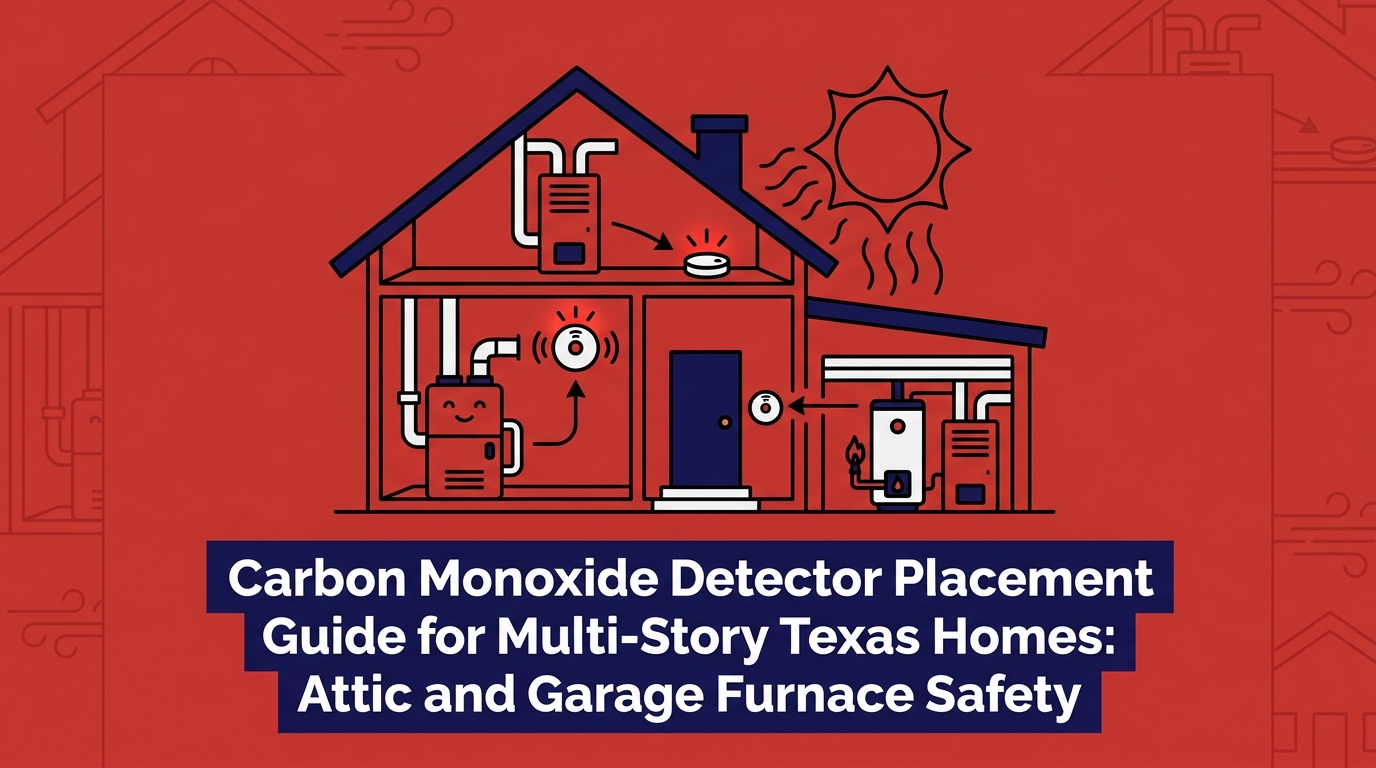
The September pre-heating season is just weeks away, which means your dormant gas furnace is about to fire up for the first time in months. At Carl's Quality Cooling and Heating LLC, we know that if you are preparing your house for cooler weather, this Carbon Monoxide Detector Placement Guide for Multi-Story Texas Homes will help you navigate the unique layout challenges of local architecture. Before the first cold front arrives, homeowners face a critical decision point: determining exactly where to install carbon monoxide (CO) alarms relative to sleeping areas, multi-level stairwells, and the physical location of their heating equipment.
If you need assistance ensuring your system is ready for the seasonal shift, our professional heating services team can verify that your equipment is operating cleanly and safely before the temperatures drop.
Why National Safety Advice Often Misses the Mark
When our technicians inspect homes across Conroe, we often find that generic safety guidelines assume a traditional northern home layout. They advise placing detectors near the basement stairs because that is where the majority of the country keeps their gas furnaces. However, as we see every day in the field, local homes are built differently. We do not have basements to isolate heating equipment from the main living areas. Instead, your gas furnace is likely positioned either directly above your bedroom in the attic or right next to your kitchen in the attached garage.
This architectural reality completely changes how carbon monoxide might enter and travel through your home. A leak originating from an attic unit behaves very differently than a leak seeping through a garage wall. Understanding these distinct travel paths is the only way to ensure your detectors provide maximum early warning without triggering constant false alarms.
How Slab Foundations Change Furnace Locations
In our years of maintaining residential systems, we've seen firsthand how the prevalence of slab foundations in our region eliminates the basement as a viable location for heavy HVAC equipment. Builders must find alternative spaces to house the indoor air handler and the gas furnace assembly. This typically leaves two options: attic-mounted vs. garage-mounted gas furnaces. The physical location of this equipment dictates the origin point of any potential combustion gas leak.
When a system is installed in the attic, the furnace sits directly above the top-floor ceiling. The gas lines, the heat exchanger, and the exhaust flue are all positioned overhead. Conversely, a garage-mounted system places the combustion process on the ground floor, often sharing a common wall with the main living space. Both setups require entirely different safety strategies.
Comparing Furnace Locations and CO Risks
• Attic-Mounted — Primary CO Origin Point: Overhead, above ceiling joists — Immediate Risk Zone: Top-floor bedrooms and hallways — Detector Priority Area: High on walls near attic access
• Garage-Mounted — Primary CO Origin Point: Ground level, adjacent to house — Immediate Risk Zone: Shared interior walls and entryways — Detector Priority Area: Indoor hallway, 10 feet from garage door
Because these systems are integrated directly into the home's primary airflow network, any malfunction can quickly compromise the air you breathe. Ensuring proper ventilation, sealed ductwork, and strategic detector placement is a core component of our comprehensive indoor air quality services. A leak doesn't just stay in the attic or the garage; it follows the path of least resistance right into your living areas.
Tracking Carbon Monoxide in Multi-Story Layouts
Our team frequently reminds Conroe homeowners that to position your alarms correctly, you have to understand the physics of how this gas moves through multi-story homes. A pattern we see often is the dangerous myth that carbon monoxide is heavy and sinks to the floor, leading some people to plug detectors into low wall outlets. In reality, carbon monoxide is slightly lighter than air. It has a molar mass of 28, while standard indoor air is roughly 28.9. Because the difference is so small, CO mixes evenly with the ambient air rather than stratifying at the floor or the ceiling.
The Stairwell Chimney Effect
In a two-story home, the central stairwell acts like a natural chimney. Warm air rises, creating gentle updrafts that can carry carbon monoxide from a lower level—such as a garage or a ground-floor utility closet—straight up to the second-floor bedrooms. This means a leak originating on the first floor can easily trigger an alarm on the second floor before a ground-level detector even registers a high concentration.
How Your Ductwork Distributes Gas
Your central HVAC system is designed to pull air in through the return vents, condition it, and blow it back out through the supply registers. If a heat exchanger cracks, the blower motor can actively push carbon monoxide through the ductwork, distributing it evenly across every room in the house simultaneously. This forced distribution makes it incredibly important to recognize the early signs of a carbon monoxide leak, such as sudden headaches, dizziness, or condensation on the inside of your windows, long before the concentration gets high enough to sound the alarm.
Detector Placement Rules for Attic-Mounted Furnaces
When our technicians service attic-mounted vs. garage-mounted gas furnaces, we stress that the overhead configuration requires a specific defensive setup. If the furnace is in the attic, the primary risk zone is the top floor of the house. Any exhaust leak or cracked heat exchanger will release gas directly above the upper-level sleeping areas.
Follow these exact steps to secure the second floor:
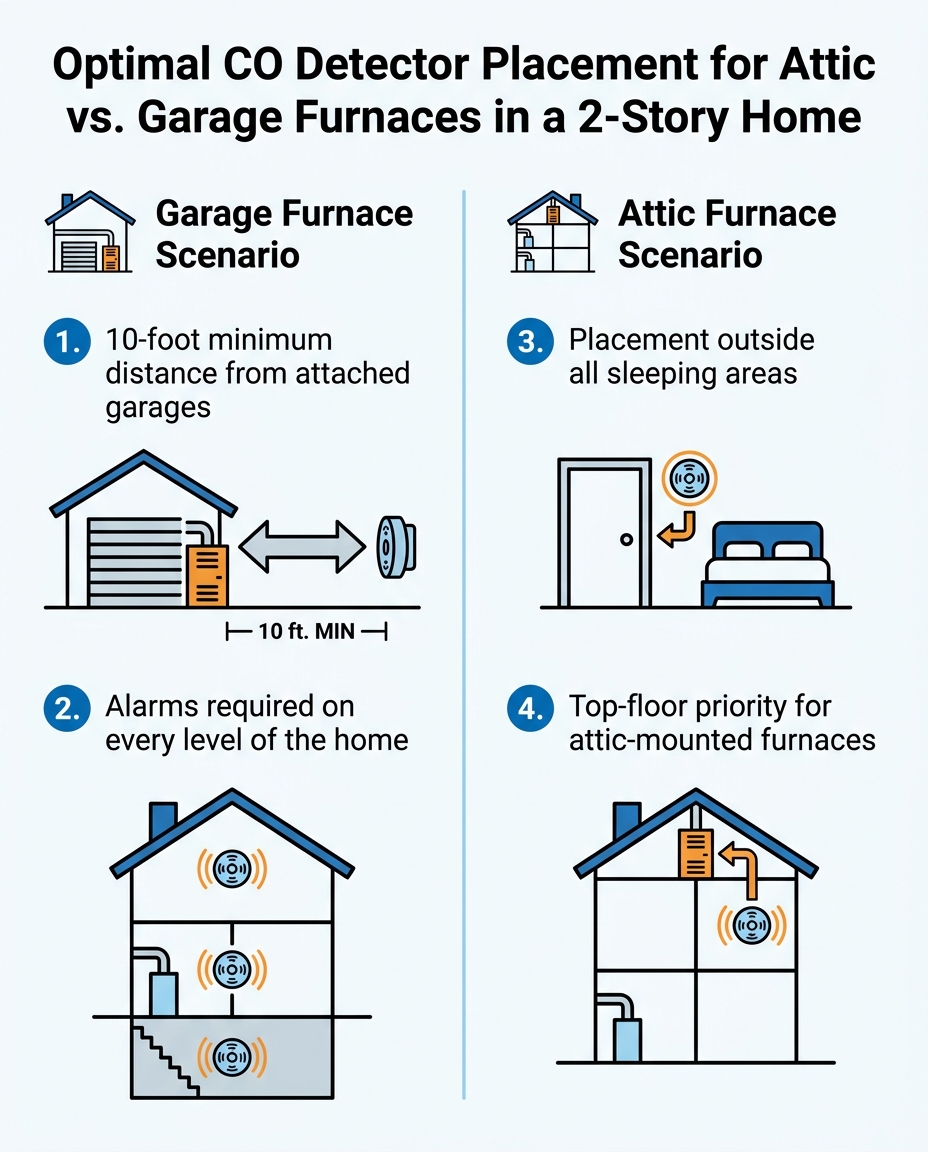
1. Target the attic access point: Install the first detector in the hallway directly adjacent to the attic drop-down stairs or access panel. If gas seeps down through the unsealed gaps around the attic door, this unit will catch it immediately.
2. Protect the sleeping areas: Place a detector in the hallway outside every separate sleeping area. The alarm must be loud enough to wake a sleeping adult through a solid, closed bedroom door.
3. Add units inside bedrooms for extra safety: If you sleep with the doors closed, placing an additional detector inside each bedroom ensures the alarm is heard immediately.
4. Avoid dead air spaces: Never install a detector at the very peak of a vaulted ceiling or in the sharp corner where the wall meets the ceiling. These areas trap "dead air" that does not circulate, meaning carbon monoxide might bypass the sensor entirely. Mount units at least six inches away from corners and ceiling peaks.
5. Keep away from bathroom humidity: Do not place detectors within three feet of a full bathroom. The heavy steam and humidity from a hot shower can interfere with the electrochemical sensor and trigger false alarms.
Safeguarding Against Garage-Mounted Systems
Through our extensive work across the area, we know that homes with garage-mounted furnaces face a different set of challenges. The garage is a high-risk zone not just because of the furnace, but because of vehicle exhaust. If you start your car and let it run for even a few seconds before backing out, a massive plume of carbon monoxide is released. You must balance the need for early furnace leak detection with the need to prevent constant false alarms from your vehicle.
Follow these steps to protect the shared boundary between the garage and the main house:
1. Apply the 10-foot rule: Never place a carbon monoxide detector inside the garage itself, and never place one directly next to the interior door leading to the garage. Install the detector in the indoor hallway at least 10 feet away from the garage entry door. This distance allows momentary vehicle exhaust to dissipate before it hits the sensor.
2. Secure the shared wall: If you have a bedroom located directly above or adjacent to the attached garage, place a detector inside that specific bedroom. Gas can seep through unsealed drywall joints or floorboards over time.
3. Seal the threshold: The physical barrier between the garage and the house is your first line of defense. Ensure the door connecting the garage to the living space has a tight-fitting bottom sweep and intact weatherstripping around the frame. A well-sealed door forces any leaked gas to vent outward rather than seeping inside.
4. Monitor ground-floor living areas: Place an additional detector in the main ground-floor living area (like a living room or den) to catch any gas that drifts away from the garage entry and settles into the spaces where your family spends the most time.

Meeting Texas Property Code and NFPA 720 Standards
Proper placement is not just about common sense; it is a legal and regulatory requirement. The Texas Property Code mandates that carbon monoxide alarms must be installed in all dwellings that contain fossil-fuel burning appliances (like a gas furnace, gas water heater, or gas stove) or have an attached garage. Because Conroe, TX multi-story homes almost always feature one or both of these elements, compliance is strictly required.
Furthermore, the National Fire Protection Association (NFPA) sets the gold standard for safety through the NFPA 720 guidelines. These regulations remove the guesswork from detector placement by establishing hard rules for residential properties.
• Every level requirement: An alarm must be installed on every level of the home, including basements (if applicable). For a standard two-story slab home, this means you need at least one unit downstairs and one unit upstairs.
• Sleeping area proximity: Alarms must be placed outside each separate sleeping area in the immediate vicinity of the bedrooms.
• Interconnected systems: For multi-story layouts, the NFPA highly recommends interconnected alarms. If a leak originates from a garage-mounted furnace on the ground floor in the middle of the night, a localized downstairs alarm might not be loud enough to wake someone sleeping on the second floor. Interconnected alarms solve this by sounding simultaneously; if the downstairs unit detects gas, the upstairs unit immediately sounds the alarm as well.
Pre-Season Inspections and Addressing Dormant Furnaces
The highest risk period for a carbon monoxide leak occurs during the September pre-heating season. Throughout the long, hot summer, your gas furnace sits completely dormant. Dust settles on the burners, spiders build webs in the flues, and metal components expand and contract with the attic heat. When the first sudden cold snap hits and the thermostat calls for heat, the system is forced to ignite after months of inactivity. If a heat exchanger developed a hairline crack over the summer, that initial ignition can push carbon monoxide straight into the home.
We see the reality of mild but fluctuating Texas winters every year. Homeowners may only run their heaters intermittently, but when the temperature suddenly drops, the equipment has to work flawlessly. For instance, one local homeowner reached out to Carl's Quality Cooling and Heating LLC during a sudden winter freeze when their heater failed at 10 p.m., leaving the house dangerously cold. Because our technicians worked around the clock, the system was diagnosed, repaired, and safely running within an hour. That level of rapid, precise response is exactly what you need when dealing with combustion appliances.
As a veteran-owned and family-run business, our team brings military discipline to every inspection. We look beyond basic code compliance because your family's safety is our actual mission. Detectors are a fantastic secondary safety net, but they should never be your primary defense. A rigorously inspected, clean-burning furnace is the only way to stop a leak before it starts. Enrolling in a comprehensive HVAC maintenance plan ensures that a professional inspects the heat exchanger, tests the gas pressure, and clears the exhaust flues long before you ever need to turn the heat on.
The pre-season safety checklist:
• Test monthly: Press the test button on every CO detector in your home on the first of every month.
• Replace batteries: Swap out the batteries at least once a year, ideally when you schedule your fall furnace tune-up.
• Check expiration dates: Carbon monoxide detectors do not last forever. The internal sensors degrade over time. Most units expire 5 to 7 years after the manufacturing date printed on the back of the device. If yours are out of date, replace the entire unit immediately.
Frequently Asked Questions
Do you need a carbon monoxide detector if your furnace is in the attic?
Yes, you absolutely need a carbon monoxide detector if your gas furnace is located in the attic. An attic-mounted furnace still burns fossil fuels and produces carbon monoxide gas. If the heat exchanger cracks or the exhaust flue comes loose, the blower motor can push that toxic gas straight down through the ceiling vents and into your living spaces.
How many carbon monoxide detectors do I need in a 2 story house?
You need a minimum of one carbon monoxide detector on every level of the home, including the ground floor and the second floor. Additionally, you must place a detector in the hallway outside of every separate sleeping area. If the bedrooms are spread out across opposite ends of the second floor, you will need a separate detector for each hallway zone.
Where is the best place to put a carbon monoxide detector?
The best place to put a carbon monoxide detector is in the hallway directly outside of your bedrooms, ensuring the alarm will wake you up at night. For homes with attached garages, another ideal spot is the indoor hallway about 10 feet away from the garage entry door. Always keep detectors away from humid bathrooms, drafty windows, and the immediate proximity of gas appliances to prevent false alarms.
Should carbon monoxide detectors be placed high or low on the wall?
Carbon monoxide detectors can be placed at any height because the gas mixes evenly with indoor air rather than sinking to the floor or rising straight to the ceiling. You can plug them into a standard low wall outlet or mount them high on the wall near eye level. The most important factor is placing them near sleeping areas and avoiding dead air spaces in the sharp corners of vaulted ceilings.
Can a garage-mounted furnace cause a carbon monoxide leak in the house?
Yes, a garage-mounted gas furnace can cause a carbon monoxide leak inside the main house. If the furnace malfunctions, the gas can seep through unsealed drywall joints, shared interior walls, or the gaps around the door connecting the garage to the living room. Proper weatherstripping and strategic detector placement are required to catch these leaks early.
What are the early symptoms of carbon monoxide poisoning?
The early symptoms of carbon monoxide poisoning closely mimic the flu, but without a fever. You may experience dull headaches, dizziness, weakness, nausea, confusion, and shortness of breath. If multiple family members or pets start experiencing these symptoms at the same time while inside the house, evacuate immediately and call emergency services.
Secure Your Home for the Heating Season
Don't wait for a cold snap to test the safety of your multi-story layout. By following clear, localized guidance on exactly where to place CO detectors near specific attic and garage setups, you ensure your family is protected. Schedule your pre-season inspection with our team today to keep your home safe, warm, and ready for winter.