


Why August Heat Exposes Hidden Ductwork Failures
As August brings a brutal, lingering heat to Conroe that pushes your cooling system to its absolute limits, prioritizing end-of-summer duct inspections: finding leaks before the winter chill becomes essential. You might notice your air conditioner running for hours on end as the kids head back to school, yet the living room still feels warm, sticky, and uncomfortable. If your AC is struggling against the late-summer extreme heat, the root problem might not be the mechanical unit sitting outside your home. Often, the true culprit is a network of undetected duct leaks spilling precious, expensively cooled air straight into a scorching attic. Addressing this now is a highly proactive move for your home's comfort and efficiency.
Maintaining airtight ducts is a core component of comprehensive indoor air quality services. Many proactive homeowners choose to bundle these diagnostic checks into a seasonal HVAC maintenance plan to stay ahead of the changing weather.
The attic environment is hostile: During late summer, the space right above your ceiling turns into an oven. When your ductwork has failed joints, disconnected seams, or deteriorating tape, the cold air meant for your bedroom never actually makes it there. Instead, it cools the underside of your roof. This creates a massive amount of unnecessary strain on your entire HVAC system, forcing it to run continuously just to maintain a baseline temperature.
The diagnostic advantage: Most homeowners don't realize that this extreme weather actually creates the perfect environment for diagnosing system failures. When the temperature outside is mild, a small duct leak is incredibly difficult to detect. But when the heat is at its peak, the massive contrast between the air inside the ducts and the air in the attic makes escaping air obvious to a trained professional. By acting now, you use the harsh Texas weather to your advantage, pinpointing vulnerabilities before the season shifts and the diagnostic window closes.
The Physics of Temperature Differentials in Conroe Attics
To understand why late summer is the ideal time to check your system, you have to look at the physics of your home. The extreme conditions above your ceiling create a unique thermal dynamic that simply does not exist during the milder months of spring or late fall.
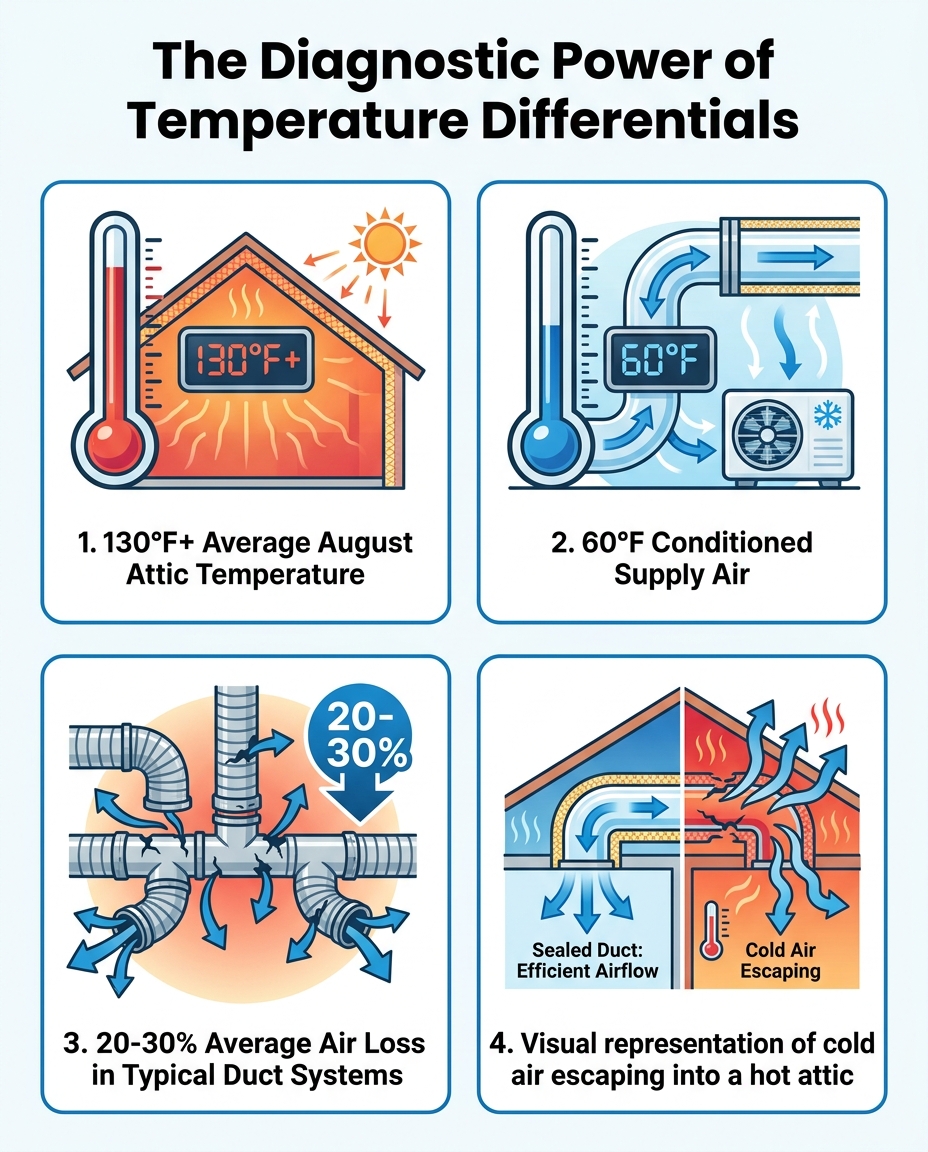
When you have 130-degree attic temperatures vs 60-degree supply air moving through your ductwork, you are dealing with a 70-degree temperature differential. This massive contrast turns a miserable attic into a highly effective diagnostic laboratory. In our years of crawling through Conroe attics, our team at Carl's Quality Cooling and Heating LLC has seen firsthand exactly how this physical reaction exposes compromised ductwork:
1. The Thermal Clash: When 60-degree conditioned air blasts out of a leak into a 130-degree space, the temperature collision is immediate. A technician sweeping the ductwork can physically feel this dramatic drop in temperature inches away from a failed seam, making even pinhole leaks easy to locate.
2. Condensation Markers: Extreme heat mixed with escaping cold air often produces condensation. Moisture forms on the outside of the ductwork or the surrounding insulation, leaving a visible water trail or dark spot that points directly to the breach.
3. Thermal Imaging Signatures: Professionals often use infrared cameras to inspect ductwork. In a sweltering attic, a plume of cold air shows up as a bright, distinct color contrast on the camera screen, allowing technicians to spot leaks that are hidden behind trusses or buried under blown-in insulation.
4. The Closing Window: As autumn approaches and attic temperatures begin to drop, this massive temperature differential shrinks. A leak that is glaringly obvious in August becomes nearly invisible by November, meaning you could head into the heating season with compromised ducts that are much harder to diagnose.
How Heat Highlights Escaping Air
The thermal dynamics of your home dictate how efficiently your system operates. Ductwork is designed to be a completely sealed highway for conditioned air. However, in our experience, the materials used to seal these highways—mastic, foil tape, and zip ties—expand and contract with the wild temperature swings in a Texas attic. Over the years, this constant expansion and contraction causes adhesives to dry out and joints to pull apart.
Because sensory and thermal detection is heightened during peak August temperatures, our technicians strongly recommend a thorough inspection right now to catch the exact points where this thermal degradation has occurred. It takes the guesswork out of the equation. Instead of wondering why a specific room is always hot, our professionals can physically trace the escaping cold air back to the exact failure point.

Identifying the Warning Signs of Compromised Air Ducts
While it takes a professional to navigate a boiling attic and pinpoint the exact location of a leak, your home will usually give you warning signs down in the living space. Recognizing these early symptoms can save your primary cooling equipment from unnecessary wear and tear.
Just last late summer, our team responded to a local homeowner who scheduled an AC service appointment during the back-to-school transition because their system simply wasn't cooling the house properly. They assumed the compressor was failing. However, our thorough inspection revealed that the outdoor unit was fine—the root cause was massive air loss in the ductwork. After we provided an honest assessment and recommendations, they had the leaks sealed, and the house quickly returned to a comfortable temperature without needing a major equipment replacement.
If you want to catch these issues early, look for these common indoor symptoms:
• Uneven cooling between rooms: If your living room feels like a refrigerator but the primary bedroom feels like a sauna, your ducts are likely failing to deliver balanced airflow.
• Excessive dust accumulation: Leaky return ducts act like a vacuum, sucking dust, fiberglass, and insulation particles from the attic and blowing them directly into your living space. If you find yourself dusting constantly, your ducts might be compromised.
• Spikes in indoor humidity: When conditioned air escapes into the attic, the resulting pressure imbalance can pull hot, humid outdoor air into your home through gaps around windows and doors, making the air feel heavy and clammy.
• Whistling or rattling noises: Air escaping through a narrow gap in a duct seam can create a high-pitched whistling sound, while disconnected metal ducts may rattle against the ceiling joists when the blower motor kicks on.
By learning to spot the signs of AC ductwork problems, you can call for a professional assessment before a minor leak turns into a major efficiency drain.
When Your AC Works Overtime
The symptom of continuous running is one of the most reliable indicators of physical air loss. When your thermostat is set to 72 degrees, but 30 percent of that cold air is leaking into the attic, the thermostat never registers that the target temperature has been reached. As a result, it tells the system to keep running.
This puts an incredible amount of strain on your blower motor and compressor. These components are designed to cycle on and off, resting between cooling phases. When they are forced to run continuously against the August late-summer extreme heat, their internal components run hotter, friction increases, and their overall lifespan drops significantly.
The Hidden Energy Costs of Waiting for Winter
Ignoring compromised ductwork doesn't just make your home uncomfortable; it quietly drains your wallet month after month. The financial and efficiency impacts of duct leaks are staggering, especially when you consider the transition toward the upcoming heating season.
According to ENERGY STAR, in a typical house, about 20 to 30 percent of the air that moves through the duct system is lost due to leaks, holes, and poorly connected joints. That means for every unit of energy you pay for to cool or heat your home, nearly a third of it is entirely wasted. During the peak demand on the Texas energy grid in late summer, this inefficiency not only drives up your utility bills but also contributes to grid instability.
Financial incentives for efficiency: Because grid strain is such a critical issue, improving your home's thermal envelope is highly encouraged. In many cases, generic Texas energy rebates for HVAC upgrades and weatherization programs may apply to duct efficiency improvements. It is always a smart move to check with your local utility provider to see what incentives are currently available for sealing and insulating your ductwork.
Preventing Winter Heat Loss
As the intense heat of August fades, it is easy to forget about your HVAC system. But unsealed ducts will waste warm air just as easily as they waste cold air once the furnace kicks on.
• Sealed Ductwork — Summer Impact (Cooling Season): Maximum cold air delivery; lower humidity; shorter cooling cycles. — Winter Impact (Heating Season): Consistent warmth delivered to all rooms; efficient furnace operation.
• Leaky Supply Ducts — Summer Impact (Cooling Season): Cold air lost to the attic; AC runs continuously to compensate. — Winter Impact (Heating Season): Heated air lost to the attic; furnace struggles to warm the living space.
• Leaky Return Ducts — Summer Impact (Cooling Season): Pulls 130-degree attic air and humidity into the cooling system. — Winter Impact (Heating Season): Pulls freezing attic air into the heat exchanger, drastically lowering efficiency.
If you wait until November to address a duct issue, you miss the optimal diagnostic window and risk paying to heat your attic all winter long. Sealing the system now ensures you are fully prepared for the seasonal shift.
Military Precision in High-Heat Attic Diagnostics
Inspecting ductwork in an enclosed space where temperatures exceed 130 degrees is grueling, exhausting work. It is not a job for someone looking to cut corners. It requires a high level of discipline, focus, and a methodical approach to ensure the entire network is evaluated correctly.
Applying military standards: As a veteran-owned, family-run business, we understand that true integrity means doing the hard work right, even when the conditions are miserable. We apply military precision to every attic inspection. When dealing with 130-degree attic temperatures vs 60-degree supply air, our technicians don't just poke their heads through the attic access hatch and guess.
We trace the entire duct network step-by-step. We evaluate every joint, every seam, and every plenum connection. We check the integrity of the mastic sealant, inspect the condition of the foil tape, and ensure that the flexible ducting hasn't been crushed or kinked. This no-stone-unturned methodology guarantees that we find the exact source of your air loss.
Once the inspection is complete, we believe in total transparency. You receive a clear, honest report of our findings, detailing exactly what is happening in your attic and what steps are necessary to secure your system. No high-pressure tactics—just straightforward, reliable diagnostics.
Protecting System Health and Indoor Air Quality
While temperature control and energy efficiency are the most immediate concerns, the state of your ductwork also plays a massive role in the long-term health of your HVAC equipment and the people living inside your home. Duct leaks are a two-way street. While supply leaks push conditioned air out, return leaks pull unconditioned air in.
The dangers of negative pressure: When a return duct has a hole or a disconnected seam, it creates negative pressure. This vacuum effect can pull attic dust, degrading fiberglass insulation particles, pest droppings, and intense humidity directly into your HVAC system. From there, it is bypassed around your air filter and blown straight into your living space, drastically reducing your indoor air quality.
Furthermore, pulling heavy, humid air from the attic into the cold, dark environment of your ductwork is a recipe for moisture problems. Ensuring clean ducts reduce mold risk by preventing this excess moisture buildup from taking hold inside your system.
Solving these vulnerabilities during routine preventative checks stops them from evolving into major, expensive system failures. For example, one homeowner relying on twice-yearly check-ups caught a significant system vulnerability during a routine spring maintenance visit. Because the technician identified and solved the issue early, they prevented expensive future repairs and ensured the system's longevity. Catching duct leaks during the August late-summer extreme heat provides that exact same level of proactive protection.
Securing Your Ductwork Before the Season Shifts
The transition from the blistering heat of summer to the crisp chill of winter is fast approaching. Right now, during the peak temperature differential between your 130-degree attic temperatures vs 60-degree supply air, is the absolute best time to find and seal hidden leaks.
Don't wait for the weather to break. Once the attic cools down, the diagnostic advantage disappears, making it much harder to locate the pinhole leaks and failing seams that are costing you money. Having a professional secure your ductwork now ensures that your system doesn't waste energy cooling the neighborhood in August, or heating the attic in December.
Take control of your home's thermal envelope. Schedule a thorough, military-precision inspection today to ensure your family remains comfortable, your air remains clean, and your HVAC system operates at peak efficiency year-round.
Frequently Asked Questions
How do professionals find leaks in ductwork?
Professionals find leaks by combining sensory checks, thermal imaging, and pressure testing. In late summer, technicians can physically feel the cold air escaping into a hot attic, and they use infrared cameras to spot the distinct thermal signatures of hidden leaks behind insulation.
Why is my AC running constantly in August?
Your AC is likely running constantly because a significant portion of your conditioned air is escaping through duct leaks before it reaches your living space. When this cold air is lost to the attic, your thermostat never reaches its target temperature, forcing the system to run continuously to compensate.
Is professional duct sealing worth the investment?
Yes, professional duct sealing is highly beneficial for both comfort and energy efficiency. By stopping the 20 to 30 percent air loss typical in compromised systems, you lower your monthly utility bills, reduce strain on your HVAC equipment, and improve your indoor air quality.
How much energy is lost through leaky attic ducts?
According to ENERGY STAR, homes can lose between 20 and 30 percent of the air moving through their duct system due to leaks, holes, and poor connections. This massive energy loss forces your system to work significantly harder, driving up costs and accelerating wear and tear.
Can extreme attic heat actually damage my ductwork?
Yes, extreme heat can degrade the materials used to seal your ducts. The constant expansion and contraction caused by wild temperature swings in a Texas attic can cause adhesives to dry out, tape to peel, and joints to eventually pull apart over time.
When is the best time of year to inspect air ducts in Texas?
Late summer is actually the best time for a duct inspection because of the extreme temperature differential. The massive contrast between the hot attic and the cold supply air makes finding leaks incredibly obvious to a trained technician before the weather cools down.