
Are Heat Pumps Ideal for Hot Humid Climates? Here's What You Need to Know
Are heat pumps ideal for hot humid climates — and the short answer is yes. Modern heat pumps are built to handle both high temperatures and heavy moisture loads, making them one of the most effective whole-home comfort solutions available for regions like Texas, Florida, and Louisiana.
Here is a quick breakdown of why heat pumps work well in hot, humid conditions:
| Factor | Heat Pump Performance in Humid Climates |
|---|---|
| Cooling ability | Matches traditional central AC using the same refrigerant cycle |
| Humidity removal | Often better than standard AC due to longer, steadier run cycles |
| Extreme heat | Modern inverter units maintain capacity up to 115°F |
| Efficiency | Typically 30-40% more efficient in cooling mode than traditional AC |
| Dual function | Handles both cooling and mild winter heating in one system |
| Mold/mildew risk | Reduced when indoor humidity stays below 50% |
Most homeowners in hot, humid areas already know what sticky, clammy air feels like — even when the thermostat reads exactly where you set it. That uncomfortable, damp feeling is not a temperature problem. It is a moisture problem. And that is precisely where heat pumps have a real edge.
Unlike a basic air conditioner that only runs in on-off bursts, a modern variable-speed heat pump runs at lower, steadier speeds for longer periods. This extended runtime pulls more moisture out of the air, not just heat. The result is a home that feels genuinely comfortable — not just technically cool.
High-efficiency heat pumps also achieve SEER2 ratings between 14 and 22, and many are ENERGY STAR certified, which means they meet strict performance standards for climates where the cooling season runs long and hard. For homeowners in Montgomery County and the greater Houston area, where summer humidity regularly pushes comfort to its limits, that kind of consistent, moisture-managing performance matters every single day.
Are heat pumps ideal for hot humid climates?
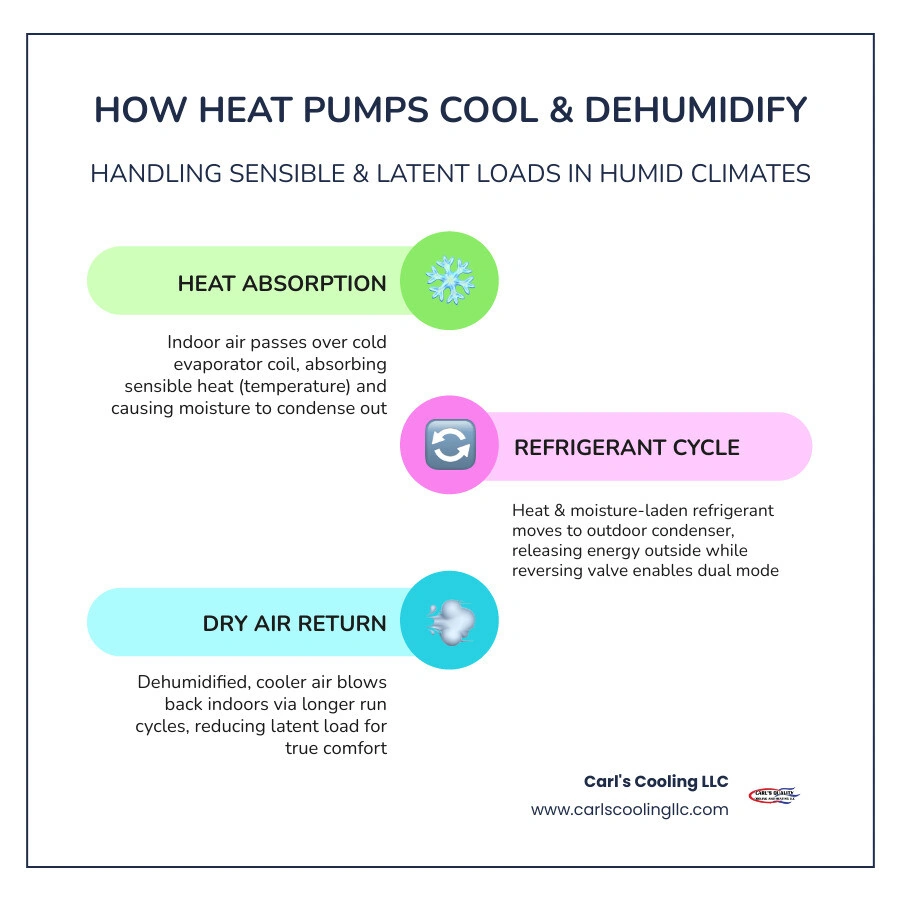
In cooling mode, a heat pump works almost exactly like a central air conditioner. It pulls heat from indoor air, moves it outside through refrigerant, and sends cooler air back into your home. The big difference is that a heat pump can reverse that process for heating when cooler weather shows up.
For humid climates, the key point is this: comfort depends on both sensible heat and latent heat. Sensible heat is temperature. Latent heat is moisture in the air. If your system only drops the temperature quickly but does not run long enough to remove moisture, your home can feel cold and clammy at the same time. That is a special kind of annoying.
Modern heat pumps help solve that problem through better control. Many use inverter-driven compressors, variable-speed blowers, and humidity-focused settings that let the system match the load instead of blasting at full power and shutting off too soon. That is why they can deliver better whole-home comfort in places like Conroe, Montgomery, Tomball, The Woodlands, Spring, and Houston.
How a heat pump cools just like an air conditioner
The cooling process is familiar HVAC physics:
- The indoor evaporator coil absorbs heat from the air
- Moisture in the air condenses on that cold coil
- The refrigerant carries heat to the outdoor unit
- The outdoor condenser releases that heat outside
- The reversing valve allows the system to switch between cooling and heating modes
That moisture condensation step matters a lot in humid weather. Every minute the system runs, water is being removed from indoor air and drained away through the condensate system.
Why humid homes need moisture control, not just lower temperature
A humid home can feel uncomfortable even when the thermostat looks fine. Why?
- High indoor humidity makes air feel sticky
- Rooms can feel muggy or heavy
- Bedding, carpet, and furniture can feel damp
- Mold and mildew risk goes up once humidity stays too high
- Homeowners often lower the thermostat further just to feel better
That last point is expensive and frustrating. If humidity is controlled properly, many people feel comfortable at a slightly higher thermostat setting. The U.S. Department of Energy commonly recommends 78 degrees Fahrenheit in summer as a balance between comfort and efficiency, but that feels a lot more realistic when the air is actually dry enough indoors.
Are heat pumps ideal for hot humid climates in places like Texas and the Gulf Coast?
Yes, especially modern systems designed for long cooling seasons. Research consistently shows that heat pumps can cool efficiently well above 86 degrees Fahrenheit, and many newer inverter systems are built to maintain performance through heat waves above 95 degrees Fahrenheit and even up to 115 degrees Fahrenheit.
For our service areas around greater Houston and Montgomery County, that matters. We are not dealing with a few warm weekends. We are dealing with extended stretches of heat, humidity, hot attics, and ductwork under stress. In that environment, a properly selected heat pump is not a compromise. It is often the smart fit.
Summer performance: cooling power, humidity control, and extreme heat
Homeowners usually ask the same practical question: will it actually keep the house comfortable in July and August? Fair question.
The answer is yes, if the system is correctly sized, properly installed, and built for humidity control.
Do heat pumps work effectively for cooling in hot, humid climates?
Yes. In cooling mode, they are air conditioners. The difference is how modern heat pumps control output. Instead of running full blast, shutting off, and repeating, variable-speed models can operate at partial capacity for longer periods. That steady run time is exactly what helps with humidity removal.
In hot, humid climates, that means:
- Fewer temperature swings
- More consistent comfort
- Better moisture removal
- Less chance of that damp feeling indoors
Can heat pumps handle extreme heat and high humidity levels typical of hot climates?
Yes, modern models can. But not all equipment is equal.
For hot-weather performance, look for:
- Inverter-driven or variable-speed compressor technology
- Strong SEER2 ratings
- Solid EER2 performance for steady high-temperature operation
- A matched indoor and outdoor system
- Proper airflow and duct design
The matched-system point is important. Even a great outdoor unit will underperform if paired with the wrong indoor coil, poor ductwork, or incorrect blower settings.
How well do heat pumps dehumidify in humid homes?
Often very well when the system is selected and set up correctly.
That is because good humidity control usually comes from longer, lower-speed cycles. A variable-speed heat pump can keep air moving across a cold coil long enough to remove more moisture without overcooling the house. Some models also include a dry mode or humidity-control setting.
That said, dehumidification still depends on setup. An oversized system can short-cycle and leave the house cold and clammy. So the answer is not just "buy a heat pump." It is "buy the right heat pump and install it correctly."
What features matter most in a heat pump for humid weather
A heat pump for Southeast Texas should be selected for moisture control, efficiency, and durability, not just raw cooling output.
The best efficiency ratings and technology to look for
Start with the basics:
- SEER2 of 14.3 or higher at minimum
- SEER2 16+ if you want high efficiency for long cooling seasons
- Good EER2 performance for hot-day operation
- ENERGY STAR certification where applicable
- Variable-speed or inverter compressor
- Variable-speed indoor fan
- Humidity or dry mode controls
- Smart thermostat compatibility
Variable-speed technology is especially valuable in humid climates because it acts more like cruise control than an on-off switch. It adjusts output to match the load, which improves comfort and moisture removal. For a deeper look at efficiency features, see our guide to an energy-efficient heat pump.
Why proper sizing matters more than raw tonnage
Bigger is not better in humid climates. Bigger is often just faster at making your house uncomfortable in a different way.
A proper Manual J load calculation is the right way to size a system. That calculation considers more than square footage. It also looks at insulation, windows, sun exposure, air leakage, occupancy, and more.
Oversized systems tend to:
- Reach the thermostat setting too quickly
- Shut off before removing enough moisture
- Short-cycle and wear components faster
- Leave rooms feeling cool but damp
Undersized systems have the opposite problem: they can run constantly and still struggle on the hottest days.
Ducted vs ductless heat pumps for problem rooms and older homes
Ducted heat pumps work well for whole-home comfort when the duct system is in good condition. But ductless mini-splits can be excellent for:
- Additions
- Bonus rooms
- Older homes
- Upstairs rooms that stay hot
- Areas with poor airflow
- Homes where duct losses are a concern
Leaky ducts can waste up to 30% of system energy in hot climates. If ducts run through a hot attic, the losses can be even more painful. Ductless systems avoid that issue entirely in the spaces they serve.
Coastal and high-moisture durability considerations
While our primary service area is inland, high moisture is still a major factor. For humid conditions, it helps to look for:
- Corrosion-resistant coil protection
- Reliable condensate drainage design
- Outdoor unit clearance from plants and debris
- Installation that allows easy service access
- Protection from standing water and heavy storm runoff
Common problems in humid conditions and how to prevent them
Humidity does not just affect comfort. It also adds strain to the system.
Why a heat pump can feel damp even when the thermostat says the temperature is right
This usually comes down to poor latent heat removal. The thermostat only tells you temperature. It does not tell you whether the air feels dry and comfortable.
Common causes include:
- Oversized equipment
- Short run cycles
- Incorrect blower speed
- Dirty filter restricting airflow
- Dirty coil
- Humidity load from air leaks or duct leaks
If this sounds familiar, learn more about heat pump performance issues.
The most common humid-weather issues: icing, airflow loss, and drainage problems
Even in summer, a heat pump can ice up. Strange, but true. Usually that points to one of a few issues:
- Dirty air filter
- Blocked return or supply vents
- Low refrigerant
- Dirty evaporator coil
- Blower problems
- Pressure imbalance
- Clogged condensate drain
Warning signs include:
- Weak airflow
- Higher power bills
- Musty or mildew smells
- Warm air from vents
- Ice on indoor components or refrigerant lines
- Water around the indoor unit
If your system is not cooling the way it should, humid weather can make those problems show up fast.
Maintenance steps that protect summer performance
Regular maintenance matters even more in humid climates because the system works harder and moisture creates more opportunities for buildup and drainage trouble.
A practical maintenance checklist includes:
- Change filters every 1 to 3 months, or more often if needed
- Keep supply and return vents open and unblocked
- Clear leaves, dirt, and plants away from the outdoor unit
- Clean coils as needed
- Inspect the condensate drain and pan
- Check thermostat settings and schedules
- Keep doors and windows closed while cooling
- Watch for unusual sounds, smells, or bill spikes
- Schedule professional service in spring and fall
For more seasonal guidance, see this HVAC maintenance checklist for the hot humid Gulf Coast, these heat pump maintenance tips for Conroe, TX, and why heat pump service matters.
Why installation quality can make or break a heat pump in humid climates
A premium heat pump installed poorly will not act premium for long.
Installation quality affects:
- Refrigerant charge
- Airflow
- Blower configuration
- Duct sealing
- Condensate drainage slope
- Equipment matching
- Thermostat calibration
In humid climates, small setup mistakes can create big comfort problems. Oversized equipment, leaky ducts, poor drain design, or incorrect fan settings can all reduce moisture removal. For more on that process, read our heat pump installation guide for Conroe.
Real-world results in hot, humid regions homeowners care about
What homeowners in Florida and Louisiana can expect
While those states are outside our service area, they are useful climate examples because they face long, humid cooling seasons similar to the Gulf Coast pattern. Research shows outdoor humidity can push extremely high in summer, and that makes moisture removal just as important as temperature control.
The big takeaways are:
- Long run seasons reward efficient equipment
- Variable-speed systems improve indoor comfort
- Lower indoor humidity can help reduce mold risk
- Duct leakage can seriously hurt performance
- Mild winters also make heat pumps attractive year-round
Why Houston-area homes are a strong fit for modern heat pumps
This is where the conversation gets local. In Houston, Conroe, Magnolia, Montgomery, Spring, Klein, Tomball, Humble, and surrounding communities, we deal with:
- Long cooling seasons
- Heavy humidity
- Hot attics
- Duct losses
- Homes with uneven room temperatures
- Frequent short-cycling complaints from oversized systems
That makes modern variable-speed heat pumps a strong fit. They are built for long, steady operation, which is exactly what helps with humidity control. In homes where the old system blasts cold air for a few minutes and quits, a properly sized heat pump often delivers much steadier comfort.
What Ontario examples show about are heat pumps ideal for hot humid climates
Ontario may not sound like the first place to look for humid cooling examples, but summer data there still helps answer the question. Modern heat pumps have been shown to maintain stable indoor temperatures during 30 degrees Celsius plus summer weather while running at partial capacity. That matters because it shows the technology is not struggling in hot weather. It is modulating.
For homeowners here in Southeast Texas, that is encouraging. If a modern system can maintain steady cooling in warm summer conditions elsewhere, it can absolutely be part of a successful humidity-control strategy here when selected and installed correctly.
How insulation, air sealing, and duct condition affect results
Even the best heat pump cannot fully overcome a leaky house.
Research suggests:
- Around 90% of homes are under-insulated
- Air leaks can waste 15% to 45% of heating and cooling energy
- Duct leakage can waste up to 30% of system energy
That is why we look at the whole comfort system, not just the outdoor unit. If the home has attic duct leakage, major air leaks, blocked returns, or insulation gaps, the HVAC system has to fight uphill all summer.
Helpful related reading:
Frequently Asked Questions About Are Heat Pumps Ideal for Hot Humid Climates?
Will a heat pump cool my whole home on the hottest days?
Yes, if it is properly sized for the home and installed with the right airflow and duct design. A Manual J load calculation is the best way to determine that. Variable-capacity systems are especially good at handling changing loads across the day.
Is a heat pump better than my current AC if humidity is the main problem?
It often can be, especially if your current system is older, single-stage, oversized, or poor at controlling moisture. A variable-speed heat pump can run longer at lower output, which usually improves comfort and helps the house feel drier.
How often should a heat pump be serviced in a humid climate?
We recommend professional service twice a year, typically in spring and fall. Filters may need attention much more often depending on use and indoor conditions. Condensate components, coils, and airflow should be checked regularly in humid regions.
For more maintenance guidance, visit this heat pump maintenance company page for The Woodlands, TX and the best Woodlands, TX heat pump maintenance guide.
Conclusion
So, are heat pumps ideal for hot humid climates? Yes. For homeowners across Conroe, Montgomery, Houston, Tomball, The Woodlands, Spring, Magnolia, Willis, and nearby communities, a modern heat pump can be an excellent choice for cooling performance, humidity control, and year-round efficiency.
The real secret is not just choosing a heat pump. It is choosing the right system, sizing it correctly, installing it carefully, and maintaining it consistently. When those pieces come together, a heat pump can keep your home cooler, drier, and far more comfortable during our long Southeast Texas summers.
If you are thinking about your next upgrade, explore heat pump installation in Tomball, TX.