
Unexplained Headaches During the First Fall Cold Snap
When you turn on your furnace for the first time this season and immediately develop a nagging headache, you might be experiencing low-level carbon monoxide exposure: symptoms homeowners often mistake for the flu. At Carl's Quality Cooling and Heating LLC, our technicians frequently visit Conroe homes during the September pre-heating season where families report feeling sluggish, slightly nauseous, or unusually tired inside their own houses. Because these symptoms align perfectly with the onset of seasonal fall bugs, it is incredibly easy to brush them off as a simple virus.
To make sure your home is actually safe and your heating system is running properly, you need expert heating services to evaluate the equipment before the deep cold sets in.
Many homeowners assume they are completely safe from carbon monoxide simply because their standard ceiling alarms have not triggered. This creates a dangerous false sense of security. Store-bought alarms are designed to alert you to immediate, life-threatening emergencies, not the slow, chronic leaks that cause daily discomfort. When you experience unexplained physical symptoms that only seem to happen indoors, you must look beyond your standard alarms. Recognizing the necessity of professional evaluation for hidden, low-level threats is the first step in protecting your household during the early fall transition.
The 'Leave the House' Test: Differentiating the Symptoms
Understanding the physiological subtleties between a viral illness and low-level carbon monoxide poisoning can save you weeks of discomfort. Carbon monoxide is an invisible, odorless gas that aggressively binds to the hemoglobin in your blood—actually attaching itself 200 times faster than oxygen does. When this happens, your brain and muscles are slowly starved of oxygen, which triggers persistent fatigue, mild nausea, and dull headaches. Because these are the exact same physical responses your body has to a passing virus, the root cause often goes undetected.
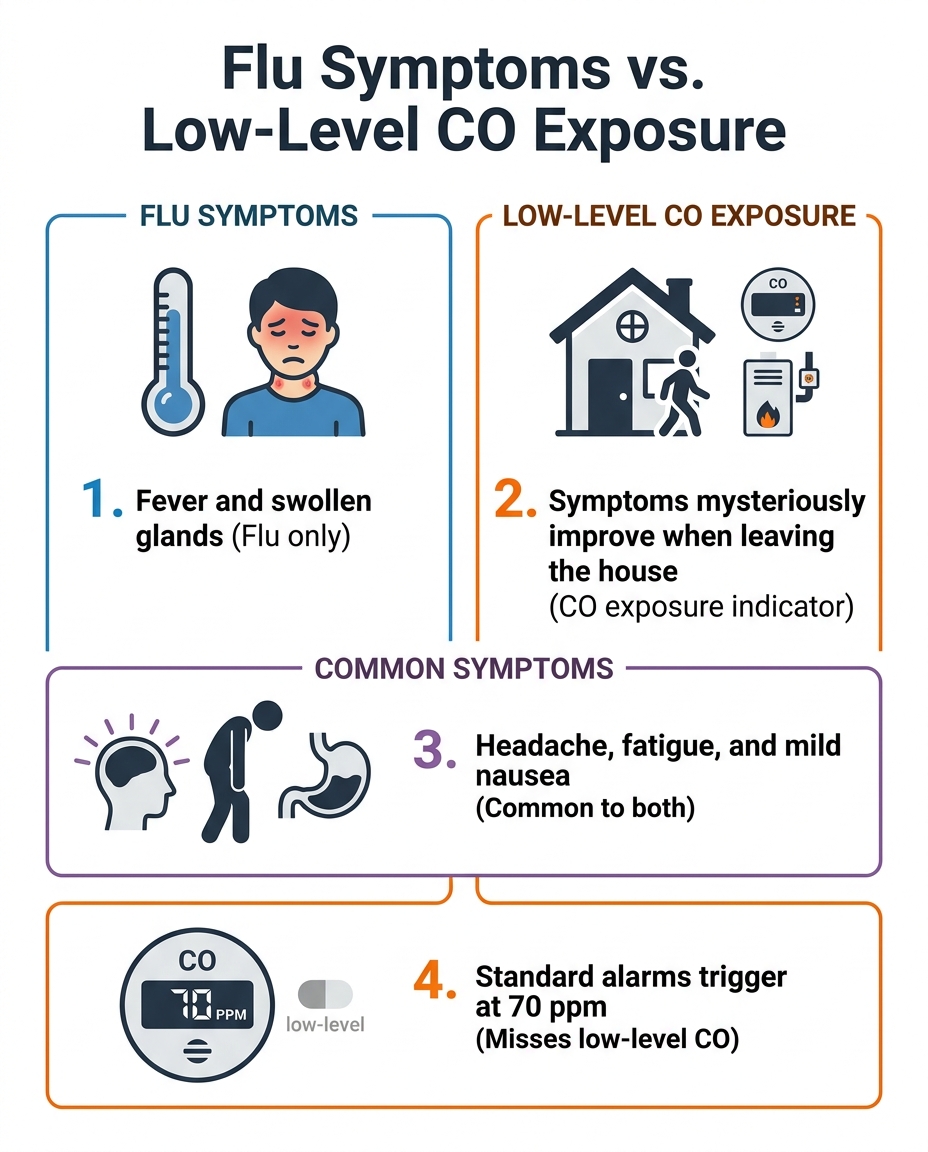
However, there are critical differences you can look for. Flu viruses and common colds typically cause fevers, swollen lymph nodes, and a persistent cough. Carbon monoxide exposure never causes a fever. If your forehead is cool but your head is pounding, you need to consider your environment.
The most effective way to differentiate these symptoms without medical equipment is the "leave the house" test. Pay close attention to how your body feels when you change locations. If your symptoms mysteriously improve when you leave the home for work or errands, and then slowly return upon re-entry, that is a major red flag. Chronic low-level exposure causes symptoms that are directly tied to your environment.
• Fever and Chills — Seasonal Flu or Virus: Very common — Low-Level Carbon Monoxide Exposure: Never occurs
• Swollen Glands — Seasonal Flu or Virus: Common — Low-Level Carbon Monoxide Exposure: Never occurs
• Headache and Fatigue — Seasonal Flu or Virus: Common — Low-Level Carbon Monoxide Exposure: Very common (often dull and persistent)
• The "Leave the House" Test — Seasonal Flu or Virus: Symptoms remain regardless of location — Low-Level Carbon Monoxide Exposure: Symptoms improve outdoors, worsen indoors
• Onset Timing — Seasonal Flu or Virus: Gradual over a few days — Low-Level Carbon Monoxide Exposure: Often aligns with turning on the heating system
Dismissing these signs during the September pre-heating season can lead to weeks of unnecessary suffering. By paying attention to exactly when and where you feel sick, you can identify a potential gas leak before it escalates into a severe emergency.

Why Your Standard Carbon Monoxide Detector Remains Silent
If you are feeling sick from carbon monoxide, you might naturally wonder why the detector in your hallway is completely silent. The answer lies in how these devices are manufactured and regulated. The hardware store alarms most people install in their homes are built to the UL 2034 standard. These are strictly life-safety devices. They are specifically designed to ignore chronic lower levels of gas in order to prevent nuisance alarms from minor, temporary sources like a burning candle or a briefly opened oven door.
Because these alarms are built to prevent acute fatalities rather than chronic illness, they have very high activation thresholds. A standard UL 2034 alarm will not sound until the concentration of carbon monoxide reaches 70 parts per million (ppm) for a sustained period of 60 to 240 minutes. This leaves families completely exposed to lower concentrations that can still cause severe daily headaches and fatigue. While passing a basic ceiling alarm test is good news, it absolutely does not mean the indoor air is safe from chronic exposure. If you suspect your alarm is missing a larger issue, you should familiarize yourself with the signs of a severe carbon monoxide leak.
Understanding PPM (Parts Per Million)
To understand the gap in your home's protection, it helps to understand how we measure this gas. PPM stands for "parts per million." It is a way of measuring the concentration of one gas within the broader air mixture. For context, the natural, unpolluted air outside your home typically contains less than 0.1 ppm of carbon monoxide.
When we look at low-level PPM thresholds vs. standard ceiling alarm triggers, the danger becomes clear. While your store-bought alarm waits for the air to hit 70 ppm before making a sound, chronic health impacts begin much lower. Medical professionals and indoor air quality experts note that long-term exposure to levels as low as 10 to 30 ppm can cause adverse health effects, particularly in children, the elderly, and those with respiratory issues. True low-level carbon monoxide monitors—which are often installed by HVAC professionals—can detect and display concentrations as low as 5 to 9 ppm, giving you real-time awareness of your indoor air quality long before you start feeling sick.
Dormant Heat Exchangers and the September Furnace Startup
The timing of these mysterious flu-like symptoms is rarely a coincidence. The mechanical cause of most residential carbon monoxide leaks is directly tied to the seasonal timing and the local climate. In our years of servicing HVAC systems across Conroe TX, our team typically sees a familiar pattern: we experience relatively mild winters but are frequently hit with unpredictable, sudden cold snaps. Because of this climate pattern, heating systems often sit entirely dormant for eight to nine months out of the year.
During this long period of inactivity, dust settles, moisture can cause microscopic rust, and the metal components of your furnace remain cold. When a sudden cold snap arrives, homeowners immediately turn their thermostats up. This places a massive, sudden demand on the heating system. The most critical component inside your furnace is the heat exchanger—a metal shield that separates the toxic combustion gases of the burner from the clean air that gets blown into your living room.
The mechanical failure: When a dormant, cold heat exchanger is suddenly blasted with intense heat, the metal rapidly expands. If the metal is aged, rusted, or compromised, this sudden expansion can cause microscopic cracks to open up. As the blower fan pushes air over the cracked heat exchanger, it pulls carbon monoxide out of the combustion chamber and distributes it through your ductwork. Because these cracks are often tiny at first, they release just enough gas to cause headaches, but not enough to trigger a standard 70 ppm ceiling alarm.
The critical safety warning: If you suspect your furnace is venting exhaust into your home, turn it off immediately and open your windows. Never attempt DIY furnace or flue repairs. Diagnosing and repairing a cracked heat exchanger or a compromised ventilation flue requires specialized training, specialized tools, and a licensed professional. Tampering with gas appliances on your own can easily turn a minor low-level leak into a fatal, high-level emergency.
Protecting Your Home's Indoor Air Quality from Invisible Threats
The conversation around carbon monoxide safety is ultimately a conversation about the overall health of your home's environment. Modern homes are built with tight construction techniques to maximize energy efficiency. We use thick weatherstripping, spray foam insulation, and double-pane windows to keep our expensive conditioned air inside. While this is fantastic for your utility bills, it inadvertently traps low-level carbon monoxide, volatile organic compounds (VOCs), and other microscopic pollutants indoors.
In older, draftier homes, a minor heat exchanger leak might have been mitigated by the natural flow of fresh air seeping through window frames. Today, a tight home acts like a sealed thermos. If a pollutant is introduced into the air stream, it stays there, circulating endlessly through your ductwork every time the blower fan turns on.
Because of this, comprehensive indoor air quality strategies must go beyond basic fiberglass air filters. A standard filter only catches physical particulates like dust and pet dander; it does absolutely nothing to stop a gas like carbon monoxide. To truly protect your family during the September pre-heating season and beyond, you need a holistic approach that includes active gas monitoring, proper ventilation, and routine equipment inspections. Exploring professional indoor air quality solutions can help you integrate low-level monitors and fresh air ventilators into your existing HVAC system, ensuring that your tightly sealed home remains a healthy place to breathe.
Mission-First Safety: Why Preventative Inspections Matter
When dealing with invisible threats, you need more than just a repairman—you need a preventative safety inspector. Thorough professional inspections catch minor heat exchanger leaks and venting issues long before they become chronic health hazards. A highly trained technician does not just look at the furnace; they analyze the complete combustion process.
As a veteran-owned company, Carl's Quality Cooling and Heating LLC brings a mission-first approach to safety. Our team applies a strict standard of discipline and accountability to every inspection. Our professionals do not rely on the basic UL 2034 alarms sold at the hardware store. Instead, we use high-sensitivity, specialized electronic combustion analyzers. These handheld computers are inserted directly into the exhaust flue to measure exactly how much carbon monoxide the system is producing, down to a single part per million. If a heat exchanger has even a hairline crack, this military-grade precision equipment will detect the subtle changes in pressure and gas concentration.
This rigorous approach to safety ensures that your family is protected during unexpected temperature drops. For example, one Conroe TX homeowner reached out to us late at night during a harsh winter cold snap when their heater unexpectedly shut down at 10 p.m. Because of our rapid, disciplined response, a technician arrived quickly, diagnosed the safety fault, and got the heater safely up and running within the hour. That level of dedicated, rapid response guarantees that your heating system is not just operational, but operating safely without venting dangerous gases into your living space.
Frequently Asked Questions About Carbon Monoxide and Heating
Does carbon monoxide poisoning feel like a cold or flu?
Yes, low-level carbon monoxide exposure closely mimics the symptoms of a cold or the flu. You will likely experience a dull, persistent headache, unexplained fatigue, mild nausea, and general sluggishness. The primary difference is that a virus will often cause a fever and swollen lymph nodes, whereas carbon monoxide exposure never causes a fever. If your symptoms magically improve when you leave the house and return when you come back inside, gas exposure is highly likely.
Why didn't my carbon monoxide alarm go off?
Your store-bought carbon monoxide alarm likely didn't go off because it is designed only to detect life-threatening spikes in gas. Standard UL 2034 alarms are programmed to remain silent until concentrations reach 70 parts per million for over an hour. This intentionally high threshold prevents nuisance alarms from minor, harmless events, but it unfortunately leaves you vulnerable to chronic, low-level leaks that cause headaches and fatigue without triggering the siren.What are the symptoms of low-level CO exposure?
The most common symptoms of low-level CO exposure include a persistent dull headache, dizziness, physical weakness, nausea, and confusion. Because these levels are not immediately lethal, the symptoms can drag on for weeks or months, often worsening when the heating system is running frequently. Over time, chronic exposure can lead to more severe neurological issues, memory problems, and increased strain on the heart as the body struggles to oxygenate its tissues.
Can a standard carbon monoxide detector detect low levels?
No, a standard carbon monoxide detector cannot alert you to low levels of the gas. While the internal sensor may register lower amounts, the device's programming strictly prevents the siren from sounding at levels below 70 ppm to comply with UL life-safety standards. To detect and be alerted to concentrations in the 5 to 30 ppm range, you must install a specialized low-level carbon monoxide monitor, which is typically sourced through HVAC or air quality professionals.
How do professionals test for low-level carbon monoxide?
HVAC professionals test for low-level carbon monoxide using highly sensitive, calibrated electronic combustion analyzers. Instead of just testing the ambient air in the hallway, technicians insert the probe of the analyzer directly into the furnace's exhaust flue and near the heat exchanger. This allows them to measure the exact parts per million of gas being produced and detect microscopic leaks in the metal long before the gas reaches the living areas of your home.
Ensuring a Safe Start to the Heating Season
As the September pre-heating season arrives, it is vital that you do not ignore persistent fall bugs if they only seem to occur while you are inside the house. Trusting professional detection and preventative maintenance over basic ceiling alarms is the smartest way to protect your household from invisible threats. Take proactive steps to secure your peace of mind before the deep winter cold sets in.
By scheduling an annual HVAC maintenance plan, you ensure one of our licensed professionals thoroughly inspects your heat exchanger and tests your system's venting. This proactive care provides the clear, non-alarmist answers you need, guaranteeing your home remains a safe, comfortable, and healthy environment all season long.