


The Frustration of Waiting for Critical HVAC Replacements
Sourcing Replacement HVAC Parts Quickly in the Greater Houston Area is often the biggest hurdle standing between a freezing house and restored comfort when a furnace fails. You walk to the thermostat during the first chill of the early fall pre-heating season, expecting warm air to circulate. Instead, the system remains silent, or worse, pushes out cold air. After our team at Carl's Quality Cooling and Heating LLC diagnoses the issue, you hear the words no homeowner wants to hear: a proprietary furnace control board has failed, and the replacement part will take days to arrive. This scenario plays out thousands of times every year, leaving residents frustrated and searching for answers about why modern supply chains cannot deliver immediate relief.
Whether you need comprehensive air conditioning services or emergency heating replacement and repair, understanding how the local supply chain operates can help you plan proactively and avoid days of discomfort.
The contrast between waiting for a specialized component and a standard repair can be jarring. If a standard universal part fails, our technicians can often pull a replacement straight from their service vehicle and restore operation in under an hour. However, highly specific proprietary parts require a much longer logistical chain. In our years of experience serving Conroe and the Greater Houston Area, we see how unpredictable winter cold snaps turn a minor shipping delay into a major indoor comfort issue. A house can lose its retained heat rapidly, making even a three-day wait feel like an eternity. Understanding the regional supply chain logistics explains why these delays happen and highlights exactly how homeowners can protect themselves through better timing.
When Comfort Can't Wait
The immediate impact: The moment a heating system goes offline, the indoor environment begins to equalize with the outdoor temperature. During a severe cold front, structural heat loss happens quickly, especially in homes with older insulation or extensive window coverage. This immediate drop in temperature makes the timeline for replacement parts a critical concern for household safety and comfort.
Varying timelines: The timeline for heating replacement and repair varies wildly based on the exact part needed to restore functionality. A standard flame sensor might take twenty minutes to clean or replace, while an OEM (Original Equipment Manufacturer) variable-speed blower motor might require authorization, specialized ordering, and cross-country freight shipping. This massive variance in repair times is entirely dependent on the engineering of your specific unit and the availability of components within the local supply network.
Universal vs. Proprietary Parts: What's Actually on the Truck?
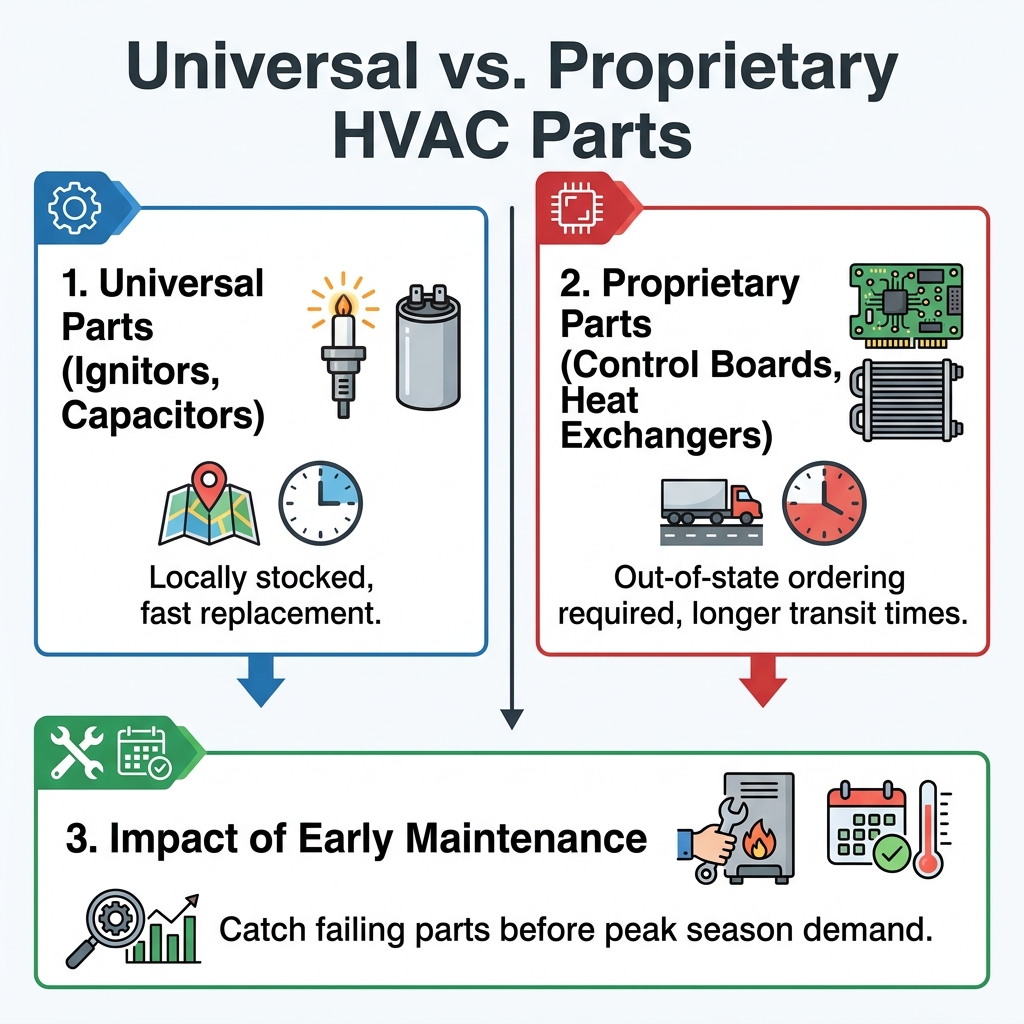
To understand why some repairs happen instantly while others stall, you have to look at the difference between universal components and proprietary parts. Universal HVAC parts are highly standardized components designed to work across dozens of different brands and models. These include items like standard ignitors, dual run capacitors, contactors, and basic transformers. Because they are universally applicable, they are heavily stocked in regional supply houses and carried on our fully stocked service trucks at Carl's Quality Cooling and Heating LLC.
Proprietary components, on the other hand, are engineered specifically for one brand, one model line, or even one specific generation of equipment. These include complex furnace control boards, uniquely shaped heat exchangers, and OEM-specific communicating motors. Because these parts are highly specialized and expensive to warehouse, local supply houses cannot realistically stock every variation. Instead, they must be ordered directly from out-of-state distribution centers, which introduces unavoidable transit times into the repair process.
If you are troubleshooting an AC fan that isn't working, the solution might be a universal capacitor that takes minutes to replace. If the issue stems from a proprietary communicating control board, the logistical process becomes much more complicated.

Locally Stocked Essentials
Common universal parts: The majority of routine breakdowns are resolved using locally stocked essentials. When a system fails to ignite, a standard hot surface ignitor is frequently the culprit. When an outdoor unit hums but fails to spin, a universal capacitor is usually to blame. These standard parts allow for same-day resolutions in a large percentage of service calls, providing immediate relief during extreme weather.
The advantage of standardization: Technicians rely on these standardized components to keep their first-time fix rates high. Regional supply houses in the Conroe and Greater Houston Area maintain massive inventories of these universal items, ensuring that our service fleet can restock daily without waiting on freight deliveries.
The OEM Sourcing Process
Matching exact specifications: Certain complex components must match the manufacturer's exact specifications to function safely and efficiently. Modern HVAC systems rely on integrated circuit boards that communicate specific fan speeds, staging times, and safety lockouts. A generic board cannot replicate these precise engineering parameters, making an OEM replacement mandatory.
Logistical steps required: Sourcing an OEM part involves multiple logistical steps. First, our technician must verify the exact model and serial number of the unit. Next, we contact the manufacturer's regional distributor to check national inventory levels. The part is then ordered, processed, and shipped from a central warehouse—often located states away. Once it arrives at the local supply house, our team retrieves it before returning to the home for installation.
Why Being a Logistics Hub Doesn't Guarantee Same-Day Sourcing
It is a common source of confusion for homeowners: the Conroe and Greater Houston Area is recognized globally as a major transit, shipping, and logistics hub. With massive ports, major interstate intersections, and massive regional warehouses, it seems counterintuitive that a small furnace control board could take three to five days to arrive. However, regional infrastructure does not dictate where HVAC manufacturers choose to base their specialized operations.
Despite the robust local infrastructure, many major HVAC manufacturers base their specialized distribution centers and manufacturing plants in the Midwest or along the East Coast. When a proprietary heat exchanger or specialized control board is required, it must physically travel from these distant locations. Supply chain realities dictate that even expedited shipping takes time, especially for heavy, bulky, or highly fragile proprietary parts that cannot be thrown onto a standard next-day air flight.
Demystifying this wait time is essential. A delay in acquiring an OEM part is a standard industry reality driven by manufacturing centralization, rather than a failure on the part of the local contractor. Understanding this process helps set realistic expectations when complex repairs are required during the early fall pre-heating season.
The Journey of a Furnace Control Board
Tracing the path: The typical path of a specialized OEM part is surprisingly complex. Once ordered, the part is pulled from a massive central warehouse in a state like Ohio or Tennessee. It is then loaded onto a long-haul freight truck, transferred through various regional sorting facilities, and finally delivered to a local supply house in the Greater Houston area. Only then can a local technician take possession of the component.
Factors influencing transit: Several factors influence these transit times. Seasonal demand spikes play a massive role; when a massive winter storm hits the Midwest, the same central warehouses supplying Texas are suddenly overwhelmed with local orders. Additionally, severe weather events along the freight route can ground flights and delay trucks, pushing delivery timelines back even further.
Military-Precision Logistics in Local HVAC Service
While out-of-state transit times cannot be eliminated, the way a local service provider manages the process makes all the difference. Proactive inventory management is the first line of defense against delays. By meticulously tracking which universal parts are utilized most frequently, our service fleet ensures our trucks are always fully stocked for standard repairs. This disciplined approach minimizes the need for mid-day supply house runs and maximizes the number of homeowners who receive same-day solutions.
As a veteran-owned company, we believe you deserve the same level of discipline and accountability that military service demands. This military-precision approach extends directly into how we handle complex OEM orders. From the moment a proprietary part is identified as necessary, rigorous communication protocols keep our homeowners informed. There is no guessing game regarding when the part will ship, when it will arrive, and when the installation will occur.
During a recent spring service call in the Conroe and Greater Houston Area, our team helped a homeowner who struggled with an undiagnosed Freon leak that previous technicians had repeatedly missed. Through a thorough, disciplined investigation, we identified the source of the leak and sourced the precise materials, allowing the job to be completed in a timely manner. This systematic approach to diagnosing issues thoroughly ensures that the correct part is ordered the first time, preventing secondary delays caused by misdiagnosis. This level of precision is critical, whether handling a residential call or coordinating complex commercial HVAC services.
Transparent Timelines and Communication
Building trust through honesty: Honest updates about shipping times build trust. Rather than offering false hope of a next-day miracle for an OEM part based in Ohio, our disciplined service team provides the actual freight tracking timeline. This transparency allows homeowners to make informed decisions about temporary heating solutions or alternative accommodations.
Tracking and scheduling: Organized service teams track shipments daily. The moment a notification confirms the part has arrived at the local supply house, our dispatch team springs into action. The installation is scheduled immediately, ensuring that the final leg of the repair happens without a single hour of unnecessary delay.
Beating the Rush: The Strategic Value of Early Maintenance
The most effective way to navigate supply chain delays is to avoid them entirely through strategic timing. Identifying a failing component during a routine tune-up is vastly preferable to discovering it during an emergency breakdown. When our technicians inspect a system during the early fall pre-heating season, they use specialized diagnostic tools to measure electrical draws, test safety limits, and inspect heat exchangers for microscopic stress fractures.
If a proprietary component shows signs of imminent failure during this early inspection, we can order and ship the part without the pressure of an active cold snap. The homeowner continues to use their current system safely while the replacement part navigates the logistics network. Once the part arrives, the replacement is scheduled at the homeowner's convenience.
This proactive strategy is your best shield against supply chain bottlenecks. Immediately after the first major temperature drop in the Conroe and Greater Houston Area, regional part demand surges. Supply houses are emptied of standard components, and manufacturer warehouses are hit with thousands of simultaneous OEM orders. You can bypass this entire chaotic cycle by enrolling in a routine maintenance plan and having your system evaluated before the extreme weather arrives.
Identifying Wear and Tear Early
What technicians look for: During a pre-season inspection, we look for specific indicators of component degradation. We check the microfarad readings on capacitors, inspect contactor points for pitting and burn marks, and test the resistance on furnace ignitors. We also perform visual and camera inspections of the heat exchanger to ensure there are no safety compromises.
Preventing emergency sourcing: Catching a degraded component early prevents emergency sourcing situations. If a blower motor is pulling higher amperage than it is rated for, it is only a matter of time before it fails completely. Ordering the OEM replacement motor in September guarantees it will be installed long before the December freezes test the system's limits.
Managing Expectations When Delays Are Unavoidable
Despite the best preparation, unexpected breakdowns still occur, and waiting for an OEM part is sometimes an unavoidable reality of modern HVAC repair. When this happens, managing expectations and maintaining safety are the top priorities. It is crucial to understand that waiting for a specialized component is a normal part of the industry, not a reflection of poor service.
While waiting for a part in the Conroe and Greater Houston Area, it is important to utilize safe, temporary measures for maintaining indoor comfort. Space heaters can provide localized warmth, but they must be used strictly according to manufacturer safety guidelines—kept away from flammable materials and plugged directly into wall outlets, never power strips. Never attempt to bypass system safety switches or use ovens and stoves as temporary heating sources, as these actions pose severe fire and carbon monoxide risks.
Even during extreme weather events, prioritized logistics make a difference. For example, during a severe summer heatwave over the July 4th holiday weekend, our team responded when a local homeowner's air conditioner failed completely. We dispatched a technician quickly, determined a new unit was required, and leveraged our regional supply connections to have the entire system sourced and installed by the next morning. This demonstrates that once parts or equipment are secured, our dedicated team prioritizes rapid installation to restore comfort immediately.
The Final Mile of HVAC Repair
Verifying the received part: The "final mile" of the repair process begins the moment the part arrives at the local supply house. Before leaving the counter, our technician rigorously verifies the received part against the exact system specifications. This quality control step ensures that the manufacturer shipped the correct revision of the control board or the exact dimensions of the heat exchanger.
Executing the final repair: Once verified, we execute the final repair efficiently. Because the diagnostic work was completed days prior, the installation process is typically straightforward. The new component is installed, the system is recalibrated, and full functionality is restored to the home.
Frequently Asked Questions About HVAC Part Sourcing
Why is my HVAC part taking so long to arrive?
HVAC parts take longer to arrive when they are proprietary components that must be ordered directly from the manufacturer. While basic universal parts are stocked locally, complex items like specific control boards or OEM motors are often warehoused in the Midwest or East Coast. Freight shipping, processing times, and regional demand surges all contribute to the transit timeline.
How long does it take to get a furnace control board?
Getting a proprietary furnace control board typically takes anywhere from three to seven business days, depending on the manufacturer's warehouse location and current supply chain conditions. Because these boards are engineered for specific models, they cannot be substituted with generic alternatives. Expedited shipping is sometimes available, but heavy freight logistics still require transit time.
Are HVAC parts universal or brand specific?
HVAC systems use a combination of both universal and brand-specific components. Universal parts, such as standard capacitors, contactors, and basic ignitors, work across many different brands and are heavily stocked by local technicians. Brand-specific, or proprietary parts, include heat exchangers, communicating control boards, and variable-speed motors, which must be ordered directly from the original equipment manufacturer.
Can an HVAC technician get parts the same day?
An HVAC technician can usually get universal parts the same day, either directly from their service truck or from a local regional supply house. If the breakdown is caused by a standard failing component, same-day repair is highly likely. However, if the diagnosis points to a proprietary OEM part, same-day sourcing is rarely possible due to out-of-state shipping requirements.
How can I avoid waiting for heating parts in the winter?
The best way to avoid waiting for heating parts during the winter is to schedule preventative maintenance during the early fall pre-heating season. A thorough inspection can identify degrading components before they fail completely. This allows any necessary proprietary parts to be ordered and installed proactively, completely bypassing the winter supply chain rush.
Do local supply houses stock OEM heat exchangers?
Local supply houses rarely stock OEM heat exchangers because they are massive, expensive, and engineered for highly specific furnace models. Keeping every variation in stock locally is logistically impossible. When a heat exchanger fails, it almost always requires a specialized freight order from the manufacturer's central distribution facility.
Secure Your Comfort Before the Cold Snaps Hit
Understanding the realities of sourcing replacement HVAC parts quickly in the Greater Houston Area empowers you to make smarter decisions about your home's comfort system. While universal parts allow for rapid repairs, the unavoidable delays associated with proprietary OEM components highlight the critical importance of proactive system care. By taking action during the early fall pre-heating season, you ensure that your system is fully evaluated before the regional supply chain is overwhelmed by winter demand.
Do not wait until a sudden temperature drop leaves you shivering and waiting on a freight delivery from out of state. Consult with our local experts at Carl's Quality Cooling and Heating LLC to evaluate your system's health today, and schedule your heating replacement and repair needs before the severe weather arrives.


