
When Your Heat Pump Runs Nonstop but the House Stays Hot
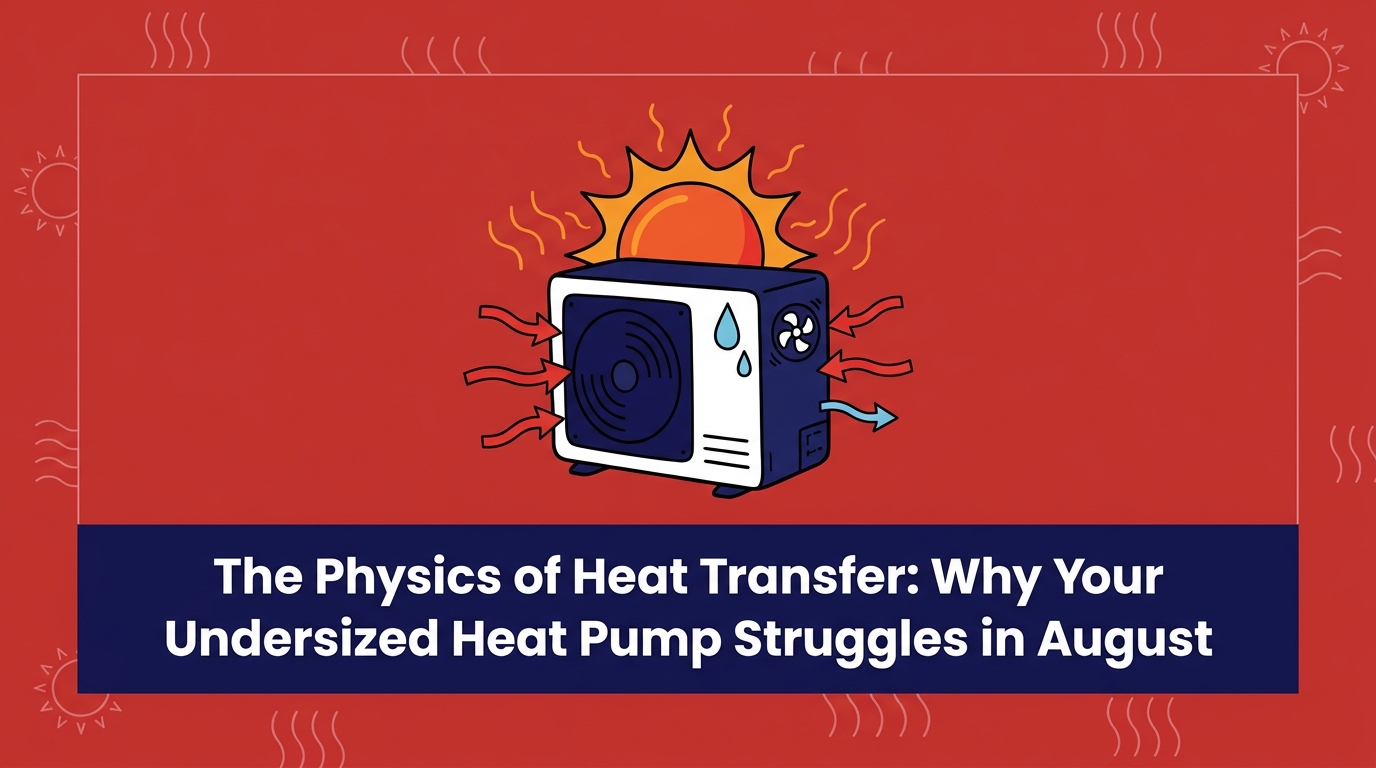
Your thermostat is set to 72 degrees, but the indoor temperature currently reads 78. You can hear the outdoor compressor humming, and cold air is steadily blowing from the vents, yet the house simply refuses to cool down. If you are dealing with this exact frustration, you are experiencing The Physics of Heat Transfer: Why Your Undersized Heat Pump Struggles in August firsthand. At Carl's Quality Cooling and Heating LLC, our technicians see this exact scenario every late summer. As kids head back to school and August weather pushes Conroe TX residential climate systems to their absolute limits, this is a phone call we receive daily.
Many homeowners immediately assume a part has broken, a motor has failed, or the system has run out of refrigerant. While mechanical failures are always a possibility, a continuously running system that blows cold air but fails to lower the room temperature is often facing a mathematical problem, not a mechanical one. The equipment is physically overwhelmed by the amount of heat entering the home.
Understanding why this happens requires stepping away from traditional troubleshooting and looking at the science of thermal dynamics. When you schedule professional air conditioning services, a trained technician evaluates more than just the electrical components; they calculate whether your equipment actually has the physical capacity to handle the heat load of your specific floor plan.
Understanding the Mathematical Limits of Cooling Capacity
To understand why a heat pump struggles, we first need to define how cooling actually works. Air conditioners and heat pumps do not "create" cold air or pump it into your home. Instead, they act as heat sponges. They physically absorb thermal energy from your indoor air and transfer it outside. This process of heat removal is measured in specific, rigid mathematical units.
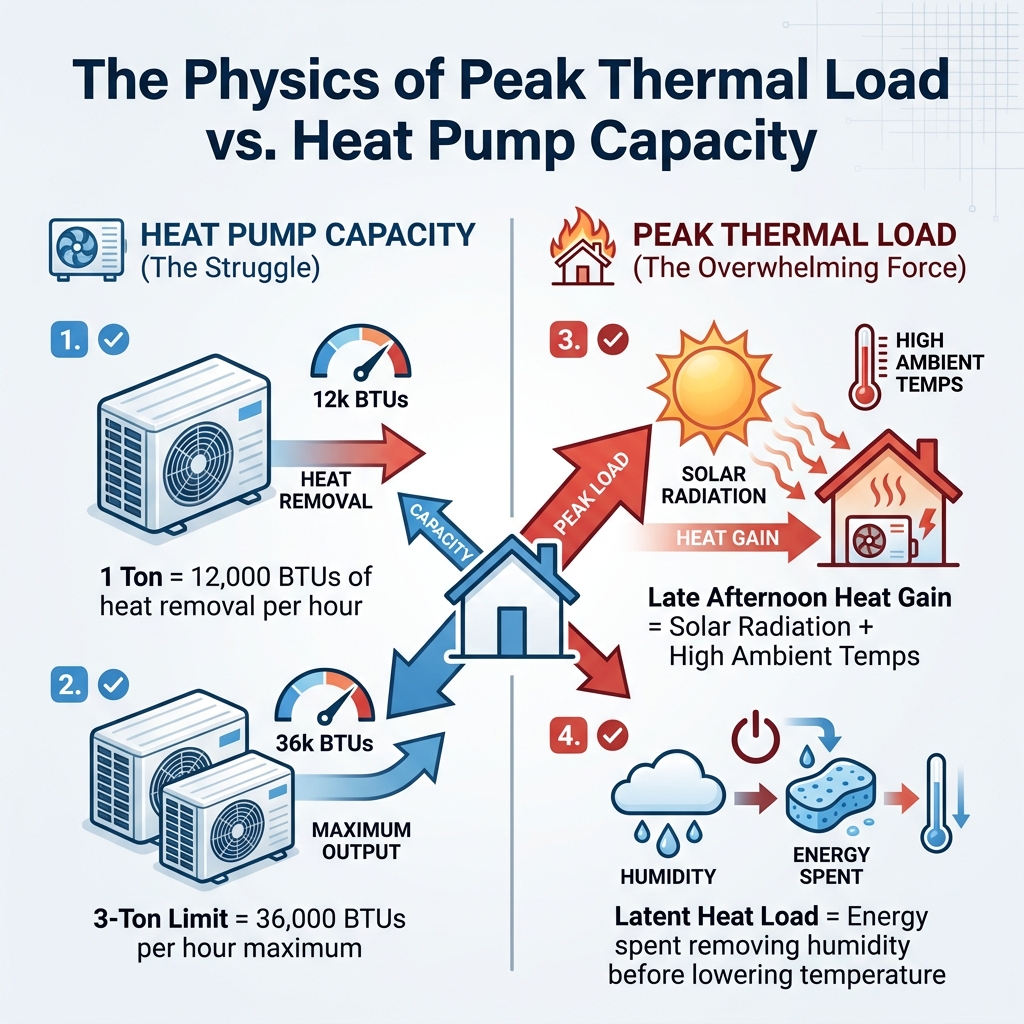
In the HVAC industry, cooling capacity is measured in "tons." This term has nothing to do with the physical weight of the machinery. A single ton of cooling capacity refers to the ability to remove 12,000 British Thermal Units (BTUs) of heat per hour. Therefore, a standard residential 3-ton system has a strict 3-ton (36,000 BTU) heat absorption limit. No matter how long the system runs, how new the compressor is, or how low you set the thermostat, a 3-ton unit can only move a maximum of 36,000 BTUs of heat out of your house every 60 minutes.
When our team arrives for heat pump and heating services or cooling diagnostics, we look closely at these BTU limits. If your home requires 45,000 BTUs of heat removal per hour to stay comfortable, but your unit is mechanically capped at 36,000 BTUs, the indoor temperature will inevitably rise.
Why BTUs Dictate Your Comfort
A BTU represents the amount of energy required to heat or cool one pound of water by one degree Fahrenheit. In practical terms, think of a BTU as a single match burning completely down. If your home gains the heat equivalent of 40,000 matches burning every hour, your heat pump must actively work against physics to remove that energy.
Heat naturally flows from warm areas to cooler areas. During the late summer, the extreme outdoor heat is constantly trying to force its way into your cooler living space through the roof, walls, windows, and tiny air leaks. Your heat pump is the only defense actively pushing that heat back out. When the incoming heat energy exceeds the system's BTU removal capacity, comfort is mathematically impossible.
Sensible Heat vs. Latent Heat: The Invisible Humidity Tax
Temperature is only half of the cooling equation. When calculating the limits of your heat pump, we must divide the total heat load into two distinct categories: sensible heat and latent heat. Sensible heat is the thermal energy you can feel and measure with a standard wall thermostat—the actual temperature of the air. Latent heat, however, is the thermal energy trapped inside airborne moisture, commonly known as humidity.
In extreme climates like Conroe TX, the August humidity introduces a massive latent heat load. Before a heat pump can lower the sensible temperature of a room, the cold evaporator coil must first condense and remove the moisture from the air. This dehumidification process consumes a massive portion of the system's available BTUs. We call this the "humidity tax."
If your 3-ton unit is capable of removing 36,000 BTUs per hour, a highly humid day might force the system to spend 12,000 of those BTUs strictly on pulling water out of the air. That leaves only 24,000 BTUs available to actually lower the sensible temperature of your home. An undersized system simply does not have enough reserve capacity to pay the humidity tax and still cool the house effectively.
Our team frequently helps homeowners navigate this exact issue. For example, one local Conroe homeowner who purchased a two-story house after Hurricane Harvey experienced a significant temperature differential between floors. When we investigated, the root cause involved both sensible heat rising and unmanaged latent heat loads overwhelming the existing equipment. Correcting the issue required us to design and install a new HVAC system that properly accounted for the massive humidity tax across the multi-story space, ensuring enough BTUs were available for both dehumidification and actual temperature reduction.
The Brutal Reality of Late-Afternoon Thermal Load
In our years of servicing Montgomery County, we constantly remind customers that even a perfectly functioning heat pump will face its greatest test between the hours of 3 PM and 7 PM. This window represents the August late-afternoon peak thermal load. Thermal load is the sum total of all heat entering your home, and during the late afternoon, two powerful forces combine to maximize this load: solar radiation and thermal mass.
Throughout the morning and early afternoon, the sun beats down on your roof, brick exterior, and driveway. These dense materials act as thermal batteries, absorbing heat for hours. By late afternoon, they are fully saturated and begin radiating that stored heat directly into your living space. Combined with peak outdoor air temperatures and heat generated internally by cooking, lighting, and electronics, the total thermal load skyrockets.
If your home's peak thermal load reaches 42,000 BTUs per hour at 4 PM, and your system's absolute limit is 36,000 BTUs, you will lose ground. The heat pump will run continuously, successfully removing 36,000 BTUs, but the remaining 6,000 BTUs of heat will accumulate inside, slowly driving the indoor temperature up.
Why the Temperature Rises While the AC is On
It can be baffling to stand over a vent, feel cold air blowing, and still watch the thermostat climb. A helpful analogy we share with clients is trying to bail water out of a sinking boat. If you have a bucket that can remove 10 gallons of water per minute (your heat pump's capacity), but a large hose is filling the boat with 15 gallons of water per minute (the thermal load), the boat will still fill up. You are successfully bailing water, just as your heat pump is successfully removing heat, but you are losing the mathematical battle against the incoming volume.

Is It Broken, or Just Undersized?
Before assuming you need to replace your entire system for a larger capacity model, our technicians always perform a thorough inspection to rule out mechanical failures. A system that is low on refrigerant, suffering from a clogged filter, or dealing with a failing compressor will exhibit similar symptoms to an undersized unit, but the root causes are entirely different.
If you find your heat pump not blowing cold air at all, or if the airflow is extremely weak, you are likely dealing with a mechanical breakdown. Conversely, if you find your heat pump running but not cooling the house despite strong, cold airflow at the vents, capacity is the likely culprit. Understanding these distinctions saves time and prevents unnecessary frustration.
• Air Temperature at Vent — Undersized Unit (Capacity Issue): Consistently cold, typically 15-20 degrees cooler than room temp. — Mechanical Failure (Broken Part): Warm, room temperature, or barely cool.
• Airflow Volume — Undersized Unit (Capacity Issue): Strong and steady from all supply vents. — Mechanical Failure (Broken Part): Weak, barely noticeable, or completely stopped.
• Time of Day Struggle — Undersized Unit (Capacity Issue): Only struggles during late afternoon peak heat; cools fine at night. — Mechanical Failure (Broken Part): Struggles at all hours, regardless of outside temperature.
• Physical Signs on Unit — Undersized Unit (Capacity Issue): System looks normal, just runs constantly. — Mechanical Failure (Broken Part): Ice on coils, strange grinding noises, or a tripped breaker.
If you suspect a mechanical issue, such as an AC fan not working, immediate professional diagnostics are required to prevent further damage to the compressor.
The Importance of Honest Manual J Load Calculations
If your system is genuinely undersized, how did it get that way? Historically, many installers relied on a "rule of thumb" based solely on square footage—for example, allocating one ton of cooling for every 500 square feet. This outdated method completely ignores critical variables like ceiling height, window quality, insulation levels, home orientation, and the severe regional climate extremes of Conroe TX.
The only scientifically accurate way to determine the correct system size is through an ACCA Manual J Load Calculation. This rigorous mathematical process measures the exact thermal load of every room, accounting for both sensible and latent heat. It factors in how much sunlight hits your western-facing windows, how well your attic is insulated, and how much heat your household generates daily.
As a veteran-owned and family-run business, our team at Carl's Quality Cooling and Heating LLC prioritizes honest, first-principles load calculations over aggressive upselling. We believe in doing the math. When a local customer recently reached out during the intense end-of-season Texas heat with a faulty AC unit, we provided same-day service to accurately diagnose the equipment. By relying on strict diagnostics rather than guesswork, we ensure that homes get correctly sized systems that can handle the massive late-summer thermal loads without failing.
Actionable Steps for Managing High Thermal Loads
If you are currently trapped with an undersized system facing the August late-afternoon peak thermal load, you have options. While upgrading the equipment is the ultimate solution, we often advise our clients to take these immediate mathematical steps to reduce the incoming heat load and help a struggling heat pump.
1. Block solar radiation: Install thermal blackout curtains or solar window tinting on all western and southern-facing windows. Blocking the sun before it enters the glass drastically reduces the immediate sensible heat gain in the late afternoon.
2. Seal the building envelope: Every cubic foot of hot, humid air that leaks in through weatherstripping or unsealed attic hatches adds to the latent heat load. Weatherstripping doors and caulking windows reduces the humidity tax your system has to pay.
3. Maximize existing efficiency: An undersized system needs every single BTU of capacity it can muster. A dirty filter or a dust-caked outdoor coil can reduce a 3-ton system's output to 2.5 tons. Enrolling in a professional HVAC maintenance plan ensures your equipment operates at its absolute maximum theoretical capacity.
4. Upgrade attic insulation: Heat radiates down from a scorching attic into your living space. Upgrading to higher R-value insulation slows this thermal transfer, giving your heat pump a fighting chance against the afternoon thermal mass.
5. Consult for a capacity upgrade: If mitigation strategies are not enough, it makes mathematical sense to consult a professional for a proper Manual J load calculation to determine exactly how many tons of cooling your home actually requires. When upgrading, federal tax credits and local utility incentive programs may apply to qualifying high-efficiency heat pump installations, so we always recommend verifying current programs with your utility provider or a tax professional.
Frequently Asked Questions About Heat Pump Capacity
Why is my heat pump running but not cooling?
When a heat pump runs constantly but the house remains warm, it is usually because the thermal load of the home exceeds the cooling capacity of the unit. The system is successfully removing heat, but the home is gaining heat faster than the unit's maximum BTU limit. This is especially common during late summer afternoons when solar radiation peaks.
Why is my heat pump not blowing cold air?
If the air coming from your vents is warm or room temperature, our diagnostic calls usually reveal a mechanical failure rather than a capacity issue. Common culprits include a refrigerant leak, a failed compressor, or a malfunctioning reversing valve. This requires immediate professional diagnostics to prevent permanent damage to the system.
Why does my AC struggle in the late afternoon?
Late afternoon is when peak outdoor temperatures combine with peak solar radiation and the release of thermal mass from your home's structure. The roof and walls absorb heat all day and radiate it inward between 3 PM and 7 PM, creating the highest thermal load of the day. An undersized system simply cannot absorb this massive influx of heat.
Can an undersized heat pump cause high electric bills?
Yes, an undersized system will cause a significant spike in utility costs. Because it lacks the BTU capacity to quickly satisfy the thermostat, it is forced to run continuously for hours on end. This nonstop operation draws maximum electrical current for prolonged periods, leading to excessively high energy bills.
At what temperature does a heat pump struggle to cool?
A properly sized heat pump should not struggle at any standard regional temperature if the load calculation was accurate. However, undersized systems typically begin losing ground when outdoor temperatures exceed 95 degrees, particularly if the humidity levels are high enough to consume the system's latent heat removal capacity.
How do I know if my heat pump is undersized for my house?
The most reliable sign of an undersized unit is a system that blows freezing cold air and runs continuously, yet fails to lower the indoor temperature during the hottest parts of the day. The only definitive way to confirm this is by having a professional perform an ACCA Manual J Load Calculation to compare your home's exact heat gain against the unit's rated capacity.
Ensure Your Home Has the Right Cooling Capacity
Home comfort is ultimately a matter of physics, not guesswork. If your system is running constantly against the August late-afternoon peak thermal load and losing the battle, you do not have to settle for a hot house. Understanding the mathematical limits of a 3-ton (36,000 BTU) heat absorption limit empowers you to make informed decisions about your home's energy efficiency and comfort.
Whether you need strategies to reduce your thermal load or a comprehensive evaluation to upgrade your equipment's capacity, our team knows that professional, math-based diagnostics are the answer. If your system is struggling to keep up with the late-summer heat, explore our local HVAC service areas to schedule an honest, thorough evaluation of your cooling capacity with Carl's Quality Cooling and Heating LLC.