



What to Expect During Emergency HVAC Repair in Montgomery County
Emergency hvac repair what to expect is something every homeowner should understand before a crisis hits — especially in Montgomery County, where summer heat and winter cold can turn a broken system into a real safety problem fast.
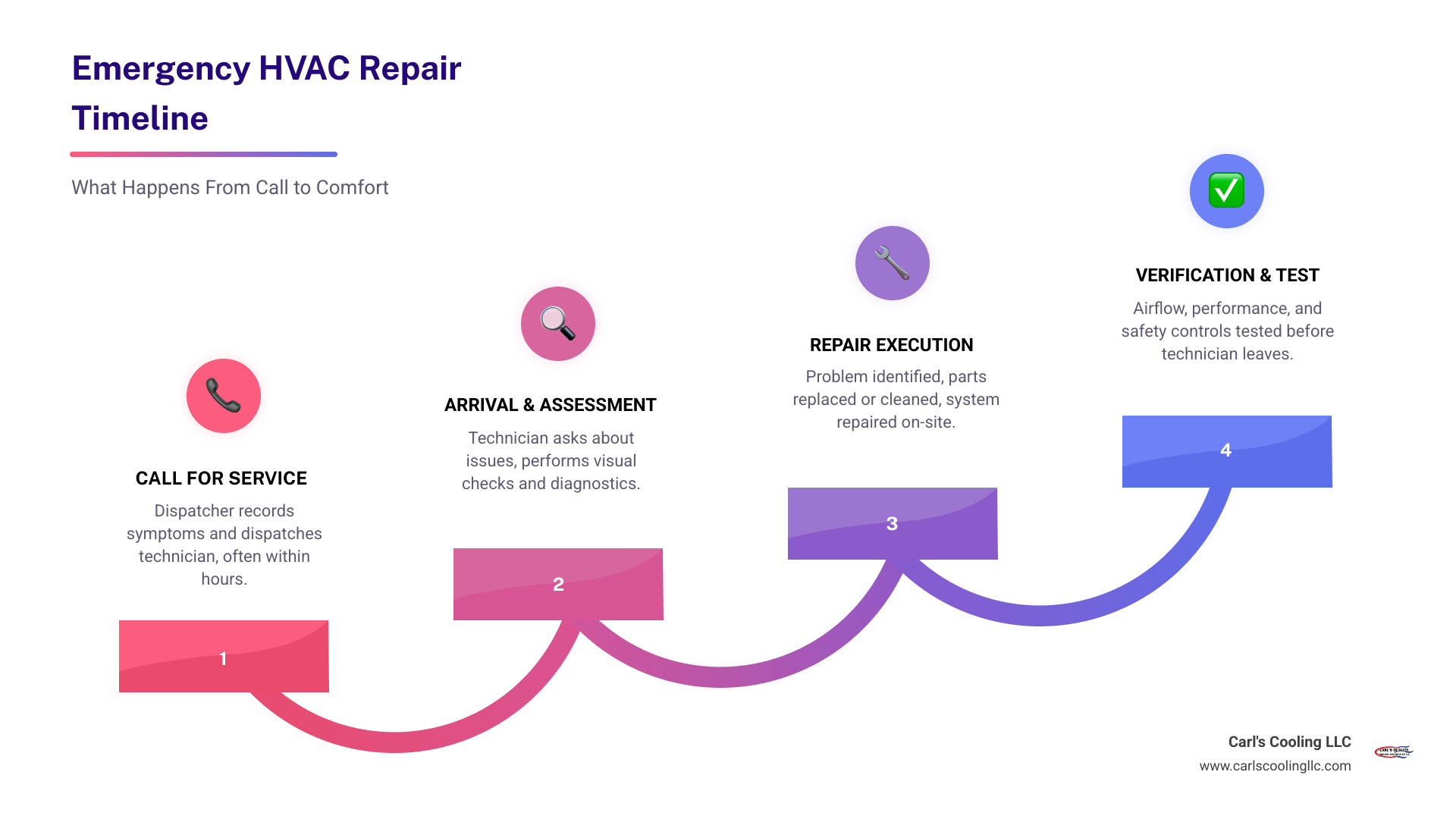
Here's a quick overview of what typically happens:
- You call for emergency service - A dispatcher takes your info and sends a technician, often within a few hours
- Technician arrives and listens - They ask about symptoms, when the problem started, and what you've noticed
- Visual inspection and diagnostics - They check airflow, electrical components, refrigerant levels, and the thermostat
- You receive a repair plan - The technician explains the problem, what's needed to fix it, and how long it will take
- Repairs are completed - Parts are replaced or cleaned, and the system is tested before the technician leaves
- Post-repair checks - Airflow, performance, and safety controls are verified to make sure everything runs correctly
According to research, over 70% of homeowners face an HVAC breakdown during peak seasons — exactly when they need their system most. And about 40% of those emergencies trace back to something as straightforward as a thermostat malfunction. The good news? Knowing what to expect makes the whole experience far less stressful.
Whether your AC quit during a Texas heatwave or your furnace stopped on a cold night, this guide walks you through every step — from the moment something goes wrong to the moment your home is comfortable again.
Identifying a True HVAC Emergency in Montgomery County
In our line of work across Conroe, The Woodlands, and Spring, we often get calls from homeowners wondering if their situation warrants an immediate dispatch or if it can wait until Monday morning. While every lack of comfort feels like an emergency, certain situations are high-priority safety hazards.
A true emergency involves any situation that threatens your family’s health, your property’s safety, or the integrity of the HVAC system itself. For example, if your furnace fails when temperatures are predicted to drop below freezing, you aren't just looking at a cold night; you are looking at the potential for burst pipes and significant water damage. Conversely, an AC failure during a 95°F Texas afternoon can lead to heat exhaustion, particularly for the elderly or small children.
Safety hazards are the most critical. If you detect a gas leak — often identified by a "rotten egg" smell (mercaptan) — or if your carbon monoxide alarm sounds, this is a life-threatening emergency. Similarly, burning electrical smells, sparks, or smoke coming from your vents or unit require immediate professional intervention. In these cases, we recommend our Emergency AC Repair or Emergency Furnace Repair services to secure your home immediately.
Common signs of an emergency hvac repair what to expect
When you are trying to determine emergency hvac repair what to expect, keep an eye (and ear) out for these red flags:
- Strange Loud Noises: While a low hum is normal, banging, screeching, or grinding sounds are not. Banging often indicates a loose or broken part in the compressor, while screeching usually points to a failing blower motor or belt.
- Complete System Failure: If the unit won’t kick on at all despite checking the thermostat and breakers, something is fundamentally wrong.
- Refrigerant Leaks: If you see liquid pooling or hear a hissing sound near your AC, it could be a refrigerant leak. This is a health risk and can cause your coils to freeze or your compressor to burn out.
- Short Cycling: If your system turns on and off every few minutes, it is under immense stress and will likely fail completely if not addressed.
If you notice these signs, especially during the peak of summer, seeking AC Repair Conroe TX can prevent a total system replacement later.
When to wait versus calling for immediate help
We understand that after-hours fees can be a concern for many families. If the weather is mild (between 60°F and 75°F) and no one in the house has health conditions that require strict climate control, you might choose to wait until standard business hours.
However, you should call immediately if:
- Indoor temperatures are reaching dangerous levels (above 85°F or below 55°F).
- There are vulnerable family members present, such as infants, seniors, or those with chronic illnesses.
- There is a risk of property damage, such as a clogged condensate line that is currently leaking through your ceiling.
For residents needing AC Repair The Woodlands TX, we prioritize these high-risk calls to ensure the safety of our community.
Immediate Steps to Take Before the Technician Arrives

Before we arrive at your home in Cypress or Tomball, there are several steps you can take to ensure the process goes smoothly and safely. Taking these actions can sometimes even resolve the issue before a technician is needed!
First, perform a quick "DIY" check. Start with your thermostat. It sounds simple, but about 40% of emergency calls are related to thermostat issues. Ensure it is set to the correct mode (Cool or Heat) and check if the batteries need replacing. Next, look at your circuit breaker. If the breaker for your HVAC unit has tripped, try resetting it once. If it trips again immediately, do not try a second time, as this indicates a serious electrical fault.
Finally, check your air filter. A severely clogged filter can cause a system to overheat or the coils to freeze, leading to a total shutdown. If the filter is caked in dust, replace it immediately.
How to prepare your home for emergency hvac repair what to expect
To help us work efficiently when we arrive for your HVAC Repair Cypress TX, please consider the following:
- Clear Access: Ensure there is at least a three-foot clearance around your outdoor condenser unit. Indoors, clear away any boxes or furniture blocking the furnace, air handler, or attic access.
- Pet Containment: For the safety of your pets and our technicians, please secure dogs or cats in a separate room.
- Symptom Logging: Write down exactly what happened. Did you hear a noise? Did it start blowing warm air at 2:00 PM? Having a timeline helps us diagnose the root cause faster.
- Access to Critical Areas: Be prepared to show the technician your electrical panel and the attic or crawlspace where the indoor unit is located.
Providing this level of preparation for HVAC Repair Spring TX allows us to get right to work, potentially saving you time on labor.
Safety precautions for gas and electrical issues
If you suspect a gas leak or see smoke, safety is the only priority.
- Evacuate: Get everyone (including pets) out of the house immediately.
- Do Not Use Switches: Do not turn lights on or off, and do not use your phone inside the house, as a small spark could ignite leaking gas.
- Main Gas Valve: If you know how to do so safely, turn off the main gas valve outside.
- Call for Help: Once you are a safe distance away, call the gas company and then call for Furnace Repair Conroe TX.
Emergency hvac repair what to expect: The Step-by-Step Process
When our technician pulls into your driveway in Tomball or Klein, you might feel a wave of relief. But what happens next? Understanding the emergency hvac repair what to expect during the actual visit can help you feel more in control.
The process begins with an initial consultation. The technician will ask you about the symptoms you’ve noticed. This isn't just small talk; your observations are the first clues in a complex puzzle. Next comes the visual inspection. We look for obvious signs of trouble like frayed wires, frozen coils, or soot near the burners.
Then, we move into electronic diagnostics. We use specialized tools to measure refrigerant pressure, check electrical continuity in capacitors and motors, and test the thermostat's communication with the unit. This data allows us to pinpoint the exact component that has failed. If you are in need of HVAC Repair Tomball TX, you can expect this thorough approach every time.
Understanding the emergency hvac repair what to expect during the visit
Once the root cause is identified, the technician will sit down with you to explain the findings. We believe in transparency, so we will provide:
- Root Cause Identification: We explain not just what broke, but why it likely happened.
- Repair Options: Sometimes there are multiple ways to fix a problem, ranging from a part replacement to a more extensive repair.
- Part Replacement: If a specific part like a capacitor or blower motor is needed, we check our fully stocked service vehicles first to see if we can finish the job immediately.
- System Testing: After the repair is made, we don't just pack up. We run the system through a full cycle to ensure the fix is stable.
For those in the HVAC Repair Klein TX area, this clear communication is the hallmark of our service.
Post-repair verification and performance checks
A repair isn't finished until we verify that the system is operating at peak efficiency. We perform airflow measurements to ensure the blower is moving the correct volume of air through your ducts. We also conduct thermostat calibration and safety control testing. This ensures that if another issue arises in the future, the system's internal safety switches will correctly shut it down to prevent damage.
Our goal with HVAC Services Spring TX is to leave your home not just cooler or warmer, but safer than we found it.
Staying Comfortable and Safe While You Wait
Waiting for a technician during a Montgomery County heatwave can be grueling. Here is a guide on how to manage the environment while you wait for your HVAC Services Cypress TX provider.
| Strategy | Summer Emergency (Heat) | Winter Emergency (Cold) |
|---|---|---|
| Hydration | Drink plenty of water and electrolytes. | Drink warm liquids like tea or broth. |
| Room Insulation | Close all blinds and curtains to block sun. | Use blankets or towels to block drafts under doors. |
| Movement | Stay on the lowest floor of the home. | Gather the family into one central room. |
| Tools | Use portable fans to create a breeze. | Use safe space heaters (3 feet from fabric). |
| Plumbing | N/A | Drip your faucets to prevent frozen pipes. |
Managing indoor air quality during a breakdown
When the HVAC system stops, air circulation stops with it. This can lead to a quick buildup of humidity and stale air. If it is safe to do so (and the outdoor air isn't worse), opening windows on opposite sides of the house can create a cross-breeze. However, in our humid Texas climate, this often brings in more moisture.
If you have a standalone air purifier or dehumidifier, now is the time to run it. Maintaining indoor air quality is a vital part of what we do, and we offer specialized HVAC Services Klein TX to help homeowners improve their air filtration and purification long-term.
Preventing Future Breakdowns with Professional Care
While we are always ready to help in an emergency, we would much rather help you avoid one. Statistics show that homeowners who schedule regular maintenance are 50% less likely to experience a total breakdown. A well-maintained system can last 15 to 20 years, whereas a neglected one may fail in as little as 8 to 10 years.
Annual tune-ups allow us to catch small issues — like a slightly worn capacitor or a dirty evaporator coil — before they turn into a 2:00 AM emergency call. Furthermore, a clean system operates 15-20% more efficiently, which reflects directly on your monthly energy bills. We highly recommend looking into our Maintenance Plan to keep your system in top shape year-round.
The role of regular monitoring in system health
You are the first line of defense for your HVAC system. By paying attention to early warning signs, you can call for HVAC Services Tomball TX before the system actually quits.
- Check your filters monthly: This is the single most important thing a homeowner can do.
- Listen for changes: If your unit starts making a new "click" or "thump," don't ignore it.
- Monitor your bills: An unexplained spike in energy usage often means your system is struggling to keep up due to a mechanical issue.
Frequently Asked Questions about Emergency HVAC Services
How long does a typical emergency repair take?
Most emergency repairs are completed within one to three hours of the technician's arrival. Simple fixes like replacing a capacitor or cleaning a flame sensor are quick. However, if a major component like a compressor or heat exchanger has failed, it may take longer, especially if parts need to be ordered from a local warehouse.
Should I repair or replace my aging system?
As a general rule, if your system is over 10-12 years old and the repair cost is significant, it may be time to consider a replacement. Modern systems are significantly more energy-efficient and can pay for themselves over time through lower utility bills. We can provide an honest assessment of your system’s life expectancy during any service call.
What questions should I ask my technician before they start?
We encourage homeowners to be informed! You should ask:
- "What exactly caused this part to fail?"
- "Is this a permanent fix or a temporary solution?"
- "Are there any other components showing signs of wear?"
- "How can I prevent this specific issue from happening again?"
Conclusion
At Carl's Cooling LLC, we know that your home is your sanctuary. When your HVAC system fails, that sanctuary is compromised. Whether you are in Conroe, The Woodlands, or any of our many Service Areas, our mission is to provide you with reliability and peace of mind.
Understanding emergency hvac repair what to expect is the first step in staying calm during a home comfort crisis. By knowing the signs, taking immediate safety steps, and calling a professional you can trust, you can protect your family and your property from the extremes of Texas weather.
If you're currently facing a system failure or simply want to ensure your unit is ready for the upcoming season, don't wait for the situation to worsen. Contact us today for dependable Emergency AC Repair and experience the professional care your Montgomery County home deserves.


